 Some of the trends noted as the future of manufacturing are:
1. Manufacturing process as a critical core competence
2. “Product as a service”, as a core part of the overall value proposition.
3, Remote Diagnostics
4. Sensor driven data as the basis for product and service Innovation
More details on these evolving core capabilities can be seen at the end.
We at STIMS Institute execute projects and offer programs for companies – big and small – to advance their internal capabilities and work force skills to position themselves as leaders in each of these emerging growth areas in manufacturing. Unlike most other companies we do not offer a “strategy” and leave the implementation in your hands. Instead we work from end to end, from concept to commercial impact.
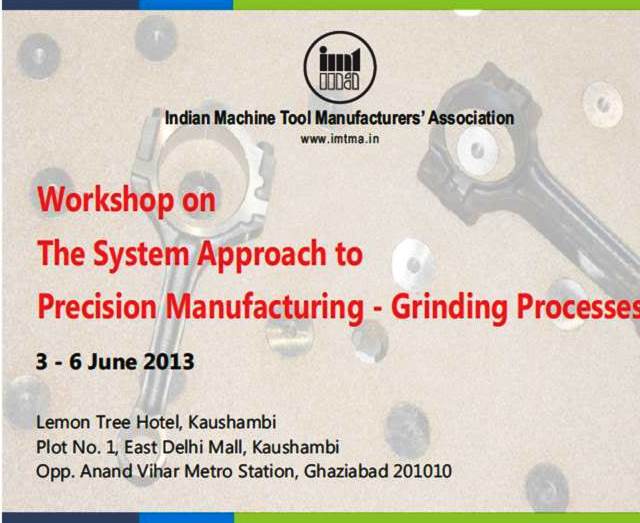
As a recent example we identified precision grinding process as a core competence for an auto parts manufacturer. Recognizing that a specific grinding process was the bottle neck operation, we used our process signal monitor to obtain the vital signs of the process. The signal was further used by our expert team trained in the System Approach for Manufacturing processes, to optimize the process and reduce the cycle time by over 40%. This in turn translated into a direct increase in line through put by 40% without any additional capital or plant and equipment investment required!
For more details please contact us
Details on evolving core capabilities in manufacturing:
1. Manufacturing process as a critical core competence: In the case of global agricultural-equipment manufacturer Deere Inc., a key driver for the tractor-manufacturing strategy hinged on drive trains, says Pat Pinkston, Vice President for Global Platform Services for the firm’s Agriculture and Turf Division. The complexities involved in the drive train manufacturing are:
- The size and configuration of the drive train
- Customers want different types of transmissions (power shift, infinitely variable, collar shift, or low cost) as part of the overall drive-train package. A further challenge was Deere’s competitive decision
- Lead-time for building a drive train from 40-50 days to one week.
These layers of complexity quickly made it apparent that the Machining of drive-train castings and gears had to be a core internal competence for the company. That one strategic decision rippled across the length and breadth of Deere’s revamped Waterloo, Iowa manufacturing facility. “We’ve got to continually understand what’s core, what’s non-core, and as the technologies, business, and customer requirements shift, be able to reassess and figure out how to integrate all that in a way that allows us to differentiate.”
2. “Product as a service” as a core part of their overall value proposition. Rolls Royce no longer just sells airplane engines to its customers. It has a service-based offering called TotalCare that sells only the hours that each engine is in service. From scheduled maintenance to overall management, Rolls Royce guarantees an engine’s performance by taking responsibility for its operations. TotalCare transfers the risks and costs associated with an engine being offline to the vendor, thereby making reliability and uptime major incentives for both the customer and Rolls Royce. Rolls Royce is part of their overall value proposition.
The aerospace/defense industry (74%) and medical device manufacturers (70%) plan to lead with performance-based contracts. Similar to the Rolls Royce TotalCare solution, these contracts are about a customer paying a vendor based on performance against a set of defined metrics.
3. Remote Diagnostics: Ingersoll Rand’s Ohio-based Trane Intelligence Systems, data from 10,000 pieces of HVAC equipment around the world are managed remotely. Remote diagnostics enable Trane Intelligence Systems to know ahead of time when HVAC filters need to be changed, when oil or bearings are starting to wear, and when Trane should plan for maintenance. Harvesting this data from operations enables more efficient service scheduling for Trane while maintaining uptime across customer premises.
But along the way to better product maintenance, Trane Intelligence Systems realized that the same diagnostic data could be used to adjust the internal temperature of buildings in order to extract better energy use from the equipment. Given that air conditioning can amount to 40% of a commercial customer’s total energy bill, this is not an inconsiderable value proposition.
4. Sensor driven data as the basis for product and service Innovation: After several product generations spent improving the core compressor design of its Copeland Scroll line of refrigeration units, Emerson’s Climate Systems unit made a strategic decision to focus on sensor-based diagnostics as a differentiator. According to Charles Peters, Senior Executive Vice President at Emerson, the initial reason for equipping the compressors with sensors was to measure use and changes in electric amperage, which is often an indicator measure for a variety of performance or fault conditions.
Source: Manufacturing Transformation – Achieving competitive advantage in a changing global marketplace http://support.ptc.com/WCMS/files/155978/en/Manufacturing_Transformation_Report.pdf

 STIMS Institute