Blog

STIMS Institute offers its vision of 21st Century Manufacturing.

CEO Dialogue 2I

In a recent CEO Forum organized by MGTL, Dr. K. (Subbu) Subramanian, President STIMS Institute Inc., offered his vision of the 21st Century Manufacturing and outlined the need for requisite work force skills to meet the emerging needs. This forum was held at Pune, India on Nov. 21, 2014. For a complete presentation, please see: Manufacturing in the 21st Century

Few excerpts:

  • “Manufacturing” is a collection of (a) physical processes enabled by a host of (b) information processes and aided by a collection of (c) pick and place and transfer processes, which at the moment are a combination of physical events and information events.
  • Core capability for any manufacturing:  repetitive use of physical processes, to achieve or USE the “Product” at the required quantity, place and time to meet the end user needs.
  • Manufacturers have two options: (a) Steady improvement in the processes already deployed; The result is a constant reduction in the explicit knowledge and skill required with respect to the Physical Processes used. Over time, they have become the black boxes surrounded by a myriad of service processes, which are generic and practiced in all companies and industries. (b) Introduction of a stream of new solutions resulting in New Products, New Processes and New Applications/ USE. These new solutions are the result of intense knowledge of the physical processes unique to the manufacturing company.
  • Breakthrough – step change – solutions will be expected as a routine output of manufacturing professionals of the future. But, in order to sustain such improvements the process has to be managed as a whole – as a system. Constant tweaking or small changes in the system which disturbs the equilibrium of the process cannot be tolerated, if maximum impact is the desired outcome. This will require manufacturing professionals who are simultaneously good at process science as well as process economics, with expertise to integrate knowledge from all available sources.
  • We find two parallel chains operating across all manufacturing companies (i.e.) Supply Chain which deals with the information processes that interconnect the various tiers of manufacturers and Functional Value Chain, where the physical processes and their exploitation play a silent but foundational role across the manufacturers.
  •  Since the products are enables by processes and the USE is also a process in a manner of speaking, we are left with “Process and its knowledge and the capability to manipulate any process” may be the primary core capability or skill set of future manufacturing professionals! The role of human labor and their employment in large numbers is not a critical need in this description of manufacturing. It is important for policy makers to make note of this subtle but significant point.
  • Work force skills required for 21st century manufacturing:

Manufacturing Processes

Traditional Sources of Knowledge

New Knowledge Required

 Traditional Worker Skills

 New Worker Skills Required

   Physical Processes Engineers and shop floor workers with technical training, trade skills and academic education. ·  Process Science·  Diagnostics·  Data and   Analysis·  Sector specific know-how Engineers with years of experience located close to the shop floor operations ·       System Thinkers and Solution Providers Reliant on Process Science·       Reliant on sensors, signals and their use.
 Information Processes Collection of tasks that evolved through the years ·       IT·       Data Base·       Big data·       Analytics White Collar Workers with standard plug and play IT solutions ·       System Thinkers·       Solution Providers·       Customized IT solutions
  Pick and Place / Transfer Processes Industrial work force through many years of training and hands on experience. ·       CNC, Robotics and AGV·       Drones ·       Blue collar workers·       Standard work and tasks·       Physical effort and de-skilled operations. ·       System Thinkers·       Solution Providers·       Comfortable in virtual control environment

Learn to swim against the tide of Binary Economy

http://www.barnesandnoble.com/w/thriving-in-the-21st-century-economy-k-subramanian/1115191210?ean=9780791860168

https://www.asme.org/products/books/thriving-21st-century-economy-transformational

It is an undeniable axiom of globalization: anyone in any job or profession has to be better than anyone else who can do the same job from a pool of workers across the globe. Conversely, those who can do a job in a similar manner to others around the globe will be rewarded for their effort at the lowest value at which the work can be procured from anyone else across the globe! Every worker will fall into one of these two extremes. Anyone in the middle will be ultimately swept to the low-labor-cost pool.
While there will be a natural tendency to be swept into the lower-wage pool, it will require a special effort to swim against the current to be associated with the limited few in the high-wage, high-reward pool. Swim against the stream and reach a high place (of New Solutions with identifiable impact) or be swept away into the global pool of low-cost resources (needed for Replication Solutions) is the true paradigm of globalization. There is little or no opportunity for treading water in this paradigm. This constant struggle to swim upstream and against the current is what is perceived as the volatility and uncertainty in the workplace. Suggestions such as higher education, higher SAT scores, and more grit and perseverance are all means to the same end. But as we have detailed in our book – see the links below – all of these have to be formatted toward identification, development, and exploitation of New Solutions using Transformational Skills as the means to this end.

http://ebooks.asmedigitalcollection.asme.org/book.aspx?bookid=657

Do you know your “core” capability?

Are you the owner of a small or medium sized manufacturing company? Are you the head of a profit center or a Business Unit that is part of a company group? If you are, it is very likely that you are one of the business leaders, trying to find ways to keep your business above water. Some of you may be concerned about growing your bottom line and in rare occasions seeking ways to further grow your business. But, no matter what your needs are, it is certain that you are facing the stiff winds of global competition, cost pressures, challenges from outsourced operations and above all a sense of uncertainty about the future.

We believe that such pessimism and the sense of gloom and doom about manufacturing industries and their future is not warranted. It is true that there are stiff head winds and it is also true that the waters are turbulent. But, you are not up the creek, with out a paddle!

Have you ever sat back and asked yourself, “How did we (your business unit) get here?” No, I do not mean, how you got into a situation of stiff competition and low profit margins and high costs. These are all obvious and readily known to every one. But, have you figured out how your business or operation grew from its beginnings to where it is today? It did not happen by chance or by some luck or through magic! It happened because you and your people along with your suppliers and your customers contributed their share of knowledge and know-how that resulted in the products you manufacture, the processes you use to make them and also the applications know-how through which your customers use your products. The “Products. Processes and Applications knowhow” are your core capabilities. These core capabilities are embedded in the knowledge of many people connected with your company – through your employees, suppliers and customers and their customers.

You might say “It is indeed true that we did not grow out of thin air. We built our company, brick by brick though our products, manufacturing process capabilities and our know-how to help our customers use our products better. Then, whatever happened to my business or operation, over the years? Why are we struggling today with low profitability and shrinking margins and low to no growth?” One can ask such valid questions and wallow in misery or merely be nostalgic about the good old days for ever. Instead, you can muster the passion to dig deeper.

Your product is not any widget you put in your shipping box. It is not merely something you identify by a product number or a bar code. Product is something of value to some one (the user), who is willing to pay you (the manufacturer) something of value to you. Can you describe your “Product” using the above definition? Is there any one in your sales, product design/development, manufacturing/production, tech-support or general management who can describe your product in terms of the value to your customer and the expected value for you in return? Do you know who they are? Do they all have the same understanding of the user value and manufacture’s value or are they speaking over each other in different languages? Your journey for the future can start right here and now, by developing a common definition of your “Product” and developing a core team across the business functions that speaks the same language about your product.

How well do you know your Processes to manufacture your products? They are not “black box” that nobody knows anything about, after Joe Smith retires from the company! All processes in your manufacturing floor have well defined Inputs, which are converted into Outputs. All processes are “Input/Transformation/Output” system. No, we are not talking about Ph.D language. In the past years, few who knew about the process could tweak them and keep them going, while others were simply pairs of hands to help them out. We can not do that any more. All processes can be diagnosed (using proper sensors and IT tools for measurement), repaired, improved and in some cases changed dramatically. But, you can not do any of the above, if you think that the processes in your shop floor are merely “black box” put in place by some one who left the company years ago! Your journey for the future can start right here and now, by developing a common definition of the key “Processes” in your manufacturing floor and developing a system view of these processes across all the business functions that support such processes. You would not like to see any medical professional with out a stethoscope and a thermometer. Then, why would you not want all your manufacturing process professionals have similar capability to measure and diagnose and cure the problem with respect to your processes and their health?

How well do you know your customer’s processes (Application) and how you can add value in their processes through your products? If software is the enabler of all the growth and success in the IT industry, you can make your AT (Applications Technology) as the enabler for your growth and success in the manufacturing industry. AT helps you to build alliances with your suppliers and customers towards building solutions of shared benefits. If you have treated your process as a black box, it is likely that your customers have done the same with their processes. It is about time, you helped them to do a “health check up” on their processes, while they use your product. After all, strong and healthy customer process is essential for your long term strength and success.

Product, Process and Applications know-how are your core capabilities, which got you where you are today! They are the bench strength of your team. You can do more or less with them enabled by all the plug and play IT capabilities. But, you can not build a manufacturing industry with out the brick and mortar (i.e) Product, Process and Applications Technology. Have you taken the time to cultivate them? If not, may be it is time for you and the key personnel in your team to go through the “Core Capability Boot Camp”?

Concerted response required for the recent letter “Compact for Academic Excellence in Higher Education” ?

The recent letter “Compact for Academic Excellence in Higher Education,” and its rejection by MIT could be a welcome opportunity for the Educational Leaders and the leading Institutions?
https://lnkd.in/gYxdYv7J
The letter “Compact for ….” from the Education Secretary appears to be a Trojan Horse for power grab and an attempt to curb free thinking. The shallow intellectual depth of the administration makes one wonder, if there is even an interest to promote “Conservative” values in lieu of “Liberal” thoughts and expression in campuses! It might just be an old ploy of pitting one group against another and relishing in the chaos, as the outcome!
The challenge through the letter from the Education Secretary and this Administration goes beyond their thinking and adversarial approach to governing. In fact they stem from insidious developments over the past five decades or more that have been metastasizing our nation, its culture and our Democratic and moral fibre.
For example:
— Technology (=Science X Engineering X Managment) is now synonymously treated as reflecting only IT, Computer Science, Data Science or AI! In other words, the entire value of MIT is reduced to one Department or one sector of activity!
— Rewards of Capitalism have degenerated the society that was once heavily middle class (40/40/20 : Poor/Middle/Rich) into a nation of “haves” and “have nots” (90/10: Poor and Middle /Ultra rich). Traditional sharing of the wealth through Risk/Reward has not shifted to Risk/Effort/Reward sharing models.
— While it may be true that over 80% of MIT undergraduates are free of loan burden, that can not be said of most UGs across the nation. Being driven out of the middle class they are also driven into economic disadvantage Vs. their global college educated compatriots.
— Most of the Social Media products – with their inability to control and limit the polarizing effect on the society – are developed and implemented by graduates from top schools like MIT, aided by low wage high skilled H1B Visa workers.
In all of the above, schools like MIT are not solely responsible for the outcomes. But, systemic failure in leadership across the nation, over the decades, to challenge the above outcomes and their corrupting influence has to be acknowledged. It has been leading to despair and “throw the baby out with the bath water” attitude on our social and democratic norms. These are the undercurrent rhat fuel this administration and its political power. As I have learned at MIT, the “System and its solution” need a comprehensive approach addressing several issues at the same time! My plea to the leadership at MIT as well as at other leading institutions is to take bold action on the above (bulleted) and other similar issues. That would be a worthy antidote raising social awareness and public support against arbitrary and misplaced demands from the current administration?

https://www.linkedin.com/feed/update/urn:li:activity:7382497220568211456/

System Approach for Customer Success Management

Customer Success Management (CSM) is a relatively new functional area within many companies, an increasingly vital operational role, a rapidly growing profession, and an underlying systems management philosophy that is growing in importance, especially – but not exclusively – within the technology industry. One leading industry organization (Customer Success Association 2021) defines CSM as “a long-term, scientifically engineered, and professionally directed business strategy for maximizing customer and company sustained business value,”. Others describe CSM as “a customer-facing, non-direct sales role that embodies the mindset of a counselor
to proactively partner with customers to help them achieve their goals and promote long-term customer health that ultimately leads to relationship growth”.

A recent paper that outlines the System Approach for CSM has been authored by Prof. Vijay Merhotra at UCSF, School of Business and Dr. Krishnamoorthy (Subbu) Subramanian from STIMS Institute. For a complete vesrion of this paper, please see: https://stimsinstitute.com/wp-content/uploads/2025/08/system-view-of-csm-published-paper-with-prof.-vijay-merhotra-ucsf-07-22.pdf

Every Co. has processses required to produce and supply their products. When their products are used and the value realized by the customer, only then recurring sales and sustained sales growth of the supplier is realized as illustrated in the figure below:

CSM plays an imptortant interfcae role between the customer and supplier as illustrated in the figure above.

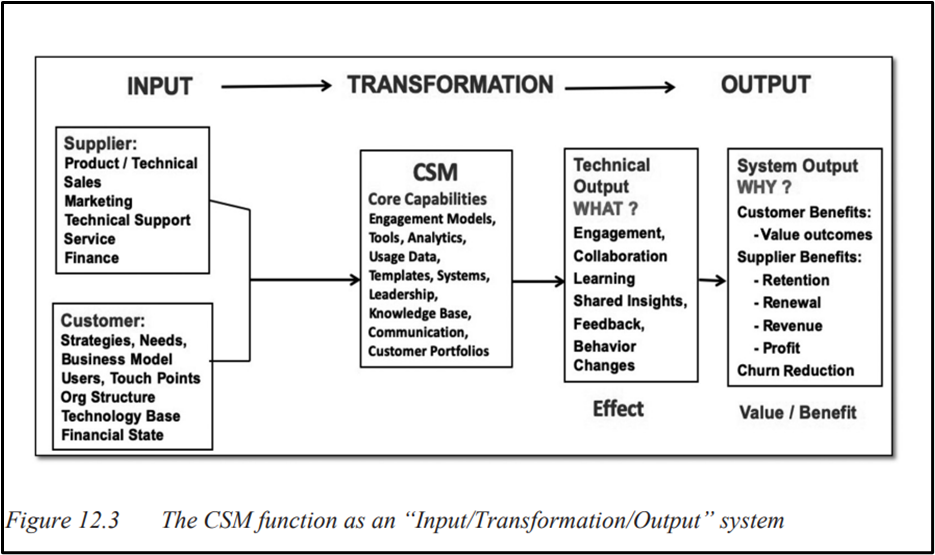
Every process of the “Customer” is a “system” that can be described as an

“Input /Transformation / Output” Scheme
The output itself may be classified as “Technical Outputs” or the nuts and bolts of the solution, leading to the desired value/benefits called the “System Outputs”.

This System Approach has been setailed in the book authored by Dr. Subramanian and Prof. Rangan: https://www.amazon.com/Thriving-Century-Transformational-TechnicalProfessionals/dp/0791860167/ref=sr_1_1s=books&ie=UTF8&qid=1371673516&sr=1-1&keywords=Transformational+Skills+Subramanian

The Customer Success Management as a System integrating customers and Suppliers is illustrated in the Figure below:

In figure 12.3 above on the input side the various functions of the “Customer” and “Supplier” are listed. Everyone of them is a stakeholder in the “Transformation” (i.e.) Customer’s process in which the Supplier’s product is used. Hence opportunities for maximizing or “Optimizing” the System outputs – Stakeholder benefits – could be far larger than that listed even in this figure!

Beyond that, consider all other “Suppliers” involved and their “Products” required for the Customer’s process. Now you have a far larger list of “Stakeholders” and their benefits that you could synergistically optimize and attempt to satisfy. Every such satisfied “Supplier” is also a beneficiary for the “Customer” and his “process”. This a substantially expands the role and impact of “Customer Success Management”! 

In this CSM Philosophy, any supplier can adopt the “Customer’s Process” as his own (i.e.) “Becoming a Customer’s Customer”! In many respects it may also be seen as the evolution of Applications Technology in the Customer / Supplier relationships.

Whose America is it? – Part 2

“It has been said that democracy is the worst form of Government except for all those other forms that have been tried from time to time” – quote attributed to Winston Churchill. Today with all the challenges we face in our system of Government, faith in Democracy and America as the unfailing cradle and leader of such Democracy is called into question.

Successful Democracy requires well informed citizens, who vote for their best self-interest. It also requires that self-interest is viewed through a larger perspective and not merely through polarized lens of narrow partisan interests. In the recent election, even narrow partisan self-interest seems to have failed. How else can one explain the vote of those in the Dearborn area – supporters of Palestinian’s aspirations – who now find themselves between a rock and a hard place, thanks to the policies proposed from the current administration, centered around expelling millions of Gazans from their historic home land. This is just one example of irrationality of voting patterns that might have failed the American Democracy, the greatest political experiment on earth.

Failure of ill-informed voting public goes beyond such narrow ethnic group oriented politically sensitive subjects. Nor is it our goal to dwell on them. Let us look at a couple of rather broadly accepted notions that cut across all groups and population segments. One among them is the notion that “Government must be run efficiently, like a business. Hence it is necessary to cut the cost to the bones!”. This statement assumes that “businesses are run efficiently”. This is a far cry from reality. Business leaders, part of the voting public, must be honest and truthful to admit that every successful business is run to make profit and meet share holder expectations. In this shadow boxing – the mythical notion of satisfying shareholders, the “kabuki theater” – there is plenty of inefficiency. Rare indeed are businesses that are truly run lean and mean in a sustained manner over time.

Next is the notion that ALL Government departments must be cut back to demonstrate efficiency! Another hog wash notion? In some areas like production operations, it is realistic and feasible to show efficiency and cost cutting as directly related to the resources needed. But that is not the case for R&D, Marketing, Administration, HR and all such “service” functions. You don’t hire and fire intellectual talent or critical resources at will and on demand. This concept may apply to many of the important Government Departments that affect our health, safety, security and welfare.

Here is one more: In the name of efficiency and cost cutting senior employees in the work force were seen as “fixed cost” and can be disposed off, leading severe loss of unique talent in Manufacturing operations in the 80s and 90s. Now we find the same mistake repeated by indiscriminate firing of key staff in FDA, Missile systems management, FAA, etc. Whose America is it to permit all these reckless and loose cannon approach to management of our vital resources and services?

Following are a few passages from an article titled: 2,400 years ago, Plato saw democracy would give rise to a tyrannical leader filled with “false and braggart words –https://qz.com/1293998/2400-years-ago-plato-saw-democracy-would-give-rise-to-a-tyrannical-leader-filled-with-false-and-braggart-words

Josiah Ober, professor of political science and classics at Stanford University says the passages from Plato’s Republic read as “a particularly harsh description of the most tyrannical parts of Trump’s public personality.”

Plato’s Republic, which evaluates the nature and justice of various political regimes and examines how individuals’ moral psychologies are interlinked with the moral psychology of their state, is intended as a work of philosophy rather than a prediction of how political events would unfold. That said, Plato’s critique of democracy contains a number of aspects relevant today.

Plato believed that the key and driving feature of democracy is desire for freedom; this very trait, though, ultimately leads a state to tyranny. A democratic regime involves such a plurality of interests, he believed, that the only way anything can be achieved under it is to have strong leadership that can unite interests. “It’s not a complete portrait of modern democracy but it captures something: This desire for a strong leader who can give guidance to diverse pluralistic uncoordinated desires,” says Oder.

Plato states “The tyrant mistrusts both those within and outside his circle, and so essentially ends up in a sort of servitude himself.” Role and influence of men like Elon Musk and their passion to change all things at all costs reminds us of this self-enforced slavery of an elected leader today.

For a more optimistic interpretation of today’s political regimes, Ober suggests looking to Aristotle, who understood that true democracy is fundamentally opposed to tyranny. Contemporary politics may cause consternation, but Ober says it’s worth believing in the political regime. After all, he adds, “Democracy has to be built on hope.”

Whose America, is it?

The recent changes in the U.S. Government policies and even more the practices should be alarming to anyone! I do not suggest what President Trump has started with a “burry the congress with B.S.” strategy, challenging the power of the Congress and the Senate and the judiciary in every conceivable dimension. Nor do I suggest the “bull in the China shop” approach, by Elon Musk, wreaking havoc in many Federal Departments and agencies. But the notion that “elections have consequences” to imply that the consequences are to suit the pet peeves of a few regardless of the people and their general welfare, poses a serious threat and raises the fundamental question “Whose America, is it?”

2.2 billion gallons of water flowed out of California reservoirs because of Trump’s order to open dams https://www.cnn.com/2025/02/03/climate/trump-california-water-dams-reservoirs/index.html  The newly released water will not flow to Los Angeles, and it is being wasted by being released during the wet winter season. Whose America is it, that allows such outrageous and yet childish behavior, all to serve the personal ego of one or few people?

$50 million for condoms in Gaza? Five big reasons to be skeptical Trump’s story is true. https://www.cnn.com/2025/01/29/politics/gaza-condoms-fact-check/index.html “This is total garbage. Either fully invented, or someone who doesn’t know how to read a spreadsheet.” Whose America is it, that propagates such false and misleading information initiated by Elon Musk, all to serve the personal ego of one or a few people?

USAID freeze risks ‘deadly consequences’ https://www.nbcnews.com/news/world/usaid-freeze-risks-deadly-consequences-work-halts-gaza-agencies-warn-rcna190553 The 90-day funding freeze was being “felt all over” by humanitarian organizations working on the ground, a spokesperson for Refugees International told NBC News. Whose America is it, where humanitarian programs are shut down without compassion and caring for others, the very hallmark of America?

Trump’s accusations against South Africa spark ‘white privilege’ self-mockery https://www.reuters.com/world/trumps-accusations-against-south-africa-spark-white-privilege-self-mockery-2025-02-11/  Trump says ‘certain classes’ treated very badly in South Africa; Trump offers refugee resettlement to white Afrikaners; Attacks draw ridicule from some white South Africans’. The long history of America is one of slow and steady progress away from Jim Crow of the South and Apartheid or bonded slavery practiced in the past in S. Africa. Is America a nation of Slave holders and their descendants or those who valiantly march on for freedom, equal justice and opportunity for all.Whose America is it?

Let us be clear. Hard working, honest, middle America was taken to the cleaners in the name of IT innovation and globalization. We have described this hollowing out of the “middle” of everything as the Binary Economy. I have written about this in my book published as early as 2013! https://www.amazon.com/Thriving-Century-Transformational-Technical-Professionals/dp/0791860167/

The origins of such Binary Economy started 50 Years ago (in the late 70s). It was exploited by billionaire barons and business leaders faithful only to the Wall Street analysts, in the guise of shrewd business management, exploiting lean processes and efficiency. Federal and State agencies were left untouched. Yes, they do need to be pruned. But sadly, the very same “exploiters” are now engaged once again to exploit what is left in these Federal jobs using the very same tools and tactics – indiscriminate use of IT and their applications – that destroyed the many business sectors including Manufacturing in America! Whose America is it to allow such repeating of the same mistakes, while pillaging of the jobs of decent, honest, hardworking employees?

Keynote Presentations at COPEN-13, @ NIT Calicut – India

Dr. Krishnamoorthy (Subbu) Subramanian, President STIMS Institute and Prof. Ramesh N. Babu, IIT – Madras and Secretary AMTDC presented a joint invited Key Note address at the 13th Conference on Precision Engineering (COPEN – 13) on Dec. 13th 2024 at NIT Calicut, Kerala, India. The presentation was followed by a panel session to further gain insights on successful models and strategy for industry/academia collaboration together with support from the funding agencies, and future directions.
It was an unique opportunity as well as experience. It was the culmination of over a decade long collaboration between STIMS Institute, IIT- Madras, several industry partners as well as support from Govt. of India. The presentations covered two themes:
Substantial collaborative work has progressed inside of India for more than a decade now. This is a remarkable demonstration of success in   Industry/Academia collaboration, much sought after by Industries, Academia and funding agencies from the Govt. in all nations across the globe.
The secret for success can be summatized as a relentless emphasis on System Thinking and Transformational Skills with a determined focus on End-to-End Innovation!
This joint key note talk was presented in two parts by an academic leader with hands on experience in real world innovation and the Knowledge-Integration expertise promoted by the STIMS Institute.

Part 1:   Prof. Babu: Real life experience – home grown success in  Industry/academia collaboration, which is now seen as the successfully established Advanced Manufacturing Technology Development Center (AMTDC) located at the IIT Research Park, Taramani, Chennai, Tamil Nady, India.
https://stimsinstitute.com/wp-content/uploads/2025/01/copen13_nitc_final-1-prof.-babu.pdf

Part 2:   Dr. Krishnamoorthy (Subbu) Subramanian: Origins and Strategy (based on over   40 years of experience in inter-industry and   Industry / Academia Collaboration).Strategies for End-to-End Innovation -“System Thinking” and “Transformational Skills”
https://stimsinstitute.com/wp-content/uploads/2025/01/copen-13-key-note-paper-final.pdf

Few images from this event and presentations are included below. We thank the conference organizers, academia and industry partners as well as industry consortium represented by IMTMA and also the fiunding agencies from the Government of India. Special thanks to Mr. N.K. Dhand, Chairman, Micromatic Grinding Technology Ltd. (MGTL) and Mr. Mohanram, adviser, Indian Machine Tool Manufacturers Association (IMTMA) for their unstincting support for this decade long collaboration and outcome.

This successful model, for industry/academia collaboration at AMTDC has also been implemented earlier as an inter-industry collaborative effort inside the industry, by Dr. Subramanian through his industrial working career. We hope there will be more efforts to replicate this successful model and its outcomes by many in the Academia/Industry and Govt. agencucies.

Advanced Manufacturing Technology Development Center (AMTDC) https://amtdc.org/