It took only 50 years for a Tech. Giant to share the reality with the public?

Following is a brief excerpt from the recent NYT essay titled: Bill Gates Warns A.I. Is More Dangerous Than Big Tech Will Admit https://www.nytimes.com/2026/08/26/technology/bill-gates-ai-risks.html

In an hourlong interview, he said his industry was downplaying the risks, which he believes include mass unemployment and bioterrorism.
Mr. Gates said technological advances had truly stunned him three times: In 1980 when he first saw a graphical user interface, which led to the modern personal computer.In 2022 when the leaders of OpenAI came to his house to demonstrate what would soon become ChatGPT. And this year when he looked closely at the advances being made by Claude Code, Anthropic’s A.I. tool.

This shock (“Stunned” as Mr. Bill Gates put it) in the unbridled development in “Technology”, has been the lived experience or nightmare of every manufacturing professional in the USA, since the 1980s later spreading to any professional  worldwide!
We have described this nightmare in the introduction to our book:
The System Approach – A strategy to survive and succeed in the Global Economy, published in 2000.  https://www.amazon.com/dp/1569902550
We have reproduced this “nightmare” scenario of a manufacturing worker below.

Let us face it. AI and its impact is a bigger monster we face today. But the problems started in the late 1970s! All those who have been claiming “Technology” driven innovation is the savior for all, have been misleading the public with that term – Technology –  by which they merely refer to Digital Technology and nothing else. We must come to accept the reality that human dignity as a workforce will be uplifted only through the true evolutions in Technology (an integrated deployment of Science, their applications -Engineering and focussed on collaboration for larger common good – Management). It requires an integrated view of the opportunities, their solutions and the benefits for a larger common goal. We can call this the “System Thinking” and the drive towards that. For details see: https://www.amazon.com/dp/0791860167
Thriving in the 21st Century Economy – Transformational Skills.

A Bad Dream:
Paul Gagnon was seated in a comfortable chair.  Next to him, in the conference room was seated his Supervisor, Mary Patterson, a young and successful engineer in the company.  It was a new and strange experience for Paul.  As a production worker in the company, Paul had never attended any such meeting before now.  Along with Paul and Mary, there were several others in the room:  Joe Whitehead – the Department Manager, Linda Cook – the Financial Controller, Ralph McCarthy – Congressman and Jack Singer the President of the Operating Unit.
“Shall we get started,” signaled Jack, trying to get the attention of everyone.  “We have relied heavily on worker productivity, to keep us ahead of our competition.  It is now at an all-time high.  I have never seen our workforce as hard at work as much as I see them perform at the present time.  We have installed the best information systems, which by the way has helped to wring out significant cost reductions in our operation in the past two years.” 
Paul shifted slowly in his chair, more in discomfort of what he had just heard.  “By significant cost reduction, Mr. Singer really meant laying off about 40 people from this company, 25% work force reduction?  Didn’t Mr. Scott Sealy, the Human Resources Manager, describe this as re-engineering?” reflected Paul.
“Our profitability, even though it is not as high as I would like it to be, is not bad,” continued Jack Singer.  “Yet, there is a lot of uneasiness everywhere.  On the one hand, we want our workers to be committed and loyal, yet I do not see any way of assuring them of our commitment to their employment.  As you know, these are not the good old days, when we can reasonably say that a person is hired for a lifetime, as long as he/she does a good job.  Doing the very best in a given job does not seem to be good enough anymore.  Yesterday, I was at the corporate meeting.  I heard talk about acquisitions and mergers.  The guys at the top feel that we cannot be competitive, even with all our improvements.  An option being talked about is moving the entire operation to an offshore location.  I simply don’t get this,” continued Jack with a sense of frustration that was clearly shared by everyone in the room.  “Well, why don’t we go around the room and see what is on everyone’s mind,” continued Mr. Singer.  “As you know, we called this meeting to get everyone’s points of view on our current situation and where we are headed.”
“This is not the Jack Singer, I know,” thought Paul Gagnon.  “Whatever happened to the orderly introductions and a careful outline of the objectives for the meeting.  Jack is good at this sort of stuff.  Clearly, something is seriously wrong.  Maybe Jack senses something serious but cannot get his arms around it.”
“I am Joe Whitehead, the design manager.  In the past five years, my department has shrunk by 50%.  I have lost most of my key design talent – the draftsman, the engineer in charge of heat transfer analysis, the design details engineer all been let go, through our re-engineering effort.”

“Joe has always been politically correct” reflected Paul Gagnon.

“We do most of the design analysis overseas and download them through the internet.  The way things are going we may not even need many design options, if our customers buy sub assemblies from our competition instead of buying our components and assembling them, as they do now.  The word is that our competitors plan to integrate the function of our components into their subassembly.  This may even eliminate the need for our components.”
“The days are getting longer and harder “jumped in Mary Pattterson, the manufacturing engineer”.  When I came into this job three years ago, we had a tooling engineer, a quality engineer in charge of inspection, a guy for maintenance and I was in charge of process development.  Today, I seem to be everywhere.  I don’t mind that as long as I can see the light at the end of the tunnel.  When I heard of the acquisitions, mergers and move to the off shore that concerns me a lot “sighed Mary.
“We have invested in the capital at an unprecedented rate in the past few years.  Yes, they are paying off, but not as much as they are supposed to.  When I walk around the company, I get the sense that everyone looks at me as if I am the one to be blamed for all the lay offs.  If everyone understood the basic economics, they would know for themselves what is happening and why,” lamented Linda as she stared at the piles of accounting documents, neatly arranged in binders in front of her.
“I simply don’t get it,” said Ralph McCarthy, the congressman in his slow drawl.  “When I go to Washington, they tell me about all these wonderful numbers.  The unemployment is low.  The labor productivity is high.  The US economy is at the top.  Yet, when I come home, all I hear is uneasiness and a sense of helplessness.  Why isn’t life the way it used to be?  Simple, where everyone did their job and everyone knew what they were supposed to do.  Maybe it is because we have moved from a manufacturing economy to an information economy?”

Paul Gagnon looked around.  Everyone had finished their turn.  Perhaps he was supposed to say something.  The only thought that came to mind was his young son David.  What will his life be like when he grows up?  Will he be doing the same job as Paul, who now runs a computer-controlled machine, with built in inspection tools?  Paul has been busy studying and taking courses just to stay on top of his current job.  He knows of several of his co-workers who were laid off, simply because they could not keep up with the changes.  Paul had dreamed that David would one day be an engineer like Mary.  Nevertheless, listening to Mary and Joe, he was not sure anymore.  Everyone in the room, whom Paul had counted as role models for his son, were gloomy and dispirited.  “I really don’t know what to say.  I really don’t,” muttered Paul. 

“Honey, it is time to wake up.  What is it you don’t know?  You have been saying this all night,” said his wife Susan as she gently stroked Paul, urging him to get up.

“It was all a bad dream, dear.  I am glad it is over” said Paul as he woke up, pushing aside the sheets of paper, getting up from the bed.  “Honey, there is no time left for dreaming anymore” retorted Susan.  “With three of our kids, all going to different schools and both of us working, I don’t even have a moment to rest up, much less a good night’s sleep.  I don’t know how you manage to find time for all your dreams”, finished Susan.

Reality: It will be wonderful indeed, if Paul Gagnon’s dream was just that – a dream.  However, it is an inescapable reality, a true nightmare!  Every one has had shades of experience reflected in this fictional episode.  The thoughts of Jack, Joe, Mary, Linda, Ralph and Paul described in the dream are shades of real-life experiences faced by millions of Americans in one way or the other.  Let us look at some of the evidence:

Concerted response required for the recent letter “Compact for Academic Excellence in Higher Education” ?

The recent letter “Compact for Academic Excellence in Higher Education,” and its rejection by MIT could be a welcome opportunity for the Educational Leaders and the leading Institutions?
https://lnkd.in/gYxdYv7J
The letter “Compact for ….” from the Education Secretary appears to be a Trojan Horse for power grab and an attempt to curb free thinking. The shallow intellectual depth of the administration makes one wonder, if there is even an interest to promote “Conservative” values in lieu of “Liberal” thoughts and expression in campuses! It might just be an old ploy of pitting one group against another and relishing in the chaos, as the outcome!
The challenge through the letter from the Education Secretary and this Administration goes beyond their thinking and adversarial approach to governing. In fact they stem from insidious developments over the past five decades or more that have been metastasizing our nation, its culture and our Democratic and moral fibre.
For example:
— Technology (=Science X Engineering X Managment) is now synonymously treated as reflecting only IT, Computer Science, Data Science or AI! In other words, the entire value of MIT is reduced to one Department or one sector of activity!
— Rewards of Capitalism have degenerated the society that was once heavily middle class (40/40/20 : Poor/Middle/Rich) into a nation of “haves” and “have nots” (90/10: Poor and Middle /Ultra rich). Traditional sharing of the wealth through Risk/Reward has not shifted to Risk/Effort/Reward sharing models.
— While it may be true that over 80% of MIT undergraduates are free of loan burden, that can not be said of most UGs across the nation. Being driven out of the middle class they are also driven into economic disadvantage Vs. their global college educated compatriots.
— Most of the Social Media products – with their inability to control and limit the polarizing effect on the society – are developed and implemented by graduates from top schools like MIT, aided by low wage high skilled H1B Visa workers.
In all of the above, schools like MIT are not solely responsible for the outcomes. But, systemic failure in leadership across the nation, over the decades, to challenge the above outcomes and their corrupting influence has to be acknowledged. It has been leading to despair and “throw the baby out with the bath water” attitude on our social and democratic norms. These are the undercurrent rhat fuel this administration and its political power. As I have learned at MIT, the “System and its solution” need a comprehensive approach addressing several issues at the same time! My plea to the leadership at MIT as well as at other leading institutions is to take bold action on the above (bulleted) and other similar issues. That would be a worthy antidote raising social awareness and public support against arbitrary and misplaced demands from the current administration?

https://www.linkedin.com/feed/update/urn:li:activity:7382497220568211456/

Keynote Presentations at COPEN-13, @ NIT Calicut – India

Dr. Krishnamoorthy (Subbu) Subramanian, President STIMS Institute and Prof. Ramesh N. Babu, IIT – Madras and Secretary AMTDC presented a joint invited Key Note address at the 13th Conference on Precision Engineering (COPEN – 13) on Dec. 13th 2024 at NIT Calicut, Kerala, India. The presentation was followed by a panel session to further gain insights on successful models and strategy for industry/academia collaboration together with support from the funding agencies, and future directions.
It was an unique opportunity as well as experience. It was the culmination of over a decade long collaboration between STIMS Institute, IIT- Madras, several industry partners as well as support from Govt. of India. The presentations covered two themes:
Substantial collaborative work has progressed inside of India for more than a decade now. This is a remarkable demonstration of success in   Industry/Academia collaboration, much sought after by Industries, Academia and funding agencies from the Govt. in all nations across the globe.
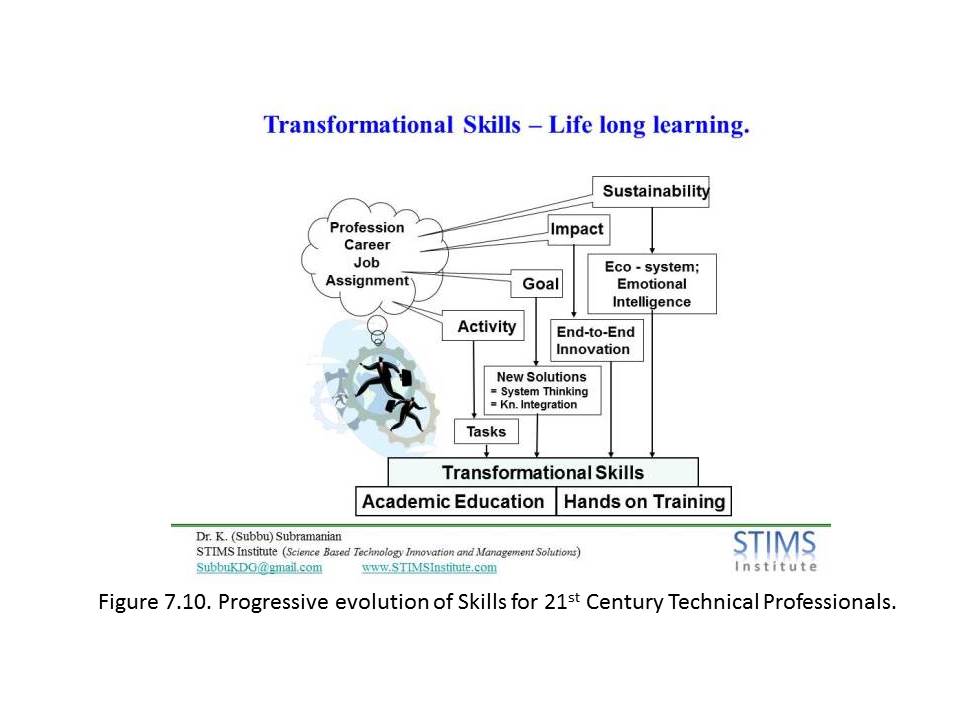
The secret for success can be summatized as a relentless emphasis on System Thinking and Transformational Skills with a determined focus on End-to-End Innovation!
This joint key note talk was presented in two parts by an academic leader with hands on experience in real world innovation and the Knowledge-Integration expertise promoted by the STIMS Institute.

Part 1:   Prof. Babu: Real life experience – home grown success in  Industry/academia collaboration, which is now seen as the successfully established Advanced Manufacturing Technology Development Center (AMTDC) located at the IIT Research Park, Taramani, Chennai, Tamil Nady, India.
https://stimsinstitute.com/wp-content/uploads/2025/01/copen13_nitc_final-1-prof.-babu.pdf

Part 2:   Dr. Krishnamoorthy (Subbu) Subramanian: Origins and Strategy (based on over   40 years of experience in inter-industry and   Industry / Academia Collaboration).Strategies for End-to-End Innovation -“System Thinking” and “Transformational Skills”
https://stimsinstitute.com/wp-content/uploads/2025/01/copen-13-key-note-paper-final.pdf

Few images from this event and presentations are included below. We thank the conference organizers, academia and industry partners as well as industry consortium represented by IMTMA and also the fiunding agencies from the Government of India. Special thanks to Mr. N.K. Dhand, Chairman, Micromatic Grinding Technology Ltd. (MGTL) and Mr. Mohanram, adviser, Indian Machine Tool Manufacturers Association (IMTMA) for their unstincting support for this decade long collaboration and outcome.

This successful model, for industry/academia collaboration at AMTDC has also been implemented earlier as an inter-industry collaborative effort inside the industry, by Dr. Subramanian through his industrial working career. We hope there will be more efforts to replicate this successful model and its outcomes by many in the Academia/Industry and Govt. agencucies.

Advanced Manufacturing Technology Development Center (AMTDC) https://amtdc.org/

The Misguided War on the SAT – Comments on NYT essay.

The essay The misguided war on the SAT, dated Jan. 7, 24 by Mr. David Leonhardt is a thoughtful and data rich essay on this topic. The essay, the contents and the debate strike a personal chord in my memory lanes!

Being an alumni of MIT, I am genuinely proud and grateful for their thoughtful probing on this matter of Standardized Test scores and their impact on diversity in their student population admitted, as well long term performance or success of students in their performance at college and subsequent career success. Life and success is more than just success in the UG studies, admission to Graduate School or working in a “Prestigious” firm! I hope MIT and other institutions will explore other factors such as good family life (long term relations); success in mentoring others (children, colleagues, fellow professionals) and social responsibility (service to the society, racial/gender cohesiveness) as well as interests in the larger interests of humanity and global issues! How are these factors related to performance in generalized tests such as SAT scores?

Born and brought up in a small village in Tamil Nadu state, India, I attended a local public elementary school and moved to a public countywide school (Board High School). Our education was entirely in Tamil, a local language (rich in history and literature). We were also exposed to English as a special language and to a minimum extent Sanskrit, another ancient and culturally rich language. Our assessment at the end of the final High School year was a common examination in all subjects (Language, Science, Mathematics, History, Geography, etc.). While students were graduated based on the individual’s score, the comparison was across all students in the District level (across several counties). I was ranked first in my school and second at the District level. There were no issues up to this point. Life was as smooth as it can be for a poor rural Indian boy!

Then I proceeded to a prestigious college in a city 12 miles away, which meant travel by train (and some walking) adding up to 3 plus hours of travel each day! But, the bigger shock was that all subjects now were taught in the English language! Without any in-depth preparation in the language, the expectation for learning all subjects in English overnight, was a rude awakening! Somehow all of us students, with similar backgrounds, plugged along. This one year course – called Pre-University Course – is a bridge before proceeding to seek admission for U.G. studies. At the end of this year, students took the prestigious IIT Entrance Examination, offered across India. This is closest to the equivalent of the SAT exam. in USA. The language for this entrance exam. was completely English! On top of that, the questions were entirely “gibberish” as seen by this totally unqualified student – myself – with little exposure to English, and absolutely no exposure to Urban values and issues and way of living as well as national or international matters. Nobody had to assess my test scores. I was certain when I left the examination hall that I had failed the IIT Entrance Examination. It was indeed the case!

Getting ahead in life is as much a matter of chance, as it is due to qualifications and preparations! As a combination of all these, I ended up at Osmania University, Hyderabad, Andhra Pradesh one of the states in India.  I proceeded to study my B.S. in Mech. Engg., being ranked second across the entire University (with several engineering colleges in their jurisdiction). Another set of chances, qualification and preparations resulted in my getting admitted to MIT. In those days students like me with limited knowledge and exposure, did not know that MIT was a prestigious institution, worth persevering for admission as much as possible! I could have easily gone to another place, but for a kind letter during the admission process from Prof. N.H. Cook from MIT (who later became my adviser). It was my father’s wise counsel to stay patient, being respectful to a professor’s letter. This guidance from my father was more from the principle of being respectful to teachers, the ancient wisdom from Eastern philosophy! It had nothing to do with the merits of MIT as an institution of great acclaim! I did exercise patience for two more weeks and in this time my admission to MIT was confirmed! My admission at that time did not require a GRE examination, the standardized test required for all students applying for Graduate Studies! I did not know the reason then, nor do I care to know it now! Past poor performance in the IIT Entrance Exam. or not taking GRE standardized exam., have not held me back in my jobs, career or life as a whole. I have been blessed with opportunities to collaborate with many across the globe including the IIT in India. My rural upbringing, exposure to the ancient wisdoms and culture have helped me to find meaning and purpose in every step as life has unfolded over the years. https://sipractce.com/   https://stimsinstitute.com/about/management-team/

There are many successful faculty at prestigious institutions like MIT, who are not necessarily graduates from the same institution or from similar well known institutions.  Life and performance as a result of education is as much a matter of chance, as it is due to qualifications and preparations! The debate should not be whether or not SAT scores ( as well as GRE scores) are valid and needed. Instead, the approach should be to use SAT score as one of the measures for the admission process as it has been practiced all along. Then the admission officers should diligently explore the background of the outliers, especially those applicants with poor SAT scores, their background and circumstances and also their performance relative to their peer groups in their local settings?

STIMS Institute offers industry focused education for fourth year in a row.

Education, Process Innovation and End to End Innovation are the focus areas of STIMS Institute. Each of these three focus areas are interconnected. education that is merely academic is less valuable today in the world where more than 80% of what is needed can be obtained through Google. Today education has to be holistic (i.e.) system oriented. That implies scientific fundamentals together with an emphasis on application of the science and the strategic reasoning required to make such education relevant and useful in the real world. Such Education was offered for the fourth year in a row . This leads to over 100 senior engineers, managers and teachers trained to meet the high end professional needs in the manufacturing sector.

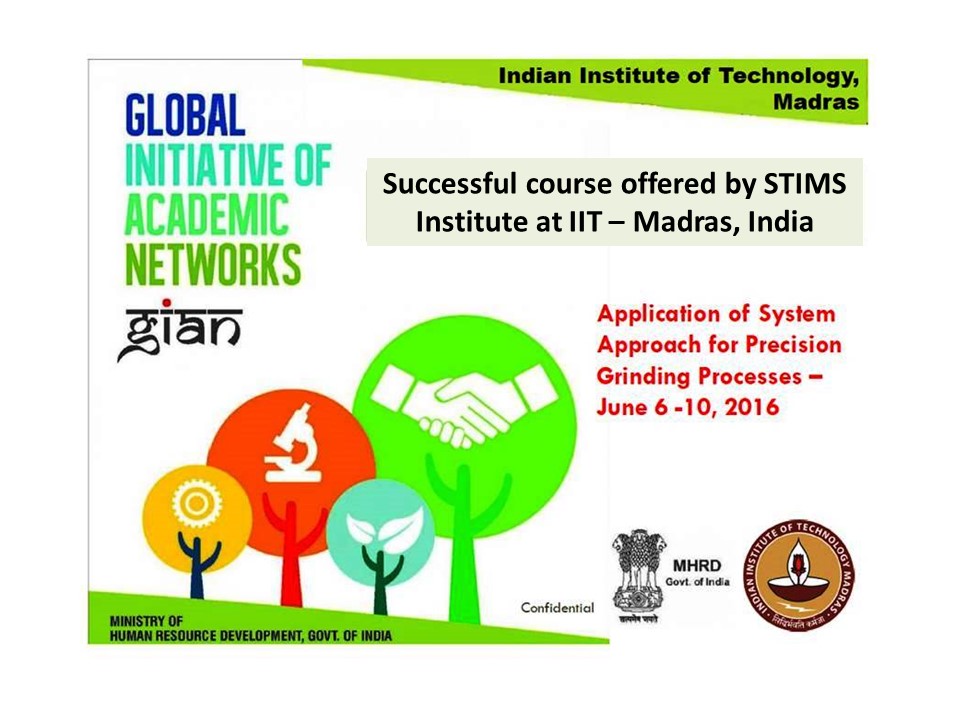
This year the course was offered under the GIAN (Global Initiative for Academic Network) program at IIT – Madras, India.

Slide1Slide5

Course Outline:

  • Why should we grind?
    • Critical and enduring role of physical processes like grinding in manufacturing and especially in Precision Components Manufacturing
    • Examples of grinding processes used in a wide variety of:
      • Work materials, machines, components and applications
      • Role of grinding processes in traditional applications as well as emerging needs like high efficiency IC engines, computer parts, LED, PV and wind energy components manufacturing.
  • The System Approach to Grinding Processes:
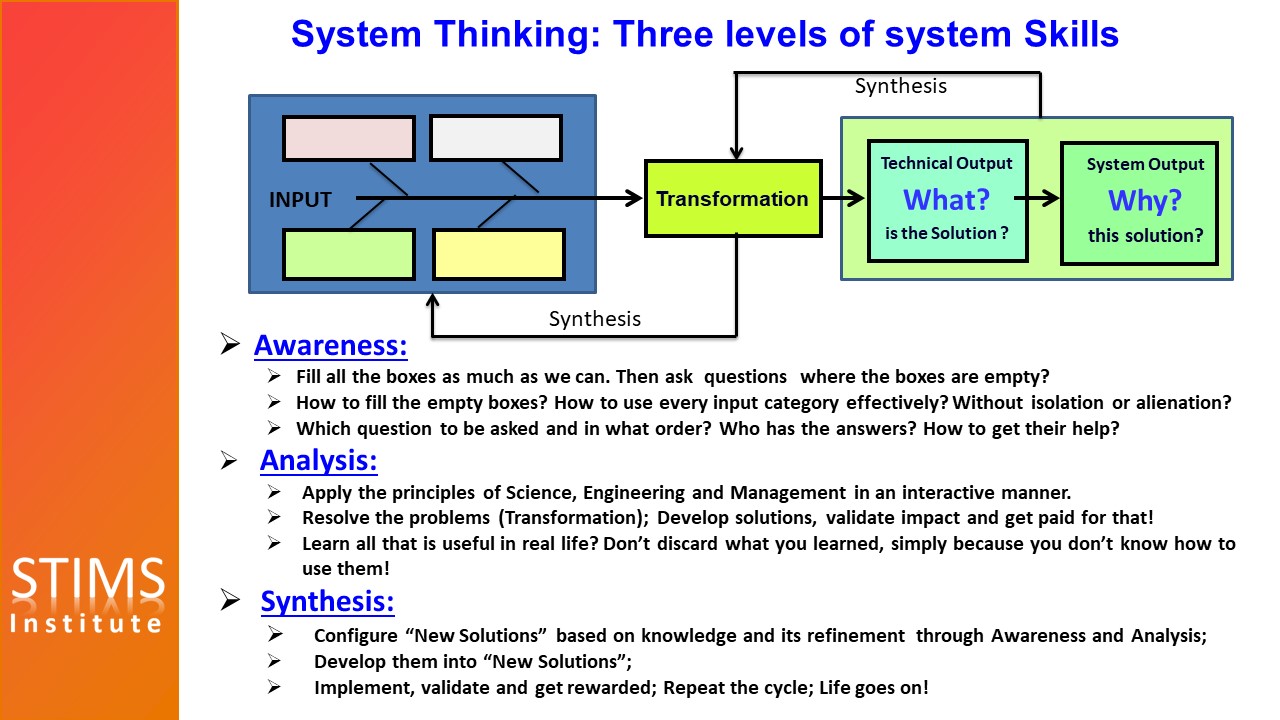
    • Every process is an Input / Transformation / Output system
    • “Transformation” represents the Science of the Process
    • System Approach requires integration of Science, Engineering and Strategy
  • Grinding Processes are Input /Transformation / Output systems for surface generation to meet critical functional needs and process economics.
  • The Science of grinding: The microscopic interactions that occur at the grinding zone and their quantification
  • Inputs to the grinding process and how they impact the microscopic interactions:
    • Work Materials and components
    • Abrasive and dressing tools, coolants and other consumables
    • Machine Tools (key element of investment and process design)
    • Process parameters (that are selected as part of process design and can be changed at the shop floor )
  • Measurement and Analysis of grinding processes
  • Hands on laboratory exercises
  • Tutorials and analytical and data driven problem solving
  • Technical Outputs – What are the requirements to be met when using grinding processes
  • System Outputs – the Why? strategic and economic considerations pertaining to grinding processes
  • Application of the System Approach – Case Studies
    • Truing & Dressing of CBN grinding wheels
    • Optimal use of CBN grinding solutions
    • Simple Solid Shape (S^3) grinding – High MRR low WIP, short lead time and flexible processes
    • Processes for micro – chip, magnetic head and LED substrate fabrication.
    • Machining to Grinding Processes
    • Data driven process solutions.
    • Optimization in the development og new machine tools for grinding process solutions.
  • Guest Lectures from Industry and academic leaders on the need and role of System Approach for manufacturing processes.

Slide2
Slide3

Slide4

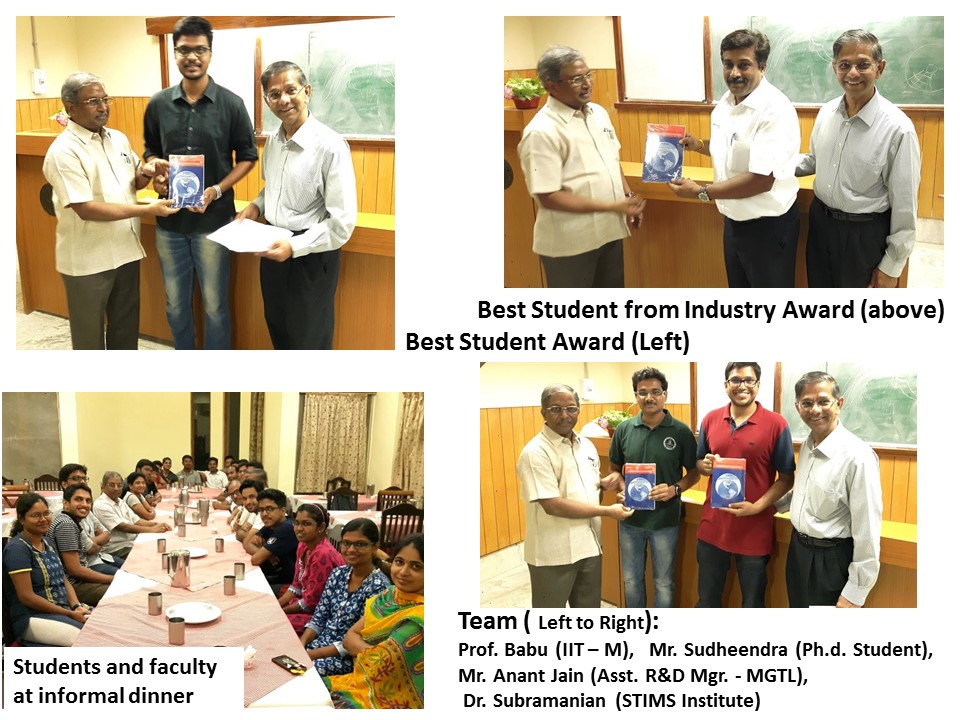
This course was a team effort in collaboration with Prof. Ramesh Babu, IIT – M, Mr. Sudheendra – a research student for his Ph.D program and Mr. Anant Jain – R&D manager, Micromatic Grinding Technologies, a well recognized Precision Grinding Machine manufacturer.

 Slide6Slide7