It took only 50 years for a Tech. Giant to share the reality with the public?

Following is a brief excerpt from the recent NYT essay titled: Bill Gates Warns A.I. Is More Dangerous Than Big Tech Will Admit https://www.nytimes.com/2026/08/26/technology/bill-gates-ai-risks.html

In an hourlong interview, he said his industry was downplaying the risks, which he believes include mass unemployment and bioterrorism.
Mr. Gates said technological advances had truly stunned him three times: In 1980 when he first saw a graphical user interface, which led to the modern personal computer.In 2022 when the leaders of OpenAI came to his house to demonstrate what would soon become ChatGPT. And this year when he looked closely at the advances being made by Claude Code, Anthropic’s A.I. tool.

This shock (“Stunned” as Mr. Bill Gates put it) in the unbridled development in “Technology”, has been the lived experience or nightmare of every manufacturing professional in the USA, since the 1980s later spreading to any professional  worldwide!
We have described this nightmare in the introduction to our book:
The System Approach – A strategy to survive and succeed in the Global Economy, published in 2000.  https://www.amazon.com/dp/1569902550
We have reproduced this “nightmare” scenario of a manufacturing worker below.

Let us face it. AI and its impact is a bigger monster we face today. But the problems started in the late 1970s! All those who have been claiming “Technology” driven innovation is the savior for all, have been misleading the public with that term – Technology –  by which they merely refer to Digital Technology and nothing else. We must come to accept the reality that human dignity as a workforce will be uplifted only through the true evolutions in Technology (an integrated deployment of Science, their applications -Engineering and focussed on collaboration for larger common good – Management). It requires an integrated view of the opportunities, their solutions and the benefits for a larger common goal. We can call this the “System Thinking” and the drive towards that. For details see: https://www.amazon.com/dp/0791860167
Thriving in the 21st Century Economy – Transformational Skills.

A Bad Dream:
Paul Gagnon was seated in a comfortable chair.  Next to him, in the conference room was seated his Supervisor, Mary Patterson, a young and successful engineer in the company.  It was a new and strange experience for Paul.  As a production worker in the company, Paul had never attended any such meeting before now.  Along with Paul and Mary, there were several others in the room:  Joe Whitehead – the Department Manager, Linda Cook – the Financial Controller, Ralph McCarthy – Congressman and Jack Singer the President of the Operating Unit.
“Shall we get started,” signaled Jack, trying to get the attention of everyone.  “We have relied heavily on worker productivity, to keep us ahead of our competition.  It is now at an all-time high.  I have never seen our workforce as hard at work as much as I see them perform at the present time.  We have installed the best information systems, which by the way has helped to wring out significant cost reductions in our operation in the past two years.” 
Paul shifted slowly in his chair, more in discomfort of what he had just heard.  “By significant cost reduction, Mr. Singer really meant laying off about 40 people from this company, 25% work force reduction?  Didn’t Mr. Scott Sealy, the Human Resources Manager, describe this as re-engineering?” reflected Paul.
“Our profitability, even though it is not as high as I would like it to be, is not bad,” continued Jack Singer.  “Yet, there is a lot of uneasiness everywhere.  On the one hand, we want our workers to be committed and loyal, yet I do not see any way of assuring them of our commitment to their employment.  As you know, these are not the good old days, when we can reasonably say that a person is hired for a lifetime, as long as he/she does a good job.  Doing the very best in a given job does not seem to be good enough anymore.  Yesterday, I was at the corporate meeting.  I heard talk about acquisitions and mergers.  The guys at the top feel that we cannot be competitive, even with all our improvements.  An option being talked about is moving the entire operation to an offshore location.  I simply don’t get this,” continued Jack with a sense of frustration that was clearly shared by everyone in the room.  “Well, why don’t we go around the room and see what is on everyone’s mind,” continued Mr. Singer.  “As you know, we called this meeting to get everyone’s points of view on our current situation and where we are headed.”
“This is not the Jack Singer, I know,” thought Paul Gagnon.  “Whatever happened to the orderly introductions and a careful outline of the objectives for the meeting.  Jack is good at this sort of stuff.  Clearly, something is seriously wrong.  Maybe Jack senses something serious but cannot get his arms around it.”
“I am Joe Whitehead, the design manager.  In the past five years, my department has shrunk by 50%.  I have lost most of my key design talent – the draftsman, the engineer in charge of heat transfer analysis, the design details engineer all been let go, through our re-engineering effort.”

“Joe has always been politically correct” reflected Paul Gagnon.

“We do most of the design analysis overseas and download them through the internet.  The way things are going we may not even need many design options, if our customers buy sub assemblies from our competition instead of buying our components and assembling them, as they do now.  The word is that our competitors plan to integrate the function of our components into their subassembly.  This may even eliminate the need for our components.”
“The days are getting longer and harder “jumped in Mary Pattterson, the manufacturing engineer”.  When I came into this job three years ago, we had a tooling engineer, a quality engineer in charge of inspection, a guy for maintenance and I was in charge of process development.  Today, I seem to be everywhere.  I don’t mind that as long as I can see the light at the end of the tunnel.  When I heard of the acquisitions, mergers and move to the off shore that concerns me a lot “sighed Mary.
“We have invested in the capital at an unprecedented rate in the past few years.  Yes, they are paying off, but not as much as they are supposed to.  When I walk around the company, I get the sense that everyone looks at me as if I am the one to be blamed for all the lay offs.  If everyone understood the basic economics, they would know for themselves what is happening and why,” lamented Linda as she stared at the piles of accounting documents, neatly arranged in binders in front of her.
“I simply don’t get it,” said Ralph McCarthy, the congressman in his slow drawl.  “When I go to Washington, they tell me about all these wonderful numbers.  The unemployment is low.  The labor productivity is high.  The US economy is at the top.  Yet, when I come home, all I hear is uneasiness and a sense of helplessness.  Why isn’t life the way it used to be?  Simple, where everyone did their job and everyone knew what they were supposed to do.  Maybe it is because we have moved from a manufacturing economy to an information economy?”

Paul Gagnon looked around.  Everyone had finished their turn.  Perhaps he was supposed to say something.  The only thought that came to mind was his young son David.  What will his life be like when he grows up?  Will he be doing the same job as Paul, who now runs a computer-controlled machine, with built in inspection tools?  Paul has been busy studying and taking courses just to stay on top of his current job.  He knows of several of his co-workers who were laid off, simply because they could not keep up with the changes.  Paul had dreamed that David would one day be an engineer like Mary.  Nevertheless, listening to Mary and Joe, he was not sure anymore.  Everyone in the room, whom Paul had counted as role models for his son, were gloomy and dispirited.  “I really don’t know what to say.  I really don’t,” muttered Paul. 

“Honey, it is time to wake up.  What is it you don’t know?  You have been saying this all night,” said his wife Susan as she gently stroked Paul, urging him to get up.

“It was all a bad dream, dear.  I am glad it is over” said Paul as he woke up, pushing aside the sheets of paper, getting up from the bed.  “Honey, there is no time left for dreaming anymore” retorted Susan.  “With three of our kids, all going to different schools and both of us working, I don’t even have a moment to rest up, much less a good night’s sleep.  I don’t know how you manage to find time for all your dreams”, finished Susan.

Reality: It will be wonderful indeed, if Paul Gagnon’s dream was just that – a dream.  However, it is an inescapable reality, a true nightmare!  Every one has had shades of experience reflected in this fictional episode.  The thoughts of Jack, Joe, Mary, Linda, Ralph and Paul described in the dream are shades of real-life experiences faced by millions of Americans in one way or the other.  Let us look at some of the evidence:

Role of decision making in Management

Role of decision making in Management

In the beginning of the NYT essay https://www.nytimes.com/2026/02/21/us/politics/gorsuch-congress-trump-tariffs.html we find the following:
“Yes, legislating can be hard and take time,” wrote Justice Gorsuch, a Trump appointee who is part of the court’s conservative majority. “And yes, it can be tempting to bypass Congress when some pressing problem arises. But the deliberative nature of the legislative process was the whole point of its design. Through that process, the nation can tap the combined wisdom of the people’s elected representatives, not just that of one faction or man.”

These are wise and timely words, also implying the failure of the current Congress and its willingness to sit on the sidelines, abrogating all its power and authority to an Executive intent on enlarging his power, laws and Constitution be damned!

There are obvious failures and pitfalls in our current political process. Every citizen in this great Democracy must reflect upon it and act as required! “A republic, if you can keep it” is a famous, cautionary quote attributed to Benjamin Franklin in 1787, emphasizing that maintaining a free, representative government requires active civic responsibility, not just its establishment!

“All politics is local” is a famous maxim coined by former U.S. Speaker of the House Tip O’Neill. Generally it is used to handle political issues by chasing its roots to the local population. We could also chase down the current plotical quagmire or failure in our governing process at the national level and its similairity to what is generally known as “management problem”?

Above words of Justice Gorsuch have profound implications in any management process as well. After all any management effort requires a relentless chain of “Plan / Organize / Coordinate / Control (verify against plan)”. In every step, decision making is required. Such decision making would be objective and free of personal bias (un-attached) when input from all sides and from everyone involved is included. Not every decision can be left to the Chief Executive. Everyone at every level has to make their decisions and stand up to defend all such decisions. It can be tempting to bypass established roles and processes when some pressing problem arises. It is such systemic failure in decision making at various levels and functions that is the root cause of what we commonly identify as “Management Failure”?

System Approach for Customer Success Management

Customer Success Management (CSM) is a relatively new functional area within many companies, an increasingly vital operational role, a rapidly growing profession, and an underlying systems management philosophy that is growing in importance, especially – but not exclusively – within the technology industry. One leading industry organization (Customer Success Association 2021) defines CSM as “a long-term, scientifically engineered, and professionally directed business strategy for maximizing customer and company sustained business value,”. Others describe CSM as “a customer-facing, non-direct sales role that embodies the mindset of a counselor
to proactively partner with customers to help them achieve their goals and promote long-term customer health that ultimately leads to relationship growth”.

A recent paper that outlines the System Approach for CSM has been authored by Prof. Vijay Merhotra at UCSF, School of Business and Dr. Krishnamoorthy (Subbu) Subramanian from STIMS Institute. For a complete vesrion of this paper, please see: https://stimsinstitute.com/wp-content/uploads/2025/08/system-view-of-csm-published-paper-with-prof.-vijay-merhotra-ucsf-07-22.pdf

Every Co. has processses required to produce and supply their products. When their products are used and the value realized by the customer, only then recurring sales and sustained sales growth of the supplier is realized as illustrated in the figure below:

CSM plays an imptortant interfcae role between the customer and supplier as illustrated in the figure above.

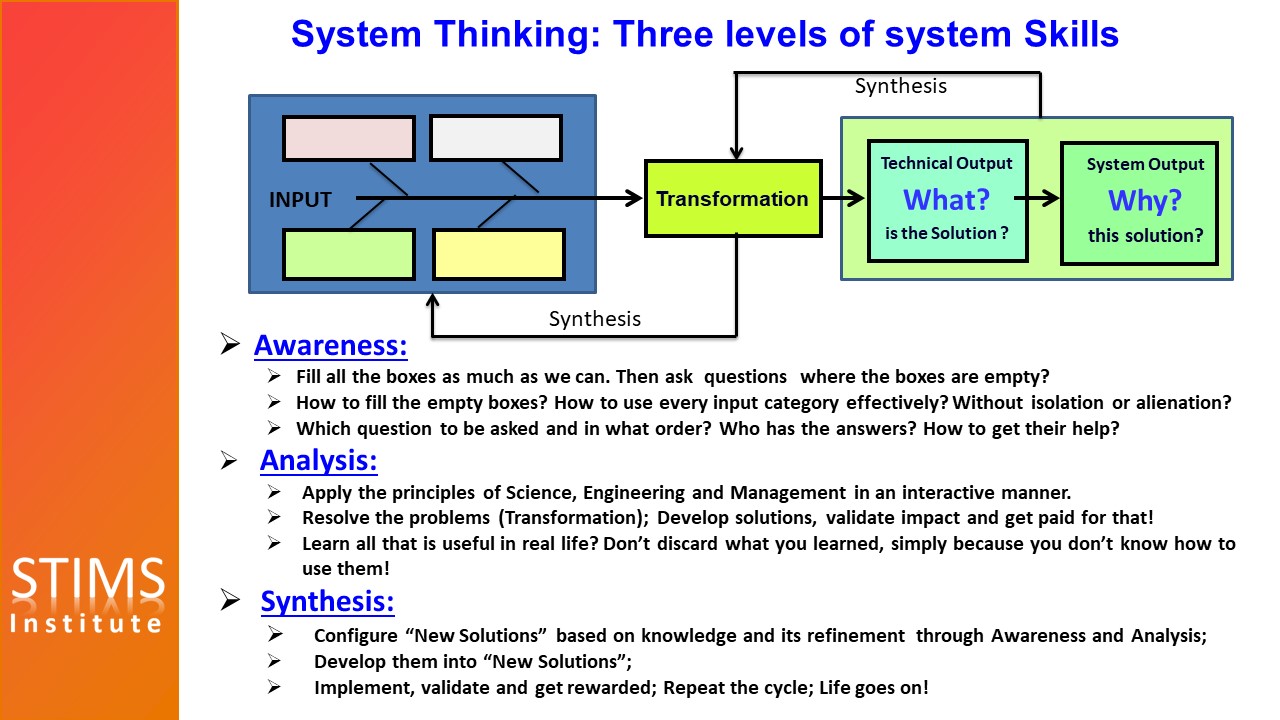
Every process of the “Customer” is a “system” that can be described as an

“Input /Transformation / Output” Scheme
The output itself may be classified as “Technical Outputs” or the nuts and bolts of the solution, leading to the desired value/benefits called the “System Outputs”.

This System Approach has been setailed in the book authored by Dr. Subramanian and Prof. Rangan: https://www.amazon.com/Thriving-Century-Transformational-TechnicalProfessionals/dp/0791860167/ref=sr_1_1s=books&ie=UTF8&qid=1371673516&sr=1-1&keywords=Transformational+Skills+Subramanian

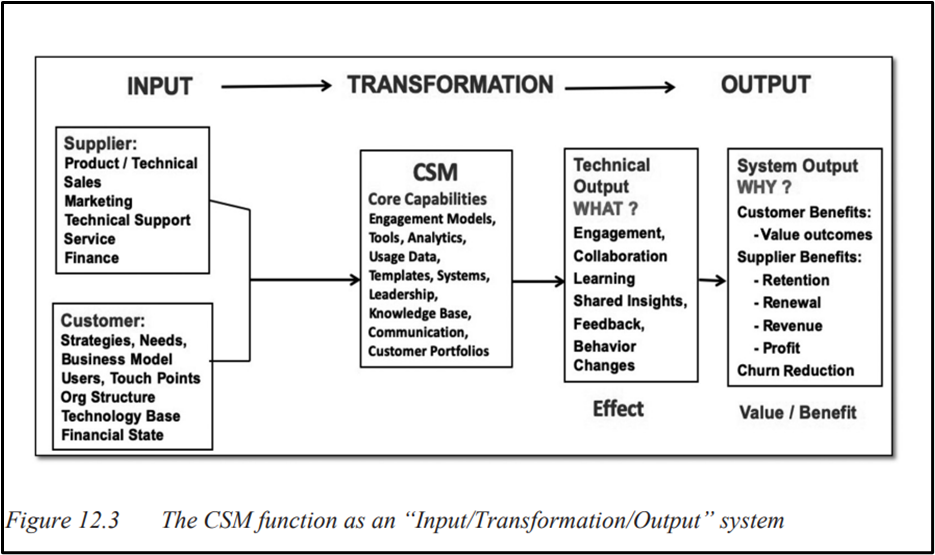
The Customer Success Management as a System integrating customers and Suppliers is illustrated in the Figure below:

In figure 12.3 above on the input side the various functions of the “Customer” and “Supplier” are listed. Everyone of them is a stakeholder in the “Transformation” (i.e.) Customer’s process in which the Supplier’s product is used. Hence opportunities for maximizing or “Optimizing” the System outputs – Stakeholder benefits – could be far larger than that listed even in this figure!

Beyond that, consider all other “Suppliers” involved and their “Products” required for the Customer’s process. Now you have a far larger list of “Stakeholders” and their benefits that you could synergistically optimize and attempt to satisfy. Every such satisfied “Supplier” is also a beneficiary for the “Customer” and his “process”. This a substantially expands the role and impact of “Customer Success Management”! 

In this CSM Philosophy, any supplier can adopt the “Customer’s Process” as his own (i.e.) “Becoming a Customer’s Customer”! In many respects it may also be seen as the evolution of Applications Technology in the Customer / Supplier relationships.

Whose America is it? – Part 2

“It has been said that democracy is the worst form of Government except for all those other forms that have been tried from time to time” – quote attributed to Winston Churchill. Today with all the challenges we face in our system of Government, faith in Democracy and America as the unfailing cradle and leader of such Democracy is called into question.

Successful Democracy requires well informed citizens, who vote for their best self-interest. It also requires that self-interest is viewed through a larger perspective and not merely through polarized lens of narrow partisan interests. In the recent election, even narrow partisan self-interest seems to have failed. How else can one explain the vote of those in the Dearborn area – supporters of Palestinian’s aspirations – who now find themselves between a rock and a hard place, thanks to the policies proposed from the current administration, centered around expelling millions of Gazans from their historic home land. This is just one example of irrationality of voting patterns that might have failed the American Democracy, the greatest political experiment on earth.

Failure of ill-informed voting public goes beyond such narrow ethnic group oriented politically sensitive subjects. Nor is it our goal to dwell on them. Let us look at a couple of rather broadly accepted notions that cut across all groups and population segments. One among them is the notion that “Government must be run efficiently, like a business. Hence it is necessary to cut the cost to the bones!”. This statement assumes that “businesses are run efficiently”. This is a far cry from reality. Business leaders, part of the voting public, must be honest and truthful to admit that every successful business is run to make profit and meet share holder expectations. In this shadow boxing – the mythical notion of satisfying shareholders, the “kabuki theater” – there is plenty of inefficiency. Rare indeed are businesses that are truly run lean and mean in a sustained manner over time.

Next is the notion that ALL Government departments must be cut back to demonstrate efficiency! Another hog wash notion? In some areas like production operations, it is realistic and feasible to show efficiency and cost cutting as directly related to the resources needed. But that is not the case for R&D, Marketing, Administration, HR and all such “service” functions. You don’t hire and fire intellectual talent or critical resources at will and on demand. This concept may apply to many of the important Government Departments that affect our health, safety, security and welfare.

Here is one more: In the name of efficiency and cost cutting senior employees in the work force were seen as “fixed cost” and can be disposed off, leading severe loss of unique talent in Manufacturing operations in the 80s and 90s. Now we find the same mistake repeated by indiscriminate firing of key staff in FDA, Missile systems management, FAA, etc. Whose America is it to permit all these reckless and loose cannon approach to management of our vital resources and services?

Following are a few passages from an article titled: 2,400 years ago, Plato saw democracy would give rise to a tyrannical leader filled with “false and braggart words –https://qz.com/1293998/2400-years-ago-plato-saw-democracy-would-give-rise-to-a-tyrannical-leader-filled-with-false-and-braggart-words

Josiah Ober, professor of political science and classics at Stanford University says the passages from Plato’s Republic read as “a particularly harsh description of the most tyrannical parts of Trump’s public personality.”

Plato’s Republic, which evaluates the nature and justice of various political regimes and examines how individuals’ moral psychologies are interlinked with the moral psychology of their state, is intended as a work of philosophy rather than a prediction of how political events would unfold. That said, Plato’s critique of democracy contains a number of aspects relevant today.

Plato believed that the key and driving feature of democracy is desire for freedom; this very trait, though, ultimately leads a state to tyranny. A democratic regime involves such a plurality of interests, he believed, that the only way anything can be achieved under it is to have strong leadership that can unite interests. “It’s not a complete portrait of modern democracy but it captures something: This desire for a strong leader who can give guidance to diverse pluralistic uncoordinated desires,” says Oder.

Plato states “The tyrant mistrusts both those within and outside his circle, and so essentially ends up in a sort of servitude himself.” Role and influence of men like Elon Musk and their passion to change all things at all costs reminds us of this self-enforced slavery of an elected leader today.

For a more optimistic interpretation of today’s political regimes, Ober suggests looking to Aristotle, who understood that true democracy is fundamentally opposed to tyranny. Contemporary politics may cause consternation, but Ober says it’s worth believing in the political regime. After all, he adds, “Democracy has to be built on hope.”

Keynote Presentations at COPEN-13, @ NIT Calicut – India

Dr. Krishnamoorthy (Subbu) Subramanian, President STIMS Institute and Prof. Ramesh N. Babu, IIT – Madras and Secretary AMTDC presented a joint invited Key Note address at the 13th Conference on Precision Engineering (COPEN – 13) on Dec. 13th 2024 at NIT Calicut, Kerala, India. The presentation was followed by a panel session to further gain insights on successful models and strategy for industry/academia collaboration together with support from the funding agencies, and future directions.
It was an unique opportunity as well as experience. It was the culmination of over a decade long collaboration between STIMS Institute, IIT- Madras, several industry partners as well as support from Govt. of India. The presentations covered two themes:
Substantial collaborative work has progressed inside of India for more than a decade now. This is a remarkable demonstration of success in   Industry/Academia collaboration, much sought after by Industries, Academia and funding agencies from the Govt. in all nations across the globe.
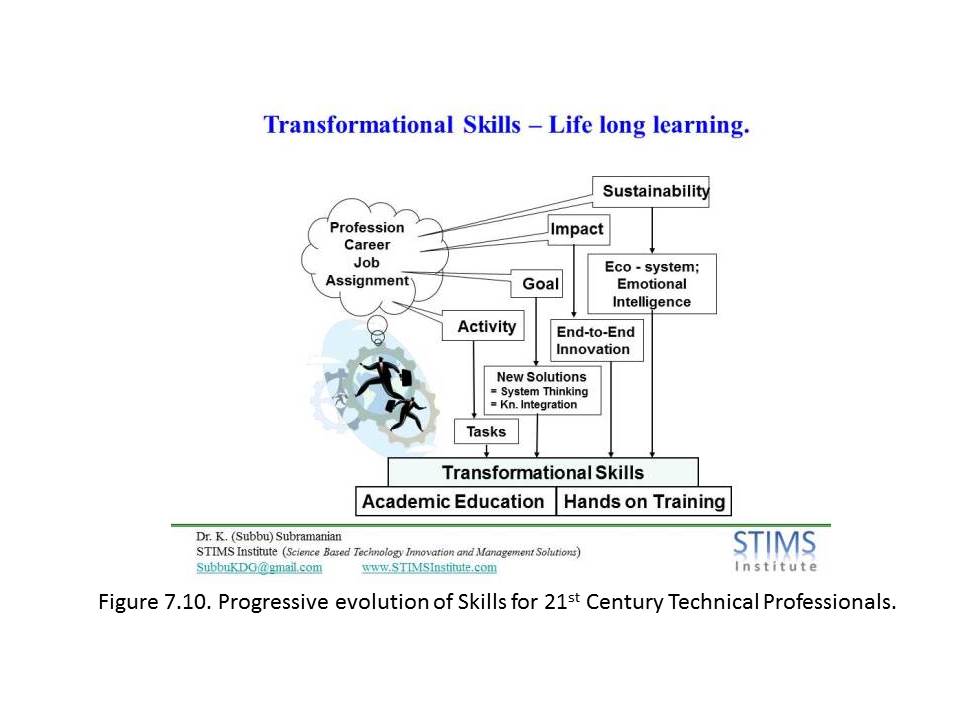
The secret for success can be summatized as a relentless emphasis on System Thinking and Transformational Skills with a determined focus on End-to-End Innovation!
This joint key note talk was presented in two parts by an academic leader with hands on experience in real world innovation and the Knowledge-Integration expertise promoted by the STIMS Institute.

Part 1:   Prof. Babu: Real life experience – home grown success in  Industry/academia collaboration, which is now seen as the successfully established Advanced Manufacturing Technology Development Center (AMTDC) located at the IIT Research Park, Taramani, Chennai, Tamil Nady, India.
https://stimsinstitute.com/wp-content/uploads/2025/01/copen13_nitc_final-1-prof.-babu.pdf

Part 2:   Dr. Krishnamoorthy (Subbu) Subramanian: Origins and Strategy (based on over   40 years of experience in inter-industry and   Industry / Academia Collaboration).Strategies for End-to-End Innovation -“System Thinking” and “Transformational Skills”
https://stimsinstitute.com/wp-content/uploads/2025/01/copen-13-key-note-paper-final.pdf

Few images from this event and presentations are included below. We thank the conference organizers, academia and industry partners as well as industry consortium represented by IMTMA and also the fiunding agencies from the Government of India. Special thanks to Mr. N.K. Dhand, Chairman, Micromatic Grinding Technology Ltd. (MGTL) and Mr. Mohanram, adviser, Indian Machine Tool Manufacturers Association (IMTMA) for their unstincting support for this decade long collaboration and outcome.

This successful model, for industry/academia collaboration at AMTDC has also been implemented earlier as an inter-industry collaborative effort inside the industry, by Dr. Subramanian through his industrial working career. We hope there will be more efforts to replicate this successful model and its outcomes by many in the Academia/Industry and Govt. agencucies.

Advanced Manufacturing Technology Development Center (AMTDC) https://amtdc.org/