Following is a brief excerpt from the recent NYT essay titled: Bill Gates Warns A.I. Is More Dangerous Than Big Tech Will Admit https://www.nytimes.com/2026/08/26/technology/bill-gates-ai-risks.html
In an hourlong interview, he said his industry was downplaying the risks, which he believes include mass unemployment and bioterrorism.
Mr. Gates said technological advances had truly stunned him three times: In 1980 when he first saw a graphical user interface, which led to the modern personal computer.In 2022 when the leaders of OpenAI came to his house to demonstrate what would soon become ChatGPT. And this year when he looked closely at the advances being made by Claude Code, Anthropic’s A.I. tool.
This shock (“Stunned” as Mr. Bill Gates put it) in the unbridled development in “Technology”, has been the lived experience or nightmare of every manufacturing professional in the USA, since the 1980s later spreading to any professional worldwide!
We have described this nightmare in the introduction to our book:
The System Approach – A strategy to survive and succeed in the Global Economy, published in 2000. https://www.amazon.com/dp/1569902550
We have reproduced this “nightmare” scenario of a manufacturing worker below.
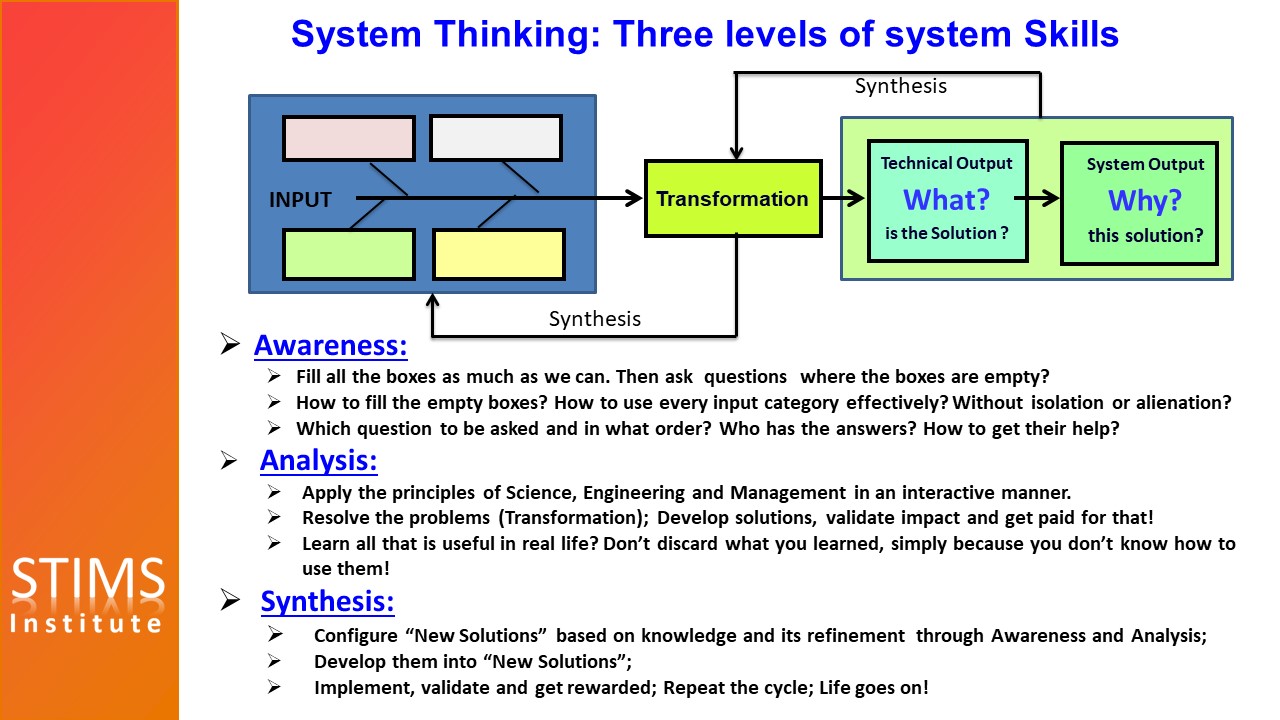
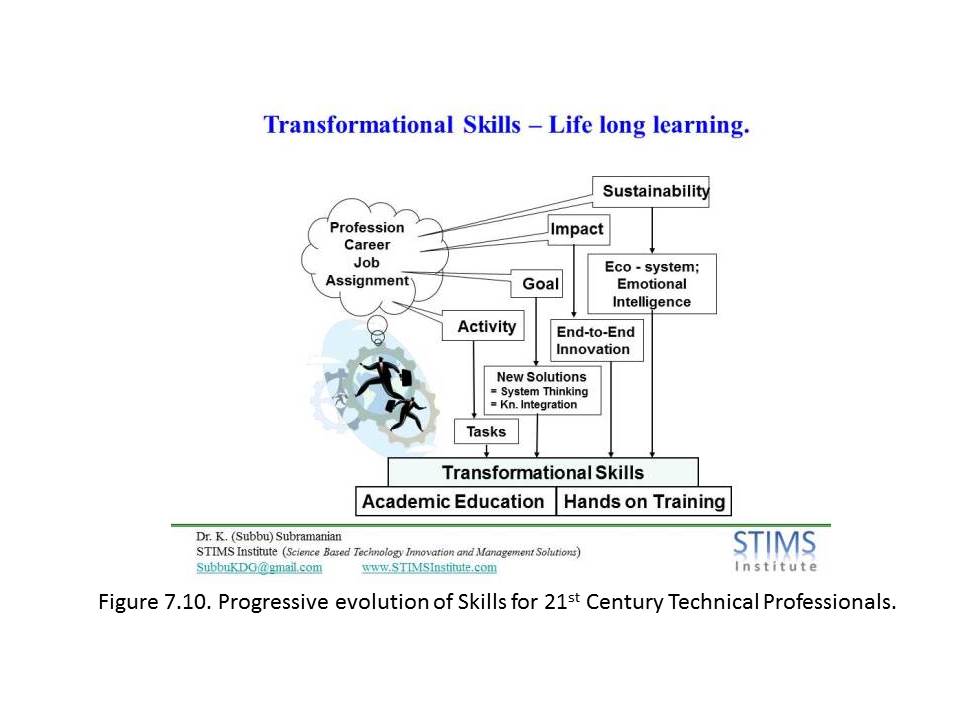
Let us face it. AI and its impact is a bigger monster we face today. But the problems started in the late 1970s! All those who have been claiming “Technology” driven innovation is the savior for all, have been misleading the public with that term – Technology – by which they merely refer to Digital Technology and nothing else. We must come to accept the reality that human dignity as a workforce will be uplifted only through the true evolutions in Technology (an integrated deployment of Science, their applications -Engineering and focussed on collaboration for larger common good – Management). It requires an integrated view of the opportunities, their solutions and the benefits for a larger common goal. We can call this the “System Thinking” and the drive towards that. For details see: https://www.amazon.com/dp/0791860167
Thriving in the 21st Century Economy – Transformational Skills.
A Bad Dream:
Paul Gagnon was seated in a comfortable chair. Next to him, in the conference room was seated his Supervisor, Mary Patterson, a young and successful engineer in the company. It was a new and strange experience for Paul. As a production worker in the company, Paul had never attended any such meeting before now. Along with Paul and Mary, there were several others in the room: Joe Whitehead – the Department Manager, Linda Cook – the Financial Controller, Ralph McCarthy – Congressman and Jack Singer the President of the Operating Unit.
“Shall we get started,” signaled Jack, trying to get the attention of everyone. “We have relied heavily on worker productivity, to keep us ahead of our competition. It is now at an all-time high. I have never seen our workforce as hard at work as much as I see them perform at the present time. We have installed the best information systems, which by the way has helped to wring out significant cost reductions in our operation in the past two years.”
Paul shifted slowly in his chair, more in discomfort of what he had just heard. “By significant cost reduction, Mr. Singer really meant laying off about 40 people from this company, 25% work force reduction? Didn’t Mr. Scott Sealy, the Human Resources Manager, describe this as re-engineering?” reflected Paul.
“Our profitability, even though it is not as high as I would like it to be, is not bad,” continued Jack Singer. “Yet, there is a lot of uneasiness everywhere. On the one hand, we want our workers to be committed and loyal, yet I do not see any way of assuring them of our commitment to their employment. As you know, these are not the good old days, when we can reasonably say that a person is hired for a lifetime, as long as he/she does a good job. Doing the very best in a given job does not seem to be good enough anymore. Yesterday, I was at the corporate meeting. I heard talk about acquisitions and mergers. The guys at the top feel that we cannot be competitive, even with all our improvements. An option being talked about is moving the entire operation to an offshore location. I simply don’t get this,” continued Jack with a sense of frustration that was clearly shared by everyone in the room. “Well, why don’t we go around the room and see what is on everyone’s mind,” continued Mr. Singer. “As you know, we called this meeting to get everyone’s points of view on our current situation and where we are headed.”
“This is not the Jack Singer, I know,” thought Paul Gagnon. “Whatever happened to the orderly introductions and a careful outline of the objectives for the meeting. Jack is good at this sort of stuff. Clearly, something is seriously wrong. Maybe Jack senses something serious but cannot get his arms around it.”
“I am Joe Whitehead, the design manager. In the past five years, my department has shrunk by 50%. I have lost most of my key design talent – the draftsman, the engineer in charge of heat transfer analysis, the design details engineer all been let go, through our re-engineering effort.”
“Joe has always been politically correct” reflected Paul Gagnon.
“We do most of the design analysis overseas and download them through the internet. The way things are going we may not even need many design options, if our customers buy sub assemblies from our competition instead of buying our components and assembling them, as they do now. The word is that our competitors plan to integrate the function of our components into their subassembly. This may even eliminate the need for our components.”
“The days are getting longer and harder “jumped in Mary Pattterson, the manufacturing engineer”. When I came into this job three years ago, we had a tooling engineer, a quality engineer in charge of inspection, a guy for maintenance and I was in charge of process development. Today, I seem to be everywhere. I don’t mind that as long as I can see the light at the end of the tunnel. When I heard of the acquisitions, mergers and move to the off shore that concerns me a lot “sighed Mary.
“We have invested in the capital at an unprecedented rate in the past few years. Yes, they are paying off, but not as much as they are supposed to. When I walk around the company, I get the sense that everyone looks at me as if I am the one to be blamed for all the lay offs. If everyone understood the basic economics, they would know for themselves what is happening and why,” lamented Linda as she stared at the piles of accounting documents, neatly arranged in binders in front of her.
“I simply don’t get it,” said Ralph McCarthy, the congressman in his slow drawl. “When I go to Washington, they tell me about all these wonderful numbers. The unemployment is low. The labor productivity is high. The US economy is at the top. Yet, when I come home, all I hear is uneasiness and a sense of helplessness. Why isn’t life the way it used to be? Simple, where everyone did their job and everyone knew what they were supposed to do. Maybe it is because we have moved from a manufacturing economy to an information economy?”
Paul Gagnon looked around. Everyone had finished their turn. Perhaps he was supposed to say something. The only thought that came to mind was his young son David. What will his life be like when he grows up? Will he be doing the same job as Paul, who now runs a computer-controlled machine, with built in inspection tools? Paul has been busy studying and taking courses just to stay on top of his current job. He knows of several of his co-workers who were laid off, simply because they could not keep up with the changes. Paul had dreamed that David would one day be an engineer like Mary. Nevertheless, listening to Mary and Joe, he was not sure anymore. Everyone in the room, whom Paul had counted as role models for his son, were gloomy and dispirited. “I really don’t know what to say. I really don’t,” muttered Paul.
“Honey, it is time to wake up. What is it you don’t know? You have been saying this all night,” said his wife Susan as she gently stroked Paul, urging him to get up.
“It was all a bad dream, dear. I am glad it is over” said Paul as he woke up, pushing aside the sheets of paper, getting up from the bed. “Honey, there is no time left for dreaming anymore” retorted Susan. “With three of our kids, all going to different schools and both of us working, I don’t even have a moment to rest up, much less a good night’s sleep. I don’t know how you manage to find time for all your dreams”, finished Susan.
Reality: It will be wonderful indeed, if Paul Gagnon’s dream was just that – a dream. However, it is an inescapable reality, a true nightmare! Every one has had shades of experience reflected in this fictional episode. The thoughts of Jack, Joe, Mary, Linda, Ralph and Paul described in the dream are shades of real-life experiences faced by millions of Americans in one way or the other. Let us look at some of the evidence: