It is just not AI; The glamor of “Technology” needs to be managed for the larger common good for all!

In their new book, “Power and Progress,” Daron Acemoglu and Simon Johnson ask whether the benefits of AI will be shared widely or feed inequality.https://news.mit.edu/2023/power-and-progress-book-ai-inequality-0517  

Following are a few brief excerpts from this book review and our comments:

“We’re suggesting we can get back onto that path of shared prosperity, harness technology for everybody, and get productivity gains,” Johnson says. “We had all that in the postwar period. We can get it back, but not with the current form of our machine intelligence obsession. That, we think, is undermining prosperity in the U.S. and around the world.”

The authors are to be commended for calling attention to a critical problem (i.e.) Shared Prosperity Vs. gains for a few from AI. This notion of shared prosperity has been abrogated ever since the introduction of “Digital Technology (DT)” which began in the late 70s. DT and its many versions of Information Technology (IT) has been the driving force enabling automation of all human work for Information processing. Its impact can be seen through outsourcing and offshoring, using low cost labor thanks to “Supply Chain” solutions. This IT driven “Globalization” lifted many boats for the poor in low labor cost countries, while depleting the waters – financial resources – on which the boats of most of the middle class were floating, in the developed nations including USA and W. Europe. This phenomena  and unabated glamor for DT applications to gain productivity and cost benefits regardless of the economic consequences for the large majority of workers is articulated in our book published in 2000. https://stimsinstitute.com/2023/05/03/three-good-books/  The suggested pathway for a limited few who can survive and succeed in this economic tsunami of “Globalization” is also suggested in this book. It is in the self-interest of professional workers to think and behave as “System integrators” and  “Solution workers” and not as “Task workers” confined to their limited knowledge or specialty area. This requires an integrated use of Science, Engineering and Management as three creative tools and NOT as three independent and isolated silos.

To alter this trajectory, Acemoglu and Johnson advocate for an extensive menu of policy responses, including data ownership for internet users (an idea of technologist Jaron Lanier); tax reform that rewards employment more than automation; government support for a diversity of high-tech research directions; repealing Section 230 of the 1996 Communications Decency Act, which protects online platforms from regulation or legal action based on the content they host; and a digital advertising tax (aimed to limit the profitability of algorithm-driven misinformation).

“Tax reform” to generate more revenue from the “Technology” driven productivity gains and quick riches they generate is a different and parallel path from “increase in employment” to enhance the job opportunities and the education and skill development required for that. They are like good nutrition and physical fitness for a human Vs. actions required to improve the heart condition and brain functions. The heart and brain specialists are different from the nutrition and physical fitness specialists. Tax reform for new revenue sources and skill development for new labor skills depend on each other. Tax reform is needed to generate revenue needed for implementation of new labor skill development programs. Tax reform to gain more revenue from Technology driven new income requires a public will to tax the rich, the beneficiaries of unbridled use of ”Tech. Sector advancements”. Creating new labor skills requires investments in education as well as a requirement to use locally available labor pool as much as possible, much similar to “Make in America, buy in America” policy being pushed by the Biden administration. Also, no amount of Government policies and programs can address the skill needs of the worker pool unless people themselves are willing to learn and change their skills. We address this need as System Thinking and Transformational Skills and their details in the book published in 2013. https://stimsinstitute.com/2023/05/03/three-good-books/ 

“Debates on new technology ought to center not just on the brilliance of new products and algorithms but on whether they are working for the people or against the people,” they write.

Above is a laudable observation, but an utopian wish unless the policy makers and public at large are truly reflective and address the larger needs of the people. This is the essence of Emotional Intelligence (i.e.) thinking on behalf of others as the starting point (which in the end would also benefit the self).

Today “Technology driven new products and algorithms” are conceived and implemented in a way that meets the immediate needs – low hanging fruits – to gain productivity and the lower cost to replace human labor irrespective of the impact on employment or how it affects people at large. The spread of fake news, disinformation, isolation and mental health issues caused by social media are all seen as problems for “somebody else to solve” and not the probl;em of the tech, companies that generate the products, implement and distribute them. Any chemical Co. or car manufactuer can not get away with such wide spread harm to the public as much as that are caused by tech, sector companies! This requires higher levels of emotional intelligence driven by Spirituality in Practice as a second nature to all. Teaching such basics in Philosophy from the middle school onwards may be overdue? This is the core of our third book published this year (2023). https://stimsinstitute.com/2023/05/03/three-good-books/ 
“We need these discussions,” Johnson says. “There’s nothing inherent in technology. It’s within our control. Even if you think we can’t say no to new technology, you can channel it, and get better outcomes from it, if you talk about it.” This is a good beginning. I am glad the authors talk about it. Let us hope enough would listen and follow. Yes, there are tangible solutions, but it will require a holistic and integrated approach. I wonder how many from the Computer Science Dept. would read the above or discuss with the faculty in the humanities and traditional engineering Departments to arrive at and articulate collaborative solutions? All such collaboration would need System Thinking, Transformational Skills and enhanced Emotional Intelligence. These are needs to be met across the board and such discussion may need to start from our institutions of higher learning?

Spirituality in Practice (SiP) — Putting to the test

Recently I read the following excerpt in a NYT column titled “The Thrill of the Office Crush” by Roxane Gay  https://www.nytimes.com/2023/04/16/business/roxane-gay-work-advice-office-crush.html 
I was honored to speak at an event in a professional capacity. …………. but I completely bombed. I spoke way too fast and stumbled over words. I kept seeing weird looks on the audience’s faces, which made it worse…………
I redeemed myself on the panel — I spoke clearly and the audience responded well to my commentary.
I am mortified and am not sure if I should say something to my peers or the woman who invited me, who I fear is in trouble with the head of her organization who was in attendance. Should I apologize? Say something to my fellow panelists when I see them again? And I know this is not a therapy column but any advice on getting over a professional embarrassment? I feel like a complete failure.
You can read the advice from Roxane in her column. Here we will explore this “experience” from the perspective of “Connector-Science” elaborated in our book: Spirituality In Practice https://www.amazon.com/dp/B0BV49NPNQ 

If the panelist were to distance from the event and experience – as I am able to as an unattached reader –  the above message can be decomposed into several components, each having their own context and the connectors:

ActivityDominant Connector
Recollecting what happened: Participation as a panelist which started badly (“bombed”) got better with time (spoke clearly and the audience responded well to my commentary) KNOWLEDGE Comprehensive self reflection of both the good and bad with equal consideration? 
Dwelling on the past (I am mortified) BIASEmotional attachment to the possible outcome.Is this a self-imposed constraint?To reflect and engage in corrective action is objective and “Professional”. But, feeling “mortified” occurs when our knowledge of the professional opportunity given and the ability to course correct in the middle of a panel session are overlooked thanks to our desire (needs and wants) to look good all the time.
Dwelling on the future (I feel like a complete failure).Professional embarrassment!IgnoranceConclusion and emotional burden, lacking objectivity or professionalism.Is this also a self-imposed constraint? There will always be success and failure, like the crest and depth of a wave. But, they are part of life. To judge the bottom of the wave as the “permanent” – total failure – would be ignorance on one’s part?

While all of the above are coexisting,  the prevailing “mood” or “experience” is a reflection of the dominant connector in each case.
Present activity: Should I say something?
The panelist (or the reader) could fill the table below through some Self-reflection.
Connectors
ContextKnowledgeBiasIgnorance
Person (s) involvedSelf, Peers, the inviter, her boss, future audience, …..?
Means / ToolsHow? “Explanation”? “Thank you”? “Apology”? Expression of genuine self-reflection”?
CircumstancesUnder what situations?
Laws of NatureCommunication Skills

This process – Science of Connectors – is the same irrespective of activity in any aspect of life!

But, there is a second and more important phase to the SiP. In the above we have attempted to analyze the various parts of the experience of this professional. Now, for a moment think about it: This professional is concerned about “I” and all that related to him/her! On the other hand, this professional is not thinking of all that enabled him to be in the panel, participate and contribute such as “Why was the panel session organized, what was the impact of the overall event for the audience? what were the take-aways for the organizers? benefits for the fellow panelists? …………” If this professional can look at the event in such a larger context, his/her “Objectivity” is further enhanced. Such thinking and reflection on the “Stake holder benefits”, may also lead to opportunities to engage with the inviter, her boss, fellow panelists, …. Through such engagement this panelist may learn even more details of his/her own participation and any follow up needed. In other words such open minded engagement and follow up may also ends up with some benefits to the self. This is generally identified as “Emotional Intelligence”, one of the transformational skills needed for the 21st Century professionals. https://stimsinstitute.com/2022/08/17/were-in-this-era-of-measurement-but-we-dont-know-what-we-should-be-measuring/ 

Third and final observation:
One can see underlying the entire spectrum – the panel discussion, panelist’s role as a speaker, follow up action as needed, ……- is the common need for being open minded and communication skills.
Both of these are aspects of nature. The more any professional reflects on these abstract enablers, the better they will be able to handle the emotional questions as well as genuine follow up with all stakeholders!.

Three good books!

If life is a journey, its story gets told through periodic collection of thoughts that summarize the journey. In turn they become books published for use by others as well as a compendium of knowledge for posterity!

My life journey as a professional and in many respects as an individual, family member and part of the society at large have evolved in parallel tracks. Now, reflecting back on the three books published over the years, they seem to provide a continuum of this journey, even though they were not contemplated like that at the time of their publication.

        In the year 2000, I wrote my first book focused on the need for every professional to be a solution provider – system oriented – with simultaneous emphasis on Science, Engineering and Management. They are three pathways for creative thinking, not three isolated silos.
In the year 2013, little over a decade after the first book, I co-authored my second book, where we laid out that developing any solution is not enough. We outlined a BINARY ECONOMY defining opportunity for new solution providers and large number of low wage/reward earners through “Replicators of Known solutions” and a collapsing middle. This has been true for individuals, projects, companies and products since the early 2000s. We see this Binary Economy showing up its impact now, even in the highly glorified IT sector, the growth engine for U.S. economy in the 21st Century. You have to be entrepreneurial and committed to finding the right need and making it into a relevant solution and making it useful to many (i.e.) End to End Innovation, which requires certain Transformational Skills (TS) that are outlined in this book. The last of these TS is Emotional Intelligence (EI).

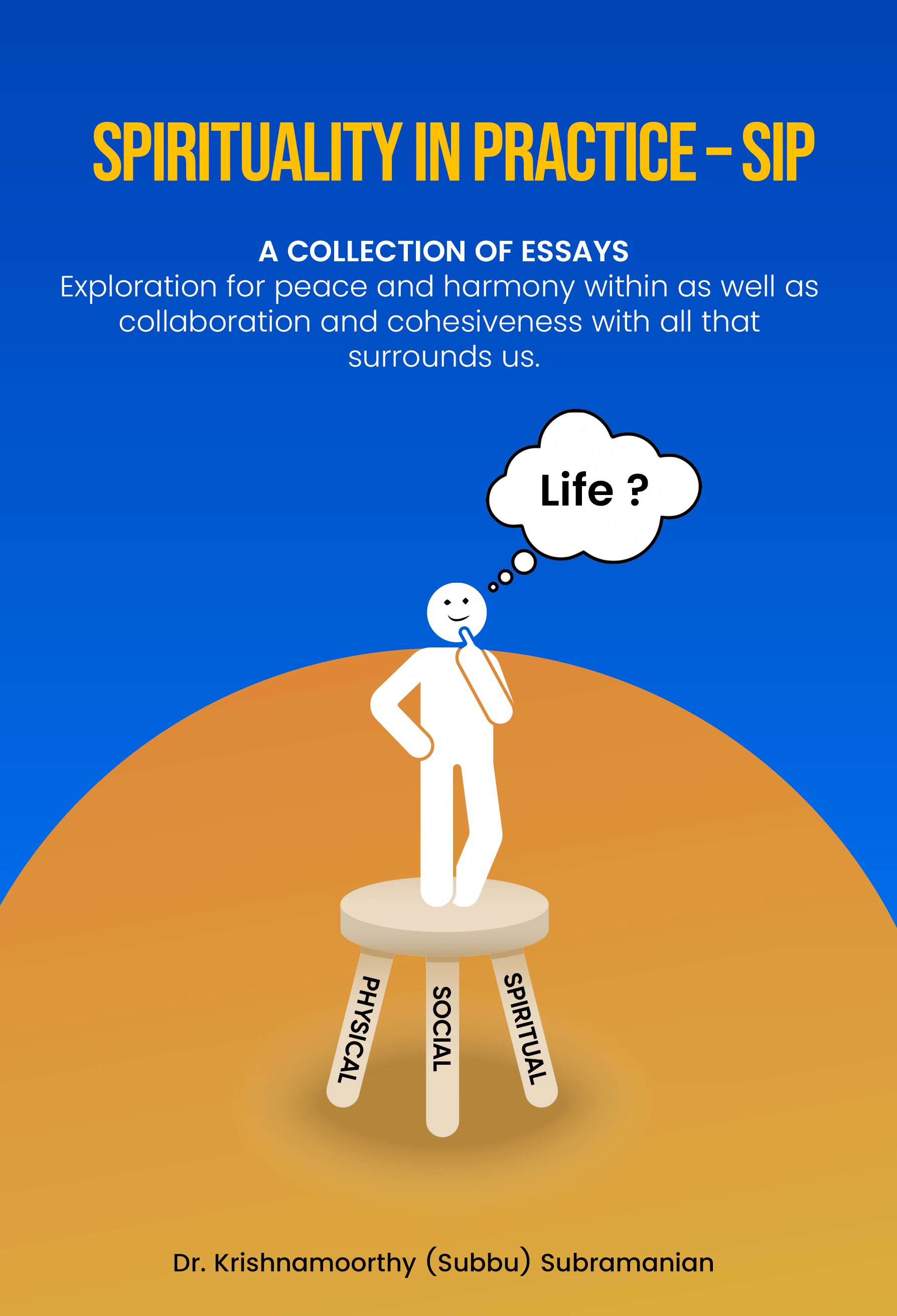
        In 2023, the current book published is for a holistic life that strengthens our EI through Spirituality in Practice (SiP). As the third pillar of life, SiP strengthens our Physical wellbeing as well as our Emotional wellbeing. In the age of Social media that are isolating people into species of depression, SiP is needed to find our humanity as an integral part of who we are – part of nature and not independent and different from nature! SiP is exactly that. The notion of “ego” (i.e.) being subjective arises when we think “I” is different from nature. We become more spiritual when we see “I” merely as an outcome of our Knowledge, Bias and Ignorance and their relative proportions. This objective outlook is further enhanced when we come to terms with the reality that whether we are subjective or objective are all mere evidences of laws on nature at work in infinite ways known and unknown to us. Hence you, me or anyone or anything is merely an evidence and a witness to the Laws of Nature. We are Spiritual always. Even the person who thinks he/she is not spiritual is able to think, thanks to the Laws of Nature, the driver (i.e) the spirit!

Above are not abstract thoughts for the theoretical or intellectual minded! We explore the laws of nature in anything, we call that “Science”. When we apply that knowledge we call it “Enginering”. Being prudent with our time and resources and focus on relevant questions to use our scientific knowledge and engineering prowess for the larger common good is management. All these efforts become productive and rewarding when our efforts are channeled through certain Transformational Skills embedded in Spirituality in Practice as a way of life. Imagine a society that operates with the above guidelines. Perhaps that is what we need to alleviate our current emotional or mental health crisis as well as challenges we face in politics, AI revolution, and conflicts across nations, religions, race and gender bias.

Now, we need a few good messengers to carry the above messages for their own good as well as for the good of those around us. How far this will spread, through whom and when – all are good questions for each of us to ponder upon as individuals for our own self-interest and collectively across all of us for our collective wellbeing and progress.