Three levels of System Thinking

In a recent blog post: http://blog.readytomanage.com/how-is-critical-thinking-different-from-analytical-or-lateral-thinking/  three kinds of “thinking” are described – Analytical, Lateral and Critical thinking. Following is our take on this subject:

In our view, every activity and/or solution is an INPUT/TRANSFORMATION/OUTPUT system.

TRANSFORMATION represents the Phenomena pertinent to the activity. Understanding the Transformation implicitly, explicitly or through inference/intuition is the “SCIENCE”. Application of the Transformation to obtain the desired change of the inputs to outputs is the “ENGINEERING” behind the activity or solution. Discerning the Output between the “What?” and “Why?” is the strategic thinking. Ensuring that the desired outputs are achieved by orderly integration – with respect to time, cost, resources and their efficient deployment – of the inputs to effect the transformation is the “Operational” aspect of the activity. Strategy and Operations are the two sides of anything we call as “MANAGEMENT”.

In this Systems thinking there are three levels, which relate to the three aspects described in in the blog post mentioned above

AWARENESS: analytical thinking mainly aims to review the data/information we are presented with (for relevance, patterns, trends etc.) — the ability to clarify the information on-hand and their assignment into the various aspects of the “System” as defined above. It also helps to identify the missing data or gaps and the questions to ask and in what order?

ANALYSIS: Lateral thinking aims to put data/information into a new or different context (in order to generate alternative answers or solutions) — answer the questions raised using the tools of Science, Engineering and Management in an interdisciplinary manner. Today such lateral thinking is part of higher education, but limited to the three disciplines, but mostly as impermeable silos!

SYNTHESIS: Critical thinking aims to make an overall or holistic judgment about the data/information which is as free from false premises or bias as much as possible — ability to answer the question ” 2 + 2 = ?” with an answer, “Why is this question raised in the first place” ? Then find answers which might lead to “2+2 = 3, 4, 5 or Fruit Salad”. In the last case it will be the sum of two fruits (Apple and Orange) with two other fruits (Peach and Banana) together with some ice cream on the side making the whole the Fruit Salad! Hence CRITICAL THINKING can be thought of as third level of SYSTEM THINKING, where the whole is seen as larger (or smaller, if that is the output of the “System”) than the mere sum of the parts. It is an ability to see the picture or pattern, rather than the mere emphasis on the pixels! For more details on System Thinking and the three levels: https://stimsinstitute.com/20151207books/

Bringing the science to shopfloor manufacturing

Slide1

Traditionally grinding process is treated as something very complex and known only to a few with many years of experience and with specialised skills in the shop floor. A portable diagnostic tool and interpreting the process signal is changing the situation and helping to reduce such challenges faced in grinding.

It is like using a torch light in a dark ally. Once the light of the signal shines, we can see the path more clearly and easily,” states Dr Subramanian.

Further analysis of the signals and explaining the variations in terms of the microscopic interactions that occur in the grinding zone, brings the science of grinding to the shop floor,” according to Dr K (Subbu) Subramanian, President, STIMS Institute Inc, USA. He has been mentoring this work at IIT Madras and its subsequent transfer for industrial use. This work at IIT Madras has been carried out as part of a larger project, “Development of Next Generation High Precision Grinding Machine Tool,” funded by the Office of the Principal Scientific Adviser to the Government of India. Prof Ramesh Babu is the principal investigator of this project along with his students at IIT Madras. MGTL, an industrial partner in this project is commercializing this mobile diagnostic tool as Grind TrakTM.

In a recent example, a grinding process was the bottleneck operation, limiting the production of the entire line. By looking at the signals obtained and analyzing them, it was determined that the cycle time for this operation can be reduced resulting in a net increase in line throughput of 40%, without the need for any additional investments.

Next generation of manufacturing will require smart and well qualified people using portable diagnostic tools and techniques very much like the medical field. In this regard, the Grind TrakTM will serve as the stethoscope and thermometer for this new generation of grinding professionals”, asserts Dr Subramanian.

42 Technology Grinding Machines EM FEB 2016


Warning against AI and job loss: What can be done about that?

“Scientists warn AI means job losses in every profession” is the headline for an article in the Financial Times dated Feb. 15, 2016. This page 1 article is authored by Clive Cookson.  The copy of the article can be seen at the end of this post.

Following are a few quotes from this article: Intelligent machines would soon replace people in all sectors of the economy, computer scientists told a meeting of the American Association for Advancement of Science in Washington at the week end. ……….. “We are approaching the time when machines will be able to outperform humans at almost any task”, according to the computer science professor Moshe Vardi from Rice University, Texas. ”Society needs to confront this question before it is upon us …..”  Professor Selman from Cornell University has helped to draft an open letter last year from the Future of Life Institute, Cambridge, MA. to policy makers urging them to explore the risks associated with increasingly intelligent machines.

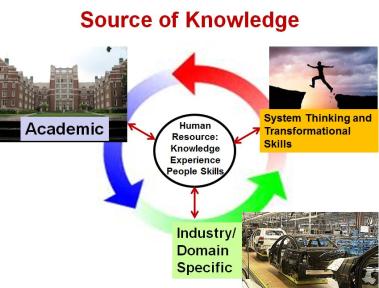
While the above caution and appeal for better public policies are valid and timely, it is perplexing to see that such caution is raised only against a future possibility imposed on us by self-driving cars, robotics and Artificial Intelligence. We believe that individuals and enterprises cannot sit and wait till some policies are debated and implemented to address the unabated role of DT (and its formulations such as AI and Robotics and driver-less cars, etc.) in eliminating human centered work. Individuals need to gain academic knowledge in combination with their applications know-how (called sector or domain specific knowledge), together with a set of skills for “System Thinking and Transformational Skills”.

Knowledge Integration

We call this collective know-how and its application as the Knowledge Integration. Such KI capability is the essential education at all levels. The practice of KI will be the competitive weapon for workers and their employers for the foreseeable future.

For education on System Thinking and Transformational skills and for projects to implement them for competitiveness in the global economy https://stimsinstitute.com/contact-us/

Our detailed views on this topic can be seen at: Warning against job loss

AI and employment