Recently I attended a coffee social organized by the MIT Alumni Club in the Bay Area. This is an informal monthly event where MIT Alum in the local area meet for an hour or two over a cup of coffee for chatting and getting to know each other. On this occasion, it was a small group of six or eight of us. Each introduced themselves with their name, department, year of graduation, etc. Then, one among us said sheepishly “I am not from MIT. I am different. I am from Yale!”. I jumped in quickly and said “Don’t feel shy or bashful. Being different is good. In fact being “different” is exactly what we need to survive and succeed today. Go ahead and celebrate your being different. Put it to good use and for your success in whatever you choose to do!”. Almost everyone seemed surprised, some even shocked! Below is the conversation that followed:
“You have to align with the mainstream, if you want to get selected for any job interview. The AI programs and algorithms are trained to look for certain keywords. If your resume does not reflect that, you are out of luck. Most hiring managers want to fill their slots who can plug and play. They are not looking for someone “different” or “unique”. Even V.C.s have algorithms to screen their opportunities to fund. They are looking for the tailor made requirements from entrepreneurs like a cookie cutter. They are not looking for some higher risk “different” opportunities”. Responses like that came in fast and furious!
“OK, I hear all that. But, is it always true?” I probed. “Not really!” came the answer. Most of the time the jobs to meet the routine needs of the company are filled by hiring managers with graduates from many colleges. They don’t really look for graduates from MIT or other Ivy league schools. In order to get attention one needs to show some unique learning and understanding of the needs of the hiring manager. “Ask the question: What aspect of the project or program that keeps the hiring manager away from sleeping at night? How can you bring a new or unique solution to resolve that? That is your unique opening at the job interview as well as in your job after getting hired.” The discussion continued. At one point someone said, “everyone is an individual, hence different. One makes a choice – consciously or otherwise – to be “different” all the time! When you sign up for education at the expensive ivy league schools, you have decided to be “different”!”. Do these schools spend enough time to train their students to think “different” and “how”? It was also mentioned that narrow, specialized and highly tailored education from these schools may be good to stand out in the beginning, but it creates an impediment as the skill set needed changes rapidly. One needs to train oneself to be different all the time!
“I have experienced this problem recently”, one person said. Everyone in the hiring team seemed happy with my broad background. But one person in the recruiting team said “you do not seem to have enough depth or specialized knowledge”. How is it possible to have both the depth needed for this one person and the breadth required by the rest of the recruiting team? This is the new paradigm, being different, having both the breadth as well as the depth. You sell your breadth or depth depending on the situation. In reality one deploys the “depth” or the “breadth” in skills as the situation warrants to resolve the problem or foster a new solution. It can be described as “T”, where the vertical line reflects the technical depth in a subject area, while the horizontal line reflects the hands-on experience as well as the ability to get results working with others.
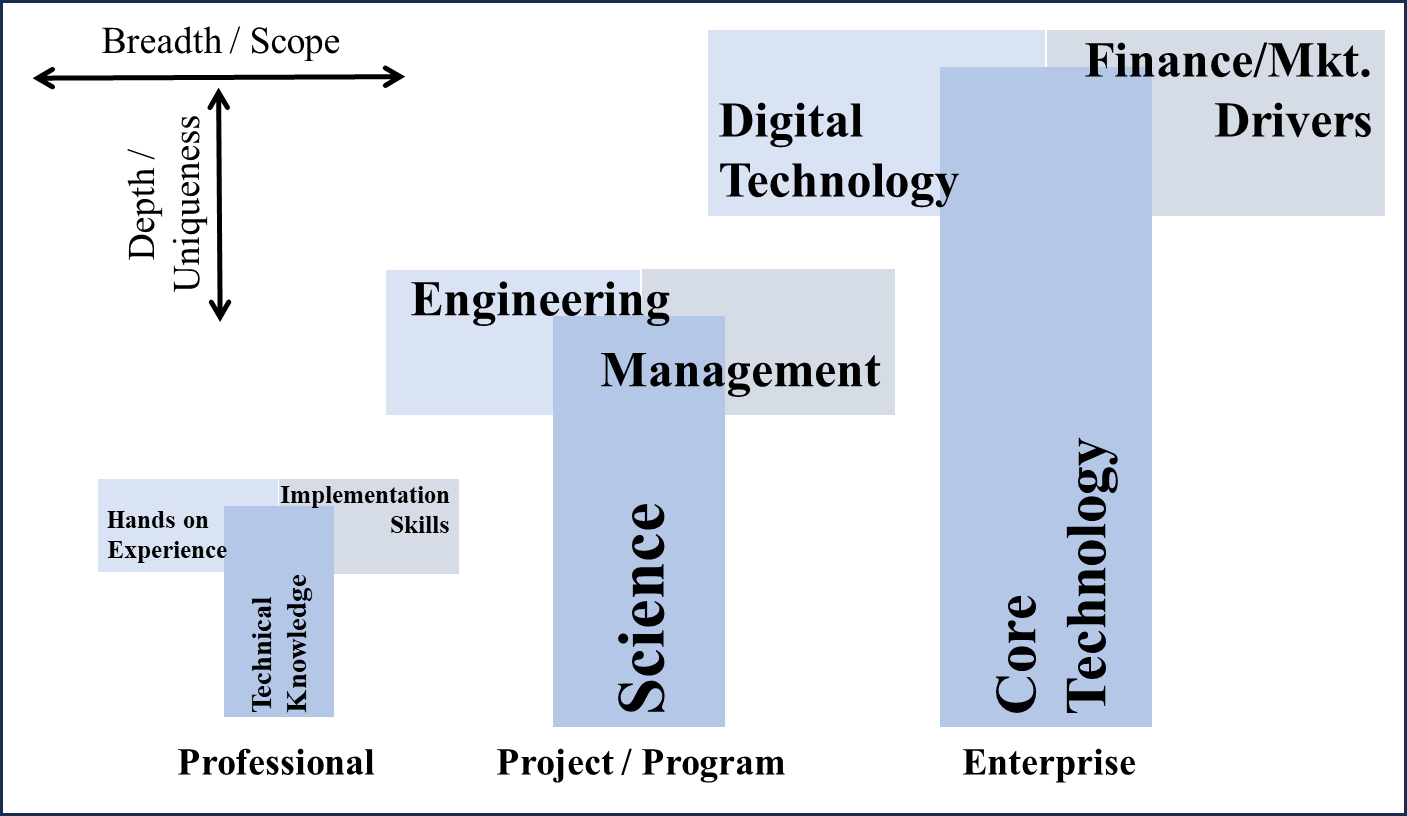
Source: Figure 6.1, Page 120, “Thriving in the 21st Century Economy – Transformational Skills for Technical Professionals”, Author: Dr. Krishnamoorthy (Subbu) Subramanian, ASME Press. (2013).
 STIMS Institute