

New ASME Press Book Examines Transformational Skills for Tech Professionals
Thriving in the 21st Century Economy: Transformational Skills for Technical Professionals is available in a paper back print edition or as an e-book, each priced at $44 for members, and $59 for non-members. The book can be purchased through ASME.org, at http://www.asme.org/shop/books, or by contacting ASME Customer Care at (800) 843-2763 or (973) 882-1170. For more information, contact Mary Grace Stefanchick, ASME Press, at (212) 591-7962 or by e-mail at stefanchikm@asme.org
https://www.asme.org/products/books/thriving-21st-century-economy-transformational
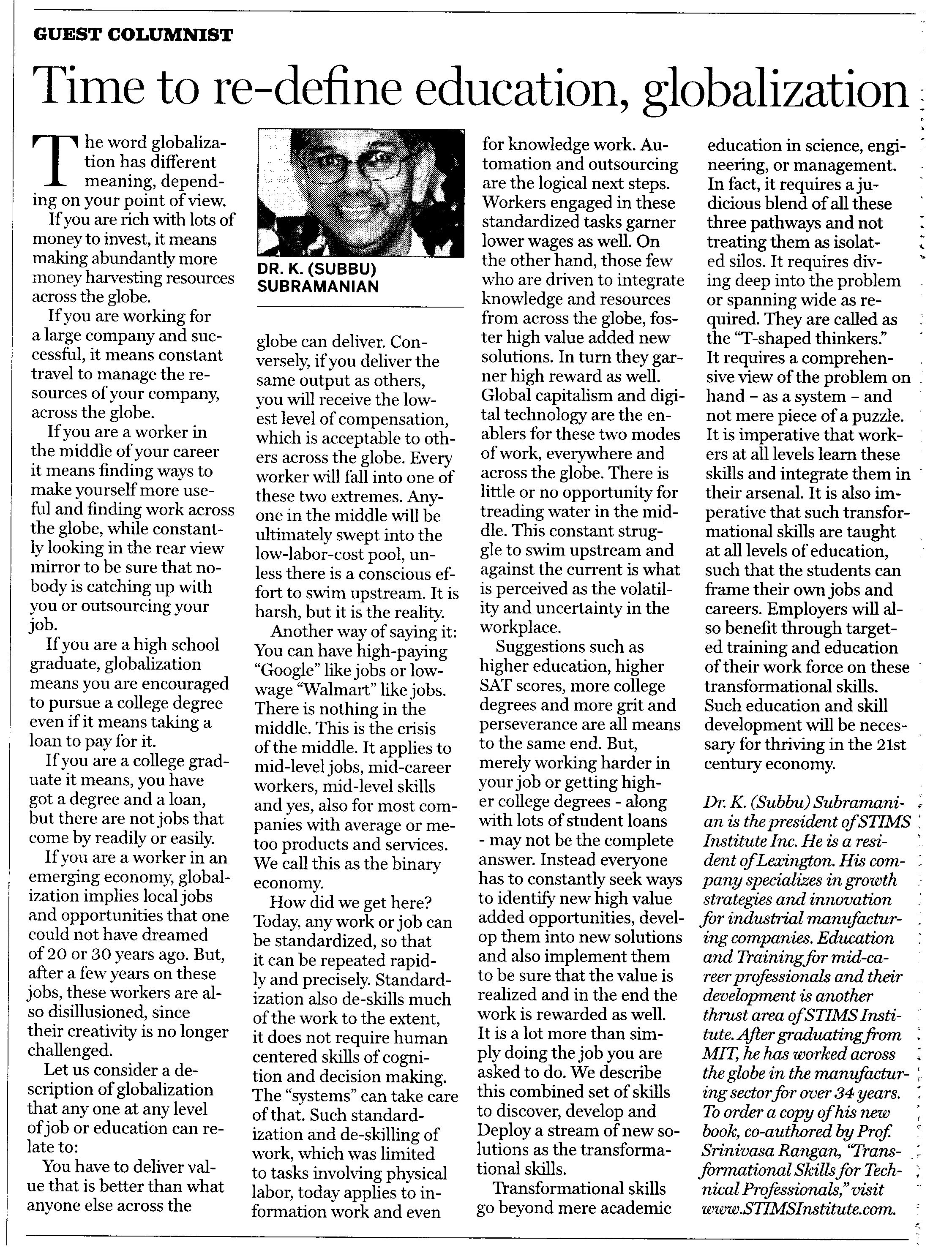
It is an undeniable axiom of globalization: anyone in any job or profession has to be better than anyone else who can do the same job from a pool of workers across the globe. Conversely, those who can do a job in a similar manner to others around the globe will be rewarded for their effort at the lowest value at which the work can be procured from anyone else across the globe! Every worker will fall into one of these two extremes. Anyone in the middle will be ultimately swept to the low-labor-cost pool.
While there will be a natural tendency to be swept into the lower-wage pool, it will require a special effort to swim against the current to be associated with the limited few in the high-wage, high-reward pool. Swim against the stream and reach a high place (of New Solutions with identifiable impact) or be swept away into the global pool of low-cost resources (needed for Replication Solutions) is the true paradigm of globalization. There is little or no opportunity for treading water in this paradigm. This constant struggle to swim upstream and against the current is what is perceived as the volatility and uncertainty in the workplace. Suggestions such as higher education, higher SAT scores, and more grit and perseverance are all means to the same end. But as we have detailed in our book – see the links below – all of these have to be formatted toward identification, development, and exploitation of New Solutions using Transformational Skills as the means to this end.
http://ebooks.asmedigitalcollection.asme.org/book.aspx?bookid=657

Recently I wrote to Senator Elizabeth Warren, thanking her for her efforts to keep the student loan interest rates as low as possible. It is a very important effort and we hope the senator will succeed.
But, I need to call to attention to an equally if not more serious issue (i.e.) the kids who borrow money and go to college, do not have enough jobs when they get off school. This is not just a matter of bad economy. It is a serious evolution happening world wide. We call this as the Binary Economy as outlined in my recent book. Please see the materials attached.
THRIVING IN THE 21ST CENTURY ECONOMY.FA_Subbu&Srini_Foreward plu Intro.
What we need are initiatives to create new STEM jobs and in large numbers. While this happens, the students should be smart to create their own jobs as outlined in our book, through Transformational Skills.
Industry will create such STEM jobs only when they need them and they can create most of what they need outside of USA (at lower cost). What we need are initiatives to create new STEM jobs, inside the USA, simply because they are needed to employ all our kids who graduate from colleges. We need Wind, Solar and PV and other jobs not because they will be economical some day – which is for the industry to start out – but simply because we need STEM educated kids to go to a job, have decent living and and pay off their student loans. Same goes for oil and natural gas jobs, High Speed Trains, Improved Infrastructure, Space Exploration, Medical Research, etc.
Government can not and should not choose the side among companies or industries. But, Government MUST choose side with educated kids and their long term living standards, since they are the future of the nation.
So, while the senators and congress fight for keeping the loan interest at low level, they are also required to fight for STEM jobs, so that the educated kids pay off the very same loans. Otherwise it is better to let them not borrow so much money, since they will only find low wage jobs with which they will be burdened with their loans for their life time.
Please don’t get me wrong. I want low interest student loans for education. But, we will be doing disservice to these kids showing them a rosy path, if we don’t create the necessary jobs available at the end of the tunnel.
Until that day comes, it will be smarter for the students to learn the Transformational Skills and for the parents help them with such education, to chart their own path for jobs and careers and avoid the pitfall of large student loans for an education that does not and will not get them decent jobs.
Thriving in the 21st Century Economy:
Transformational Skills for Technical Professionals
By
Dr. K. Subramanian and Prof. U. Srinivasa Rangan
 Thriving in the 21st Century Economy: Transformational Skills for Technical Professionals, co-authored by Dr K. Subramanian, President, STIMS Institute Inc., USA and Professor U. Srinivasa Rangan, Luksic Chair Professor of Global Studies, at Babson College has been published by the ASME Press. Copies of this book can be accessed at any of the following links:
http://www.amazon.com/Thriving-Century-Transformational-Technical-Professionals/dp/0791860167/ref=sr_1_1?s=books&ie=UTF8&qid=1371673516&sr=1-1&keywords=Transformational+Skills+Subramanian
https://www.asme.org/products/books/thriving-21st-century-economy-transformational
Below is the link for the image of the cover of the book along with reviewer’s comments:
The following is a short summary of the book:
Technical professionals, represented by the short hand STEM (Science, Technology, Engineering, and Mathematics), face a crisis, especially in the United States. Fewer American students are interested in pursuing these disciplines in college. Even many professionals currently working in these areas discourage their children from following them into their profession, since they see few attractive and financially rewarding jobs and careers when compared to the IT or financial sector. As research budgets shrink in the public and private sectors, many professionals feel that their contributions are not valued. Some blame the outsourcing fad for this and some others believe that foreign professionals are taking their jobs. Amidst all this, senior managers in major industrial and technology firms expect technical professionals to manage their own careers rather than help the professionals to develop their abilities for such career management.
Drs. Subbu Subramanian and Srinivasa Rangan address these concerns through three critical and related questions:
1. What is the nature of the challenge facing STEM professionals in the twenty-first century global economy?
2. What are the reasons for it?
3. How should STEM professionals manage their careers in the future if they want to lead a professionally fulfilling and productive life?
At the outset, Subramanian and Rangan assert that, since the 1980s, the workplace in most industrial companies has been undergoing a rapid transformation largely due to two factors: globalization and business model revolution. Globalization is described as the outcome of Global Capitalism combined with evolutions in Digital Technology. The business model revolution is seen as the result of disaggregation of the value chain and its disbursement across the world. These new business models require a new type of professional skillset. The result of these two trends are pushing more firms to rely on a small cadre of high quality professionals to be problem solvers or solution providers and a much larger group of professionals (even with lower levels of technical skills as required), to be replicators of those solutions across the globe. As more firms across the world adopt this new model of workforce deployment, a binary labor force is emerging. The first part, consisting of leading technology professionals, specializes in creating and implementing new solutions. This is enhanced through the use of DT solutions, which aggregates information from across the globe. The other part of the labor force, required for lower skilled jobs, is finding their functions further de-skilled and de-localized because of DT driven automation and off-shoring. There appears to be no middle ground, which in the past employed a large number of technical professionals. All STEM professionals now face the challenge of adapting to this binary economy that is becoming the hallmark of the twenty-first century.
STEM professionals are experiencing angst because of their transition to new roles in this binary economy. Many who have invested years getting trained at advanced levels and acquiring specialized skills suddenly feel unable to create new solutions that are considered valuable.
Subramanian and Rangan argue that STEM professionals need to become exceptional and relentless solution providers. They must be able to identify new opportunities, convert such opportunities into complete and integrated solutions, and maximize the benefits from these solutions. These skills are not purely technical or managerial. Instead they are a combination of skills pertaining to Science, Engineering and Management. These Transformational Skills are:
• Identify a problem or opportunity and frame it as a “need”:
• Develop a Common Language
• Three Dimensional view of Core Capabilities and their deployment:
— As an individual
— As part or member of a team
— As part of the company or enterprise
— As part of the industry/community
• Develop the need into a “Solution”:
• Integrate Knowledge from all available sources (across the globe)
• Place emphasis on “Science”; Relentlessly use Portable Diagnostic Tools and methods, Analysis
techniques and Analytics
• “System Thinking”: Focus on the big picture and not merely on the pixels;
• Deploy the Science/Engineering/Management pertinent to the “solution” simultaneously (The
System Approach); Emphasize on mobile/portable diagnostic tools.
• Synthesize: Connect the dots leading to the “Solution”; Emphasis on Core Technology driven
ecosystems.
• Exploit the “Solution” and maximize the benefits:
• Focus on “End to End Innovation” = Idea X Use X Impact
Measure innovation in a scale of 1 to 125 (= 5X5X5 and not 1 to 5 scale in isolated silos). “Branding” as an outcome of End to End innovation
• “Emotional Intelligence”:
Find ways to be useful to others, which in turn benefits you.
Co-create value; I open the door for you, and you let me in as well.
Focus on end user (Customer) benefits as the primary goal and driver for innovation and entrepreneurships.
The authors then describe the roles of individual professionals, organizations, management, the Government and the educators. Each player is called upon to understand these Transformational Skills and integrate them into education as part of a Life Long Learning strategy. The authors conclude that this education is the only reliable pathway enabling technical professionals to thrive in the 21st Century economy.
 STIMS Institute