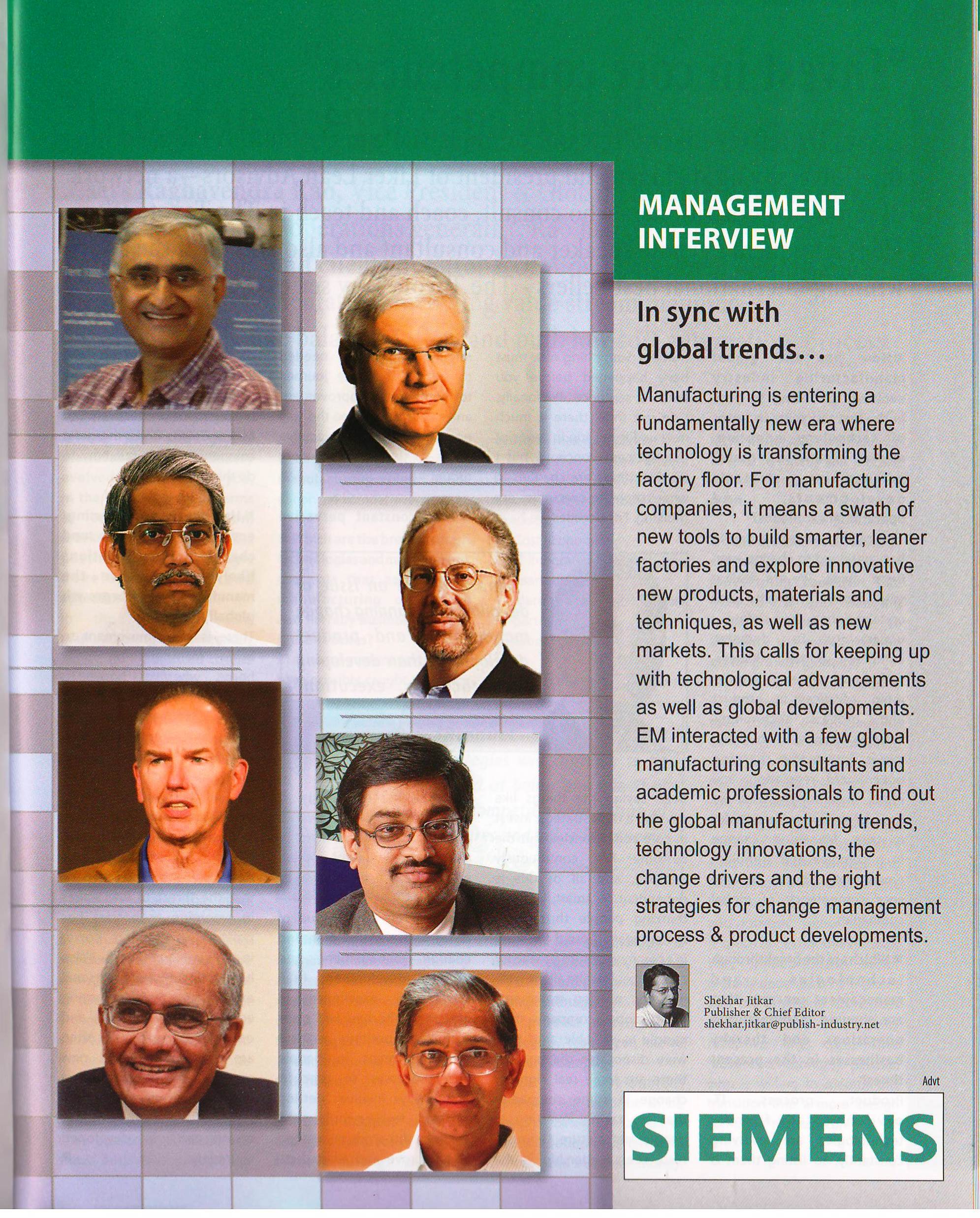
Shekat Jitkar, Publisher and chief Editor of Efficient Manufacturing magazine interviewed eight global experts on trends in manufacturing.
The interview is published in their Kompendium 2014. Following is a summary :
| Dr Wilfried AulburManaging Partner for Roland Berger Strategy Consultants Pvt Ltd. | Establish the right capabilities and Culture.* Shift to Asia: China is the #1 machine building country worldwide and performance and quality requirements in Asia are getting closer to European levels.
* Game change in the mid-end: The mid-end performance segment is growing the fastest and this is the new global battlefield for emerging and developed market players. * Go Green: Energy efficiency is increasingly important in key markets such as Europe and Japan. Substantial energy savings can be achieved for selected applications, while for others it is mostly a marketing issue |
| Dr K (Subbu) SubramanianPresident, STIMS Institute Inc, USA. | System Thinking and Transformational Skills required.* Data, analysis and process intelligence aided by Big Data and analytics
* Sensors and Smart devices everywhere; Innovation in manufacturing processes; Programmable automation (the generic name for CNC, robots, flying robots, AGV and drones); * Products and their manufacturing to increase the quality of life at all levels? * No more learning curve (price -vs- volume is a flat line and not a curve)? * If low labor cost only means low skilled labor for physical labour tasks or well defined information tasks, then such low cost labour is no longer a competitive advantage? * Product (Source of revenue), Physical Processes (that enable the products) and USE (Application process of the customer) are the only three unique core capabilities of any manufacturing company. |
| Michael BremerPresident, Cumberland Group – Chicago;
VP of Manufacturing Excellence Awards process for the Association for Manufacturing Excellence (AME) |
Eliminate Waste, but create new Value.* People, people, people! — Ability to find and develop talent. People will be attracted to organizations that treat them with respect and develop their skills and capabilities. Elite organizations create an environment where associates are encouraged to give that little bit of extra effort = passion and engagement
* Rapid prototyping (faster lead times) * Use of sensors to track manufactured product, provide feedback for early maintenance, and develop closer relationships with customers * Safety of intellectual property and cyber security – ability to more easily identify fake products * Ability to more deeply understand customer requirements and total cost of the supply chain * More collaborative practices across the supply chain where companies partner together to pursue joint growth opportunities. |
| Dr P N RaoProfessor, Department of Technology, University of Northern Iowa, USA. | Utilize the Opportunities available.* Developments in robotics
* Digital Everywhere: Information thread that integrates design, planning, manufacturing and product support through all stages will greatly improve the possibility to achieve first pass success. This will combine innovative automation, various sensors and control systems, communications across all segments, including the global supply chain. This would mean advanced manufacturing enterprises, intelligent machines, advanced analysis techniques, and cyber security systems in view of the information exchange across the internet with globalization. * Additive manufacturing (3D printing) * Integrated systems that will have sensors to monitor the manufacturing process continuously and then adapt the process to achieve the best possible performance by a combination of software and hardware tools. * Sustainable manufacturing that deals with product design for sustainability, sustainable manufacturing processes, and sustainable manufacturing systems, while also trying to maximize resource efficiency |
| Sanjeev BaitmangalkarPrincipal Consultant (Strategy & Lean Manufacturing), Stratmann Consulting. | Go Lean …..* The growing number of embedded sensors, collecting information about the world, and the rise of social networks that store the data people share, will generate immense quantities of information.
* Many businesses of the future will use analytics to mass customize and differentiate themselves. * Business intelligence, which enables organizations to gather quantifiable data on each area of the organization and analyses it in a way that yields information they can act on — helping them enhance decision making, improve performance, mitigate risk and sometimes even create new business models — is growing in importance. * Small, comfortable, low cost, fuel efficient cars will drive product development. |
| Suresh Lulla
Founder and MD, Qimpro Consultants Pvt. Ltd. |
Quality will not be negotiable.
* Leadership, Strategy and Customer focus* Work force and its quality; cycle time reduction; double the profit without capital through better quality practices; left brain for quality improvement and right brain for process innovation; cross-country bench markeing. * Low labor cost in developing nations is not sustainable; * Three bottom lines: Planet, people and profit! * Three core capabilities needed: Understand customer needs; ability to translate that into product design and ability to outsource where required! |
| Raghavendra Rao V.P. & Global Mfg. Leader, Frost & Sullivan | Invest in design capability.* Rapid prototyping, 3 D printing, real time data and analysis
* Manufacturing “hub” for toll manufacturing to “Design to manufacturing” alliance between partners across developed and emerging economies. * Cost/ economics; IT Integrated Mfg.; Lean supply chain; Mature, eithical and stable partners; Green manufacturing. |
| Dr. Jeffrey Liker Prof. of Ind. And Opertions Engineering, U. of Michigan, President, Liker Lean Advisors | Invest in core competencies.* Excellence in Execution
*Serious focus on investing in people and culture * Culture that is humble and open to new knowledge and new sources of learning may have a competitive advantage in the future. |

 STIMS Institute