DR. K. SUBRAMANIAN APPOINTED TO MASSMEP BOARD OF DIRECTORS

High res image available at:
http://www.telesian.com/marketing/vpr/massmac/mac132806-01.cfm

MassMEP

FOR IMMEDIATE RELEASE
JUNE 28, 2013

For More Information Contact:
– Kathie Mahoney, kathiem@massmep.org
– Shari Worthington, sharilee@telesian.com

DR. K. SUBRAMANIAN APPOINTED TO MASSMEP BOARD OF DIRECTORS

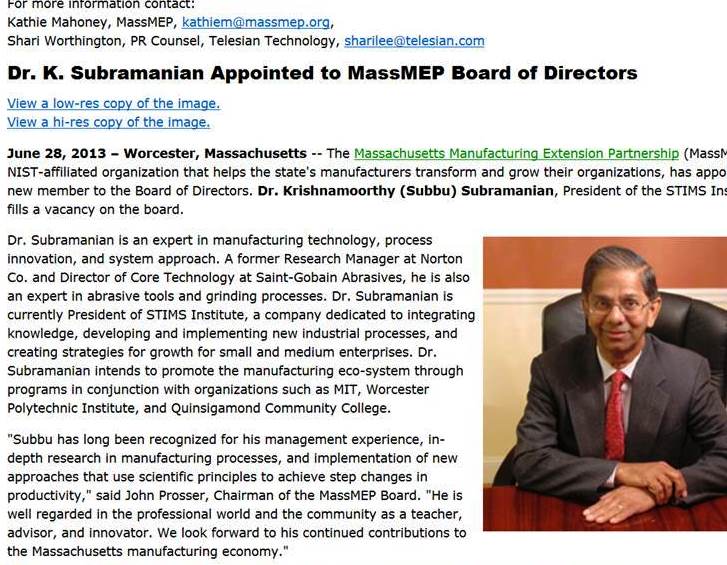
Worcester, Massachusetts – The Massachusetts Manufacturing Extension Partnership <http://www.massmep.org> (MassMEP), a NIST-affiliated organization that helps the state’s manufacturers transform and grow their companies, has appointed a new member to the Board of Directors. Dr.Krishnamoorthy (Subbu) Subramanian, President of the STIMS Institute, fills a vacancy on the board.

Dr. Subramanian is an expert in manufacturing technology, process innovation, and system approach. A former Research Manager at Norton Co. and Director of Core Technology at Saint-Gobain Abrasives, he is also an expert in abrasive tools and grinding processes. Dr. Subramanian is currently the  President of STIMS Institute, a company dedicated to integrating knowledge, developing and implementing new industrial processes, and creating strategies for growth for small and medium enterprises. Dr. Subramanian intends to promote the manufacturing eco-system through programs in conjunction with organizations such as MIT, Worcester Polytechnic Institute, and Quinsigamond Community College.

“Subbu has long been recognized for his management experience, in-depth research in manufacturing processes, and implementation of new approaches that use scientific principles to achieve step changes in productivity,” said John Prosser, Chairman of the MassMEP Board. “He is well regarded in the professional world and the community as a teacher, advisor, and innovator. We look forward to his continued contributions to the Massachusetts manufacturing economy.”

“My career has been dedicated to improving manufacturing processes through the consistent application of knowledge, innovation, and technology – a perfect fit with the goals and programs provided by MassMEP,” stated Dr. Subramanian. “I am pleased to be working closely with the organization to affect change across the state for those manufacturers looking for sustained, long term growth.”

Dr. Subramanian holds more than a dozen patents and many awards, including an IR-100 Award for the invention and commercialization of a new family of ceramic cutting tools while at Ford Motor Co. A Fellow of the ASME and the SME, Dr. Subramanian is an invited keynote speaker at conferences around the world, including India, Brazil, China, Japan, and the USA. He is the author of two books: The System Approach: A Strategy to Survive and Succeed in the Global Economy and Thriving in the 21st Century Economy: Transformational Skills for Technical Professionals.

About MassMEP

Massachusetts Manufacturing Extension Partnership provides services that help manufacturers transform and grow their organizations. From workforce strategies to lean training to supply chain management, MassMEP delivers positive, measurable, and sustainable impact on a company’s top and bottom ines. Key programs include Innovation for Growth, Workforce Strategies, Systemic Continuous Improvement, and Value Opportunity Profile. For more information, visit http://www.massmep.org

###

For more information, contact:
Kathie Mahoney
MassMEP
100 Grove Street
Worcester, MA 01605
Tel: 508-831-7020
E-mail: kathiem@massmep.org
Web: http://www.massmep.org

PR Office:
Shari Worthington
Telesian Technology Inc.
49 Midgley Lane
Worcester, MA 01604
Tel: 508-755-5242
E-mail: sharilee@telesian.com

Massachusetts Manufacturing Extension Partnership does not discriminate on the basis of race, color, creed, national or ethnic origin, gender, disability, age, political affiliation or belief. This nondiscrimination policy encompasses the operation of all educational and training programs and activities. It also encompasses the employment of personnel and contracting for goods and services.

New ASME Press Book Provides Career Advice for Technical Professionals

ASME News article 07 22 13

New ASME Press Book Examines Transformational Skills for Tech Professionals
Thriving in the 21st Century Economy: Transformational Skills for Technical Professionals is available in a paper back print edition or as an e-book, each priced at $44 for members, and $59 for non-members. The book can be purchased through ASME.org, at http://www.asme.org/shop/books, or by contacting ASME Customer Care at (800) 843-2763 or (973) 882-1170. For more information, contact Mary Grace Stefanchick, ASME Press, at (212) 591-7962 or by e-mail at stefanchikm@asme.org

Learn to swim against the tide of Binary Economy

http://www.barnesandnoble.com/w/thriving-in-the-21st-century-economy-k-subramanian/1115191210?ean=9780791860168

https://www.asme.org/products/books/thriving-21st-century-economy-transformational

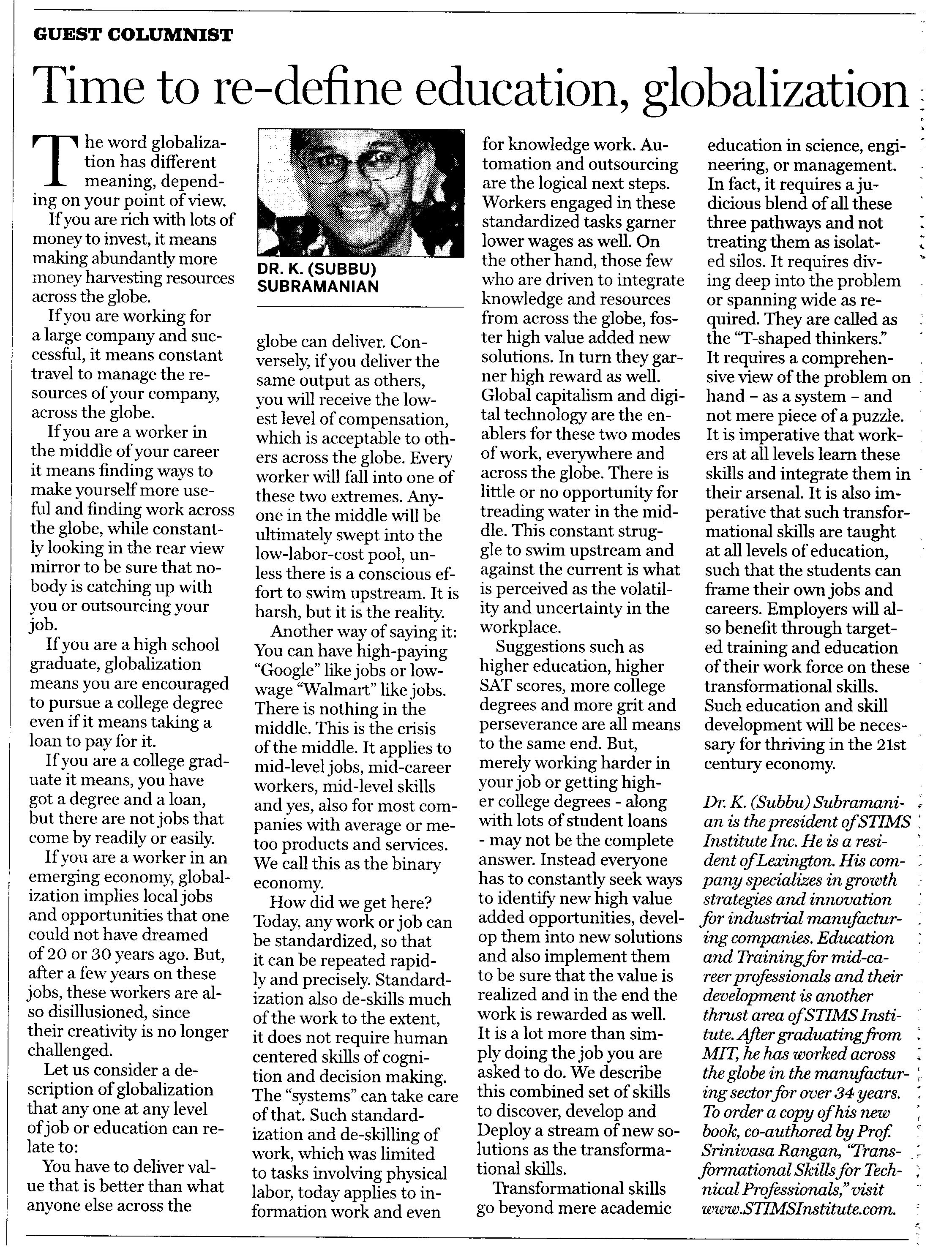
It is an undeniable axiom of globalization: anyone in any job or profession has to be better than anyone else who can do the same job from a pool of workers across the globe. Conversely, those who can do a job in a similar manner to others around the globe will be rewarded for their effort at the lowest value at which the work can be procured from anyone else across the globe! Every worker will fall into one of these two extremes. Anyone in the middle will be ultimately swept to the low-labor-cost pool.
While there will be a natural tendency to be swept into the lower-wage pool, it will require a special effort to swim against the current to be associated with the limited few in the high-wage, high-reward pool. Swim against the stream and reach a high place (of New Solutions with identifiable impact) or be swept away into the global pool of low-cost resources (needed for Replication Solutions) is the true paradigm of globalization. There is little or no opportunity for treading water in this paradigm. This constant struggle to swim upstream and against the current is what is perceived as the volatility and uncertainty in the workplace. Suggestions such as higher education, higher SAT scores, and more grit and perseverance are all means to the same end. But as we have detailed in our book – see the links below – all of these have to be formatted toward identification, development, and exploitation of New Solutions using Transformational Skills as the means to this end.

http://ebooks.asmedigitalcollection.asme.org/book.aspx?bookid=657

Low Interest Student Loans – Is that enough?

Slide1

Recently I wrote to Senator Elizabeth Warren, thanking her for her efforts to keep the student loan interest rates as low as possible. It is a very important effort and we hope the senator will succeed.

But, I need to call to attention to an equally if not more serious issue (i.e.) the kids who borrow money and go to college, do not have enough jobs when they get off school. This is not just a matter of bad economy. It is a serious evolution happening world wide. We call this as the Binary Economy as outlined in my recent book. Please see the materials attached.
THRIVING IN THE 21ST CENTURY ECONOMY.FA_Subbu&Srini_Foreward plu Intro.

Book Flier 07 10 13

What we need are initiatives to create new STEM jobs and in large numbers. While this happens, the students should be smart to create their own jobs as outlined in our book, through Transformational Skills.

Industry will create such STEM jobs only when they need them and they can create most of what they need outside of USA (at lower cost). What we need are initiatives to create new STEM jobs, inside the USA, simply because they are needed to employ all our kids who graduate from colleges. We need Wind, Solar and PV and other jobs not because they will be economical some day – which is for the industry to start out – but simply because we need STEM educated kids to go to a job, have decent living and and pay off their student loans. Same goes for oil and natural gas jobs, High Speed Trains, Improved Infrastructure, Space Exploration, Medical Research, etc.

Government can not and should not choose the side among companies or industries. But, Government MUST choose side with educated kids and their long term living standards, since they are the future of the nation.

So, while the senators and congress fight for keeping the loan interest at low level, they are also required to fight for STEM jobs, so that the educated kids pay off the very same loans. Otherwise it is better to let them not borrow so much money, since they will only find low wage jobs with which they will be burdened with their loans for their life time.

Please don’t get me wrong. I want low interest student loans for education. But, we will be doing disservice to these kids showing them a rosy path, if we don’t create the necessary jobs available at the end of the tunnel.

Until that day comes, it will be smarter for the students to learn the Transformational Skills and for the parents help them with such education, to chart their own path for jobs and careers and avoid the pitfall of large student loans for an education that does not and will not get them decent jobs.

What do you need to create good jobs? The answer is not “more of the same” education

Different educationIn a recent article, with the by-line, “What happens when good jobs disappear? It’s a question that has been asked for centuries”, Dr. Paul Krugman states, “Today, a much darker picture of the effects of technology on the labor is emerging. In this picture, highly educated workers are as likely as less educated workers to find themselves displaced and devalued, and pushing for more education may create as many problems as it solves”.  “Sympathy for Luddites”, Paul Krugman, The Global Edition of New York Times, Page 9, Saturday-Sunday, June 15-16, 2013,

In this description Dr. Krugman uses the commonly used version of “technology” (i.e) Digital Technology. The real world of technology is far larger than mere limitations and constraints of DT. The industrial society has to come to the realization that Technology in its broader context is an integration of Science, Engineering and Management of any phenomena of nature. This broader view of technology opens limitless possibilities for the educated work force. Absent such Transformation in their learning and thought process the broader range of educated work force – and their educators  and the society at large – will not be served well by the constant evolutions in DT. This is not to suggest that DT is a detriment. Instead it has to be used wisely and prudently with technology pertaining to other fields to create a stream of new solutions.

We agree with Dr. Krugman in that the opportunities even for the highly educated is limited to a narrow set of jobs, where knowledge is integrated from everywhere across the globe (using DT as an enabler for such integration) and hence create a constant stream of “New” solutions. There will also be a large range of low wage jobs, where the skills of educated work force is not much needed, thanks to standardization and de-skilling of the work and as a result automation and outsourcing of the jobs. Most others – in the middle – will find uncertainty and loss of economic competitiveness as the norm, which we have come to accept as the crisis of the middle class. For details on this emerging Binary Economy and the Transformational Skills to cope with that please see:

https://stimsinstitute.com/2013/06/19/new-book-authored-by-dr-subramanian-and-prof-rangan-has-been-published-by-asme-press/