Spirituality in Practice (SiP) — Putting to the test

Recently I read the following excerpt in a NYT column titled “The Thrill of the Office Crush” by Roxane Gay  https://www.nytimes.com/2023/04/16/business/roxane-gay-work-advice-office-crush.html 
I was honored to speak at an event in a professional capacity. …………. but I completely bombed. I spoke way too fast and stumbled over words. I kept seeing weird looks on the audience’s faces, which made it worse…………
I redeemed myself on the panel — I spoke clearly and the audience responded well to my commentary.
I am mortified and am not sure if I should say something to my peers or the woman who invited me, who I fear is in trouble with the head of her organization who was in attendance. Should I apologize? Say something to my fellow panelists when I see them again? And I know this is not a therapy column but any advice on getting over a professional embarrassment? I feel like a complete failure.
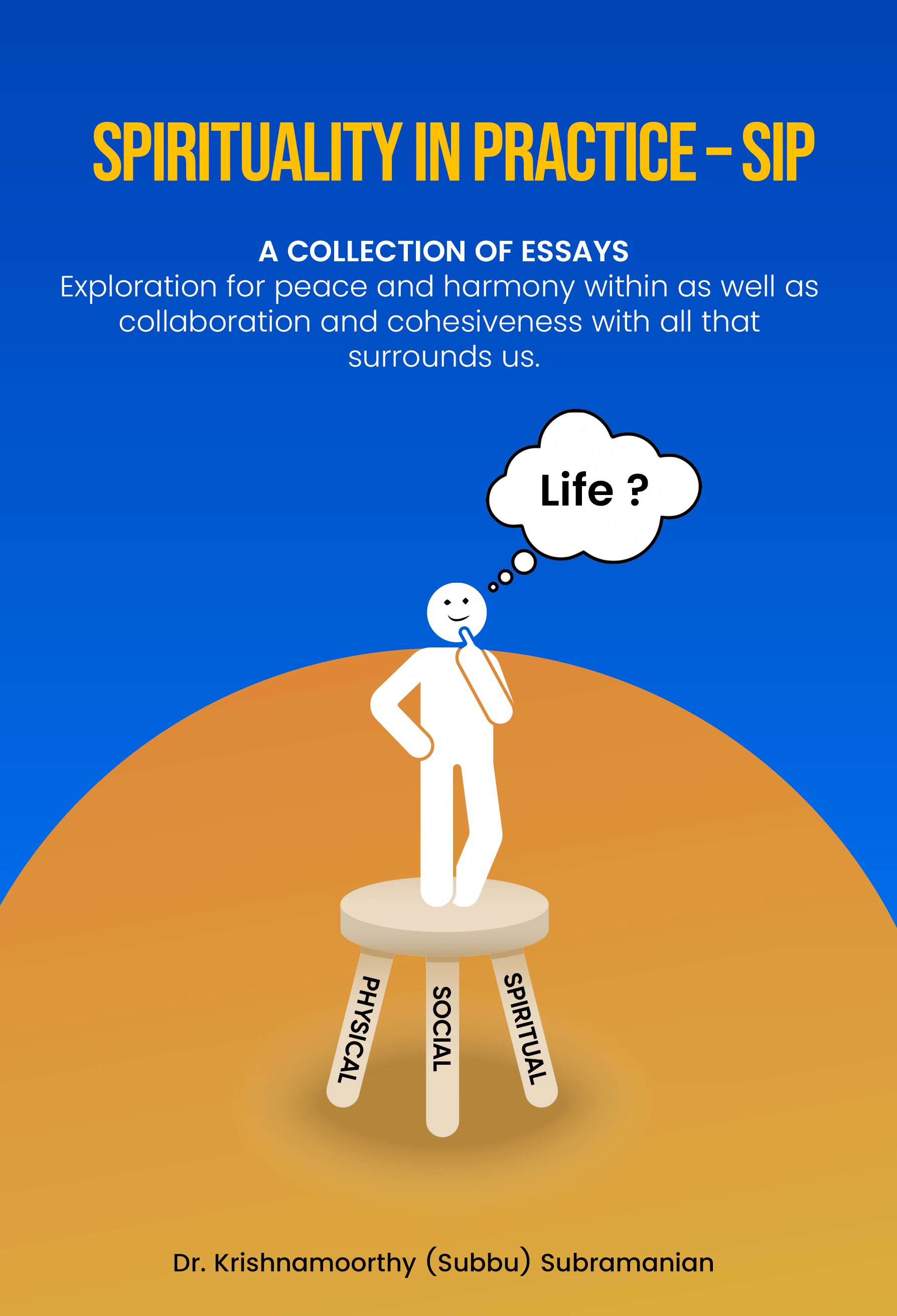
You can read the advice from Roxane in her column. Here we will explore this “experience” from the perspective of “Connector-Science” elaborated in our book: Spirituality In Practice https://www.amazon.com/dp/B0BV49NPNQ 

If the panelist were to distance from the event and experience – as I am able to as an unattached reader –  the above message can be decomposed into several components, each having their own context and the connectors:

ActivityDominant Connector
Recollecting what happened: Participation as a panelist which started badly (“bombed”) got better with time (spoke clearly and the audience responded well to my commentary) KNOWLEDGE Comprehensive self reflection of both the good and bad with equal consideration? 
Dwelling on the past (I am mortified) BIASEmotional attachment to the possible outcome.Is this a self-imposed constraint?To reflect and engage in corrective action is objective and “Professional”. But, feeling “mortified” occurs when our knowledge of the professional opportunity given and the ability to course correct in the middle of a panel session are overlooked thanks to our desire (needs and wants) to look good all the time.
Dwelling on the future (I feel like a complete failure).Professional embarrassment!IgnoranceConclusion and emotional burden, lacking objectivity or professionalism.Is this also a self-imposed constraint? There will always be success and failure, like the crest and depth of a wave. But, they are part of life. To judge the bottom of the wave as the “permanent” – total failure – would be ignorance on one’s part?

While all of the above are coexisting,  the prevailing “mood” or “experience” is a reflection of the dominant connector in each case.
Present activity: Should I say something?
The panelist (or the reader) could fill the table below through some Self-reflection.
Connectors
ContextKnowledgeBiasIgnorance
Person (s) involvedSelf, Peers, the inviter, her boss, future audience, …..?
Means / ToolsHow? “Explanation”? “Thank you”? “Apology”? Expression of genuine self-reflection”?
CircumstancesUnder what situations?
Laws of NatureCommunication Skills

This process – Science of Connectors – is the same irrespective of activity in any aspect of life!

But, there is a second and more important phase to the SiP. In the above we have attempted to analyze the various parts of the experience of this professional. Now, for a moment think about it: This professional is concerned about “I” and all that related to him/her! On the other hand, this professional is not thinking of all that enabled him to be in the panel, participate and contribute such as “Why was the panel session organized, what was the impact of the overall event for the audience? what were the take-aways for the organizers? benefits for the fellow panelists? …………” If this professional can look at the event in such a larger context, his/her “Objectivity” is further enhanced. Such thinking and reflection on the “Stake holder benefits”, may also lead to opportunities to engage with the inviter, her boss, fellow panelists, …. Through such engagement this panelist may learn even more details of his/her own participation and any follow up needed. In other words such open minded engagement and follow up may also ends up with some benefits to the self. This is generally identified as “Emotional Intelligence”, one of the transformational skills needed for the 21st Century professionals. https://stimsinstitute.com/2022/08/17/were-in-this-era-of-measurement-but-we-dont-know-what-we-should-be-measuring/ 

Third and final observation:
One can see underlying the entire spectrum – the panel discussion, panelist’s role as a speaker, follow up action as needed, ……- is the common need for being open minded and communication skills.
Both of these are aspects of nature. The more any professional reflects on these abstract enablers, the better they will be able to handle the emotional questions as well as genuine follow up with all stakeholders!.

Three good books!

If life is a journey, its story gets told through periodic collection of thoughts that summarize the journey. In turn they become books published for use by others as well as a compendium of knowledge for posterity!

My life journey as a professional and in many respects as an individual, family member and part of the society at large have evolved in parallel tracks. Now, reflecting back on the three books published over the years, they seem to provide a continuum of this journey, even though they were not contemplated like that at the time of their publication.

        In the year 2000, I wrote my first book focused on the need for every professional to be a solution provider – system oriented – with simultaneous emphasis on Science, Engineering and Management. They are three pathways for creative thinking, not three isolated silos.
In the year 2013, little over a decade after the first book, I co-authored my second book, where we laid out that developing any solution is not enough. We outlined a BINARY ECONOMY defining opportunity for new solution providers and large number of low wage/reward earners through “Replicators of Known solutions” and a collapsing middle. This has been true for individuals, projects, companies and products since the early 2000s. We see this Binary Economy showing up its impact now, even in the highly glorified IT sector, the growth engine for U.S. economy in the 21st Century. You have to be entrepreneurial and committed to finding the right need and making it into a relevant solution and making it useful to many (i.e.) End to End Innovation, which requires certain Transformational Skills (TS) that are outlined in this book. The last of these TS is Emotional Intelligence (EI).

        In 2023, the current book published is for a holistic life that strengthens our EI through Spirituality in Practice (SiP). As the third pillar of life, SiP strengthens our Physical wellbeing as well as our Emotional wellbeing. In the age of Social media that are isolating people into species of depression, SiP is needed to find our humanity as an integral part of who we are – part of nature and not independent and different from nature! SiP is exactly that. The notion of “ego” (i.e.) being subjective arises when we think “I” is different from nature. We become more spiritual when we see “I” merely as an outcome of our Knowledge, Bias and Ignorance and their relative proportions. This objective outlook is further enhanced when we come to terms with the reality that whether we are subjective or objective are all mere evidences of laws on nature at work in infinite ways known and unknown to us. Hence you, me or anyone or anything is merely an evidence and a witness to the Laws of Nature. We are Spiritual always. Even the person who thinks he/she is not spiritual is able to think, thanks to the Laws of Nature, the driver (i.e) the spirit!

Above are not abstract thoughts for the theoretical or intellectual minded! We explore the laws of nature in anything, we call that “Science”. When we apply that knowledge we call it “Enginering”. Being prudent with our time and resources and focus on relevant questions to use our scientific knowledge and engineering prowess for the larger common good is management. All these efforts become productive and rewarding when our efforts are channeled through certain Transformational Skills embedded in Spirituality in Practice as a way of life. Imagine a society that operates with the above guidelines. Perhaps that is what we need to alleviate our current emotional or mental health crisis as well as challenges we face in politics, AI revolution, and conflicts across nations, religions, race and gender bias.

Now, we need a few good messengers to carry the above messages for their own good as well as for the good of those around us. How far this will spread, through whom and when – all are good questions for each of us to ponder upon as individuals for our own self-interest and collectively across all of us for our collective wellbeing and progress.

How Strong is the U.S. Economy? It depends on your understanding of what “Success” means!

How Strong is the Economy? The answer depends on how you measure success. https://www.nytimes.com/2023/04/24/briefing/economy.html
This is an essay as a follow up to the recent cover story titled “Riding high: The lessons from America’s astonishing economic record.” in the Economist magazine.

The Economy is not measured only by GDP or the glittering electric cars driven in either coasts. It is driven by the wellbeing of a society using the resources of nature for a better livng. Having promoted “Global Economy” for the past four decades, now there is glorification of national economies. This by itself is a failure of the analysis. It is is this revulsion to “national” preservation that left the global population exposed to the global Covid pandemic! Imagine a world constrained to local economic activiies within their national borders of the early 20th century. There would have been so little global travel and avoidance of such rapid spreading of the disease. This single evidence alone suggests the flaw in analyzing and extolling individual nations and their economic success in isolatetion.

Following is a passage from the famous play “Merchant of Venice” by Shekespeare. https://theplaystheblog.wordpress.com/2012/07/12/shed-thou-no-blood-nor-cut-thou-less-nor-more-but-just-a-pound-of-flesh/ “Although Bassanio has arrived back in Venice and offers to repay Antonio’s debt twice over, Shylock demands nothing less than his full legal rights.  The Duke is stalling for time when a young lawyer, “Balthasar” (Portia in disguise), arrives with Nerissa (also disguised) acting as her clerk.  When their appeals to Shylock’s mercy fail, Antonio’s fate seems sealed and Shylock prepares to make the fatal incision.  Suddenly, however, Balthasar/Portia stops him, pointing out that although he is entitled to a pound of flesh he may not shed a drop of blood while obtaining it.   Stunned by the use of the legal technicality, Shylock agrees to take the money after all.  But the judgment is not complete:  Balthasar/Portia also informs him that, as an alien attempting to take the life of a Venetian, he faces the death penalty”

Measuring economic success in terms of GDP is like Shylock seeking his wealth in gold! Economic success – a measure of economic wellbeing – does not come only in terms of share holder benefits (i.e.) GDP. Like the “drop of blood”, economic success also comes from the economic wellbeing of the citizens of the nation and indeed that of the global population in this “global economy”. Glorifying GDP alone as a measure of success is a disservice. Anyone promoting such wrng narrative such as the Economist and NYT should be held accountable and demanded for conversion of their views, for larger common good?

The NYT essay does point out these broader measures of the “Economy”: “When you look at broad measures of well-being, the U.S. stops looking so good. We have the lowest life expectancy of any high-income country, a relatively recent development. Americans have uniquely poor access to health insurance and paid parental leave. Surveys show that Americans are deeply dissatisfied with the country’s direction.

We have repeatedly described the evolving “Binary Economy” since the late 1970s.
https://stimsinstitute.com/2021/12/03/futureofwork/
https://stimsinstitute.com/2018/11/08/it-is-the-binary-economy-stupid/ https://stimsinstitute.com/2013/07/17/learn-to-swim-against-the-tide-of-binary-economy/
https://stimsinstitute.com/2014/02/16/can-the-economy-continue-to-grow-while-creating-fewer-well-paying-jobs-the-answer-is-yes/

Any nation that fails to address this “Collapsing middle”, a natural outcome of the BINARY ECONOMY can never claim to be an economic success, no matter how high the GDP. This is not a Republican or Democratic point of view. It is not a liberal or conservative point of view either. It is solely based on three measures of good living for any human being.
The first is the rapidly falling GDP for the “middle class” and their being driven to poverty. Need evidence? Just stand outside the sprawling soup kitchens! You will see people in a stream of shiny looking cars drive by to pick up free food donated at these soup kitchens in the heartland of American Economy (i.e.) Silicon Valley in CA.
Second measure of economic wellbeing is the social wellbeing! Being shot at – leading to death – simply because one stepped into a wrong door in the neighborhood may be due a reflection of racial fear as much as a built up anger for loosing economic standards (GDP) and their way of life.
Third and finally, in the Shakepeare’s story, Shylock was not just greedy. He lacked an Emotional intellegence, a genuine desire to care for the nedy, being the neighbor’s keeper. Any society or economy that does not promote that – which one can identify as “Spirituality in Practice” – can never claim to be a success, no matter how high the national GDP!

Spirituality in Practice to promote Emotional Intelliegence (EI).

Spirituality in Practice https://www.amazon.com/dp/B0BV49NPNQ
is the third and most recent book in a series of three books published. They cover my professional and personal life journey and lessons learned over a span of three decades. https://www.amazon.com/stores/Dr.-Krishnamoorthy-%28Subbu%29-Subramanian/author/B0BVKTC9JL? In this post we follow the evolution of thought connecting these three books. We hope all professionals will find time to procure these books and gain the benefit of the real life knowledege shared through them.

“System” for almost anyone implies an organized approach to look at, handle, understand, frame or model anything. I think everyone would agree on that. Beyond that there could be many divergences on the use of the word “System”. I use this word – system – in the phrase “System Approach” to define and address any professional assignment, problem or project from all three points of view (i.e.) Science, Engineering and Management in an intergtated manner and not as isolated silos —– My first book, published in the year 2000! https://www.amazon.com/System-Approach-Modern-Machine-Books/dp/1569902550

“System Thinking” is used to define a mental framework, a holistic way, that seeks to use the above System Approach and related Transformational Skills to achieve measurable impact – to be entrepreneurial in any assignment, job or career. This is the second half of the Second Book published in 2013. https://www.amazon.com/Thriving-Transformational-Technical-Professionals-Managers/dp/0791860167 As soon as I use the term “Entrepreneurial” most people would think of entrepreneurs (i.e.) new business creators! I have to explain painstakingly that  “Entrepreneurial” outlook, attitude and work ethic is different from just a new business creating entrepreneur or investor. There may be one or few entrepreurs in a Start up Co., but everyone in any Co. has to be entrepreneurial to succeed in the “Binary Economy”! We describe the Binary Economy and the need to be entrepreneurial in the first half of my second book. The seventh and final Transformational Skill described in this book is “Emotional Intelligence”.

Our third book is Spirituality in Practice https://www.amazon.com/dp/B0BV49NPNQ In the world dominated by IT, DT, Social Media and AI, forces are everywhere that polarize us as individuals and self-selection into isolated narrow groups. This also incraeses political, racial and religious bias, insecurity, and general unease. No amount of what we have, seems to meet and satisfy our needs in our quest and longing for that which we want and do not have. It is in this context that all of us need to rely on our “Emotional Intelligence (EI)” now more than ever. Our third book on Spirituality in Practice is very much dedicated to EI, how to build and foster its use. //www.amazon.com/dp/B0BV49NPNQ

We are alone if we choose to be, but we are also seamlessly part of everything since that is the way it is. This is the True knowledge, to see ourselves as part of the eternal and ever-present universe. The goal is to feel good through self-compassion but also work towards peace and harmony of all, limitlessly. We are subjective when we see ourselves as isolated individuals. We become increasingly objective when we are under self-control (in our physical/material world), with non-attachment (in our emotions), and liberated in our thoughts from all that bind and isolate us as “I” or individuals. We gain tthis rue knowledge when we realize that all that is cognitive and all their enablers (laws of nature) are like two sides of a coin, like the waves on the surface and the deep ocean below – coexisting, inseparable, and enabling the other.
Even if a few among the readers learn to look at life in its larger context, an integral part of the universe at large, rather than being shackled by the constraints as isolated individuals or belonging to a small family, narrow social, religious, or political groups, my gratitude to you for that transformation and the joy it will bring forth for all around you. https://www.amazon.com/dp/B0BV49NPNQ

Happy New Year – 2023

Our very best wishes to each of you and everyone in your families for a healthy and joyful New Year – 2023.

I am a bit behind posting this New Year greetings since I was away on travel most of Dec. and in the first week of January. This travel gave me a chance to visit Dharamsala at the foot hills of Himalayas. An amazing and serene experience to this peaceful Buddhist and Hindu sanctuary, where every house seems to be built on hill side and every road is a  narrow lane built on a steep slope! The food was amazing. Our host was the most delightful blessing for us in our life!

I had the opportunity during this trip to India to meet and speak with so many in various walks of life – from the adviser (industry) to GOI, Faculty and Director at IIT – Madras, Industry leaders and professionals as well as relatives and friends from urban as well as rural India. Our R&D Center – which I have been associated as an adviser at IIT – Madras https://amtdc.org/ is evolving into a model for research and innovation, worthy of emulation by others. This relationship opened the window for some very fruitful discussions.

Great opportunity to visit IIT – M center for History of Innovation and Innovators.
Innovation team at AMTDC https://amtdc.org/
Committed long terms alliance across Academics, Industry leaders, Professional Society and STIMS leadership – corner stone for any successful Industry focused innovation center.
A decade and more of collaboration!
Building industry alliance to foster System Thinking and Transformational Skills.
Learning by doing: STIMS System Document Certification training for every new machine tool shipped.
RV – Camper built on Mahindra pickup van to meet Indian Travel needs; Innovation at
IIT – M

Few common themes emerge as a result:

— Learning has to be by doing: Engage in “practice or application oriented hands on learning”. There is plenty of all that we need to know already available in the internet, available at the tip of your fingers through a Google Search. The new knowledge is what you bring to the table and how useful it is!

— There is plenty of scam to offer all kinds of education and degrees, but without any usable knowledge; Beware of it. As an example, a poor rural Indian student was admitted to a course in Marine Engineering with a promising career in the merchant marine. He did not step foot in a ship during his four years of degree course! A student graduated in mechanical engineering, manufacturing focus without ever touching a machine tool in his UG study! Do not sink good money after such bad education!

Companies have to recruit and train their own employees. Yes, they can poach or steal good employees from other companies (which happens through constant jumping of the ship by the employees). But, this is reaching its limits, usefulness and saturation? In the end industries merely rely on “Copy and paste” work from their collaborators from abroad!

Creating a stream of “New Solutions” is the only way you survive and succeed in the current “Knowledge Economy”. This is a global need. This requires System Thinking and Transformational Skills for the employees as well as employers.

Few who practice ST and TS and are also visible through their business success. They are acknowledged as “Entrepreneurs”. But the success rate of entrepreneurs is very small. It is NOT for everyone, especially for those at the lower rung of economic order where putting food on the table is priority number one! They can ill afford the financial risk required of entrepreneurs.

— BUT, New Solutions and making them happen as a natural part of anyone’s job and career is the need for EVERYONE – all employees as well as employers. ST and TS is the basic necessity for this outcome for everyone.

We shall be pursuing these themes in the coming New Year! Best wishes to all and let the journey continue!!