Blog

Did anything go wrong?

Did anything go wrong?
or
Do we refuse to accept the reality of the Binary Economy?

In a recent TV Interview http://www.msnbc.com/the-daily-rundown/watch/economic-model-failed-in-2008-says-greenspan-94106691726 Mr. Greespan stated that he has been working on an ideology for more than forty years that “people behave in their own self-interest”. He has now come to the conclusion that this assumption is wrong or false.
Before rejecting the well-established principles of classical economics, it may be prudent to look at such conclusion in light of the rules of operation in the Global Economy. What happens when the playing field for the investors is across the globe (which includes capitalism, socialism, communism and dictatorship and everything in-between), while all the workers – wage earners – are constrained to the opportunities limited to the national boundaries and the rules and regulations pertaining to the country they live in? Have we come to a point, where the needs of the investors and the needs of the community or nation where the investors live are no longer congruent? Under these new rules what does self-interest really mean? May be there are two self-interests: of the investors (across the globe) and the wage earners in each country ? May be they are mutually exclusive? May be they are binary?
Mr. Green span correctly concluded that the “Income in-equality is very significant. There are two segments of the population: Those who earn their income through wages and salaries, who are also called as production and non-production workers. The income for the average worker in any category has been flat and extremely dampened; Then the second category of workers who gain their income from the value of the assets. The income for this category – the investors – have been climbing steadily”.
When asked what to do about this, Mr. Greenspan replied, “It is mostly the Government acting in a manner that is creating the uncertainty and the sluggish US economic growth. No simple Government program will change the income inequality”.
Somehow he believes that under right climate the investors will find their courage to invest aggressively to grow the economy in a way that creates prosperity for all. He fails to ask the questions: Why it is not in the self-interest of the investors to continue to reap more rewards? Why is it in their self-interest to do something to address the income in-equality? In the Global Economy, the investor’s self-interest to acquire more wealth across the globe and the prosperity through high wage workers in larger numbers may be in conflict with each other?
The reality is that we now live in a Binary Economy. In this economy there are four distinct classes of workers: The physical laborer (the worker in Walmart who stocks the shelves or the worker in FedEx distribution center who sorts the boxes or the worker in McDonald’s who flips the burgers); the Information worker (who works in call centers and those who follow the script given to him/her), the Professional who creates and implements something new all the time and gets paid for it and finally the Investor.
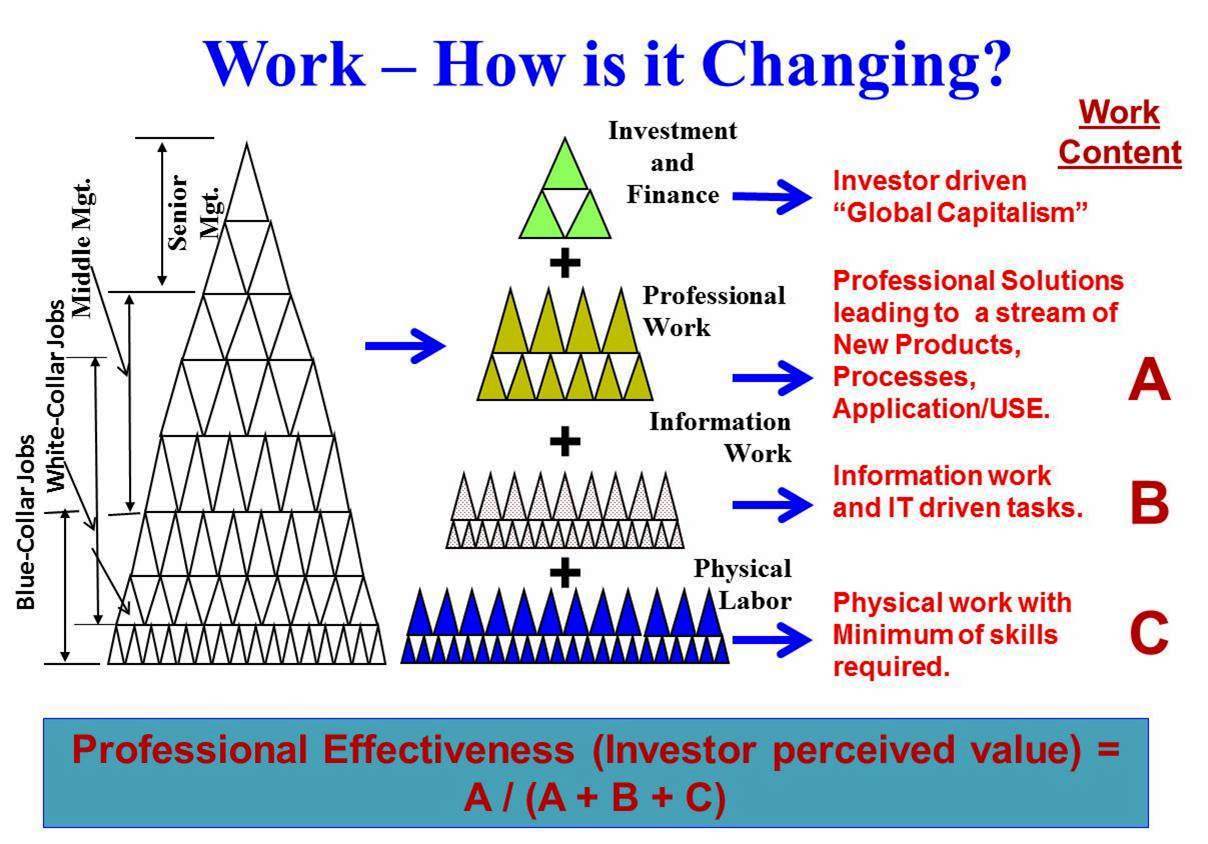
How is work changing

Of these four, the first two groups – physical labor and information worker – who are also generally the poor and low income workers will see stagnant wages since they bring no additional value in this new economy even through their years of experience. All their jobs will continue to be relentlessly de-skilled, standardized and automated (through programmable automation like the drones to deliver packages or self-guided robots). That is the power of the evolutions in Digital technology. The Genie is out of the bottle. There is no way to put it back in the bottle! Their chance of getting ahead in the economic ladder and growing into a middle class are less to none, as the statistics for the past few decades bears out. Increased minimum wages and social safety net may be their only way out. Only Government programs can change their economic lot.
The global finance, a version of Global Economy is also here to stay forever. Hence the investors will continue to do well, since their playing field and resources accessible to them are not limited to any one nation and its boundaries. This so called global capitalism is also enabled thanks to Digital Technology. Those with some non-wage income – through mutual funds, 401K investments, etc. – will do well as they chase the coat tails of the rich investors.
This brings us to the last group – the professionals. There were the days where the professional invented one new product or had the tricks up the sleeve for one process or some special know-how. Since it was in his/her head or in the private file folders, investors needed them for life time. Not anymore. As soon as they have documented their idea, it is available for everyone to use, across the globe, thanks to Digital Technology enabled capabilities. They need to start on the next one and continue this chase relentlessly. Their economic future will largely depend on: do they choose to be passionate to identify and create and implement a relentless stream of new solutions? We call this passion and the skills required for that as the Transformational Skills. If yes, they will be seen as valuable by the investors and hence may continue to climb the economic ladder. Or, do they choose to be a one trick pony and after that merely take orders and carry out assigned tasks? If yes, they will be mercilessly pushed into the category of low wage information workers, consistent with their low value addition. Investors will have no mercy for their economic wellbeing. It is only rational and consistent with the basic principle of classical economics: People behave in their own economic self-interest.
It will require Government to protect the self-interest of the workers whose income comes from salaries and wages. These are also the large body of the middle class as well as the consuming public in any nation. They are not the traditional unionized workers. They are everyone but the investors. They are the 99%
The Government can be the intervener creating programs that educates everyone on their self-interest to become “Transformational”. It is not a matter of more of the same education. Instead it has to be more and yet different education. Government can also start programs that create employment in areas where the investor’s self-interest may not be the driver. These include seed efforts for exploitation of new areas for economic activity, Research and Development investments to explore basic sciences – to expand advancements in the technology base beyond Digital technology, health and environmental sciences, infrastructure investments, etc..
It may not be the uncertainty of Government policies that is slowing the US economic growth. Investors always will know how to take risks, whatever the climate they face. It is in their economic self-interest to do so. The key question to address may be: Have the wage earning workers learned the rules of the new game?
We now live in a Binary Economy. Job-less recovery, high reward for investors from across the globe, high wages for a selected few – also from across the globe – who deliver a constant stream of new solutions, productivity growth through the work of these few that eliminates the need or lowers the wages for many more workers and resultant income in-equality are the basic features of this economy. In this new economy, growth in terms of GDP and low unemployment or decreasing the wage gap may not be congruent.

Critical issues facing Organizational Development

I came across this blog prost recently: December 10, 2013http://www.blog.gr2010.com/?author=1The regular script and Bold highlights are by the original author. I have underlined a few important passages.

The items in Italics  are my comments and links.

Best wishes

Dr. K. (Subbu) Subramanian, President, STIMS Institute Inc.

1) organizations are war zones in which people struggle not to join the ranks of the unemployed. Few people expect to have job satisfaction; “satisfaction” is having a job. Since market conditions favor the employer and not the employee, people are no longer all that important. People have become spare parts.

This severe economic crisis, “organizations at war” and “people have become spare parts” is the reality in most developed nations, which are suffering the severe impact of the Binary Economy. This may not yet be the case in some startup companies or across the board in emerging countries, but it will certainly be the case for most established companies or businesses across the globe (it is becoming more of a case for IT sector also).

The cornerstone of OD was to align the individual with the organization and focus on creating an environment which is good for the individual and for the organization. Thus, the relevance of OD’s value proposition appears bizarre at the present moment.

Today OD has to focus on making sure each professional has the highest effectiveness – PE Score – which in turn translates to identifiable business impact. In other words, OD has to become “bottom up” rather than “top down”.

2) Professions should have professional standards. These professional standards serve as a balance and complement the commercial criteria by which professions are evaluat

We recommend the PE Score as the standard for all professionals and System Thinking and Transformational skills as the means to increase the PE Score.

So, a chartered accountant who has a thriving business but violates accounting practices will find himself in deep water.

Any scientist or engineer who is successful today will be in deep water soon, if they do not continue to exploit the principles of Science or Engineer pertinence to their profession. This is part of the System Approach.

OD is a poorly defined profession with no borders. There are no agreed upon professional standards. Thus, commercial standards are totally dominating how OD is practiced. OD has become a commodity, sold by an OD vendor, and the OD practitioner must satisfy the client. If the client does not know what he needs, this is irrelevant because you “follow the money” and deliver what has been ordered.

In most cases the client as well as the OD vendor is unaware that the needs of 21st century are not the same. They are Binary now: An organization to create a stream of New Solutions, and in parallel with an organization that can replicate known solutions in larger quantities. The requirements of these two parallel organizations – technical skills, people skills, risk taking, aptitude, System Thinking and Transformational Skills – are substantially different.

OD requirements for the two parallel organizations in the Binary Economy

Slide2

A cornerstone of OD was to “speak truth to power”. If one needs to “titillate” and please the “customer”, the ability of OD to deliver on one of its major principles is castrated.

The truth that needs to be spoken today is the emergence of the Binary Economy.  Requiring the above two parallel modes for OD. Customers are not aware of this or focused on this. The OD support providers are not aware of this or focused on this. This leads to the above conflict – need to titillate and inability to speak the truth – between OD Support provider and the clients.

3) OD was founded by White Western and European males, and the Western values of OD are in line with those of the founders: participation, openness, authenticity, delegation, team work. Organizations are now configured globally. In most of the world, there is more autocracy, more secretiveness, more discretion than is seen in the west; many of the values of OD are seen as parochial and irrelevant to the way people should operate, especially when they are threatened as people are in today’s economy.

These are not serious issues in the organizations focused on Replication Solutions (e.g): Large majority of Walmart workers or McDonald’s employees are not impacted by these issues of global cultures and management styles. But, this is true for professional workers (Scientists, engineers and managers, who work in global teams to create and implement New Solutions). The OD developmental requirements (see the Table above) for these professionals – engaged in New Solutions organizations – are nearly the same across the globe.

4) As OD “stands its ground” and waits for the economy to “recover”, other professions cannibalized OD. Change Management promises those in power that changes can be “managed” with a set of templates. HR is disguising itself as a “business partner”, has cast aside/betrays the lobbying for the human resource and often serves as management’s 5th column to “deal” and contain the human resource. Unions and organized labor may/will fill in the vacuum. Certainly in the country where I live, re-unionization is rampant.

This cannibalization is a reality in every profession. When the OD focus is largely for cost reduction, outplacement and out sourcing, then OD Providers serve this needs largely through Psychological counseling and rigorous training for effectiveness on standard tasks (such as speaking skills for call center employees). The Binary Economy requires structured and well executed OD development tools to growth the two parallel organizations at all levels in a diligent and sustained manner (and also in the right balance) unique to each company.

5) OD had a massive focus on communication. In organizations, people rarely talk too much anymore; they text and email and use portals. A major domain in which OD brought huge value is shrinking.

Knowledge (Academic, Sector/domain specific and Transformational), Experience and Inter-personal skills are the legs of any solution for OD. Of these, the Inter-personal skill requires effective communication. This small part of the skill development has been the major focus of OD, as mentioned above. But this view of the OD has to change. Instead OD has to become a system focused on a ladder of core capabilities, at the three levels: Individuals; Department/team; Enterprise/industry,  leading to an organization of T- shaped thinkers and problem solvers.

Slide2

T – Shaped employees,
organization and enterprise development.

Scientists, Engineers and Managers – are they innovators and entrepreneurs too?

Sc En Mgr as entrepreneurRecently I was speaking with a friend, who is a successful dot com entrepreneur. We both agreed that, to be successful today you need to be an entrepreneur and an innovator. After this initial agreement, I was startled to learn how profoundly different we were in our thinking in terms of what it means to be an entrepreneur or innovator?
My friend told me that he always admired the sorts of people who took the risk, by getting a second mortgage on his/her home, to fund their business. They were the risk takers and the true entrepreneurs”
I asked him, “How about all those people who take risks and move all the mountains to put a new material in the jet engine blades or new process that melts glass or holds beams together in a sky scraper or pushes a new product out in the market, even when the marketing says they have never heard about it in the field? Are they all not entrepreneurs and innovators?”
After some reflection, he agreed and said, “You are partially correct. Entrepreneur and innovator need not always be only the investors. True, they sow the seed and create the climate. But the many scientists, engineers and managers – the professionals – are also innovators and entrepreneurs. It is their collective efforts that make entrepreneurship and innovation successful”.
While we teach entrepreneurship and skills for innovation in colleges as they pertain to investors and as part of management education, we rarely teach the skills for technical professionals – the scientists and engineers. The ability of the professionals that combines their Science, Engineering and Management skills – as a system – together with innovation and entrepreneurship can be best described as Transformational Skills. Is it about time we offered formal education on System Thinking and Transformational skills?
For more information Contact us

What is your “Professional Effectiveness – PE” Score?

Are you a professional? — An Engineer, Scientist, Manager, Consultant, Doctor, Lawyer, ………….. ?

You are busy more than ever, working literally on a 24 x 7  clock?  Why is this? To help you assess your situation better, we offer you a simple test.

Everything you do, as part of your job or work can be divided into three distinct categories of work:

  • A = Clearly identifiable contribution of your work, in terms of Product (which generates revenue), Process (to make or create the product) and Application/USE of the product of your department, team or company.  This may sound a bit abstract at first. But, if you think carefully you will find, these are the only outcomes that ultimately determine your value or use to your team or the employer. This category of work requires active and deliberate use of your professional knowledge, your experience in creating and implementing New Solutions. It requires thinking, reflection, data analysis, inferences, conclusions, risk taking, …….. Only you can do this category of work. Try as best as you may, you can not simply delegate this category of work!
  • B = Your effort in processing information (e-mail, phone calls, net browsing, voice mails – recording/receiving, paper work, keeping track of budgets, accounts, expense reports, budgets, booking travel tickets,  etc.. With the increasing capability of  IT Tools and their applications , each of us are increasingly drawn into this category of work. Gone are the days where administrative assistants and support staff could be used to carry out these tasks. It appears easier to do it all by yourself and apparently more efficient. Companies may see it as a cost reduction, when you do all this by yourself. But, it has every opportunity to distract and diminish your output under category A. You can delegate this category of work if you choose to. May be some one has already put this monkey – more of it – on your shoulders?
  • C = Your effort in physical work, such as travelling, commuting, sit in meetings, typing, etc. When you over do this category of work, it leads to your lower back pain, Carpal tunnel syndrome, lack of sleep, jet lag, physical exhaustion, and all other ailments!

Your total effort  = A + B + C

Your PE = A / (A + B + C )

How is the work changing (1)

In a recent informal survey of professionals, over half of them felt that their PE is less than 20% While individual professionals attempt to increase their contribution through “A”, most companies are reducing the “B” and “C” content through IT applications, outsourcing, globalization, etc. The combined effect of these is a steady increase in labor productivity, where fewer people are producing more perceived outcomes. But, unless the “A” category of work is deliberately increased the innovative outcomes – in terms of new Products, Processes and/or Applications/USE – will continue to slide down. All that is left will be cost reduction (like squeezing the last few drops of water from  dry wood)!

Any one at any level of responsibility has to be worried about the PE score. Integrated across all the professionals in the company, PE score will be the true measure of innovation or lack there of, in the company.

Senior executives, HR managers, as well as individual professionals need to become aware of the PE score. Such awareness, has to be followed by next steps to increase the PE score, which in turn will require formal and structured education, training and practice of Transformational Skills

For more details and for tailored support  Contact US

The three legs of Work force skills development promoted by STIMS Institute, quoted in a recent article in Lexington Minuteman

paper heading jpg (2)

Lexington Minuteman, a newspaper well known in the New England area recently carried an article on November 28, 2013 in their ECONOMY section titled, “Skills gap has a high cost” authored by Spencer Buell and Caitlyn Kelleher Lexington@wickedlocal.com

An abstract from this article is cited below:
Three-legged approach for high-tech
……………….
In Lexington, K. “Subbu” Subramanian, a mechanical engineer and President of STIMS Institute Inc., said closing the skills gap to foster a more vibrant economy in the future is going to require building a triangle: Education and training are its two legs, with motivation to create and implement new solutions – the Transformational Skills serving as the base.

Triangle of Skills

The STIMS Institute, according to Dr. Subramanian is focused on developing physical, science-based technology innovation and management solutions. “There is a need to combine academic education and training application educations with a passion to create new solutions, Subramanian said. “This
triangle has to be created no matter what level we are going to. We are not thinking of the triangle. Nobody wants to come together to create a triangle.” The triangle needs to include educational institutions and businesses, he said, adding academic schools should take a lesson from vocational schools and encourage internships.

This year, Subramanian wrote the book “Thriving in the 21st Century Economy: Transformational Skills for Technical Professionals,” which focuses on the changing economy and the need for a new model for workers because of an increasing demand for high-tech skills.

“The parents have to push because their kids need the Transformational skills,’ Subramanian said. “The schools have a need because they have a social obligation. They can’t say we have high scores and we are good with that. They need to give kids the Transformational skills to get a job.” Businesses are not hiring, he said, because they want people with practical experience and Transformational skills.

Indeed, a National Manufacturing Institute study estimates that failure to fill 600,00O jobs due to a lack of qualified workers would cost the economy $67.8 billion in exports, $47.4 billion in foreign investment and $8.5 billion in lost research and development investment. Add that to that the $17.6 billion in unemployment insurance claims, $17.6 billion in lost income taxes and $6.6 billion in lost corporate taxes.

……………………….