Welders and philosophers – a case for skill needed for Developing Common Language

In the fourth Republican debate Senator Rubio stated, “Welders make more money than philosophers,” “We need more welders and less philosophers.”

One can fully appreciate the possible resurgence of the need for welders, as the manufacturing sector shows some signs of life after decades of being decimated under the banner of globalization. Yes, if you are a hands on welder there are some good jobs available in the range of $35,000 to $50,000/year. Before every one rushes to send their children for welding schools, let us be sure that they are also trained on basics of engineering, business economics and IT applications. Otherwise the welders of today will be left behind in the next few years as Robotics get a greater and stronger foot hold in our manufacturing not long from now.

In every discipline of study one is awarded the highest degree (i.e.) Doctor of Philosophy (Ph.D). It is very logical to find – and indeed there are many – Doctor of Philosophy in welding as well. Any Ph.D in welding capable of integrating and implementing new solutions is a hot commodity for employment today. Indeed we need such results oriented Ph.D in every field. At any time the demand for such highly educated and qualified people will be far fewer than welders with basic trade school education and training. But their income will always be higher than the welders in the shop floor.

Why is it that Mr. Rubio suggests that we need more welders and not philosophers? Such thought and language comes from a limited knowledge of the words and their repeated use. The word Philosophy is an in-depth study of any subject. Of course in-depth study of life in general is commonly referred to as “Philosophy”. But every graduate in philosophy major is not a Philosopher any more than any one holding a welding gun is a welder!

Mr. Rubio’s comment also has another ramification as well. There is a general misconception that education in a hot field and income are directly correlated and hence once should get educated in specific areas where opportunity presents itself. This has been the case for the 20th century education. Students flocked to Automobile engineering, Textile engineering, Nuclear engineering, Chemical engineering, Polymer engineering, etc. as each industry grew and shrunk well within the confines of the US shores. With the globalization such sector specific education may still be a need, but every worker needs also to be a system thinker and solution provider first. Absent such transformational skills no amount of education will be a sustainable competitive advantage for the workers at any level. These considerations and in-depth analysis leading to meaningful solutions of impact for average workers will require every presidential candidate to be a bit more philosophic in their reflection, thinking and answers. May be we don’t need more philosophy graduates compared to the number of welders required. But for certain we need every presidential candidate be required to take a crash course in philosophy and the reflection and analytical thinking such education brings.

This episode also points to another important issue we face in the economy and the society today. Words and their true meaning are lost, when they are misused. Thanks to the advent of IT, this abuse spreads quickly and across the globe at the speed of electrons. Then with very little thought such terms and their erroneous meaning become the accepted norm! Welding is a technical skill and philosophy is a thought process. A welder could also be a philosopher. To be grounded on the true meaning of the word requires an ability to step back and look at the big picture and a special skill to “Develop a common language”. We call this as the capacity for System Thinking and Transformational Skills.

Few other examples where we need the above skills and the common language are:

  • Technology (it is not IT or Digital Technology alone as presumed in many conversations),
  • Service Economy is distinct from Industrial Economy (Every economy – industrial, service, high-tech., brick and Mortar, etc. – is rooted in Products (source of revenue), Process (Means to an end) and Application/USE (where the value of the product is perceived hence generating revenue))
  • Globalization  is the cause of many of our problems (It is an outcome and not a cause; pervasive and indiscriminate use of IT applications is the cause))
  • Globalization will lift all boats (Globalization as the result of indiscriminate use of IT to improve operating costs and re-distribute employment across the globe is like a shrinking vessel and can not lift all boats; Unless IT applications together with human skills are also used to create new products, markets and better way of living for all, Globalization as it exists can not lift all the boats)
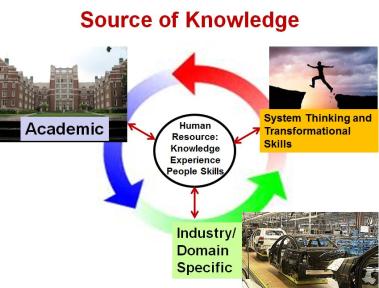
Career Strategies for success: It is a game plan using System Thinking and Transformational Skills.

According to the analysis, in a recent blog post: These 150 People Are Ridiculously Successful and All Have the Same Career Path: None https://www.linkedin.com/pulse/career-advice-one-could-give-zachary-karabell the site reports: The real lesson is not some shared attribute that contributes to career success. The lesson is that for these 150, and surely for the hundreds of others who could also have joined this list, what matters is personal passion and vision, not some paint-by-numbers guide. In fact, few if any of these individuals followed a familiar playbook and that might just be the real key. The greatest success comes from the indelible marriage of a unique idea with uncommon individuals addressing needs that are widely shared. This Next Wave may find their futures bright, and they may encounter more turbulence as they flow into the next stage of their careers. But all of them are addressing real needs that someone will address and solve if not them and if not now. We can thank our collective lucky stars that for all the troubles that swirl through the world, so many are striving with such determination, vision and skill to improve the collective us.

Every one of the examples cited in the link above highlights individuals who created and implemented “NEW SOLUTIONS”: addressing real needs that someone will address and solve if not them and if not now. So, the success comes to those few who are relentlessly focused on New Solutions as opposed to those who merely execute tasks (do what they are asked to do). We have described this field of opportunity in great detail and the evolving Binary Economy: Success for the few who identify, develop and deploy NEW SOLUTIONS and low wage opportunities for the many who execute tasks required for the REPLICATION SOLUTIONS.

What happens to the millions who are not naturally gifted to identify such New Solutions? Our glamour and adoration of these few naturally gifted successful persons should not become a source of despair and inaction to help the millions who may fall by the wayside (and who are now the economically impoverished middle class?)

Is there a frame work to define what a solution is? How do we frame a need as a New Solution? What happens to those whose economic situation does not permit them to dedicate their life and mortgage their future into a new opportunity? May be every new solutions is not a new startup company? Will not focus, hard word and determination be enough? I posed these questions to my recent class of students, who are being trained and educated on the principles of System Thinking and Transformational Skills.

The class consensus was that, while these are the basic desired qualities, the System Thinking and Transformational Skills provide a platform, a strategy and/or a game plan to identify, develop and execute your efforts for new solutions and potential future success.

  1. Every solution is an Input/Transformation/Output system.
  2. Every New Solution is an unmet need that fills the gap that exists at three levels:
    1. Knowledge, Experience and/or interpersonal relationship for individuals.
    2. Science (or knowledge of the Transformation), Engineering (application or use of the transformation) and/or Management (What? Why? How? and When?) to exploit the Transformation.
  3. Opportunities for any New Solution can come from:
    1. Developing a common language to articulate the need and the solution as a system
    2. Identifying the missing gaps (core capabilities) as mentioned above.
    3. Development and use of Diagnostic tools.
    4. Making such tools available on the go (through Apps. If required)
    5. Promoting a network of users and providers with common needs
  4. Success of the New Solution depends on:
    1. Relentless focus on the entire chain — from beginning to end (Discovery X Development X Use) without any breakage.
    2. Empathy and a willingness to help users to succeed and then make hay out of it (and not in the reverse order).

We can transform common and ordinary individuals -not a rare few by chance, but many by design – with a game plan and a strategy so that success comes to them from the indelible marriage of a unique idea with an uncommon individual skill sets to address the needs that are widely shared.

Contact Us

Are you a good plumber? Then you may be OK as a professional!

Recently, I had a leak in the hot water tank in our house. Fortunately the hot water tank in my house is located on the basement floor. So, the damage was only modest. As one would in a situation like this I called the plumber. The company I contract with is a one man operation. he was away on vacation. But, he had arranged one of his fellow plumbers – another one man operation – to follow up on the calls. The back up plumber came to my house, checked my hot water tank, followed up with my primary contact, got all the paper work, figured out that the tank can be replaced on warranty. He had used the camera in his phone – mobile diagnostic tool – to take pictures and document the details to communicate with the manufacturer. When he informed me of all this it was time for me to travel. He said  not to worry. He offered me a suggestion to turn off the water, while I was away and scheduled the hot water tank replacement work, as soon as I returned. No sooner had I returned the plumber was at my home with the replacement tank, which he had arranged to secure while I was on travel.  He did all the work a plumber does – drain the system, disconnect pipes, connect where needed, solder the and seal the joints as needed, refill and test the system. He could have left right away after that. Instead he asked me to put the system to full duty cycle for nearly thirty minutes. Much to his surprise one of the solder joints, which he had not touched started leaking! As you might know a leaking solder joint can not be fixed with out starting all over again, draining the water in the system. The plumber went through the steps diligently and ensured that I had a fully functioning system – a system that met all my requirements as a user.

You might think that is what the plumber is supposed to do. But the plumber is also rated and the rating is uploaded on to a on-line data base like the Angie’s list. Only those with good ratings get calls from the tech savvy social media dominated population.

What does this have to do with you as a professional? How often do you take on an assignment where the problem is clear, well defined and the user needs clarified up front? Do you then systematically and methodically follow up on all aspects of your work and rely on all your core capabilities: your knowledge, information work and physical labor? Do you check and re-check your work so that the person who relies on your work – like the home owner reliant on the plumber – is fully satisfied with your solution. Do you operate as a single owner company whose livelihood and success are entirely of his own making? Do you have people as back ups in your work that you can rely on, when you have to be away? Do you subject yourself for constant scrutiny and review so that you have a constant pulse on user satisfaction of your work? If you do all of these you will be a successful professional, no matter where you work – may be it is a small start up, a medium sized company or a large enterprise.

We call these collection of skills as Transformational Skills. For more details Contact us.

Stop being nice to your boss?

The news item “BlackRock’s Chief, Laurence Fink, Urges Other C.E.O.s to Stop Being So Nice to Investors” appeared in the recent NYT Dealbook segment.

In a letter sent recently by Mr. Fink to the top 500 CEOs in the country, he suggests, “Too many of CEOs have been trying to return money to investors through so-called shareholder-friendly steps like paying dividends and buying back stock. These maneuvers, often done under pressure from activist investors, are harming the long-term creation of value and may be doing companies and their investors a disservice, despite the increases in stock prices that have often been the result. The effects of the short-termist phenomenon are troubling both to those seeking to save for long-term goals such as retirement and for our broader economy …… such moves are being done at the expense of investing in innovation, skilled work forces or essential capital expenditures necessary to sustain long-term growth.  This move sends a discouraging message about a company’s ability to use its resources wisely and develop a coherent plan to create value over the long term …….  with interest rates approaching zero, returning excessive amounts of capital to investors isn’t helpful because they will enjoy comparatively meager benefits from it in this environment”.

In our opinion we need such bold leadership also among professionals to stop bowing to the pressures of the boss or organization that demands “fire fighing” on short term problems at the expense of time and resources necessary to dedicate to the long term needs and success of the company and the organization.

You can stop bowing to investors if you know who they are! The problem is that the “Investors” today are those who make money off of money. They pay everyone else for doing their work to get that result. This stratification of work between the investors and the rest is the insidious problem that has been evolving for the past three decades. You and I who invest in mutual funds – which can be local or global – are also the investors! The issue may be: Can the CEOs sell the value of their long term vision and goals to the “investors”? Once convinced can they deliver the long term value as promised? These are the questions that need to be addressed by every one – from the CEO to the lowest level employee in every company. We call these as the Transformational Skills.

Today the  hedge fund managers, day traders, arbitragers, financial analysts and the fund managers are increasingly isolated from the main stream business. In this new model Finance, Professional work, Information work and Physical work are in stratified impermeable silos. In this scenario, the CEOs are just like any other professional (who gets paid for their work) as opposed to Finance (where money is made off of money!). Hence the CEOs have to learn new skills – Transformational Skills – to get the “investor driven finance” do what the CEO needs (long term business focus). The question is “Should the CEO quit bowing to investors? or “Should the CEO learn skills necessary to get the investor driven Finance bow to him/her?”

The question is also identical for many professionals where they say that their boss and organization is forcing them to focus on short term projects and quick results. Do these professionals have the necessary “Transformational Skills” – which is beyond academic education and industry/sector know-how that will make their boss and organization sit up and listen to them?

Contact us

Where is the real “Skill gap” ?

In his recent opinion page, Mr. Paul Krugman writes the following in the NYT:  Most people would surely agree that stagnant wages, and more broadly the shrinking number of jobs that can support middle-class status, are big problems for this country. But the general attitude to the decline in good jobs is fatalistic. Isn’t it just supply and demand? Haven’t labor-saving technology and global competition made it impossible to pay decent wages to workers unless they have a lot of education? ….  And the evidence that technology is pushing down wages is a lot less clear than all the harrumphing about a “skills gap” might suggest.

In the above referenced citation on “Technology”,  Mr. Mike Kanczal writes: When we think of the economic malaise of the past 30 years, we should probably think of it as a combination of technology, globalization, sociology, and public policy.

In all of the discussion, the word “Technology” is used with out a clear common understanding. If you are a Mechanical Engineer, your knowledge in applied mechanics, materials science and physics are not counted as “technology” in the above discussion by these eminent scholars. Same goes for Electrical Engineers, Chemical Engineers, Civil Engineers, Chemists and Biologists and their knowledge or know-how. Even a Robotics expert and his/her knowledge of mechanical design, path planning and fixturing are not counted in the above “technology” reference.

Instead, what is counted as “Technology” is the automation in the collection, processing, analysis and dissemination of information of any kind and in any place and for any reason. This is the automation of human centered capability in any and all aspects of our life. Instead of calling this as “Technology” we should call it as “Information work”. People, described as labor can be engaged in four sets of work:

  1. Finance – make money off money
  2. Professional Work – create and deliver a stream of new solutions each and every day (like a carpenter who makes and sells furniture, a plumber who fixes the leaking pipe and get paid for it, a cardiologist who fixes broken hearts (literally), etc.)
  3. Information Work
  4. Physical Work

The “Skill gap” mentioned above – which is seen as the major impediment against good paying jobs truly involve the following:

  • Recognizing that the work has indeed stratified into these four impermeable layers and only one of the four is available as a source of good wages (unless you are born with a silver spoon)
  • Recognizing that the Physical work and Information Work – which employed a large majority of the labor force with or with out higher education – will both be automated and what is left will only lead to low paying – “service” – jobs. Number of these jobs may grow, but their wages will hover around the minimum wage.
  • Only a narrow window of “Professional” work exists where there will be decent wages and opportunities to nudge into the middle class.
  • Finance – making money off the money – work is for a select few and these are the affluent 1%. If you can make it there great. Or if you are lucky to be born with a silver spoon, then you can count your blessings!
  • But, the better bet for the large cross section of the people may be to acquire skills that deliberately place them in the “Professional Work” category.
  • Such professional skills are not merely higher “Academic” education or Industry specific trade skills.
  • Instead the true skill gap is the blend of Academic, industrial specific skills together with System Thinking and Transformational Skills.

For details Contact us.