Career Strategies for success: It is a game plan using System Thinking and Transformational Skills.

According to the analysis, in a recent blog post: These 150 People Are Ridiculously Successful and All Have the Same Career Path: None https://www.linkedin.com/pulse/career-advice-one-could-give-zachary-karabell the site reports: The real lesson is not some shared attribute that contributes to career success. The lesson is that for these 150, and surely for the hundreds of others who could also have joined this list, what matters is personal passion and vision, not some paint-by-numbers guide. In fact, few if any of these individuals followed a familiar playbook and that might just be the real key. The greatest success comes from the indelible marriage of a unique idea with uncommon individuals addressing needs that are widely shared. This Next Wave may find their futures bright, and they may encounter more turbulence as they flow into the next stage of their careers. But all of them are addressing real needs that someone will address and solve if not them and if not now. We can thank our collective lucky stars that for all the troubles that swirl through the world, so many are striving with such determination, vision and skill to improve the collective us.

Every one of the examples cited in the link above highlights individuals who created and implemented “NEW SOLUTIONS”: addressing real needs that someone will address and solve if not them and if not now. So, the success comes to those few who are relentlessly focused on New Solutions as opposed to those who merely execute tasks (do what they are asked to do). We have described this field of opportunity in great detail and the evolving Binary Economy: Success for the few who identify, develop and deploy NEW SOLUTIONS and low wage opportunities for the many who execute tasks required for the REPLICATION SOLUTIONS.

What happens to the millions who are not naturally gifted to identify such New Solutions? Our glamour and adoration of these few naturally gifted successful persons should not become a source of despair and inaction to help the millions who may fall by the wayside (and who are now the economically impoverished middle class?)

Is there a frame work to define what a solution is? How do we frame a need as a New Solution? What happens to those whose economic situation does not permit them to dedicate their life and mortgage their future into a new opportunity? May be every new solutions is not a new startup company? Will not focus, hard word and determination be enough? I posed these questions to my recent class of students, who are being trained and educated on the principles of System Thinking and Transformational Skills.

The class consensus was that, while these are the basic desired qualities, the System Thinking and Transformational Skills provide a platform, a strategy and/or a game plan to identify, develop and execute your efforts for new solutions and potential future success.

  1. Every solution is an Input/Transformation/Output system.
  2. Every New Solution is an unmet need that fills the gap that exists at three levels:
    1. Knowledge, Experience and/or interpersonal relationship for individuals.
    2. Science (or knowledge of the Transformation), Engineering (application or use of the transformation) and/or Management (What? Why? How? and When?) to exploit the Transformation.
  3. Opportunities for any New Solution can come from:
    1. Developing a common language to articulate the need and the solution as a system
    2. Identifying the missing gaps (core capabilities) as mentioned above.
    3. Development and use of Diagnostic tools.
    4. Making such tools available on the go (through Apps. If required)
    5. Promoting a network of users and providers with common needs
  4. Success of the New Solution depends on:
    1. Relentless focus on the entire chain — from beginning to end (Discovery X Development X Use) without any breakage.
    2. Empathy and a willingness to help users to succeed and then make hay out of it (and not in the reverse order).

We can transform common and ordinary individuals -not a rare few by chance, but many by design – with a game plan and a strategy so that success comes to them from the indelible marriage of a unique idea with an uncommon individual skill sets to address the needs that are widely shared.

Contact Us

Binary Economy and the views of Pope Francis

We have described in our earlier blog posts that the Digital Technology is a two edged sword :

  • One edge that enables enormous opportunities for a few skilled workers (System Thinkers with Transformational Skills) while the other side that de-skills and automates all our work that creates only a vast pool of low wage work (and unsustainable living conditions for a large majority of people).

This development enabled by Digital Technology can also be thought of as a two sided coin:

  • One side of the coin that connects and informs every one across the globe about anything and everything, while the other side isolates people into their narrow subsets and contact lists, specialties and task oriented efforts and SOPs.

Both these modes of developments are inevitable. More pervasive the role and impact of Digital Technology, faster and greater will be the polarization into these extremes with a constantly disappearing middle. We have described this dichotomy as the emerging Binary Economy in our recent book:

Pope Francis seems to perceive this dichotomy as expressed in his views highlighted below.

http://www.cnn.com/2015/06/18/health/pope-francis-versus-media/index.html

Taken as a whole, do our technological advances — news in real time, live global communication, access to more information and entertainment (and all the shades in between) than we could ever fully absorb — help or hurt the causes when those causes should be engaging with our lives to the fullest, and fostering peace, love and happiness?

Real relationships with others, with all the challenges they entail,” Pope Francis said, “is giving way to more fickle online relationships and “a new type of contrived emotion which has more to do with devices and displays than with other people and with nature.”

“Nobody is suggesting a return to the Stone Age, but we do need to slow down and look at reality in a different way?”

When media and the digital world become omnipresent, their influence can stop people from learning how to live wisely, to think deeply and to love generously. In this context, the great sages of the past run the risk of going unheard amid the noise and distractions of an information overload.”

http://www.cnn.com/2015/06/18/world/pope-encyclical-quotes/index.html

We need to reject a magical conception of the market, which would suggest that the problems can be solved simply by an increase in the profits of companies or individuals.”

Recently I met a graduate student from the business school at MIT. He said that he is being mentored by a business leader from a large financial services company. He said, “I am trained to think and act on how I can make the most money every moment I work”! The lack of empathy for those in need or the consequences of such relentless focus on profit at all cost was totally lost in this young person. This example of survival at all cost is also noted in industrial organizations, where leaders do everything for their survival and profits with no regard for the long term impact of their company or organization. Focus on short term profits and results, which used to be a matter of convenience, have increasingly become a badge of honor. Climate change and the increasing gap between the rich and the poor have become a political weapon for one side  vs. another rather than phenomena that need to be addressed and solved for the good of all. For them Pope Francis asks: “What would induce anyone, at this stage, to hold on to power only to be remembered for their inability to take action when it was urgent and necessary to do so?”

Optimising Complex Manufacturing

Slide1Every aspect of our economy is now undergoing a transformation, leading to the evolution of a broadening gap between modes for

  • Replication Solutions for cost reduction where minimum skills are required along with minimum of wages and a mode for creating and
  • New Solutions, where high skills and ability to integrate knowledge from all sources is the need. This New Solution mode is also the opportunity for the few – companies, employers and workers – to gain high wages and high rewards in terms of growth and profitability.

Binary Economy

These two modes are also leaving behind a widening gap – a chasm – and if you are trapped in this middle, you are part of the growing middle class (of companies, workers and professionals) where the floor is collapsing under your feet. Of course if you are the investor – the rich – you make money off both these economic modes and hence the rich getting richer, the poor getting poorer and the middle left clueless. This is not the issue for the left vs. right or progressives vs. conservatives. WE ARE ALL IN THE SAME BOAT, with cracks developing in the middle.

We have described this evolving economic model as the Binary Economy and how to get a handle on this through a set of Transformational Skills in our New Book.

The challenges of doing well in the cost reduction mode, while creating opportunities through New Products and Services is the new complexity in the manufacturing. Dr. Subramanian, President, STIMS Institute was interviewed along with a panel of experts. This panel discussion is published in the Efficient Manufacturing Magazine

Round Table EM India 2015

Slide2The draft of the Q &A with Dr. Subramanian is presented below.

For more details and for any services we can help you with in your manufacturing and innovation efforts Contact US.

  • What are the various ways through which one can take advantage of advanced technologies and at the same time avoid complexity in manufacturing processes?      Worldwide there is a plateau – point of diminishing return – being reached in cost reduction and continuous improvement. Supply Chain, Lean and such practices are slowly running out of steam. What is needed is a step change or radical departure in terms of new processes leading to new products. Companies like Apple are setting this new vision by introducing totally new products every six months, backed up by manufacturing processes that allow them to offer over ten million units within the first quarter of product release.

In India, manufacturing seems to be facing the same head wind as well. Instead of toll manufacturing based on what is already well established, manufacturers are required to design new products and adapt new processes to produce them. The complexities in such manufacturing increase largely because of a lack of knowledge and inability to perceive the value added through the physical processes imbedded in manufacturing. Education and training of the work force on the knowledge and methods to exploit value through physical processes across the entire supply chain would be required as the first step. Developing an eco-system of suppliers and manufacturers working as a team for such value addition through the physical processes in manufacturing could be another step.

  • Currently, manufacturing enterprises have been increasingly focusing on optimising performance, productivity and asset management. What are your recommendations for such approaches?   It is imperative that these steps are pursued relentlessly. But, are they happening in the real world and what is their effectiveness? Consider this case for example: A senior manufacturing executive wanted to improve line productivity and asset utilization. Expert resource was used to achieve cycle time reduction in the bottle neck operation which resulted in throughput increase by about 40%. No additional investment was required. Higher productivity and better asset utilization was demonstrated. But these results could not be sustained after a short period of two weeks. The exercise revealed that the process know-how in this plant was very limited. The process was restored to the original – longer – cycle time due to a perceived fear the machine tool may wear out! This situation clearly illustrates the need for better education of the engineers and managers already in the work force. Incentives are required for changing their attitude to gain the most value out of the assets used in the manufacturing operations.

There is also a need to get over the “frog in the well” mind set. Even the most efficient manufacturing operations in India have tremendous scope for improvement in quality, productivity and cost. I can personally attest to the fact that the cycle times and machine capacity used for precision grinding processes are well below the industrial practice in the manufacturing plants in USA and Germany. Also many of the advanced tooling available for several processes may not be accessible inside of India due to very small usage and the supply chain issues faced in handling such small volume of consumables.

  • How to overcome the challenges of complexities arising out of collaborative manufacturing, outsourcing, innovation compulsion, flexibility and risk management?   Complexity in any situation is a matter of two issues: (a) lack of clear goals agreed upon by everyone and (b) lack of specific knowledge required for achieving such goals.

Consider for example a manufacturer who sees a new opportunity to produce a new component to meet the requirements of an export customer or a large new market inside of India. How does it translate into new opportunities for every one required in the development of the solution? The manufacturer may require collaboration with machine tool builders, raw material supplier and several tooling manufacturers. These are all the stake holders in the new solution. Unless the benefits for all these stake holders are agreed upon and clarified upfront, the risk will be too high and the collaboration may be limited or constrained. To avoid this pitfall we encourage the senior managers to actively promote the concept of Emotional Intelligence for Innovation. It implies that you seek out collaboration with a mind-set “I seek your help for my success, but I am also committed to make sure that you succeed as well in the end”. When the second half of the above equation is ignored or left unspecified, then the eco-system does not evolve. Leaving the benefit sharing to the people at lower levels, who have little influence, vision or authority also increases the complexities in collaboration many fold.

Even with good intent, knowledge specific to the solution is vital. A supplier who undertakes a new project may not have adequate knowledge to arrive at the final solution. It may require several iterations. Are these iterations carried out before the solution is approved? Frequently such learning steps are postponed for reasons of cost or lack of collaborative mind-set between the supplier and the manufacturer. Such learning steps may not be scientific with due emphasis on in-process data and their analysis. Documentation of such results and a system approach for problem solving may be missing. Lack of data driven problem solving also leads to trial and error where each step is seen as new, even though the same path might have been crossed many times. All of these result in a partially cooked solution implemented on the shop floor.

When the knowledge and communication methods are not institutionalized, mobility and changes in the people involved leads to complexity in the solution development effort. There are efforts in India to foster common knowledge pool through collaboration across the universities and the industry. Trade associations and government bodies such as the Department of Science and Technology also have a role to bring the industries and research institutions into a consortium. Recently collaboration between a CEO with long term vision, a research team from one of the IITs together with our worldwide expertise has resulted in some unique results. While the nature and magnitude of the collaboration is small, it shows the potential for new a vision for “Make in India”!

  • Can you brief on the major manufacturing trends which can be expected in the next 5 years?    Thanks to higher level of automation in the shop floor, in the years to come there will be less competitive advantage due to low cost labour. This will put manufacturers in India competing for the export markets at a serious dis-advantage. They need to overcome this challenge through advanced manufacturing solutions, higher productivity in current manufacturing and introduction of unique new manufacturing solutions. On the other hand the prospects for a growing demand in the domestic market will provide added opportunities for suppliers and manufacturers for this market segment. Collaboration between like-minded companies for mutual and long term growth and shared knowledge base will be the key to success here.


What is common between Bernie Sanders and Donald Trump?

There has been huge attendance in the recent Democratic rallies featuring the Vermont Senator Mr. Bernie Sanders. On the  other hand Mr. Donald Trump has been sucking up all the oxygen and attention with his harsh language against immigrants and his fellow presidential candidates in the Republican primaries. The popular support for these candidates may be seen as the pent up anger in the population against the Wall Street and the perceived syphoning of jobs and economic opportunities by the illegal immigrants from the south of the border respectively. This kind of anecdotal explanations by the reporters and political pundits may not serve the nation well for the long term.

In a recent article published in the Washington Post titled: Sorry, but the jobless future isn’t a luddite fallacy  the author makes the point: Policy makers have a big new problem to deal with: the disappearance of human jobs. Not only will there be fewer jobs for people doing manual work, the jobs of knowledge workers will also be replaced by computers. Almost every industry and profession will be impacted and this will create a new set of social problems — because most people can’t adapt to such dramatic change.

The author makes it look like it might be a problem developing into the future. But, reality suggests that the problem started a decade before Regan years, got established through the Clinton years. When the very survival of the economic order was in question due to the financial crisis along with protracted engagements in wars, when Mr. Obama took office, gradual erosion of employable opportunities for the large cross sections of the society has continued but seen merely a side issue. Now as these two national concerns are addressed to some extent, the pent up fear and anger and despair in the population is finding its voice through the emotional appeals of Mr. Sanders and Mr. Trump, even if their tones are completely different.

We have documented this erosion in the meaningful opportunities for employment and economic well being as the Binary Economy well documented in our recent book. Instead of waiting for some one else to fix the problem we have suggested that technical professionals, students and others should systematically cultivate specific skills – Transformational Skills –  to enhance their job and career opportunities. These individual centered initiatives will go only so far. It requires national leaders to comprehend the evolving Binary Economy and develop policies and national consensus for coping with its  impact. Merely cloaking the Digital Technology as “high tech” and glorifying the thief using DT tools as “hackers” does not do well for societies that have succeeded through the use of all sorts of technologies as the backbone for their success.

Absent such policies we see continued isolation and layering of job opportunities. This leaves people in the lower levels of jobs (largely involving physical work or information tasks) with a sense of despair that unless you are born in a well to do family and go to school in a better neighborhood, your opportunities are permanently shut off. The knowledge economy and the skill based economy have become code words for the success of a few while others stagnate. These issues may be the under currents supporting the fan base for Mr. Sanders and Mr. Trump.

Clearly the answer is not the anger and abuse against the immigrants unleashed by Mr. Trump. Raising minimum wage and such social policies for re-distribution of wealth by Mr. Sanders may be temporary fix. But they may not be the sufficient or sustainable long term answers as well.  As noted in the Washington Post article: If we can develop the economic structures necessary to distribute the prosperity we are creating, most people will no longer have to work to sustain themselves. They will be free to pursue other creative endeavors. The problem, however, is that without jobs, they will not have the dignity, social engagement, and sense of fulfillment that comes from work. The life, liberty and pursuit of happiness that the constitution entitles us to won’t be through labor, it will have to be through other means. Is this the way of life we want?

What are the other means for such living, where anything a human can do – read, write, think, analyze, infer, conclude, decide and control – can all be done by computers and IT solutions? Mr. Steven Hawkins has raised this specter and fear one can envision due to irrational deployment of Artificial Intelligence in the future. But, the irrational deployment of digital technology for incremental gains in cost reduction and elimination of human employment has started at least four decades ago. This has been happening in parallel with unprecedented gains in many new areas thanks to advancements in Digital Technology. Are these two sides of the lever balanced? If not how to maintain the balance? These are the questions that have not been addressed for the past four decades.

There is also a need for discussion on another balancing act: Investors – those with capital or money – can work and use all resources across the globe and we call that as global capitalism. Yet national economic policies – of the countries in which the same investors live – are constrained by what the government can do within its shores. When human beings as employable resource  migrate from rural areas of China and India to the urban centers it is considered legal. The same migration of people for the same reasons from poor countries to more affluent regions in their neighborhoods we decry them as illegal labor.

Such balancing act in several fronts are entirely new. This is an open space for any national leader from either party to develop a dialogue and national mandate for future actions. Whoever fills this void may emerge as our next President. Or we may go through another election without any consensus and more shouting and name calling. After all any social  system under great stress needs to find the vent to release its anger and frustration. We see this release of frustration as the common outcome of the campaigns of Mr. Sanders and Mr. Trump at this time.

Some might say “the train has already left the station and it is too late to do anything”. Such pessimism and acceptance of systematic loss of opportunity for large segments of work force and relegate them as un-employable will only fuel the pent up anger. Then we can expect to see even larger crowds at Bernie Sanders rallies or higher poll numbers for Mr. Trump, even though neither of them may win the presidency. But it will also weaken any future president without a mandate to strike the right balance required, as mentioned above.

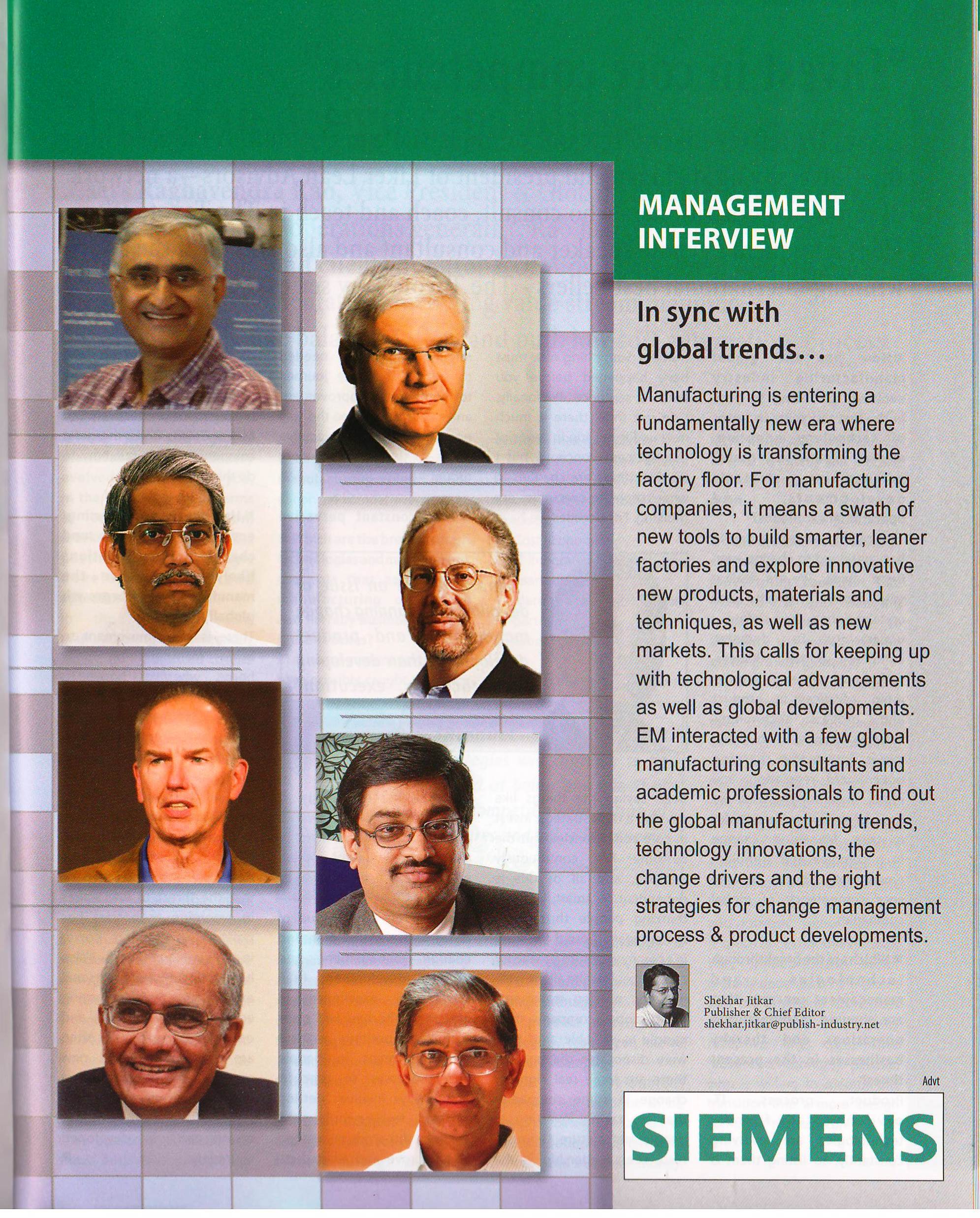
Global Manufacturing trends and technology – Management Inteview

View point 1

Shekat Jitkar, Publisher and chief Editor of Efficient Manufacturing magazine interviewed eight global experts on trends in manufacturing.

The interview is published in their Kompendium 2014. Following is a summary :

Dr Wilfried AulburManaging Partner for Roland Berger Strategy Consultants Pvt Ltd. Establish the right capabilities and Culture.* Shift to Asia:  China is the #1 machine building country worldwide and performance and quality requirements in Asia are getting closer to European levels.

* Game change in the mid-end: The mid-end performance segment is growing the fastest and this is the new global battlefield for emerging and developed market players.

* Go Green: Energy efficiency is increasingly important in key markets such as Europe and Japan. Substantial energy savings can be achieved for selected applications, while for others it is mostly a marketing issue

Dr K (Subbu) SubramanianPresident, STIMS Institute Inc, USA. System Thinking and Transformational Skills required.* Data, analysis and process intelligence aided by Big Data and analytics

* Sensors and Smart devices everywhere;  Innovation in manufacturing processes; Programmable automation (the generic name for CNC, robots, flying robots, AGV and drones);

* Products and  their manufacturing to increase the quality of life at all levels?

* No more learning curve (price -vs- volume is a flat line and not a curve)?

* If low labor cost only means low skilled labor for physical labour tasks or well defined information tasks, then such low cost labour is no longer a competitive advantage?

* Product (Source of revenue), Physical Processes (that enable the products) and USE (Application process of the customer) are the only three unique core capabilities of any manufacturing company.

Michael BremerPresident, Cumberland Group – Chicago;

VP of Manufacturing Excellence Awards process for the Association for Manufacturing Excellence (AME)

Eliminate Waste, but create new Value.* People, people, people! — Ability to find and develop talent. People will be attracted to organizations that treat them with respect and develop their skills and capabilities. Elite organizations create an environment where associates are encouraged to give that little bit of extra effort = passion and engagement

* Rapid prototyping (faster lead times)

* Use of sensors to track manufactured product, provide feedback for early maintenance, and develop closer relationships with customers

* Safety of intellectual property and cyber security – ability to more easily identify fake products

* Ability to more deeply understand customer requirements and total cost of the supply chain

* More collaborative practices across the supply chain where companies partner together to pursue joint growth opportunities.

Dr P N RaoProfessor, Department of Technology, University of Northern Iowa, USA. Utilize the Opportunities available.* Developments in robotics

* Digital Everywhere: Information thread that integrates design, planning, manufacturing and product support through all stages will greatly improve the possibility to achieve first pass success.  This will combine innovative automation, various sensors and control systems, communications across all segments, including the global supply chain. This would mean advanced manufacturing enterprises, intelligent machines, advanced analysis techniques, and cyber security systems in view of the information exchange across the internet with globalization.

* Additive manufacturing (3D printing)

* Integrated systems that will have sensors to monitor the manufacturing process continuously and then adapt the process to achieve the best possible performance by a combination of software and hardware tools.

* Sustainable manufacturing that deals with product design for sustainability, sustainable

manufacturing processes, and sustainable manufacturing systems, while also trying to maximize resource efficiency

Sanjeev BaitmangalkarPrincipal Consultant (Strategy & Lean Manufacturing), Stratmann Consulting. Go Lean …..* The growing number of embedded sensors, collecting information about the world, and the rise of social networks that store the data people share, will generate immense quantities of information.

* Many businesses of the future will use analytics to mass customize and differentiate themselves.

* Business intelligence, which enables organizations to gather quantifiable data on each area of the organization and analyses it in a way that yields information they can act on — helping them enhance decision making, improve performance, mitigate risk and sometimes even create new business models — is growing in importance.

* Small, comfortable, low cost, fuel efficient cars will drive product development.

Suresh Lulla

Founder and MD, Qimpro Consultants Pvt. Ltd.

Quality will not be negotiable.

* Leadership, Strategy and Customer focus* Work force and its quality; cycle time reduction; double the profit without capital through better quality practices; left brain for quality improvement and right brain for process innovation; cross-country bench markeing.

* Low labor cost in developing nations is not sustainable;

* Three bottom lines: Planet, people and profit!

* Three core capabilities needed: Understand customer needs; ability to translate that into product design and ability to outsource where required!

Raghavendra Rao V.P. & Global Mfg. Leader, Frost & Sullivan Invest in design capability.* Rapid prototyping, 3 D printing, real time data and analysis

* Manufacturing “hub” for toll manufacturing to “Design to manufacturing” alliance between partners across developed and emerging economies.

* Cost/ economics; IT Integrated Mfg.; Lean supply chain; Mature, eithical and stable partners; Green manufacturing.

Dr. Jeffrey Liker Prof. of Ind. And Opertions Engineering, U. of Michigan, President, Liker Lean Advisors Invest in core competencies.* Excellence in Execution

*Serious focus on investing in people and culture

* Culture that is humble and open to new knowledge and new sources of learning may have a competitive advantage in the future.