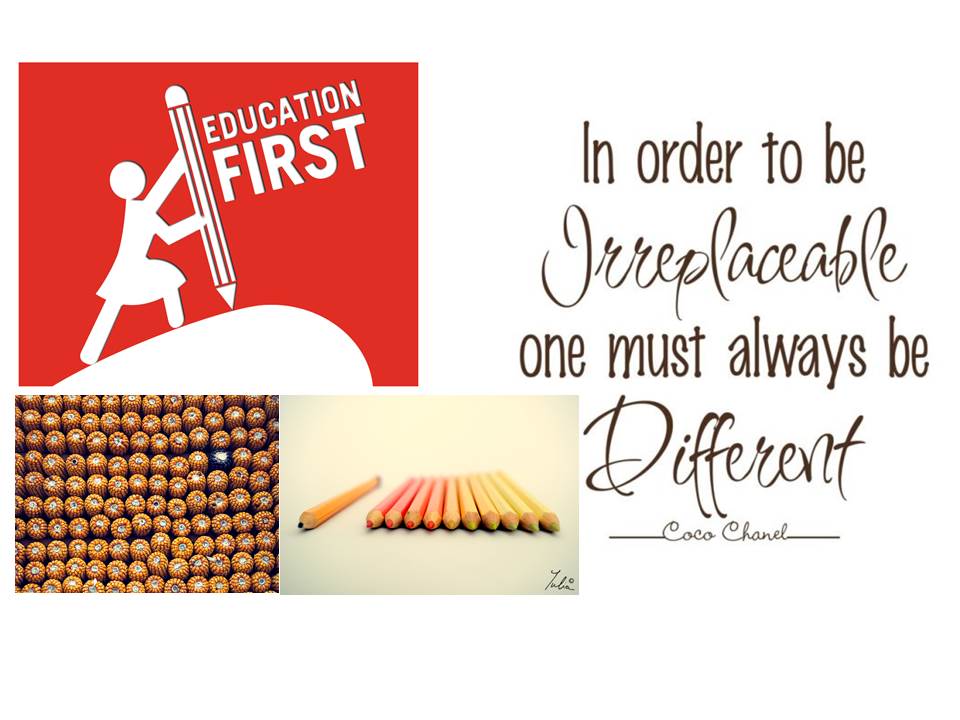
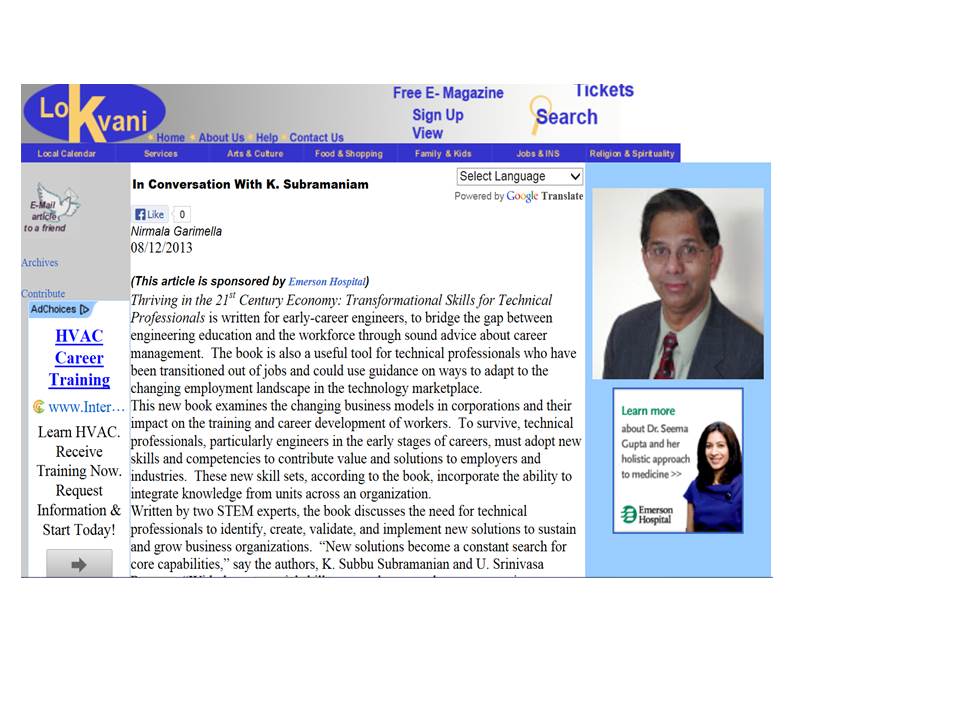
Nirmala at Lokvani interviews Dr. Subramanian

Slide1

http://www.lokvani.com/lokvani/article.php?article_id=9233

1. How did you get the idea of writing this book?
2. Why is it relevant in today’s world? What ideas does it emphasize?
3. What is the salient concept of a the binary economy?
4. Why is it important for students to be aware of this?
5. How does the STIMS institute prepare students?
STIMS Institute has developed courses on Transformational Skills and System Approach for Knowledge Integration. We are implementing these courses in some colleges. We also teach/train mid-career professionals in companies. We offer one-on-one training/mentoring for students and professionals. We have written the book to promote the ideas on Binary Economy and the Transformational Skills for broader dissemination od these ideas.
6. The back cover says that this is more a self-help book? Can you explain that?
7. Finally where can readers find this book?
The book is available at Amazon: http://www.amazon.com/Thriving-Transformational-Technical-Professionals-Managers/dp/0791860167/ref=sr_1_1?s=books&ie=UTF8&qid=1375275381&sr=1-1&keywords=transformational+skills+subramanian+asme+press

At Barnes and Noble: http://www.barnesandnoble.com/w/thriving-in-the-21st-century-economy-k-subramanian/1115191210?ean=9780791860168

And also at the publisher, ASME Press: https://www.asme.org/products/books/thriving-21st-century-economy-transformational

“Automotive industry is doing well in the USA; Detroit goes bankrupt” – What does it tell us about the claimed resurgence of manufacturing in USA?

Mfg Engg view point article 07 31 13

Dr. K. (Subbu) Subramanian, Fellow – SME, is the President of STIMS Institute Inc. www.STIMSInstitute.com. His company specializes in growth strategies and innovation for industrial manufacturing companies and education / training for mid-career professionals and their development. After graduating from MIT, he has worked across the globe in the manufacturing sector for over 34 years. His new book, “Thriving in the 21st Century Economy: Transformational Skills for Technical Professionals” is co-authored by Prof. Srinivasa Rangan.

Automotive industry is doing well in the USA; Detroit goes bankrupt” – What does it tell us about the claimed resurgence of manufacturing in USA?

In the past, there was a close connection between the innovators and investors. Both of them lived and worked in the same place like Detroit. The role of investors and innovators was inseparable and inter-mingled. Today, the roles of investors and innovators have been separated.

Innovators are those who Discover, Develop and Deploy a stream of new solutions of added value. These end to end innovators displayed unique Transformational Skills to render new ideas into reality. Their impact also helped the community around them flourish. While they relied largely on local resources, the financial fruits of their labor was also shared and enjoyed by the community around them. They also invested their rewards for further growth of the community. As a result Detroit flourished.

The innovators and their Transformational Skills are needed today as well. To identify a need as an “opportunity,” frame that as a solution in a comprehensive manner (as an input/transformation/output system), and execute that to completion is the need today as much as it was in the hay days of Detroit. The reach for resources across the globe as well seeking out customers across the globe is a great boon for all innovators.

While the innovators live and work in the main streets, the investors now work in the Wall Street. The investors also live (or at least park their wealth) across the globe. The focus of the investors on their needs vs. the need to focus on the community around them has also been separated. These divergences have been evolving for the past four decades. “Let Detroit go bankrupt” was the slogan. Now Detroit is indeed bankrupt!

What are the lessons to be learned, If you are a manufacturer?

Do not wait for some investor to tell you what you are good at? Do not wait for someone to define what “Manufacturing” is? Products, Processes and Applications knowhow are your core capabilities, which are embedded in the knowledge of many people connected with your company – through your employees, suppliers and customers and their customers. These three core capabilities and the value exploited through them is manufacturing.

Product is something of value to someone (the user), who is willing to pay you (the manufacturer) the value you deserve.

How well do you know your Processes to manufacture your products? They are not “black box” that nobody knows anything about, after Joe Smith retires from the company! They are not merely SAP, ERP, MRP or any of the myriad of IT driven tools. All processes are “Input/Transformation/Output” systems. In the past years, the few who knew about the physics of the process intuitively could tweak them and keep them going, while others were simply pairs of hands to help them out. You can no longer think like that.

You would not like to see any medical professional without a stethoscope and a thermometer. Then, why would you not want all your manufacturing process professionals – your employees as well as suppliers and customers – have similar capability to measure and diagnose and cure the problems with respect to all the manufacturing processes and their health?

How well do you know your customer’s processes (Application) and how can you add value in their processes through your products? You can make your Applications Technology (AT) the enabler for your growth and success in the manufacturing industry, just as you have IT solutions providers for your computers and IT systems. It is about time, you helped your customers in a “health checkup” on their processes, while they use your product. After all, strong and healthy customer processes are essential for your long term strength and success.

Product, Process and Applications know-how are your core capabilities. They are the bench strength of your team. Build your bench strength and then you can do more with them enabled by all the plug and play IT capabilities. Your journey for the future can start right here and now, by developing a common definition of your “Product” and the key “Physical Processes” that enable your product, as well as the “Applications”. Then develop a system view to study and manage these core capabilities across all your business functions that support them. Build further alliances based on these core capabilities with your customers and suppliers. Let this manufacturing eco-system flourish. If you do, then Detroit along with others will also flourish.

You certainly need investors to help you out. But, you cannot build a manufacturing industry without the brick and mortar (i.e) Product, Process and Applications Technology. Have you taken the time to cultivate the manufacturing eco-system based on these core capabilities? The alternative is to repeat the history of Detroit in many other cities and communities in the USA.


Low Interest Student Loans – Is that enough?

Slide1

Recently I wrote to Senator Elizabeth Warren, thanking her for her efforts to keep the student loan interest rates as low as possible. It is a very important effort and we hope the senator will succeed.

But, I need to call to attention to an equally if not more serious issue (i.e.) the kids who borrow money and go to college, do not have enough jobs when they get off school. This is not just a matter of bad economy. It is a serious evolution happening world wide. We call this as the Binary Economy as outlined in my recent book. Please see the materials attached.
THRIVING IN THE 21ST CENTURY ECONOMY.FA_Subbu&Srini_Foreward plu Intro.

Book Flier 07 10 13

What we need are initiatives to create new STEM jobs and in large numbers. While this happens, the students should be smart to create their own jobs as outlined in our book, through Transformational Skills.

Industry will create such STEM jobs only when they need them and they can create most of what they need outside of USA (at lower cost). What we need are initiatives to create new STEM jobs, inside the USA, simply because they are needed to employ all our kids who graduate from colleges. We need Wind, Solar and PV and other jobs not because they will be economical some day – which is for the industry to start out – but simply because we need STEM educated kids to go to a job, have decent living and and pay off their student loans. Same goes for oil and natural gas jobs, High Speed Trains, Improved Infrastructure, Space Exploration, Medical Research, etc.

Government can not and should not choose the side among companies or industries. But, Government MUST choose side with educated kids and their long term living standards, since they are the future of the nation.

So, while the senators and congress fight for keeping the loan interest at low level, they are also required to fight for STEM jobs, so that the educated kids pay off the very same loans. Otherwise it is better to let them not borrow so much money, since they will only find low wage jobs with which they will be burdened with their loans for their life time.

Please don’t get me wrong. I want low interest student loans for education. But, we will be doing disservice to these kids showing them a rosy path, if we don’t create the necessary jobs available at the end of the tunnel.

Until that day comes, it will be smarter for the students to learn the Transformational Skills and for the parents help them with such education, to chart their own path for jobs and careers and avoid the pitfall of large student loans for an education that does not and will not get them decent jobs.

What do you need to create good jobs? The answer is not “more of the same” education

Different educationIn a recent article, with the by-line, “What happens when good jobs disappear? It’s a question that has been asked for centuries”, Dr. Paul Krugman states, “Today, a much darker picture of the effects of technology on the labor is emerging. In this picture, highly educated workers are as likely as less educated workers to find themselves displaced and devalued, and pushing for more education may create as many problems as it solves”.  “Sympathy for Luddites”, Paul Krugman, The Global Edition of New York Times, Page 9, Saturday-Sunday, June 15-16, 2013,

In this description Dr. Krugman uses the commonly used version of “technology” (i.e) Digital Technology. The real world of technology is far larger than mere limitations and constraints of DT. The industrial society has to come to the realization that Technology in its broader context is an integration of Science, Engineering and Management of any phenomena of nature. This broader view of technology opens limitless possibilities for the educated work force. Absent such Transformation in their learning and thought process the broader range of educated work force – and their educators  and the society at large – will not be served well by the constant evolutions in DT. This is not to suggest that DT is a detriment. Instead it has to be used wisely and prudently with technology pertaining to other fields to create a stream of new solutions.

We agree with Dr. Krugman in that the opportunities even for the highly educated is limited to a narrow set of jobs, where knowledge is integrated from everywhere across the globe (using DT as an enabler for such integration) and hence create a constant stream of “New” solutions. There will also be a large range of low wage jobs, where the skills of educated work force is not much needed, thanks to standardization and de-skilling of the work and as a result automation and outsourcing of the jobs. Most others – in the middle – will find uncertainty and loss of economic competitiveness as the norm, which we have come to accept as the crisis of the middle class. For details on this emerging Binary Economy and the Transformational Skills to cope with that please see:

https://stimsinstitute.com/2013/06/19/new-book-authored-by-dr-subramanian-and-prof-rangan-has-been-published-by-asme-press/