Role of decision making in Management

Role of decision making in Management

In the beginning of the NYT essay https://www.nytimes.com/2026/02/21/us/politics/gorsuch-congress-trump-tariffs.html we find the following:
“Yes, legislating can be hard and take time,” wrote Justice Gorsuch, a Trump appointee who is part of the court’s conservative majority. “And yes, it can be tempting to bypass Congress when some pressing problem arises. But the deliberative nature of the legislative process was the whole point of its design. Through that process, the nation can tap the combined wisdom of the people’s elected representatives, not just that of one faction or man.”

These are wise and timely words, also implying the failure of the current Congress and its willingness to sit on the sidelines, abrogating all its power and authority to an Executive intent on enlarging his power, laws and Constitution be damned!

There are obvious failures and pitfalls in our current political process. Every citizen in this great Democracy must reflect upon it and act as required! “A republic, if you can keep it” is a famous, cautionary quote attributed to Benjamin Franklin in 1787, emphasizing that maintaining a free, representative government requires active civic responsibility, not just its establishment!

“All politics is local” is a famous maxim coined by former U.S. Speaker of the House Tip O’Neill. Generally it is used to handle political issues by chasing its roots to the local population. We could also chase down the current plotical quagmire or failure in our governing process at the national level and its similairity to what is generally known as “management problem”?

Above words of Justice Gorsuch have profound implications in any management process as well. After all any management effort requires a relentless chain of “Plan / Organize / Coordinate / Control (verify against plan)”. In every step, decision making is required. Such decision making would be objective and free of personal bias (un-attached) when input from all sides and from everyone involved is included. Not every decision can be left to the Chief Executive. Everyone at every level has to make their decisions and stand up to defend all such decisions. It can be tempting to bypass established roles and processes when some pressing problem arises. It is such systemic failure in decision making at various levels and functions that is the root cause of what we commonly identify as “Management Failure”?

System Approach for Customer Success Management

Customer Success Management (CSM) is a relatively new functional area within many companies, an increasingly vital operational role, a rapidly growing profession, and an underlying systems management philosophy that is growing in importance, especially – but not exclusively – within the technology industry. One leading industry organization (Customer Success Association 2021) defines CSM as “a long-term, scientifically engineered, and professionally directed business strategy for maximizing customer and company sustained business value,”. Others describe CSM as “a customer-facing, non-direct sales role that embodies the mindset of a counselor
to proactively partner with customers to help them achieve their goals and promote long-term customer health that ultimately leads to relationship growth”.

A recent paper that outlines the System Approach for CSM has been authored by Prof. Vijay Merhotra at UCSF, School of Business and Dr. Krishnamoorthy (Subbu) Subramanian from STIMS Institute. For a complete vesrion of this paper, please see: https://stimsinstitute.com/wp-content/uploads/2025/08/system-view-of-csm-published-paper-with-prof.-vijay-merhotra-ucsf-07-22.pdf

Every Co. has processses required to produce and supply their products. When their products are used and the value realized by the customer, only then recurring sales and sustained sales growth of the supplier is realized as illustrated in the figure below:

CSM plays an imptortant interfcae role between the customer and supplier as illustrated in the figure above.

Every process of the “Customer” is a “system” that can be described as an

“Input /Transformation / Output” Scheme
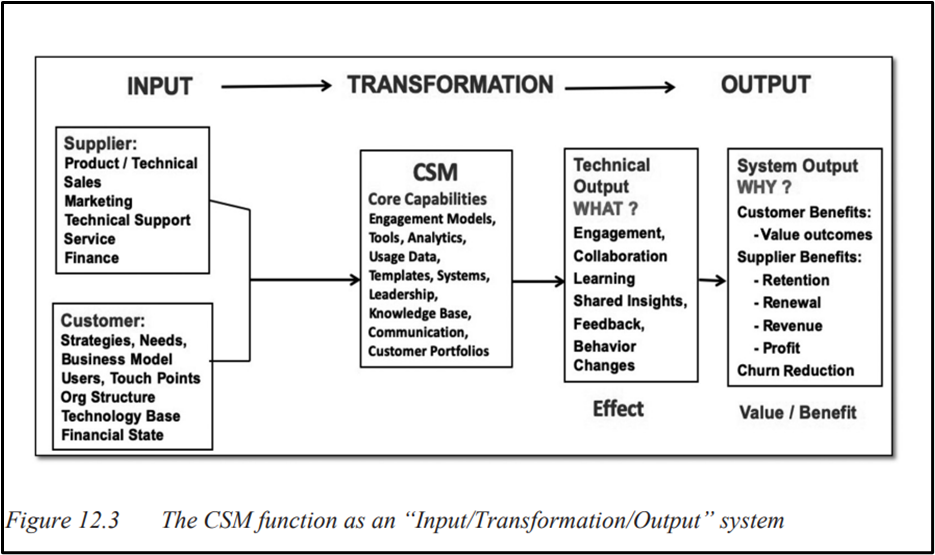
The output itself may be classified as “Technical Outputs” or the nuts and bolts of the solution, leading to the desired value/benefits called the “System Outputs”.

This System Approach has been setailed in the book authored by Dr. Subramanian and Prof. Rangan: https://www.amazon.com/Thriving-Century-Transformational-TechnicalProfessionals/dp/0791860167/ref=sr_1_1s=books&ie=UTF8&qid=1371673516&sr=1-1&keywords=Transformational+Skills+Subramanian

The Customer Success Management as a System integrating customers and Suppliers is illustrated in the Figure below:

In figure 12.3 above on the input side the various functions of the “Customer” and “Supplier” are listed. Everyone of them is a stakeholder in the “Transformation” (i.e.) Customer’s process in which the Supplier’s product is used. Hence opportunities for maximizing or “Optimizing” the System outputs – Stakeholder benefits – could be far larger than that listed even in this figure!

Beyond that, consider all other “Suppliers” involved and their “Products” required for the Customer’s process. Now you have a far larger list of “Stakeholders” and their benefits that you could synergistically optimize and attempt to satisfy. Every such satisfied “Supplier” is also a beneficiary for the “Customer” and his “process”. This a substantially expands the role and impact of “Customer Success Management”! 

In this CSM Philosophy, any supplier can adopt the “Customer’s Process” as his own (i.e.) “Becoming a Customer’s Customer”! In many respects it may also be seen as the evolution of Applications Technology in the Customer / Supplier relationships.