When public discourse leaves reasoning and logic to the way side ….

I could not believe what I heard, as I was watching the TV show on a Cable channel. “middle income wage earners have not had an increase in wages in 15 years. You can look at the statistics from the government. They’re furious, they’re beleaguered, they’re angry. They’re looking for someone to represent them and that turns out to be Donald Trump who has tapped into this anger,” Kudlow explained.

Was it really the Larry Kudlow? Where was Larry when there has been constant obstruction from the Republicans to any investment in infrastructure in all these years? Where was Larry when everyone in the industry and the business community diligently took advantage of lower cost manufacturing in China, while eliminating well-paying jobs in the US? Does Larry truly think that it is the Chinese Government and the Mexican immigrants who are the causes of the problem and the investors and the business men in the USA have no part in it? How can he believe that one of these businessmen who took the American workers to the cleaners will be their savior going forward? Now my mind is growing numb in disbelief.

We are not political or partisan. We do not support either party or any candidate. But when public discourse leaves reasoning and logic to the way side, we are obliged to point out such folly. We have earlier pointed out that US economy can continue to grow without a related growth in higher wage jobs. https://stimsinstitute.com/2014/02/16/can-the-economy-continue-to-grow-while-creating-fewer-well-paying-jobs-the-answer-is-yes/ We have also pointed out the reasons for such jobless recovery and its impact on the growing disparity between the rich and the poor. https://stimsinstitute.com/2015/10/18/why-are-the-rich-getting-richer-and-the-poor-getting-poorer-what-can-be-done-about-that/ We have also described how the support for Mr. Trump and Mr. Sanders emanate from the same reasons, even though the language and style of these two gentlemen are the polar opposites: https://stimsinstitute.com/2015/07/24/what-is-common-between-bernie-sanders-and-donald-trump/

As long as jobs are the only source of income for the workers, they are paid through their contribution to work in three ways: Knowledge work (Professional), Information work and Physical (labor) work. This is true for any job and at any level. Of these Information work can be increasingly automated and this also enables the physical labor work to be outsourced to low cost countries. Scapegoating the Chinese Government or Mexican immigrants by the Trump campaign will not reverse this reality. It is merely preying on their anger, like a thirsty man being led for water by pointing to the mirage in a desert.

Distributing the wealth from the rich to the needy is not a political reality in the US at any time. With the Republican party dominating the Congress (in both houses) and a large Republican majority in many state governments, even fair and equitable distribution through progressive taxation is in question.  The appeal of Sander’s campaign to the young with a promise of re-distribution of wealth is hence rooted in their enthusiasm for change more than it is rooted in reality.

The gradual elimination of information work and physical labor as human centered activities is a development over the past four decades. Evolution in Digital Technology in broad terms and Information Technology in particular is their cause. It is like life before electricity and life after. There is nothing one can do about this shifting nature of jobs and employment, by merely clinging on to the old paradigms and economic tools.

There was limited room to accommodate the shifting of wage earning capacity. As factory labor jobs became scarce, people took to IT jobs. As they become scarce we need new ways for people to work and earn their wages. Government investment in infrastructure projects is one way forward. This will create labor work to some extent. This is the proven path from the Eisenhower days. Failure for such large investments and their negative impact should be placed squarely on the US Congress and its inaction. It has resisted any large scale infrastructure investments in every step for the past decade. This role of the Congress is like those who are happy to cut their face in spite of their nose! Can Mr. Trump or Larry Kudlow reverse this inaction in congress? Can Mr. Trump claim to have a mandate for such investments? Will the congress heed to such mandate any more than their obstruction to Mr. Obama’s plans? It will require opening of their purse by the rich – friends of Mr. Ludlow – through a more progressive tax plan. It is not clear how Mr. Trump will accomplish that any more than Mr. Obama could with an intransigent congress?

Indeed large growth in employment through infrastructure investment has been a major source of economic growth in countries like China. These investments in airports, roads, bridges and power plants in China by the Chinese Government have also been a source of “subsidy” for business men like Mr. Trump, who make their products cheaper there for sale in the USA. This economic reality cannot be swept under the rug in the heated rhetoric now in vogue in the presidential debates.

Higher education has been used as a tool for moving away from the diminishing factory labor jobs – rust belt jobs – into belter paying information work on the East and West coast. As this transition seems to have reached its limits we have more people with college degrees and large student loans. Mr. Sanders can wipe out their debt burden, but what are they supposed to do after that? Where will the new jobs come from?

Reducing college debt by having the beneficiaries re-pay that through service work of value to the nation is a temporary measure. That still leaves several issues for an economy with limited demand for human capital. We call this as the Binary Economy, which by definition has the relentless focus on eliminating whatever we call as the “middle”, which is composed of human centered work focused on information and physical labor.  This Binary Economy is propelled by unrelenting development and deployments of the tools of IT and in a broader sense the Digital Technology. The Genie is out of the bottle. There is no way to reverse that. No amount of demagoguery against the Chinese, Mexicans, immigrants or Muslim will solve this problem. No amount of anger directed against the Wall Street and its greed and the crony capitalism will address this fundamental driving force. But the wise minds must find the answers before the anger fueled by Mr. Trump becomes a global anger. That will be far worse than the global terrorism we are forced to confront today.

We are a nation where individuals take action long before the actions of the government. To those who believe in self-help we suggest a strong dose of education on System Thinking and Transformational Skills.

Three levels of System Thinking

In a recent blog post: http://blog.readytomanage.com/how-is-critical-thinking-different-from-analytical-or-lateral-thinking/  three kinds of “thinking” are described – Analytical, Lateral and Critical thinking. Following is our take on this subject:

In our view, every activity and/or solution is an INPUT/TRANSFORMATION/OUTPUT system.

TRANSFORMATION represents the Phenomena pertinent to the activity. Understanding the Transformation implicitly, explicitly or through inference/intuition is the “SCIENCE”. Application of the Transformation to obtain the desired change of the inputs to outputs is the “ENGINEERING” behind the activity or solution. Discerning the Output between the “What?” and “Why?” is the strategic thinking. Ensuring that the desired outputs are achieved by orderly integration – with respect to time, cost, resources and their efficient deployment – of the inputs to effect the transformation is the “Operational” aspect of the activity. Strategy and Operations are the two sides of anything we call as “MANAGEMENT”.

In this Systems thinking there are three levels, which relate to the three aspects described in in the blog post mentioned above

AWARENESS: analytical thinking mainly aims to review the data/information we are presented with (for relevance, patterns, trends etc.) — the ability to clarify the information on-hand and their assignment into the various aspects of the “System” as defined above. It also helps to identify the missing data or gaps and the questions to ask and in what order?

ANALYSIS: Lateral thinking aims to put data/information into a new or different context (in order to generate alternative answers or solutions) — answer the questions raised using the tools of Science, Engineering and Management in an interdisciplinary manner. Today such lateral thinking is part of higher education, but limited to the three disciplines, but mostly as impermeable silos!

SYNTHESIS: Critical thinking aims to make an overall or holistic judgment about the data/information which is as free from false premises or bias as much as possible — ability to answer the question ” 2 + 2 = ?” with an answer, “Why is this question raised in the first place” ? Then find answers which might lead to “2+2 = 3, 4, 5 or Fruit Salad”. In the last case it will be the sum of two fruits (Apple and Orange) with two other fruits (Peach and Banana) together with some ice cream on the side making the whole the Fruit Salad! Hence CRITICAL THINKING can be thought of as third level of SYSTEM THINKING, where the whole is seen as larger (or smaller, if that is the output of the “System”) than the mere sum of the parts. It is an ability to see the picture or pattern, rather than the mere emphasis on the pixels! For more details on System Thinking and the three levels: https://stimsinstitute.com/20151207books/

Bringing the science to shopfloor manufacturing

Slide1

Traditionally grinding process is treated as something very complex and known only to a few with many years of experience and with specialised skills in the shop floor. A portable diagnostic tool and interpreting the process signal is changing the situation and helping to reduce such challenges faced in grinding.

“It is like using a torch light in a dark ally. Once the light of the signal shines, we can see the path more clearly and easily,” states Dr Subramanian.

“Further analysis of the signals and explaining the variations in terms of the microscopic interactions that occur in the grinding zone, brings the science of grinding to the shop floor,” according to Dr K (Subbu) Subramanian, President, STIMS Institute Inc, USA. He has been mentoring this work at IIT Madras and its subsequent transfer for industrial use. This work at IIT Madras has been carried out as part of a larger project, “Development of Next Generation High Precision Grinding Machine Tool,” funded by the Office of the Principal Scientific Adviser to the Government of India. Prof Ramesh Babu is the principal investigator of this project along with his students at IIT Madras. MGTL, an industrial partner in this project is commercializing this mobile diagnostic tool as Grind TrakTM.

In a recent example, a grinding process was the bottleneck operation, limiting the production of the entire line. By looking at the signals obtained and analyzing them, it was determined that the cycle time for this operation can be reduced resulting in a net increase in line throughput of 40%, without the need for any additional investments.

“Next generation of manufacturing will require smart and well qualified people using portable diagnostic tools and techniques very much like the medical field. In this regard, the Grind TrakTM will serve as the stethoscope and thermometer for this new generation of grinding professionals”, asserts Dr Subramanian.

42 Technology Grinding Machines EM FEB 2016


Warning against AI and job loss: What can be done about that?

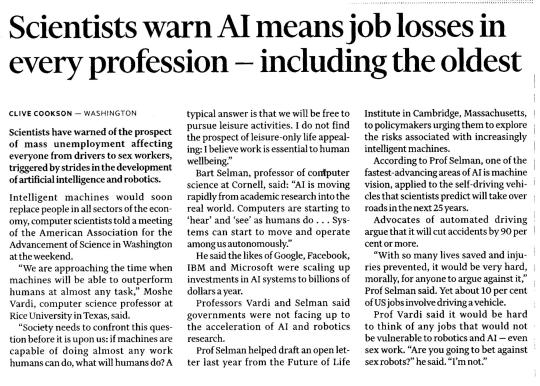
“Scientists warn AI means job losses in every profession” is the headline for an article in the Financial Times dated Feb. 15, 2016. This page 1 article is authored by Clive Cookson.  The copy of the article can be seen at the end of this post.

Following are a few quotes from this article: Intelligent machines would soon replace people in all sectors of the economy, computer scientists told a meeting of the American Association for Advancement of Science in Washington at the week end. ……….. “We are approaching the time when machines will be able to outperform humans at almost any task”, according to the computer science professor Moshe Vardi from Rice University, Texas. ”Society needs to confront this question before it is upon us …..”  Professor Selman from Cornell University has helped to draft an open letter last year from the Future of Life Institute, Cambridge, MA. to policy makers urging them to explore the risks associated with increasingly intelligent machines.

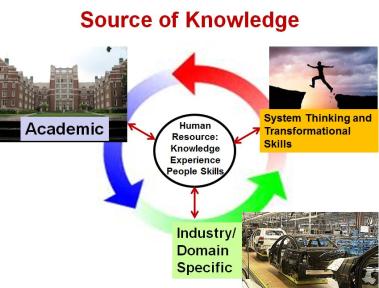
While the above caution and appeal for better public policies are valid and timely, it is perplexing to see that such caution is raised only against a future possibility imposed on us by self-driving cars, robotics and Artificial Intelligence. We believe that individuals and enterprises cannot sit and wait till some policies are debated and implemented to address the unabated role of DT (and its formulations such as AI and Robotics and driver-less cars, etc.) in eliminating human centered work. Individuals need to gain academic knowledge in combination with their applications know-how (called sector or domain specific knowledge), together with a set of skills for “System Thinking and Transformational Skills”.

Knowledge Integration

We call this collective know-how and its application as the Knowledge Integration. Such KI capability is the essential education at all levels. The practice of KI will be the competitive weapon for workers and their employers for the foreseeable future.

For education on System Thinking and Transformational skills and for projects to implement them for competitiveness in the global economy https://stimsinstitute.com/contact-us/

Our detailed views on this topic can be seen at: Warning against job loss

AI and employment

Leadership: Three levels of System Skills

In a recent post in the HBR titled: Want to be an outstanding leader: Keep a journal? https://hbr.org/2016/01/want-to-be-an-outstanding-leader-keep-a-journal? the author suggests keeping a personal journal and also taking time off for periodic reflection. We fully agree with these suggestions. Here are some additional thoughts:

A Leader evolves to be one by gathering ideas (Self and that from others), integrates them into a solution and leads a team to achieve and enjoy the benefits of such solution. Hence by inference every leader and in any field is a Knowledge Integrator, capable of thinking of problems or opportunities as a system: The Whole is larger than the mere sum of its parts.
There are three levels of System Thinking in any leadership role:
AWARENESS of the big picture (at this level any form of knowledge and information aggregation is very useful; Maintaining a personal diary or journal is one such tool; it offers a structure or discipline for knowledge aggregation.)
ANALYSIS: This is the next level of System Thinking for any leadership role. Some times this analysis of data and information is personal, some times it is collective. A good leader finds ways to push every one to this stage. Most will resist it as the tendency will be to just supply information and wait for orders. Such task oriented persons can never be a leader, no matter what their title or assigned role is.
Moments of peace and introspection are ways in which a leader separates himself from the mere tasks and engages in analytical reasoning that connect the dots, to see the big picture – how the whole can become larger than mere sum of the parts.
SYNTHESIS: Few, Very few ascend to this level. The synthesis is an outcome of analysis. While Analysis offers an answer to the “Why?”, synthesis challenges the leader to inspire the self and others to ask “Why not?” and then find the answers.
For details on the three levels of System Skills for a leader:

Books