Every one of us needs a strong dose of “System Thinking”. Do you agree?

Every one of us needs a strong dose of “System Thinking”. This includes all of us –  those in the Government, business, professionals, academics, fellow citizens,    …. Do you agree?

Recently I posted the two comments in the LinkedIn as noted in this message. I wrote them as a response to two blog essays. These essays suggest a need for a strong dose of System Thinking – looking at the big picture, as a whole and not in bits and pieces.

One of the blog essays suggested that Government and political leaders must act like the way businesses are managed:

    quote from blog

We agree with this need for a focus on long-term sustainability and not on the short term gains. We also need to recognize complexities of Democracy and each of us need to do our part.

If you hired 500 workers and about thirty among them said “we want to bring down the President of the company no matter what”, then what will you do? Suppose these thirty employees are also guaranteed that they cannot be fired from their job – thanks to “safe seats” – then what will you do? Suppose the “supervisor” – the speaker in this case, does not want to take any action and side line these 30 workers, then what will you do? You cannot fire the supervisor ad-hoc and you need a rigorous process – next election ? – Then what will you do? It is time the CEOs and journalists and those who fund these non-performing employees and their elections speak up and say “enough is enough” and call the spade a spade! The political correctness and being superficially equal to all sides can be very harmful. The poor who are affected by sequestration and the un-insured who are poor do not have any voice. The rest of us who are fortunate not to be poor or be already insured also need to speak up. Beyond that, ballot box is the loudest voice available. That is the price and privilege of democracy. Other than that, we can call upon the national pride and plead with those who are driven by ideology to think of the nation at large, her economic needs and avoid the deep self-inflicted wounds.

http://www.linkedin.com/today/post/article/20131003131039-73785410-we-are-still-waiting?anchorTime=1380814227134&deepLinkCommentId=5791554636129079296&trk=hb_ntf_MEGAPHONE_LIKE_TOP_LEVEL_COMMENT

System thinking also requires attention to details and avoid pithy phrases and cliché. Commenting on the current crisis in Washington, one blogger wrote: “Don’t hate the players, hate the game”. What does it really mean? Drop the rules and principles of a democratic process (the game), because few politicians want to impose their will ad-hoc?

At the end of the day, any system or organization works only to the extent the people play by the rules. If required, rules can be changed again through a set of rules established for such change. “Don’t hate the player, hate the game” means nothing when the game is not played by the rules! You can not play basketball with those who want to spill water on the court to deliberately injure some players! This will happen when people coming to the basketball court not to play ball but cause havoc to those who want to play. President Obama was elected twice and the ACA was passed by the congress, upheld by SCOTUS and was re-affirmed through a national election. Now 30+ congressman from districts where Obama was defeated by 20% or more, do not want to play ball. This is like a few players from a team who lost the game don’t want to leave the court, instead want to rip and tear the court. Sadly there is no security force that can be called upon for this unruly behavior! The only people who can fix this are those voters in these “safe districts” who need to talk sense into their elected representatives. Otherwise those fellow citizens will be the laughing stock of the nation. Are they listening?

http://www.linkedin.com/today/post/article/20131002122233-201849-who-caused-the-government-shutdown?anchorTime=1380822830677&deepLinkCommentId=5791590722003955712&trk=hb_ntf_MEGAPHONE_LIKE_TOP_LEVEL_COMMENT

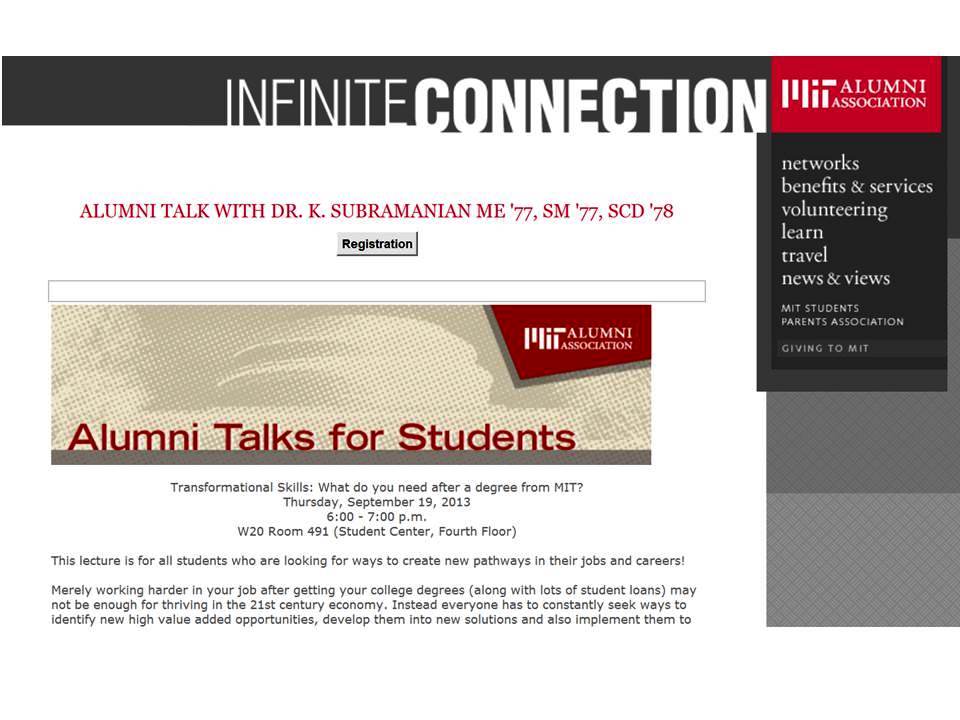
Transformational Skills: What do you need after a degree from MIT?

Slide1

2016 MIT Community talk

K. Subramanian

Merely working harder in your job after getting your college degrees (along with lots of student loans) may not be enough for thriving in the 21st century economy. Instead everyone has to constantly seek ways to identify new high value added opportunities, develop them into new solutions and also implement them to be sure that the value is realized and in the end the work is rewarded as well. It is a lot more than simply doing the job you are asked to do. This combined set of skills to Discover, Develop and Deploy a stream of new solutions are the Transformational Skills.

Transformational skills go beyond mere academic education in science, engineering, or management. In fact, it requires a judicious blend of all these three pathways and not treating them as isolated silos. It requires diving deep into the problem or spanning wide as required. Workers with such skills are called as the “T-shaped thinkers”.  It also requires a comprehensive view of the problem on hand – as a system – and not mere piece of a puzzle. It is imperative that workers at all levels learn the Transformational Skills and integrate them in their arsenal to frame their own jobs and careers.

Dr. K. (Subbu) Subramanian, President, WWW.STIMSInstitute.com, obtained his Ph.D. from MIT in 1977. Following his successful career than spans over 35 years working in the industry and across the globe, he has captured the lessons learned on Transformational Skills in a recent book co-authored by Prof. Srinivasa Rangan. https://www.asme.org/products/books/thriving-21st-century-economy-transformational

Full of insights and valuable information for ambitious professionals

5.0 out of 5 stars

September 5, 2013,

By S. McFarlane

Amazon review

This review is from: Thriving in the 21st Century Economy Transformational Skills for Technical Professionals (Technical Manager’s Survival Guides) (Paperback)

As a young, aspiring professional I found this book to be an enlightening and informative read. It outlines the changes our economy has seen as a result of globalization and information digitization and details the new challenges we face. The book goes on to describe ways to manage careers and how professionals must adapt to the new binary economy (read the book to learn what a binary economy is!). It encourages you to think of ways to take ownership of your career and strategize ways you can become a value-add to an organization. The book details the significance of developing a common language “between those who have a need and those capable of recognizing the need as an opportunity” and emphasizes the critical importance of developing transformational skills to establish New Solutions (again read the book to learn about New Solutions!). Thriving in the 21st Century Economy is not a light read. To take full advantage of what this book has to offer and develop a strategy to foster life long learning, it requires you to focus and really think about the concepts presented. If you give it your full attention I have no doubt you will walk away with ideas that will help you thrive throughout your career.

Aidan Harney from Engineers Ireland reviews the book

Presentation1

http://www.engineersjournal.ie/engineers-need-transformational-skills-to-survive-today/

Dear Aidan:

What a wonderful and well written review! Thanks a lot.

Few additional thoughts as noted below.
Best wishes
Dr. K. (Subbu) Subramanian
You have hit the nail on its head in paragraphs 2 and 3.
Regarding “Common Language”, it is more than exemplary communication. It starts with a precise – rational and scientific understanding of the key words used  in each job, project, sector and domain and ensuring they truly reflect the intended meaning. As an example the word “product” means many things for the many people in a company! The word
” technology” is totally misused to mean “IT”, by almost every one – every pundit on TV, news, academia, …. Such misunderstanding or lack of understanding is a great source to discover new opportunities to fill the unmet needs!
Few other examples:  
  • Do we know what STEM really stands for?
  • There are hundreds of millions of $ in research spent in the name of “nano – technology”, but what is the “technology” – the science, engineering and strategy – here?
This publication may make uncomfortable reading for many  — This is a powerful and telling insight. We (the authors) did not want to make it explicit. But, since you have stated it, now every one should know :-)
This is also the crisis of the “middle” which we address in great detail in our book.