STIMS Institute – President receives the coveted 2020 Merchant Medal

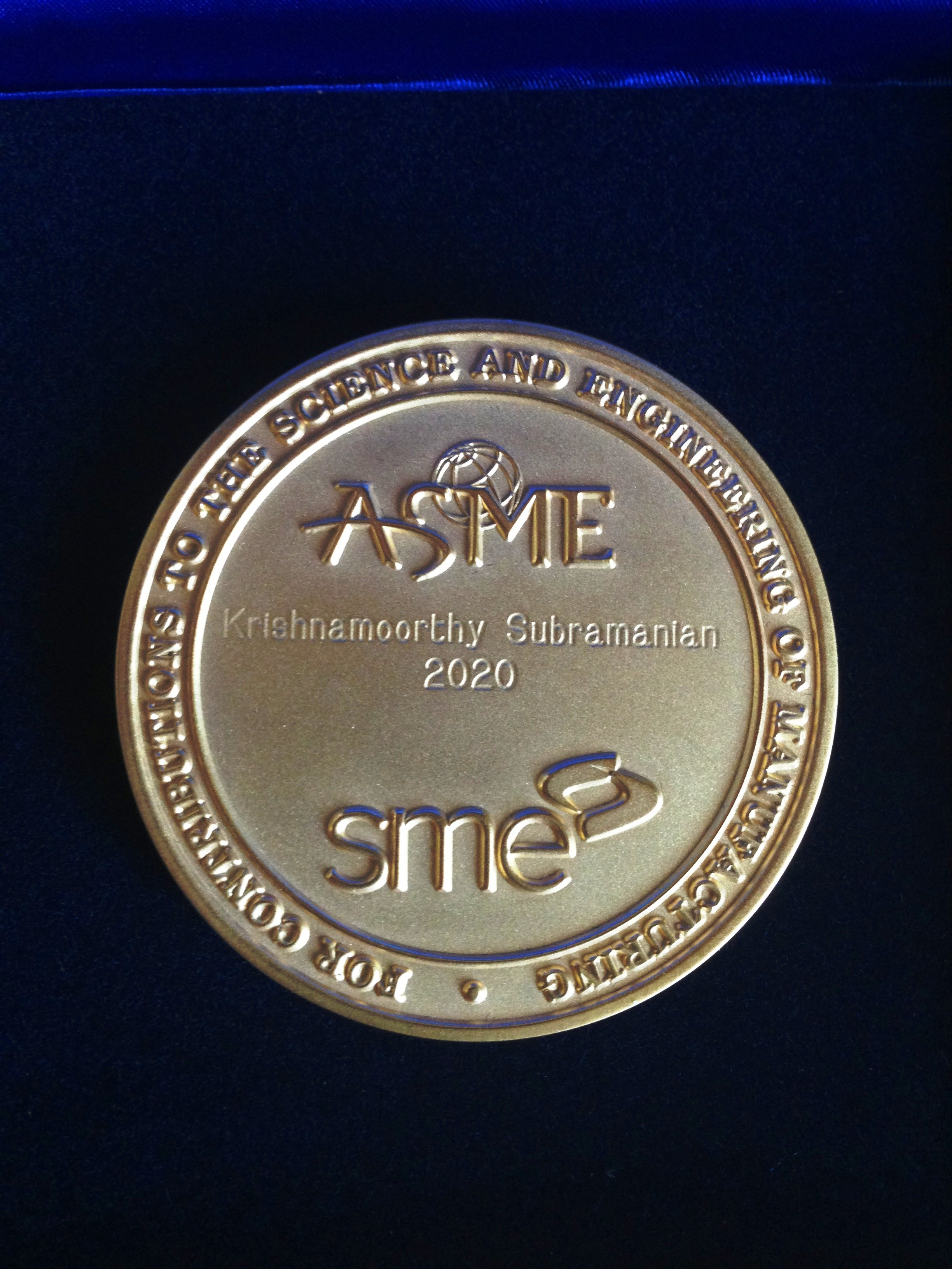
Dr. Krishnamoorthy (Subbu) Subramanian, President STIMS Institute has been awarded the coveted 2020 Eugene Merchant Medal offered jointly by two professional Societies (American Society of Mechanical Engineers – ASME; Society of Manufacturing Engineers – SME).

https://www.asme.org/topics-resources/society-news/asme-news/dr-krishnamoorthy-s-subramanian-2020-asme-m-eugene-merchant-manufacturing-medal-winner

The M. Eugene Merchant Manufacturing Medal was established in 1986 by ASME and SME to honor an individual who has played a significant role in improving the productivity and efficiency of the manufacturing operation. https://www.asme.org/about-asme/honors-awards/achievement-awards/m-eugene-merchant-manufacturing-medal-of-asme-sme

Accepting the award, Dr. Subramanian shared the following brief remarks:

Following is a brief summary by Dr. Subramanian on the highlights of the work that resulted in this prestigious award:

My sincere thanks to ASME and SME. I am very grateful to the awards committee, chairman as well as all my nominators; especially Prof. Jawahir from University of Kentucky. The guidance from my parents and grandparents was the motivation in my early years. Thanks to Prof. Nathan Cook at MIT, Dr. Eugene Merchant and many others for my academic depth and professional approach Special thanks to my family and especially my wife Dr. Durga Subramanian. As a fellow industry professional, as a Chemist, as a mother and grandmother, Durga equally deserves this award! This award is also recognition of the work of a large body of people from Industry and academia from all across the globe. My sincere thanks to all of them.

In the field of Manufacturing, there are countless Physical Processes like Grinding, Machining, etc. They grow their roots through research; become visible through industrial use and yield fruits measured as commercial results. Merchant medal is an honor that recognizes the contribution to this combination of efforts and outcome in manufacturing. I am genuinely honored and humbled to receive this recognition and the award. Thank you very much!

Background:

In a world dominated by computers and Digital Technology one would wonder what is left to do in a 100 or 1000 year old process like Grinding Processes?

Whatever work I did at Norton Co. (and later as part of Saint-Gobain) stand on the shoulders of many others from the long list of researchers in the Norton abrasives Co. family such as: Dr. Loring Coes; Dr. George Reichenbach;  Mr. Bob Rowse (who invented Norzon together with Prof. Mert Flemings from MIT); Dr. Richard Lindsey (together with Dr. Hahn from Heald Machine Tool Co.), etc.

The researchers who worked on principles of grinding outside of Norton Family include: Prof. Milton Shaw, his student Prof. Nathan Cook and his student Prof. Steve Malkin and many others. I am also a student of Prof. Cook!

There are also many other eminent researchers from USA, Europe, Germany, Brazil and India among others from across the globe over the years.

Accomplishments:

Seminal work: Microscopic Interaction model : Every grinding process – from manual grinding using Coated Abrasives sanding of furniture or manual weld grinding to precision grinding of every kind to ultra-precision grinding including high tech ceramics manufacturing can be measured, modeled and studied using the “Microscopic interactions model” as the starting framework. https://stimsinstitute.com/wp-content/uploads/2018/01/manu-17-1209-final.pdf Such model is also needed to analyze and manage all modern grinding processes, where abrasive tools are used as Engineered Components as opposed to the traditional approaches where the abrasives have been used as commodity and consumables (and hence any deficiency in the grinding system was compensated by wearing away the abrasive tool!). In this aspect this model is analogous to the seminal work of Dr. Merchant (this award is named after him) and his model for cutting or machining.

This was followed by the drive for in-process data and its accessibility through a portable device that resulted in development of Field Instrumentation System (FIS) and its use. https://stimsinstitute.com/2016/02/16/bringing-the-science-to-shopfloor-manufacturing/ Extensive use of FIS together with the analysis method resulted in many SGA sales people (who were not engineers but technically inclined) become “problem solvers” for our customers. Hence the concept of Application Technology – AT (distinct from Product Engineering) was developed. https://stimsinstitute.com/2012/08/19/vision/

Today in the Bay Area there is a movement called “Customer Success Management” for SaaS Companies. It is almost identical to what we have then called as Applications Technology as a core competence for the hardware and manufacturing sector.

Collectively all of these have enabled for the grinding process to be seen and used more as a science – driven by measurements, data and analysis – rather than as an art. 

This was the time of globalization where traditional approaches of selling abrasives in tonnage and price alone were not sufficient. Rather the need was for generation of functional surfaces with added value. This was also the time when Ceramics Grinding in high tech. sector was emerging as a new growth opportunity. This required active collaboration with customers and machine tool builders. While it was like pushing at the end of a rope to move it forward, the System Approach model gave us a frame work for collaboration of many players based on Science and Strategy resulting in several Commercially viable end results for SGA, Customers and Machine Tool builders: https://stimsinstitute.com/2013/04/21/workshop-on-system-approach-to-precision-manufacturing-manufacturing-grinding-processes-june-3-6-2013/ Hence Ceramic Machining Technology Center (CMTC) was born. CMTC was a modest workshop with five or six machines (worth over $2 Million in total on loan from Machine Tool Companies to Norton Co. largely based on mutual trust, technology and innovation) which resulted in many new grinding process innovations, new products and new business for the machine tool partners. For details: https://stimsinstitute.com/wp-content/uploads/2015/06/published-paper-imece2015-52952.pdf This included novel processes for Thin Film Head fabrication in the hard Disk Manufacturing for Data Storage Technology, Machining to Grinding (M2G) processes for aerospace and wind mill gear components, etc.

This was also the time of acquisition of 100+ year old Norton Co. of USA by 300+ Year old Saint-Gobain Co. from France. The role of AT, the System Approach and CMTC was recognized as the cutting edge need for success in the Global Economy. These concepts were expanded to all abrasive applications across the globe. The Grinding Technology Centers were set up at many locations in the world (HGTC – USA, EGTC – Germany/ Europe, CGTC – China, India, Brazil, Japan, Australia). These centers have helped to organize and focus Education and Training on AT using the System Approach, International Trainee program, etc. https://stimsinstitute.com/2016/07/21/stims-institute-offers-industry-focused-education-for-fourth-year-in-a-row/ Any technology organization survives based on the commercial impact to the bottom line of the Co. Such commercially valuable outcomes have been achieved across the globe through New Test Methods, New Product and Process development, new markets and business development, new sales approach using AT as a core competence – all focused on Grinding Processes. The emphasis on AT and the System Approach also fostered collaboration across companies and industry/university. All these GTCs continue to function successfully to date, 30 years after they were established! This speaks volumes on the technical foundation and the strategy on which they were established. I summarized the System Approach – A strategy to survive and succeed in the Global Economy in a book published in the year 2000. https://smile.amazon.com/System-Approach-Modern-Machine-Books/dp/1569902550/ref=sr_1_1?s=books&ie=UTF8&qid=1509138730&sr=1-1&keywords=The+System+Approach+Subramanian

This award is the recognition of the collective outcome of many from Norton Co., SGA, their customers, Machine tool builders and other suppliers from across the globe. It is also a reflection of the collective effort and collaboration with many more researchers and faculty from across the globe.

Over the recent years the collaboration with a number of professionals has continued to further document the theoretical models and their application potentials. This time also gave me a chance to compile my thoughts into the second book: Transformational Skills for Technical Professionals, co-authored with a business school professor (Prof. Rangan). http://www.amazon.com/Thriving-Century-Transformational-Technical-Professionals/dp/0791860167/ref=sr_1_1?s=books&ie=UTF8&qid=1371673516&sr=1-1&keywords=Transformational+Skills+Subramanian This book has been published by the ASME Press. https://www.asme.org/products/books/thriving-21st-century-economy-transformational

Dr. Subramanian has expanded the education of the System Approach for Grinding to many locations in India and China. New R&D center for Mfg. Research based on System Thinking and Transformational Skills has been established at IIT – M, for which he is the advisor. https://www.amtdc.org/about/profile/

New Machine tools and hence process innovation have also continued. Some of these outcomes are highlighted at  https://stimsinstitute.com/

Now Dr. Subramanian is collaborating with a professor here at UCSF school of Management to adapt many of the AT models for Customer Success Management for software product companies!

Dr. Subramanian is also involved in efforts to integrate basics of philosophy as best practice for success in professional life and modern day management practices: https://www.softpowermag.com/vedanta-for-emotional-intelligence-and-universal-well-being/ More of his essays on Philosophy and its application can be seen at: https://sipractce.wordpress.com/

Looking into the future:

Every one of the items highlighted above is not unique to Grinding Processes. They can be readily adapted for their use in any physical manufacturing process and also for many information processes. It is hoped that this award will serve as a catalyst for such expanded use across many manufacturing and industrial processes of the ideas and methods already proven and validated.

  1. Any industrial process can be seen and used more as a science – driven by Model, measurements, data and analysis – rather than as an art. 

Microscopic Interaction model

2. Portable Instrumentation System and its use at the manufacturing floor with accelerated data science and IoT.

3. Manufacturing, Sales and R&D Engineers acquire proficiency to obtain customer process driven data through sales channels for internal use (in test methods and mfg. rationalization)

4. Application Technology – AT (leveraging end customer’s process and its related know-how, distinct from Product Engineering) to leverage gain through new sales, share gain and higher margins. Today in the SaaS companies in the IT Sector, leveraging Customer Process Know-how for business success is now being developed and managed under the theme of “Customer Success Management”

5. System Approach model as a frame work for collaboration of many players based on Science and Strategy: Collaboration with customers, OEM and other partners for development and implementation of new process solutions.

6. Grinding Technology Centers:

  • Education and Training on AT using the System Approach as a frame work
  • International Trainee program,
  • New Test Methods,
  • New Product and Process development,
  • New markets and business development,
  • New sales approach using AT as a core competence
  • — all focused on one or few manufacturing Processes.

7. Collaboration across companies and industry/university.

Largely based on mutual trust, technology and innovation(e.g.):   Consignment agreement with OEM; University / Industry Collaboration.

Post COVID 19: An assessment of jobs and careers; Need for System Thinking and Transformational Skills

Abstract:

In this brief presentation we look at the driving forces for the nature of jobs and careers in the first two decades of the 21st Century. After this brief preview, we look at the impact of COVID 19 pandemic and how it is likely to leave its imprint. The net result we believe will be a further narrowing of good paying jobs for the few highly skilled and motivated workers to deliver value through new solutions to their employers, customers and / or investors. This will further force the emphasis on the System Thinking and Transformational Skills, to obtain and retain the limited number of high paying jobs in return for high value addition. For the rest – the large majority of the work force – progressive social and economic policies may be needed such as higher minimum wages, better and readily accessible health care, housing and education, early childhood care, etc.

Pre COVID 21st Century Economy:

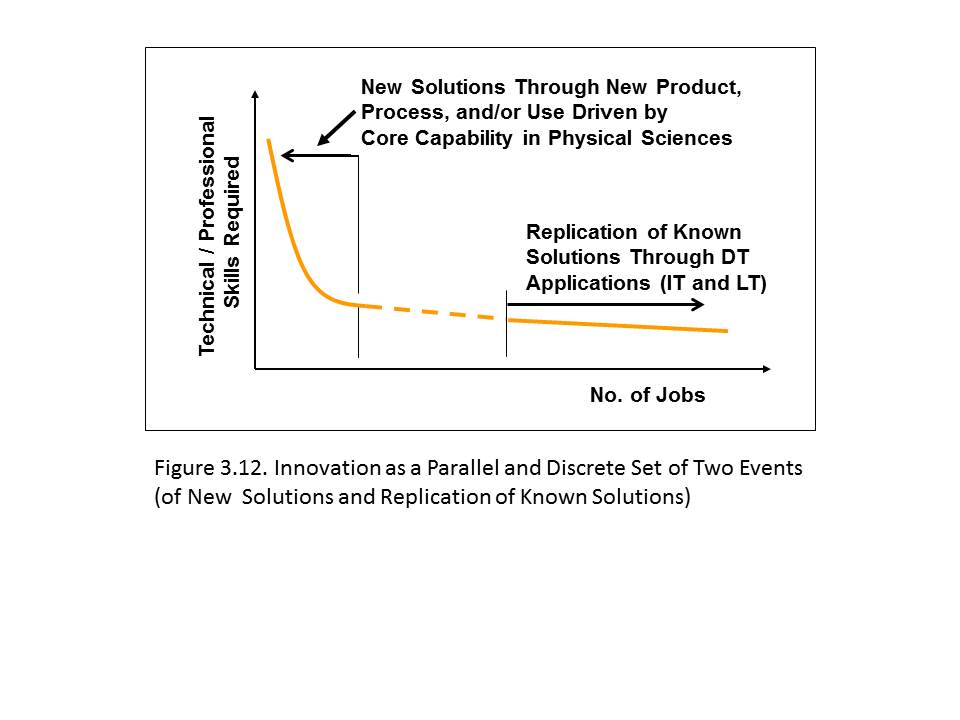
 If we look at the labor population as the number of workers engaged by employers we find them with a range of skills to do their jobs. We find an exponentially decaying curve on an average, with few people with very high skills and increasingly larger number of workers with lower skill levels. As a general rule higher skills are acquired through higher levels of education. These higher skilled workers are also paid higher wages for their outputs. This averaged exponential decay curve also created the rich, large body of middle class and low wage earning labor pool.

Since the early 1970s the advent of Digital Technology started permeating the way we live, work, shop, consume resources of all kind, etc. The role of DT included collection and processing of data and information, wireless communication, worldwide supply chain, IT automation, de-skilling, off shoring, outsourcing, gig work, …… One could use these same tools and resources for integrating knowledge to create new skills and outcomes not conceived before. The combined effect of all these can be grouped into two categories:

NEW SOLUTIONS: that are created through integrating knowledge from across the globe leading to outcomes of higher value and higher skill levels. These require high value addition workers such as at Google, Apple, Space X, Amazon AWS and at all the startup companies as well as innovation and new business teams operating within every company.

REPLICATION SOLUTIONS: that are mere re-production of what is already known cheaper, faster, better and increasingly larger quantities. These are the low skill and low wage jobs at Walmart, McDonald, fulfillment centers of Amazon, meat processing plants, farm workers, workers at the mines, workers in the service sectors, minimum wage workers in the health care, etc.

The net result of these two modes of employment and work outcomes has been to distort the curve for skills required and the wage earned as a result. We now see an L – shape or Binary Economy with a steep line with rewards increasing sharply with more skills for a narrow set of work and workers and a shallow or flat segment where the skill required for a large number of jobs is relatively small and constant. This Binary Economy which evolved in the end of the 20th century has taken its deep foot hold for the past two decades at the beginning of this 21st century.

For details on the Binary Economy please see: https://books.google.com/books/about/Thriving_in_the_21st_Century.html?id=pblemwEACAAJ&source=kp_cover

Before we look at the impact of COVID 19, we need to take a closer look at the impact of the Binary Economy and its effect. They provide the basis or starting point for our further analysis of the serious impending impact of this pandemic.

The impact of the Binary Economy can be divided into two categories based on its effect on the  developed economies such as the USA and emerging economies such as China, India and Brazil. The Income Vs. number of people in the work force has always been an exponential decay curve for any nation. But the rate of decay or decline vs. work force size has been more gradual for developed nations. This also sustained a larger number of people in the middle class. The developing nations with their huge population have a steeper decline in wages with few in the middle class and a large number of people living in poverty. When we superimpose the Binary Economy on top of these pre-existing economic conditions one can see the following outcomes:

Developed Nations:

  1. Higher labor productivity and efficiency through Digital Technology applications leading to lower direct wages ($/hr.) paid to workers. Wage stagnation.
  2. Most of the workers in these economies who were the middle class are pushed into Economy 2 and are suffering from downward economic pressures.
  3. Few investors and innovators, who participate in Economy 1 have done very well.

Developing Nations:

  1. Much of the middle class and some poor—most of the population in these economies -benefit from Economy 2
  2. Many investors and innovators, who participate in Economy 1 have done extremely well.
  3. Extreme poor have not seen any benefits.

The above are inevitable consequences of relentless reliance on “Replication Solutions” to produce and distribute more of what is already knows such as automobiles, transportation, fossil fuel solutions, etc. All forms of “New Solutions” have been concentrated on Digital Technology applications that have been adapted for further efficiencies in the Supply Chain, Global logistics and productivity gains in the above Replication Solutions. In other words Globalization can be thought of as a scheme where the water (knowledge and resources) from the lakes at a higher level are drained to fill the lakes at a lower level raising a few boats in it (increasing middle class in China and India). This has lowered the water level in the lakes (at the source) in higher altitude making many of the boats in it hit the rocks (Collapse of the middle class). This could be avoided only if the lakes at the higher altitude are filled with more water (such as more New Solutions for alternate energy, better climate, control of hunger and poverty through better resource management, control of pandemics, etc.) Occasional outcomes in New Solutions such as in Bio Sciences are too small and limited to have the required impact (fill the lakes in higher altitude). The outcome of this economic activity (Globalization) has been to pump some rewards to a limited few, the class of people described as “investors”.

The above impact of the Binary Economy can also be seen in the nature of available work to earn wages. It has been stratified into four layers which are increasingly impermeable.

As a broad category we can divide the impact of jobs and careers between Non-Wage income and Earned income. Non-wage income is gained through equities and dividends. They are called “Investment Income” dependent on the stock and bond markets and many other investment instruments.

Earned income is the wage gained, paid for by the employer. These are the salaries, benefits, bonus and such compensation paid to the workers.

The non-wage income and ability to acquire that from sources across the globe has substantially increased the wealth of the few at the cost of the large majority of the global population. As a result we have a few highly rich (the 1%) Vs. all others (who are modestly well off to the very poor (the 99%)

The investors look at their outcomes only in terms of the financial metrics. They do not generally have the insights or knowledge of the physical processes and methods that enable the products and their use. It is reported that over 70% of the stocks traded daily in the Wall Street are purchased and sold in less than 3 minutes. Is it realistic that these investors know anything about the ins and outs of the company they buy and sell in 3 minutes? Increasingly the top executives of most companies are also non-wage income earners focused only on the financial metrics of the company. These senior executives earn higher levels of compensation through stock options and bonus paid based on stock prices more than their salary and wages.

The wage earning population (the 99%) is now further divided between three separate layers:

The Professionals, Information workers and Physical Labor workers. It is easy to identify them as College educated workers, Call center workers and the large majority of low skilled workers at Walmart, McDonald or Amazon fulfillment centers without any college education. They are also mostly the minimum wage earners. These low skill, low wage physical labor workers do not have opportunities to migrate to the information work for two reasons: One is that they lack the basic education and proficiency in IT applications; Second the information work and physical work take place at locations distinct from each other. For example the physical labor may be employed in a factory in China or Thailand while the call center for information work may be in India or Korea. There is little room for on the job learning or cross pollination between these two sets of workers.

Now let us focus on the “Professional work”. This is the work required to conceive, develop, deploy and exploit a complete solution and get paid for it. This work requires higher education. This work also requires selected physical labor and substantial information work. These jobs require integration of knowledge and fostering high value added new solutions.

These layers of work are no longer well integrated within one organization. It requires workers to think broadly, beyond their comfort zones and ask what is the solution I am creating? What is the solution I am responsible for? – in a larger and broader context. This is the beginning of the system thinking required for jobs in 21st Century economy.

The information and physical labor work is constantly standardized, deskilled and pushed into the low wage “Replications Solutions” category. It is only those who participate in professional work and deliver a constant stream of new solutions who are also able to sustain high wage levels consistent with the value of their new solutions and their use.

Post COVID Economy:

In the post COVID world, the entire world economy has been put on hold, while the world population finds ways to survive the Pandemic. The economic consequences of this pandemic are yet to be quantified. But one thing is certain: Every sector of the economy and all categories of the workers everywhere in the world will be negatively affected for sure. This down ward pressure or the negative effect is already felt in the financial sectors. At the same time the poor who truly live from pay check to check are also devastated. This is evident through the long lines – over 10,000 cars in line each day – at the food shelters in many states across the USA.

We have already discussed the economic conditions which are represented by the Binary Economy. The wealth is also divided between the 1% ultra rich and the rest (99%). While these challenges and inequities continue, the COVID 19 has imposed a downward pressure or depression across all categories of workers.

How will the recovery after COVID 19 look like?

To answer this question we have to assume that nations across the globe and their leaders will exercise prudence and collaboration. This globalization will have to be for the betterment of all. Otherwise economic cannibalization and related policies across the globe may leave little room for meaningful predictions.

Let us assume that the Pandemic is contained in the next six months and a vaccine as well as cure is found in 18 months. These conditions provide room for meaningful recovery of the economy across the globe.

Such recovery for the rich (1%) is highly likely to be V shaped with a sharp apex at the bottom. As long as the financial markets respond to certainty of possible recovery and not the actual recovery itself (which will take a while to achieve and establish) the recovery of the financial markets might be sharp and quick.   

For the 99% wage earning workers the economic pain of COVID 19 will be very intense. Their economic conditions to start with are already “L” shaped or binary as we have discussed earlier. This L shaped economy will be further depressed across the board and in all sectors of the economy.

        The recovery of Individual workers and their economic plight from COVID 19 may have to be separated from the impact based on industry sector. Thanks to the need for cost reduction and higher efficiency to achieve higher profitability, the drive for further Automation, Robotics and AI Solutions may only make the L shaped economy even more acute. These will further propel a faster recovery of companies in the Digital “Technology” sector. However the hardware or brick and mortar industries will see a slow and painful recovery best described as a large “U” with a large flat at its bottom.

Nationalism and Unilateralism may also reduce the spreading of work across the globe, especially to lower wage countries. But their replacement in wealthier countries may be through automation and AI rather than through engagement of more workers and their labor. Increase in minimum wage may be the only way to address the needs of the poor in wealthier nations to limited extent.

     Will the recovery be U shaped or V shaped may be the question for the companies and the industry and sectors as described above. For wage earning workers the L shaped economy will continue to dominate. Their ability to nudge into the steep line of the “L” through Transformational skills required for conceiving, developing and implementing new solutions will determine their better economic condition. Otherwise they will be pushed further into the flat segment of “L” with lower wages and diminishing growth opportunities.

Core Capabilities and their alignment – Globalization in the post COVID world:

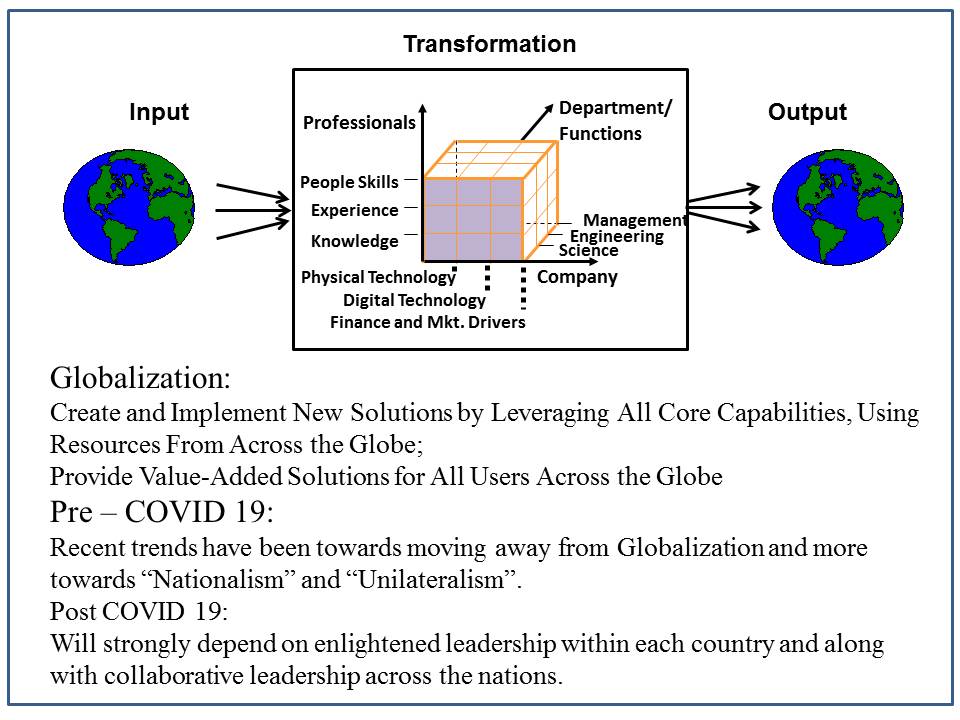
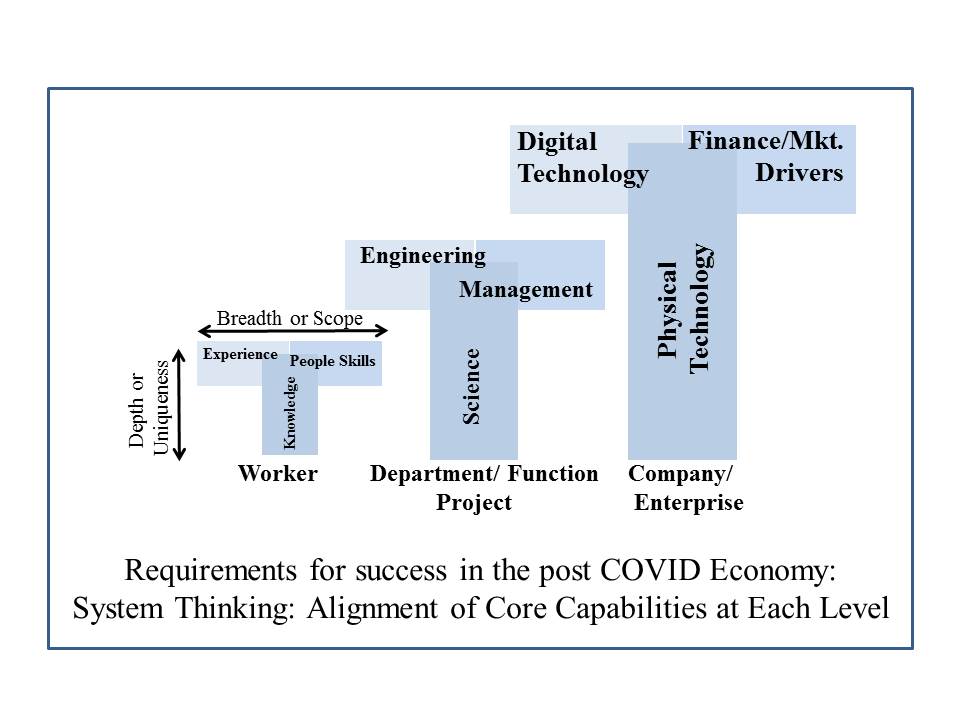
We can identify core capabilities for any economic effort delivered through three dimensions: Professionals or workers; Collection of workers engaged in a project or activity (we shall call this as a department or function) and the enterprise or company which deploys a collection of workers and their collaborative outcomes. Each of these vectors have three core capabilities imbedded in them.

Starting from late 1970s, when the Globalization took hold all of these three dimensional core capabilities have been used leveraging every available resource from across the globe to deliver outcomes or benefits needed for anyone in the world. This unbridled inputs (use of resources) and outputs (to serve the needs of global customers) was enabled thanks to rapid developments in Digital Technology applications such as Wireless communication, Internet, networks, I phone, ……..

Along with the benefits of Globalization also came the challenges of Climate crisis, income inequality (1% Vs. 99%) and isolated layering of jobs and careers as we discussed earlier. Despite all these plus and minus have been the good news of collaboration across the countries through Trade Agreement, Accord for Climate Crisis, etc.

But in the recent few years all such collaboration are being systematically broken. Current COVID Pandemic could have been localized and managed – like Ebola crisis – but for the nationalism and unilateralism of the leaders across the globe and their hiding into their corners to find local solutions instead of working together to find a global solution addressing the needs of the humanity at large. Today countries are blaming each other for hiding the origin of the Pandemic. They are fighting with each other for PPE. Can you imagine the fighting that will occur once a vaccine is found – after all each nation would want to protect its citizens first and not the neighbors!

The point is this:  The jobs and careers as well as the economy as a whole Post COVID will largely depend on enlightened leadership within each country along with collaborative leadership across the nations.  The current approaches and leadership are ominously opposite to such success through mutual collaboration.

It may be better for individual workers to look out for their success based on their skills and opportunities to identify, develop and implement a stream of New Solutions. This may require greater emphasis by individual workers more than ever for emphasis and realignment of their core capabilities as individuals and as part of group or team. The core capabilities required in Post COVID economy would be the same as in the pre COVID era. However the need to pursue these core capabilities as organized set of tools through System Thinking and Transformational Skills will be far more critical and imperative in the post COVID era for the following reasons:

The opportunities for new solutions and hence demand for high skilled professionals will be limited as the enterprises struggle for their mere survival more so than growth initiatives. With the limited opportunities available the enterprises will look for higher rate of success through any new solutions for their economic justification. In other words if there were pressures in the L shaped Binary economy before, they will be even more exaggerated in the post COVID economy. This will require view of any activity, project, program or enterprise wide activity as a “Solution” not a mere collection of tasks.

System Thinking and Transformational Skills:

The solution viewed as a system involves:

  1. Simultaneous emphasis on breadth as well as the depth of the problem on hand or the solution required. We can call this T- shaped thinking (as it is referred to by IBM).
  2. This requires integrated use of the three core capabilities appropriate at every level.
  3. Science pertaining to any solution is the data driven analysis of the fundamentals of the problem or solution.
  4. Engineering is the application or use of the above data and analysis
  5. Management is the strategic thinking or “Why?” we are interested in the problem or solution and operational excellence or how to achieve what is needed efficiently and economically?
  6. We define “Technology” as the integration of the above three (Science X Engg. X Mgt.) and not merely as IT or Digital technology applications.

Three levels of System Thinking and the corresponding Transformational Skills:
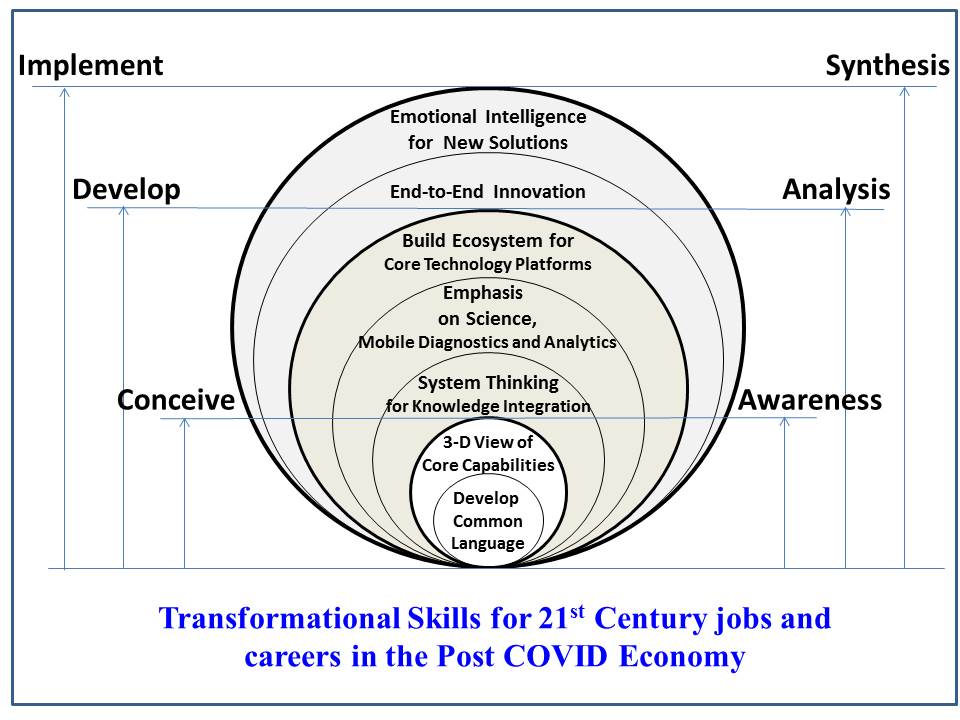
Awareness:

  1. Develop a common language or conceive the problem on hand as a system with all the relevant contributors identified. The system is also described as the Input/Transformation/Output scheme; the output itself is clarified between Technical Output or the “What?” we need and the System Output of “Why?” is that needed?
  2. With the above system description of the problem or solution, we need to identify the opportunities to integrate the relevant knowledge at each level (T shaped thinking) as described in the previous figure.

This level of system thinking also coincides with the “Conceiving” of the New Solution.

Analysis:

This level of system thinking also coincides with the “Development” of the New Solution.

  1. This is the phase where core capabilities are rigorously integrated.
  2. This also relies heavily on data, analysis, analytics and validation.
  3. Core capabilities are not always limited to those available from a few. Instead they are readily available and accessible provided we reach out to them and incorporate them into our eco-system. This integration of resources should not be random and hence inefficient. More rigorous our effort in the Awareness level greater the clarity and specificity of the resources integrated in our eco-system. Such integration should also be based on the system outputs (Stake holder benefits) of which every eco-system partner id truly a stake holder!

Synthesis:

  1. The important transformational skill here is End to End Innovation. It can also be described as “Concept to realization of Commercial Impact”. This may require the system thinker to play many roles some which are assigned but some others which are necessary whether formally assigned or not.
  2. This flexibility required to take on many roles, integrate several eco-system partners as well as learn new skills to integrate core capabilities as needed requires a high level of emotional intelligence.

The Synthesis level of system thinking also coincides with the “Deployment or Implementation” of the New Solution.

What is Emotional Intelligence and why is this needed as a Transformational Skill?

 New solutions by definition imply something new or different. They require change. Such change may be incremental or disruption on large scale. No matter what, New Solutions require acceptance by others. This implies convincing others to collaborate with us for a common goal. This ability to foster collaboration for shared and common goals is best described as “emotional intelligence”.

In this image here a new solution, something new – a black dot – stands out readily from the rest of the larger space in the white circle. Compare this in contrast to “replication solutions” or doing more of the same and in larger quantities. It is like blending a white dot in the white space, which happens readily, seamlessly and without notice.

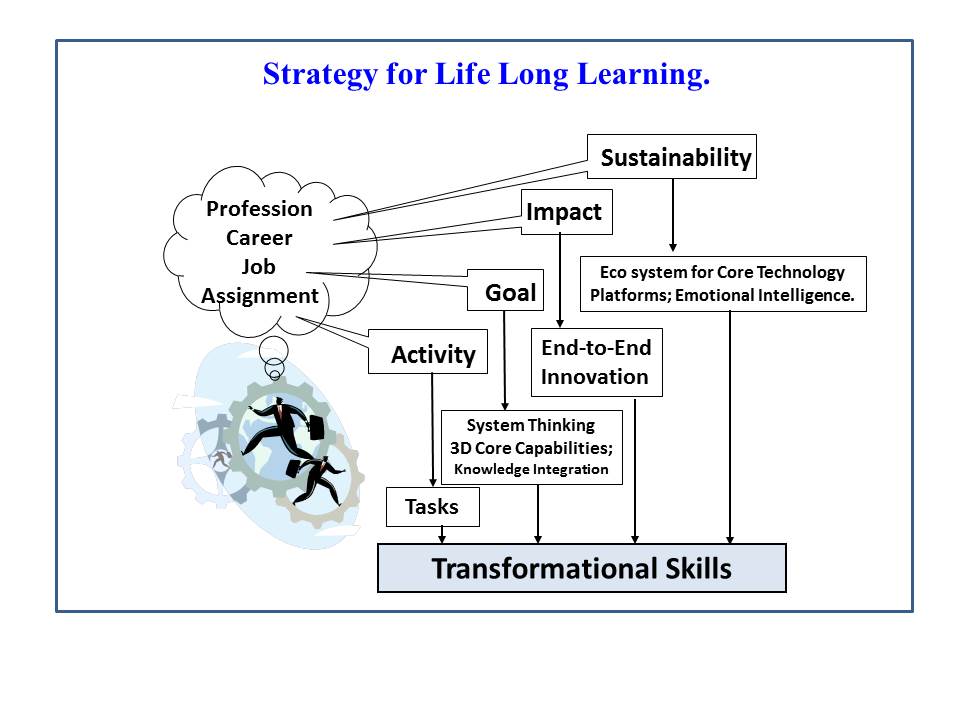
Today a large majority of professionals carry out the job as the task assigned to them. This task oriented jobs are plenty as they pertain to Information work and Physical labor. Increasingly professionals will also fall into this trap of task oriented jobs as their work gets standardized, de-skilled, automated and laden with AI tools. To go beyond this limitation these workers have to learn to become system thinkers with a clear understanding of the Knowledge Integration and 3D Core capabilities described earlier. For these professionals the job has a goal with identifiable New Solutions to be conceived, developed and implemented. As they progress through these system skills they will become more involved in achieving and delivering “Impact” through end to end innovation. As COVID 19 has made clear to all of us we are not safe unless all of us are safe. The same goes for job success and its sustainability as well. It implies promoting and fostering eco-systems and emotional intelligence for the sustainable growth for all. This step wise and yet lifelong strategy is illustrated in the figure below.

Developing Talent Pool: Every part of the fish has to be alive for the fish to be alive.

STIMS Institute and MICROMATIC Grinding Technology Ltd (MGT) have been collaborating for more than eight years on an initiative to develop Unique New Solutions (UNS). These are solutions for new machine tools and their auxiliaries for novel grinding processes for customers. The goal is to focus on unique outcomes
not available in India and, in some cases, first of its kind in the world. The focus is always on the end to end innovation (i.e.) from concept to commercially realized or implemented solutions.

This initiative also involves an innovative program designed to train and foster a few highly competent graduates into future leaders in manufacturing technology through System Thinking and Transformational Skills.

This team works in close collaboration with design, manufacturing and application departments at MGT, with end customers as well as research teams at the innovative University / Industry collaborative R&D center: Advanced Manufacturing Technology Development Center (AMTDC) at IIT Madras, India. Dr. Subramanian, President, STIMS Institute serves as the adviser to AMTDC.

Through the years, these teams at MGT and AMTDC have had several successes many of which are first of its kind for ‘Make in India’. Some of them are unique or novel in the world. The lessons learned from these collaborations are summarized below:

TALENT DEVELOPMENT FOR THE Unique New Solutions (UNS) TEAM:
Recruitment and development of the members for this initiative is rather unique. Individuals, mostly recent graduates, are recruited and assigned to assume a range of responsibilities in a short period of time. The assignments include:
• Market assessment in close collaboration with Sales and Application Engineering to establish the ‘need’ or the customer’s interest and the reason behind;
• Concept development for new solutions as a system, pricing and commercial contract execution;
• Research, Design and analysis of critical sub-assemblies and components;
• Design validation through theoretical calculations using modern tools and methods of FEA/FEM/ Mechatronics as well as advanced software solutions;
• Development of the solution through Concept Validation (establish the ‘science’), Prototype Demonstration (refine the ‘Engineering’), develop the Complete Solution (driven by “Strategy”) and implement at the customer facility;
Complete ownership in the development of unique products (machines, software, process solutions) from Concept to Commercially Viable Solutions.
Thus, in a short period of a few years, the fresh graduate can grow into a thorough technology professional (with integrated skills across Science, Engineering and Management) in the manufacturing sector. All this shift requires constant training and mentoring on System Thinking and Transformational Skills. This experiment in human resource innovation has been very interesting to say the least! It requires
continuous engagement by the senior management as well as rigorous review and on-line mentoring. Location or time zones are not the barriers for such human resource innovation!

TALENT IS MORE THAN ACADEMIC KNOWLEDGE:
Developing a new solution requires an integration of knowledge across various disciplines. No one person can come with the knowledge from diverse fields such as Manufacturing Processes, Mechanical Engineering, Design, Materials, Electrical Engineering, Instrumentation, Testing, FEA, Mechatronics, Advanced Software
and CNC programming skills. Hence, recruiting the right talent with the required knowledge is a challenge and a starting point.

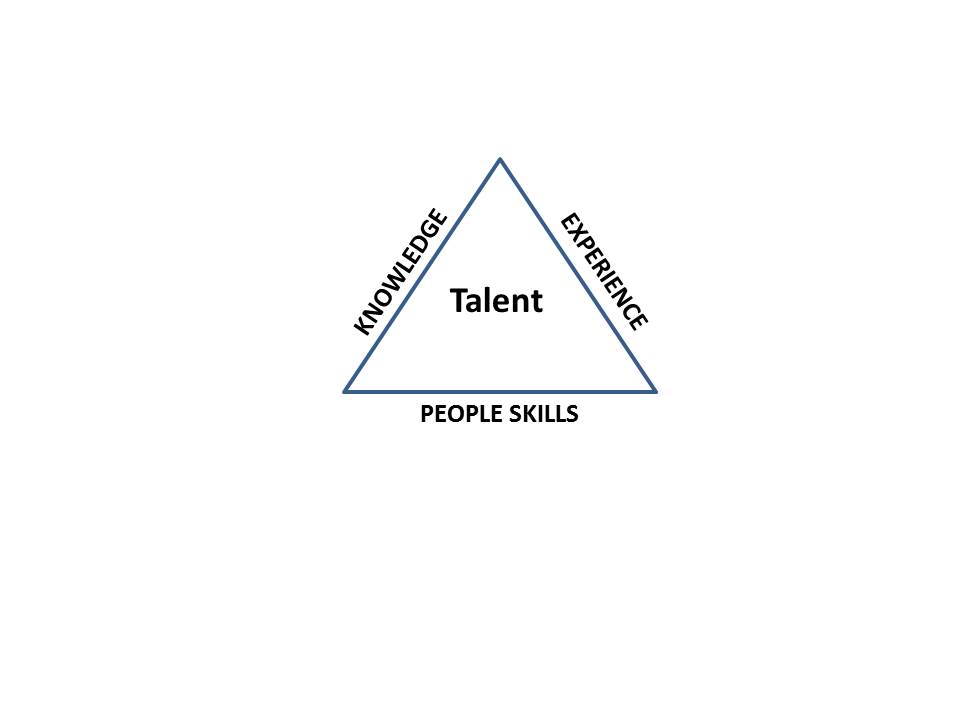
While graduates from well-known institutions have an edge in the beginning, this advantage is sustained more by those with a passion for continuous learning. After a few years of our experiment we find that true talent resides in those who excel at
three core capabilities: Knowledge, Experience and People skills.

Core Capabilities for Talent Development

Experience is not to be judged by the years of work in a given job or assignment. Instead it’s gained very quickly by those who are risk takers, willing to experiment with new ideas. Real life validation of their knowledge through working models, prototypes or sales contract builds self-confidence and a true sense of self-worth in young professionals, which is priceless. But this also requires a set of personal skills such as involvement, risk taking, collaboration and a result-driven attitude.

Core Capabilities of Professionals 
Description
   
Tools or Enablers
    KnowledgeDeep and extensive learning; Well informed; Comprehension of various aspects of the subjectFormal Education, Reading, Learning from peers, Data driven, searching on-line data base, Observations
    Experience  Skill derived from actual participation or direct involvement; Accumulated wisdom from real life.Hands-on Activities, Involvement, Experiments, Risk-taking
    People Skills  Ability to seek out others and receive their support, help, and cooperation; Willingness to reciprocate, to achieve mutual benefitsHonesty, Integrity, Communication Skills, Collaboration, Team Spirit, Results driven, Emotional Intelligence.
Core Capabilities of professionals

People skills are those beyond the well-known attributes for inter-personal interactions to get along well with others. In some regards, the people skills we find valuable are grounded in factors such as honesty, integrity and emotional intelligence. These are the skills that not only impel one to personal success, but also helps others and the team to the same outcome.

END TO END INNOVATION:

End to End Innovation: Fish is not alive unless every part of the fish is alive!

In most companies, R&D and commercial efforts are run as two parallel silos. One is an internal driven approach where ideas are developed and pushed outside. In other cases it is the sales driven identification of customer needs being pushed into the company for further internal development. Most of the time the internal identified solutions are partial representation of the “system” largely driven by “science” based ideas and their “engineering” refinement. The externally identified marketing driven needs are also partial in that “sales potential” is translated into “engineering” parameters which may or may not be compatible with the internal core capabilities. Hence these partial descriptions of the solution are often incompatible. Also the science and engineering minded professionals show little interest in engaging with the end customers and their needs. Sales and marketing professionals also show little or interest in the graphs, charts and simulations proficient to the technical “experts” inside the company. Our experiment has been to find a seamless blend between the two. Typically, such seamless connection happens in small startup companies. But our goal through UNS and AMTDC is to bring about entrepreneurial teams, talent and outcome while leveraging the resources and facilities of a well-established enterprise and institutions. The talent development for this effort requires education and commitment from everyone, especially the young talented professionals who learn and believe that ‘Every part of the fish has to be alive for the fish to be alive!’.

Methodologies for “Problem Solving”

Recently we came across the article titled: “How to master the seven-step problem solving process: Structured problem solving can be used to address almost any complex challenge in business or public policy” from Mckinsey & Co.  This article makes a very useful and interesting reading material. Below is a table that shows the alignment of the STIMS Strategy for System Thinking and Transformational Skills as well the as the differences.

STIMS strategy emphasizes knowledge integration across the disciplines of Science, Engineering and Management, skills which are dependent on collective core capabilities of human resources involved in the project and problem solving. STIMS Strategy also requires treating every problem as a “System” and handling the solution at three levels: Awareness, Analysis and Synthesis.

The referenced article also makes reference to the “Design Thinking” methodology. The table below provides a comparison between this methodology and the STIMS methodology for System Thinking and Transformational Skills.

Figure 1
Figure 2.
McKinsey: seven-step process https://cdn.ksrinc.com/mckinseysurvey/How-to-master-the-seven-step-problem-solving-process.pdfSTIMS Institute: System Thinking and Transformational Skills. https://stimsinstitute.com/2018/01/24/stims-strategy-for-life-long-learning-for-intrepreneurship/
1.Problem definitionDevelop a Common Language:  Define the “problem” as Input / Transformation / Output system. (See Figure 1)
2. Use logic trees to disaggregate the problem. (e.g.): “How can we save Pacific salmon?”Decompose the outputs between the “What?” – the deliverables (TECHNICAL Outputs) – and the “Why?”- value /benefit for the user (SYSTEM Outputs). This is the STRATEGY behind the solution. Transformation = The “SCIENCE”, the causal  connection between the inputs and the outputs;
ENGINEERING is the application of the “Science” to achieve the deliverables Problem and its solution = Knowledge Integration (Across relevant Science, Engineering and Management (Strategy) relevant to that problem.
3. Rigorous prioritization—we ask the questions “How important is this lever or this branch of the tree in the overall outcome that we seek to achieve? How much can I move that lever?Decompose the “inputs” in four categories: Investment / Expenses / Need / Constraints  or Platform (Hardware) / Tooling (Software) / Need / Specifications
Machine / Tools (Supplies) / Component / Parameters.
Develop tools and methods to validate the “Science” and the “Strategy”
4. Work plan: Depending on what you’ve prioritized: It could be breaking the work among the team members so that people have a clear piece of the work to do. It could be defining the specific analyses that need to get done and executed, and being clear on time lines. There’s always a level one answer, there’s a level-two answer, there’s a level-three answer.  One can solve any problem during a good dinner with wine. It won’t have a whole lot of backing.Complete the STIMS Diagram. Identify the gaps and find the data and resources to fill the gaps: This step leads to a natural formation of inter-disciplinary Team (Eco-system) across relevant resources inside the company, across companies and other players. Develop a “Hypothesis” – science based model – based on real life data. Demonstrate the hypothesis and its modifications: Using a controlled “testing” or “incubator” unit. More rigorous the understanding of relevant Science and Engineering more accurate and reliable is the testing and validation. At this stage the TECHNICAL Outputs and how to achieve them (in a scaled down version) are well established. Scale up the testing unit to achieve the desired outcomes – the SYSTEM Outputs.
Some people think of problem solving as a linear thing, but of course what’s critical is that it’s iterative.System Thinking involves three levels:
AWARENESS (of the problem as a whole) – Steps 1and 2 above.
ANALYSIS (of the problem in terms of relevant Science, Engineering and Strategy) – Steps 2, 3 and 4 (See Figure 2).).
SYNTHESIS (Knowledge integration and delivery of SYSTEM outputs) – Step 4
It’s also the place where we can deal with biases. Bias is a feature of every human decision-making process.Bias is an outcome of subjective (task oriented) approach for problem solving; System Thinking (and related knowledge Integration) is non-personal and hence distances human bias from the solution process. However caution must be exercised with respect to bias due to lack of relevant knowledge (Science, Engineering and Management (Strategy / operations) – core capabilities) behind the problem and its solution.
5. AnalysisSee Step 4
6. and 7.
Synthesize the pieces that came out of the analysis and begin to weave those into a story; That helps people answer the question “What should I do?” Motivating people to action
Synthesize the solution at three levels or scales:  
Feasibility demonstration (Bench Scale) where the Science is validated.
Scale up where the Engineering (and its constraints) are established.
Full scale implementation where the SYSTEM outputs (from Item 2 above) are validated.
  
“Design Thinking”:
Start with an incredible amount of empathy for the user and use that to define the problem; go out in the wild and spend an enormous amount of time seeing how people interact with objects, seeing the experience they’re getting, seeing the pain points or joy—and uses that to infer and define the problem.
System thinking and Transformational Skills (Seven steps):
1. Develop a common language: Define the problem as Input / Transformation / Output system
2. Decompose the “problem” into relevant Science / Engg. / Mgt.
3. Distinguish between “deliverables” and “Value/benefits” – end user experience (Technical Vs. System Outputs).
4. Emphasize on Science and Strategy;
Rely on diagnostic tools, in-process (real life) data and analysis.
5. Eco – system Development (Every solution requires many partners both inside the company as well as outside).All partners in the eco-system are connected through the common Science, Engineering and Strategy (System Outputs).
6. End to End Innovation (Awareness to Analysis to SYNTHESIS)
7. Emotional Intelligence (for innovation and problem solving) https://stimsinstitute.com/20151207books/

Transformational Skills that are critical (and missing today) in many service engineering / science solutions.

           Take for example the customer experience when one calls the “Call Centers” for any help such as your cable TV service or phone bill or whatever. The automated systems are designed to minimize interaction with human respondents at all cost. More efficient and modern the system, more are ways of routing the customers internally to as many automated options as possible. Only the most ardent and persevering customer may get through. The rest will give up merely due to sheer fatigue! :-(         

In all of the above the “customer” is designed into the system as the “enemy” to get rid off as fast as possible. The myriad of options the company deals with have to be sorted through by the customer by listening to the endless pull down menu presented in so many ways. Poor application of data science on the part of the programmer is inflicted as the burden on the customer in the above interaction!          

In the mean time and when the customer finally gets through to a real live person, the poor call center workers are trained to say “Is there anything else I can help you with?” when the original problem is not resolved or left to the next agent. These call center workers are endless chain of people with responsibility to communicate without any authority to resolve the issue on hand.         

All of the above suggest a need for (a) Common Language (b) System thinking or integrated view of the problem from a larger perspective vs. task oriented actions seen as the “job”) (c) emphasis on End to End innovation and (d) Emotional Intelligence that treats customer as one with a need (instead of merely as a source of data). These are four of the seven Transformational Skills essential to be practiced by the service solution developers (who are in most cases technical professionals). For more details: https://stimsinstitute.com/20151207books/