Transformational Skills that are critical (and missing today) in many service engineering / science solutions.

           Take for example the customer experience when one calls the “Call Centers” for any help such as your cable TV service or phone bill or whatever. The automated systems are designed to minimize interaction with human respondents at all cost. More efficient and modern the system, more are ways of routing the customers internally to as many automated options as possible. Only the most ardent and persevering customer may get through. The rest will give up merely due to sheer fatigue! :-(         

In all of the above the “customer” is designed into the system as the “enemy” to get rid off as fast as possible. The myriad of options the company deals with have to be sorted through by the customer by listening to the endless pull down menu presented in so many ways. Poor application of data science on the part of the programmer is inflicted as the burden on the customer in the above interaction!          

In the mean time and when the customer finally gets through to a real live person, the poor call center workers are trained to say “Is there anything else I can help you with?” when the original problem is not resolved or left to the next agent. These call center workers are endless chain of people with responsibility to communicate without any authority to resolve the issue on hand.         

All of the above suggest a need for (a) Common Language (b) System thinking or integrated view of the problem from a larger perspective vs. task oriented actions seen as the “job”) (c) emphasis on End to End innovation and (d) Emotional Intelligence that treats customer as one with a need (instead of merely as a source of data). These are four of the seven Transformational Skills essential to be practiced by the service solution developers (who are in most cases technical professionals). For more details: https://stimsinstitute.com/20151207books/

Ethics and AI

Recently I attended an on-line seminar on “Ethics and Artificial Intelligence (AI)” by Roberto Zicari (Prof. of DBIS) – Goethe University Frankfurt) on the need of an Ethical AI Due Diligence. http://cognitive-science.info/community/weekly-update/?utm_source=ALL+Active+ISSIP+Users&utm_campaign=020be710c1-EMAIL_CAMPAIGN_2018_06_06_06_14_COPY_01&utm_medium=email&utm_term=0_1b14cc9881-020be710c1-91822821

It was an interesting seminar that addressed the issues relevant to measurement and management of ethics in the development and use of AI Tools. As a result of this seminar, I was motivated to ask the question: Ethics is a matter of philosophy. Do we need a sustained education on Philosophy and the related topics on Subjectivity Vs. Objectivity as part of AI Technology education? The speaker acknowledged the need and pointed out some effort in this direction in the academic circles.

Following are some reflections on ethics and philosophy:

We have discussed earlier that Philosophy is an in-depth analytical study of any subject matter: https://sipractce.wordpress.com/2011/05/25/anatomy-of-our-experiences-objectivity-the-end-result/

It is not a mere coincidence that the highest degree awarded in any field of study is called “Doctor of Philosophy”. The best researcher in any field has the best KNOWLEDGE of the laws of nature at play in that field, the limitations (IGNORANCE) of such knowledge and possible wrong or erroneous interpretations (BIAS) of the same! The same can be said of any true professional – the best engineer, doctor, surgeon, musician, carpenter, etc.  The knowledge, bias and ignorance are the three connectors through which we relate to the subject matter. The process of understanding these connectors, when it is explicit and analytical and quantitative, we call the process as “scientific”. The more intuitive and inferential the process, we call it as “Common sense”. https://sipractce.wordpress.com/2011/05/25/anatomy-of-our-experiences-objectivity-the-end-result/  

The relative proportion of the three co-existing connectors – Knowledge, Bias and Ignorance – with respect to the subject on hand and the dominance of one is not always easy to identify and separate out. If we observe carefully, we find that our “education” of every kind is intended to facilitate our skills to identify these three connectors, their relative proportions and how to sort them out! One who is good at this skill (to identify these connectors in any given field) becomes “expert” in that field of study.

This process of search for the three connectors and their relative proportions can be precise, only when there is equal weight placed on all three connectors! Consideration of all evidences with equal weight and emphasis on all three connectors – knowledge, bias and ignorance – is called “Objectivity”. An objective person is not swayed by his/her knowledge nor tends to understate or diminish the evidences pertaining to bias and ignorance. An objective frame of mind treats all three connectors with equal weight or merit.

The characteristic features of Knowledge, Bias and Ignorance have been outlined earlier:https://sipractce.wordpress.com/2011/03/10/anatomy-of-our-experience-the-connectors-gunas/

  Knowledge Bias Ignorance
Features or key characteristics of the three Connectors (Guna). Knowledge adds illumination and clarification of the situation or problem on hand Bias arises out of personal needs and wants and our attachment to them. Ignorance is driven by illusion, fantasy or irrational expectations.
  Knowledge binds a person through genuine sense of happiness Bias binds a person to endless chain of activities Ignorance binds one through lack of directions.
  Knowledge can be recognized through the happiness and contentment based on the well-being for all. Bias can be recognized through associated endless chain or recurrence of additional activities, without a sense of closure, satisfaction or fulfillment. Ignorance shrouds the knowledge and leads to lack of direction.
How can one perceive the dominance of each connector? When knowledge, illumination or comprehension is perceived in every aspect of the subject matter and its functions, one can recognize that through the tranquility that follows. When Bias is dominant the subject matter or activity is drawn into greed or desires of endless nature, driven by intense personal needs, initiation of innumerable activities due to a lack of satisfaction or contentment, unease and longing. When stagnation or inactivity prevails, the result is ineptness, lack of direction or sense of purpose and illusion (attraction born out of ignorance).
At a time of crisis or when a decision needs to be made,  the dominant connector leads to: True Knowledge transforms a person to a higher plane of existence (of total self-control and unattached active participation). Bias leads a person to more activities, merely as a means to satisfy growing personal wants and desires which continue to remain as unfulfilled. Ignorance leads one to the vicious cycle of being shrouded by ignorance
The result or fruit of dominance of each Connector: Proper or virtuous acts and purity or clarity  Sorrow. Depression and despair
Each Connector Leads to:  Knowledge and understanding  Greed Lack of direction and illusion
Accomplishment of the intended purpose by the persons under the influence of each connector: Rise to the higher level (through greater levels of engagement of self-control and the reasoning and logic that occurs as a result) Stay in the middle (due to the self and its reasoning being constantly over ruled by attachments and its insatiable needs and wants) Sink to the lower level (since the reasoning and logic of the self never occurs, like the fire being shrouded by the ashes eventually gets quenched).

Now let us discuss the relevance of these three connectors with respect to “Ethics”. Whatever we learn on this aspect would be applicable as it pertains to “ethics in any subject” including AI.

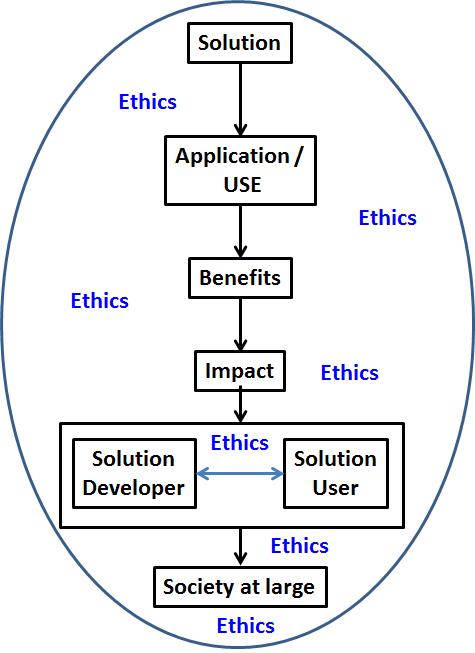
Let us begin our discussion by first defining the subject matter. AI is often thought of a solution using the tools of Machine Learning and Data Science. The AI proliferates depending on the data, its collection methods, tools for analysis, etc. To keep it simple let us state that the end result is a “solution” and its use. Ethics will be of concern during the development of the solution, its application / use, benefits achieved of value to the developer of the solution as well as the user and finally the impact of the solution and its benefits to the society at large. This chain of events is illustrated in the schematic diagram as noted above.

While ethics is often thought of as the impact of the solution on the society at large, such focus will be like attempting to lock the cattle inside after the barn door has been left open for a while! In many respects this might be the ignorance as it pertains to ethics and its management. In fact, ethics must be taken into account at every stage – from solution development, testing and USE or deployment – keeping in mind the impact to the developer, user and the society at large. This emphasis on benefit at large (which in turn also leads to the benefit to the self) may be described as the Emotional Intelligence for innovation. For details: https://stimsinstitute.com/2015/01/03/670/

Focus on ethics at every stage of the innovation process also requires a passionate engagement of professionals in areas beyond their comfort zone. It is natural for engineers and technical professionals – often computer scientists – to think of their work as “technical” and leave all the rest to “others” to worry about. This bias and attachment to partial knowledge is often the source of problems that manifest as larger issues. The same can be said of ethics and how it is impacted by the bias or task oriented approach to solution development and implementation of AI solutions. To overcome such limitations of bias, it is imperative to teach and train professionals on “System Thinking” and its comprehensive understanding: https://stimsinstitute.com/2017/03/22/system-thinking-and-transformational-skills-the-basics-for-courage-and-empathy/

Once we have minimized the ignorance and bias as described above Knowledge pertaining to ethics permeates. Ethics is no longer seen as an afterthought, but built into every phase of the solution development and deployment. Such effort is preceded by comprehensive description and definition of the entire solution chain. Ethics is no longer a thought or task to be carried out. Instead ethics becomes a way of life, the life blood of every professional at every level engaged in the solution. Taken in abstract, this statement may sound Utopian. But, when efforts are made and education is provided to minimize the ignorance and bias as described above, ethics as a way of life, ethical solutions as the only acceptable solutions become a natural and accepted practice.

System Thinking and Emotional Intelligence are part of a set of seven Transformational Skills described in two books: https://stimsinstitute.com/20151207books/

Rendering a human touch to smart manufacturing!

Rendering a human touch to smart manufacturing

  eq_2018_pages_7-10

If we can treat the Physical Processes in the manufacturing shop floor as human beings, then much of the information management practices may be applicable to the manufacturing sector as well. This humane treatment of machines and manufacturing processes may be the next generation Smart Manufacturing?

“Value Manufacturing” Vs. “Volume Manufacturing”.

Recently I came across an article https://www.nytimes.com/2019/01/28/technology/iphones-apple-china-made.html?action=click&module=Top Stories&pgtype=Homepage

Following are few extracts from this article and our views:

“To start building their damn computers and things in this country,” Apple is unlikely to bring its manufacturing closer to home. A tiny screw illustrates why?

When Apple began making the $3,000 computer in Austin, Tex., it struggled to find enough screws, according to three people who worked on the project and spoke on the condition of anonymity because of confidentiality agreements.

In China, Apple relied on factories that can produce vast quantities of custom screws on short notice. In Texas, where they say everything is bigger, it turned out the screw suppliers were not.

Tests of new versions of the computer were hamstrung because a 20-employee machine shop that Apple’s manufacturing contractor was relying on could produce at most 1,000 screws a day.

Chinese suppliers shipped their components to Texas. But in some cases, the Texas team needed new parts as designs changed, and engineers who were tasked with designing the computer found themselves calling machine shops in central Texas.

That is how they found Stephen Melo, the owner and president of Caldwell Manufacturing in Lockhart. Employees of Flextronics, the company hired by Apple to build the computers, in turn hired Caldwell to make 28,000 screws — though they would have liked more.

When Mr. Melo bought Caldwell in 2002, it was capable of the high-volume production Apple needed. But demand for that had dried up as manufacturing moved to China.He said he had replaced the old stamping presses that could mass-produce screws with machines designed for more precise, specialized jobs.

He made do with his new machines, although he could not make the exact screws Apple wanted. His company delivered 28,000 screws over 22 trips. Mr. Melo often made the one-hour drive himself in his Lexus sedan.

Let us look at the above story a bit closer. There is a real story behind this simple minded statement that Apple is unlikely to bring the manufacturing back to the U.S. shores because of a few small screws!

Manufacture of small lots of custom screws on demand is different from manufacture of large volume lots for mass manufacturing. 

Apple did enjoy and does enjoy the luxury of custom manufactured items at low cost and short lead times in China thanks to many factors listed in the article – low labor cost, massive investment by Chinese Government in the manufacturing sector, authoritarian rule that can flex its muscle at will to make things – even custom manufacturing – happen on demand and at will.

If U.S. manufacturing has to take hold again, U.S. Government and Apple as the end user must invest in such mass customization resources for manufacturing.  But this investment has to be well thought out – between “Value Manufacturing” and “Volume Manufacturing”.

As noted in the story above, Apple had a good source for quality screws in the USA in 2002. When they shifted their manufacturing to China, the local manufacturer had to shift their production capability. Now Apple cannot expect to rely on its old friends in US, without systematic rebuilding of the needed eco-system and capabilities. These are the shortages in the planning for manufacturing in the USA. PLEASE DON’T BLAME THE TINY SCREWS!

The screw shortage was one of several problems that postponed sales of the computer for months, the people who worked on the project said. By the time the computer was ready for mass production, Apple had ordered screws from China.

Read the above carefully and again! Apple did not strive to work on the manufacturing infra-structure. Instead they chose to ship their procurement to China! Detroit was not built as the automotive capital of the world by large manufacturers fleeing away from Detroit at the drop of a dime. This eco-system development has to be one of Transformational Skills for the return of US Manufacturing base.

The challenges in Texas illustrate problems that Apple would face if it tried to move a significant amount of manufacturing out of China. Apple has found that no country — and certainly not the United States — can match China’s combination of scale, skills, infrastructure and cost.

Above is an opinion stated as a fact. It is true that China has a unique combination of scale, skills, infrastructure and cost. But these advantages are not eternal or cast in stone. These are relative advantages gained through investments – both private and public – over a period of time. Since the late 70s US Govt. and the private sector as well as the educators have given lip service to these factors, the essentials for manufacturing competitive advantage. Now we are complaining that the barn is empty after having left the door wide open for decades. The answer is not to state that China has these advantages as a foregone event. Instead discussions and investments have to focus on how to corral more horses and fill the barn. It will require mfg. infra structure investments worthy of a leading global power. But we are far from any thought or discussions in this direction.

“In the U.S., you could have a meeting of tooling engineers and I’m not sure we could fill the room,” he said. “In China, you could fill multiple football fields.”

The above statement means nothing. Today there are conferences on Brain and Cognitive sciences or Computer forum in the USA that attract over 30,000 attendees. Engineers are also people who will converge where they see opportunities. Let us create the right climate and opportunities in order for people to be attracted to that field. For over four decades there has been a drum beat of news coverage to describe everything “manufacturing” as “brick and mortar”, “legacy technologies”, etc. With that kind of beating down it is no surprise there are few left in the US who are proud to stand up and proclaim themselves as “manufacturing professionals”.

Kristin Huguet, an Apple spokeswoman, said the company was “an engine of economic growth in the United States” that spent $60 billion last year with 9,000 American suppliers, helping to support 450,000 jobs. Apple’s Texas manufacturer, Flextronics, did not respond to requests for comment.

If Apple invested so much in the manufacturing infrastructure in US and they could not get the screw they needed at the right time, place and quantity, does it reflect on Apple’s effectiveness in their supply chain management as much as it reflects on the Supplier base?

Mr. Cook often bristles at the notion that iPhones are Chinese-made. Apple points out that Corning, at a factory in Kentucky, makes many iPhone screens and that a company in Allen, Tex., makes laser technology for the iPhones’ facial-recognition system.

The above is the most interesting and valid point pertaining to “manufacturing” in the USA. The Gorilla Glass from Corning is a great example of the kind of success one can envision in US Manufacturing – high value added products, design, services, capabilities, manufacturing resources. Instead of treating all manufacturing in one bucket, it may be necessary to discriminate between “Value addition” Vs. “High Volume low value added manufacturing”. As an example in the disk drive industry, the hardware for thin film heads are manufactured in the USA as hundreds of heads nestled in a single substrate. After this high value added manufacturing, a large amount of large volume fabrication and assembly are carried out off shore using low cost labor.

Mr. Cook has also disputed that cheap labor is the reason Apple is still in China. But it doesn’t hurt.

There is nothing to be ashamed of in using low cost labor where it counts. Low cost labor is a reflection of the prevailing standard of living in the given country or region. As long as there are lower cost resources – products, suppliers, labor, etc. it is imperative for any manufacturer to take advantage of that. But, what do you do and how do you take care of the people on whose back you built your company and products is a moral question that must be addressed by the manufacturer (seeking off shore resources) as well as the Government. The profit made on low cost manufacturing comes from the earlier work of people in home countries who invested their skills and toil leading up to the high volume manufacturing stage. Today the manufacturers (Capitalists) and the Government (ruled for and by special interests and lobbyists) are morally deficient. That is the reality, which this article, the author of the referenced article and the media at large miss when they discuss manufacturing.  I have witnessed highly skilled workers travel to China to set up plants and train the workers there only to find their pink slips on their return. This lack of empathy, moral commitment and emotional intelligence on the part of the Capitalists and the Government has to be the critical issue to be addressed ASAP.

A former Apple manager who spoke on the condition of anonymity said the Flextronics team had also been far smaller than what he typically found on similar Apple projects in China. It was unclear exactly why the project was understaffed, the manager said, speculating that it was because American workers were more expensive.

Insufficient resources in a supplier are a reflection of poor Project Management. Speculating on higher wages of the US workers (which is an obvious constraint) as the reason suggests a total lack of understanding of the basic principles of Supply Chain Management! SAD!!

Another frustration with manufacturing in Texas: American workers won’t work around the clock. Chinese factories have shifts working at all hours, if necessary, and workers are sometimes even roused from their sleep to meet production goals. That was not an option in Texas.

How could one write such hypocritical views and then print that as well?

American workers won’t work around the clock” is a self-full filling prophecy? Has anyone seen the millennials who work in the Bay Area or in the startup companies across the globe? Aren’t those hundreds of workers who travel across the globe to get their job done evidences of US workers who are ready to lose their sleep to meet their goals? Aren’t those employed today in manufacturing sector in the USA working days and sleepless nights just to keep their jobs, pay checks and hence put food on the table?

Ms. Helper said Apple could make more products in the United States if it invested significant time and money and relied more on robotics and specialized engineers instead of large numbers of low-wage line workers.

Ms. Helper and Apple may need to look at their “manufacturing” in a holistic manner and segregate the ”Value intensive” aspects of their manufacturing Vs. “Volume intensive” aspects of manufacturing and then foster infra-structure and invest plans in alignment with these two needs. This may not automatically imply robotics vs. low wage workers. This will certainly require high skilled engineers who are System Thinkers with Transformational Skills.

She said government and industry would also need to improve job training and promote the development of a supply-chain infrastructure.

Everyone can agree on these needs. Let us hope that Apple (and other manufacturers) and the US Govt. can work collaboratively on these needs.

But, she added, there is a low chance of all that happening.

Sadly this is also the fact and reality. But, to articulate the above needs is also the role of the Media. Let us hope we can read more of articles reasoned on real needs as opposed to glib statements, full of opinions and pre-conceived notions as noted in this article.
High Tech. Vs. …..?

After having moved recently I am often asked how do I find living in the Bay Area or what is new or different? Something caught my attention this morning as I was flipping through the Sunday morning shows. After “Meet The Press”, the nationally televised TV program, the local channel had a 30 min. program which covered the following:

  • Electric Vehicle and the subsidy and its future;
  • A startup Company providing electric charging services at department stores and shopping malls.
  • Low frequency radar to guide vehicles vs. laser assisted radar (LIDAR) system for driverless cars being developed by a startup Co. founded by a Physicist from MIT;
  • A startup venture capital Co. that works on behalf of banks to fund very small and small companies.

Every topic was covered in depth and with language jargons that will make any nerd happy and proud.

For example the disappearing subsidy for Electric Vehicles was discussed not as a hand out, but a way to reward success. Subsidies ran out since it was meant only for 200,000 cars and Tesla blew through that quota early on.

The electric charging services Co. is not an energy utility Co. at all. Instead it is an IT based Co. much like Airbnb with no investments in physical infra structure! The discussion on business model and market segmentation will easily blow away any MBA from a top school!

During the discussion on low frequency radars I learned all the details on how they work, why they are safe (since they are mm wave low energy beams) and the entrepreneur prediction that Automated Driverless cars will be here to stay in ten years! I couldn’t not believe that I was hearing details on analog Vs. digital signals in a TV Channel program!

The startup VC Co. CEO explained why the banks are not doing this investing directly and were relying on this middle man Co. His explanation of data base and how it is used was amazing.

All in all, a fast paced show; music for someone proficient in science and technology.

But I was also wondering how far away is this show from the stuff covered in the main TV channels in East Coast? Believe me what I saw was a mainstream TV program in the Bay Area, CA. not a Geek show. It was not Science Friday on Public Radio channel.

Wonder how these topics and subject will ever be covered in the TV channels in middle and rural America? How will the larger popiulation in USA wiull get immersed on these details and possibilities? It is in this widening chasm between the entrepreneurial, make it happen High Tech. world and the rest of the country that economists, political leaders and policy planners have to come to terms with. Sooner they do, better off will be everyone and the nation as a whole.