Blog

It may be a mistake to get a degree in Chemistry, unless you have also figured out how to use your knowledge!

ChemsitryFollowing is an extract from this article: A glut of chemists with bachelor’s degrees as well?
       http://cenblog.org/just-another-electron-pusher/2013/01/a-glut-of-chemists-with-bachelors-degrees-as-well/
This past November, C&EN ran a cover story on the employment outlook for chemists. The coverage consisted of several simultaneously published stories regarding various aspects of the employment  outlook. The main focus shared by many of these stories was on chemists already in the workforce, and the effects that recent or impending layoffs have had on their lives. I offered a few thoughts on the topic as it stirred up fresh memories of having gone through similar experiences myself.

            The bleak employment outlook for recent graduates with bachelor’s degrees in chemistry was also described, but in less detail than given for experienced workers. Those details, plus profiles of some recent graduates, were provided earlier this week, in “New Bachelor-Level Chemists Face Grim Job Market,” an excellent article by C&EN Senior Editor Susan J. Ainsworth. Some thoughtful comments on this story have been provided by Chemjobber this week.

With the likelihood of employment within their discipline fading, many BS/BA chemists have opted to continue their education—often outside of science altogether, let alone chemistry. Some popular choices: law school and MBA programs. So. They’re seeking a career change. Before their careers have even begun. I’m sad that this decision has been forced upon them, but I certainly wish them all well.

OUR View:
It is sad that we are ready to quit and accept that our young graduates  end their years of dreams and passion for physical sciences , even before they can find their first job. Sad indeed that they have to seek a degree in law or MBA, since they are hurting for jobs in their chosen area of interest.
The reality is that the economy has changed. We call this as the Binary Economy. https://stimsinstitute.com/2013/07/17/learn-to-swim-against-the-tide-of-binary-economy/

You no longer have jobs with well-defined roles and clear tasks. Instead you need to become a solution provider, constantly using the knowledge you gained in the college courses. This requires System Thinking – ability to see the big picture, connect the dots to see the pattern, figure out what needs to be done and make it happen. You cannot merely do what you are asked to do (Task orientation) and then wait for some one to tell you what to do next..

Such System Thinking should be demonstrated through Transformational Skills to span or migrate across Discovery, Development, Deployment and Exploitation of your solution- as a continuous stream and not as silos. This requires constant integration of your knowledge (Science) and its application (Engineering) and the strategy to get ahead (Management). You need to do that while keeping at bay all those nay-sayers and door stoppers under the guise of administrators, supervisors, managers and the like, who are there merely to preserve their jobs rather than help you get ahead. There are good reasons for this reality. https://stimsinstitute.com/2013/12/18/did-anything-go-wrong/

These skills for System Thinking and Transformational Skills are not taught anywhere  through organized courses. We need a concerted effort on such education from High School through college as a parallel to STEM education and UG degree courses. In the meantime ACS and other professional associations can teach these skills through courses and as part of continuing education. americanceramicsociety.org/bulletin/2014/apr14/#/44/

Recently I was counseling a student with B.S. Degree in Bio-Informatics. Sounds great! But the college did not help the student find the places where he can apply for jobs or tell him where such jobs are available. It would appear that the faculty put together a collection of courses based on their research work – suitable probably for the few Ph.D level students. Then they put together an U.G. Degree curriculum and graduated many students with no place to go after graduation. After all an UG Degree in Bio-informatics sounds lot more jazzy than a degree in Biology. It also shows some link to computers or IT!

Few among them with a natural ability for ST and TS do indeed find their jobs. The rest are burdened with huge college loan and harsh criticism – unwarranted in our view – as noted in the comment as a response to the above article: How was this decision forced upon them? Could they not of left the country to find a chemistry job somewhere in the world? Nothing was forced on them, they just decided they wanted more convenience. Nobody cuffed them and dragged them to go to school to get their MBA.

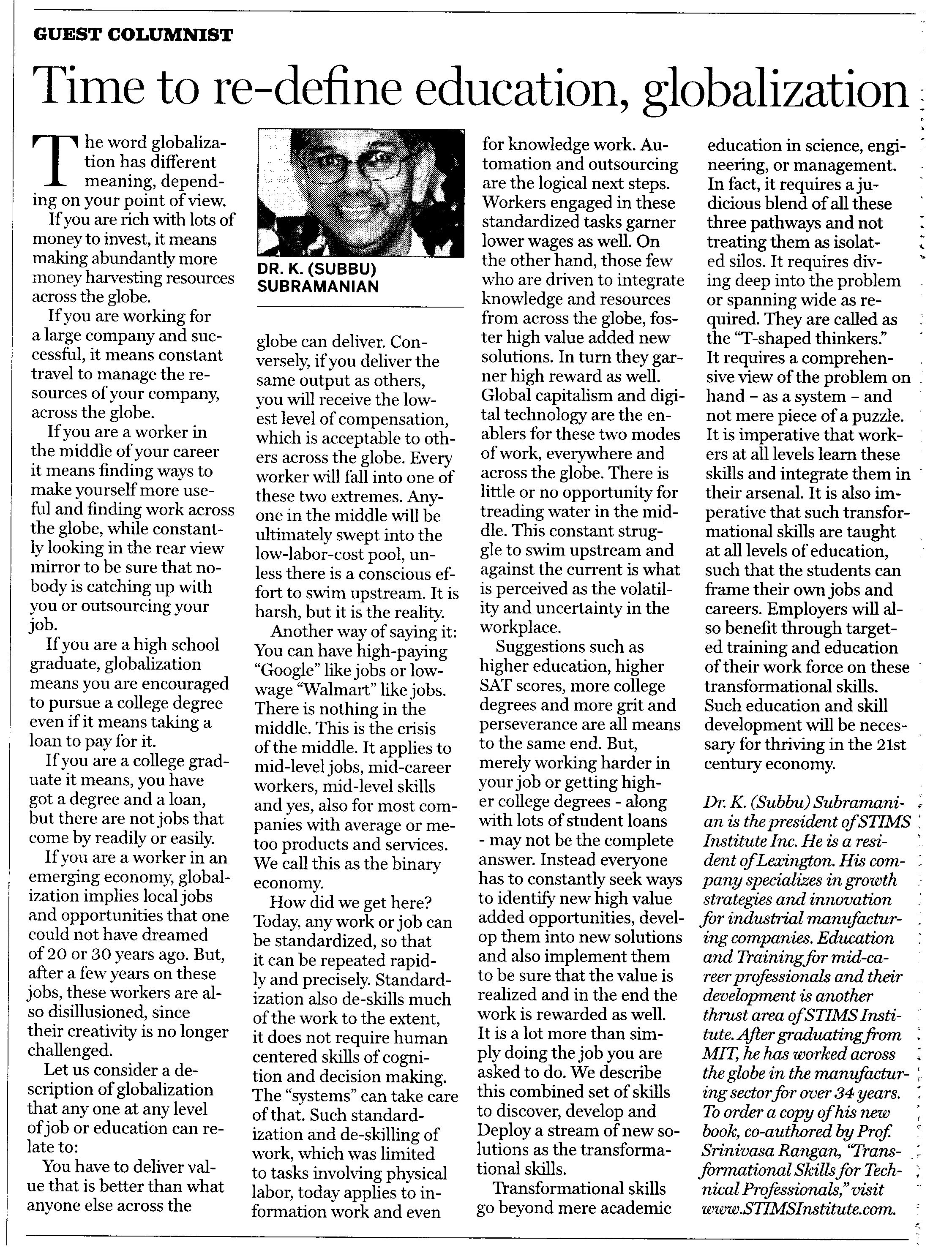
It is a harsh criticism of graduates in any field, especially in physical sciences – such as Chemistry, Physics, etc. – to ask them, why did you get a degree in this subject? or why don’t you find the job overseas? Let us stop the blame game and the harsh unwarranted criticisms. https://stimsinstitute.com/2013/08/08/time-to-re-define-education-globalization/ Let us teach our kids – with strong interest – with solid education in Physical Sciences. Let us add to their talent the ST and TS Education. They will be the shining stars of the professions in Physics, Chemistry and all other physical sciences world in the 21st Century. For more details please Contact US
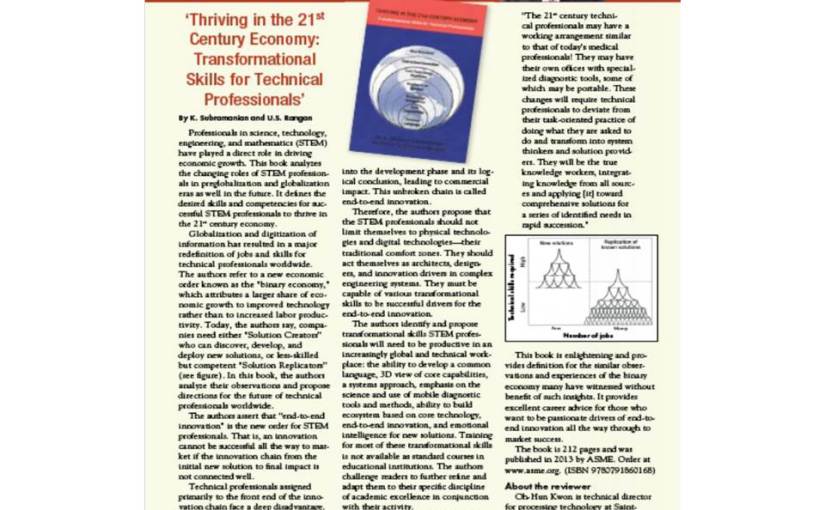
American Ceramic Society Bulletin Review of our recent book

ACS Book reviewThe American Ceramic Society Bulletin has review of our recent book titled:
Thriving in the 21st Century Economy: Transformational Skills for Technical Professionals. It is posted here with the permission of the ACS.

April 2014-Bulletin-Book Review

The magazine also is live online now. The link to the on line review:

http://americanceramicsociety.org/bulletin/2014/apr14/#/44/


Work shop for increasing the PE Score

Professionals today face challenges from two fronts.
• Their output is highly valued when there is a direct and visible connection to the PRDUCT (source of revenue), PROCESSes (That enable the Product) and/or the Application/USE of the Product. We identify this kind of work with identifiable impact as Professional Work (A).
• Absent such deliberate emphasis the professionals slowly drift towards highly task driven information work (B) and endless physical tasks (C)

As a result the professional is required to constantly focus on increasing the Professional Effectiveness. The PE – Score can be measured as the ratio of the impactful work of professionals as a fraction of their total effort.

PE Score = A / (A + B + C)

Recently we conducted a 2- day work shop on System Thinking and Transformational Skills at a Fortune 100 company to train their professionals with tools and means to increase their PE Score. The work shop was conducted for a group of 40 senior engineers and managers. We are pleased to present the summary of the feedback as noted in the table below:
Category Rating        (%)
Facilitator
The facilitator was knowledgeable about the subject                                                   91%
The facilitator was prepared and organized                                                                   89%
Participants were encouraged to take part in course discussions                             90%
The facilitator was responsive to participants’ needs and questions                        90%
The facilitator’s energy and enthusiasm kept the participants actively engaged  84%
Work shop materials and content:
The material content was appropriate                                                                          81%
The objectives were clearly explained                                                                           83%
The course content/materials were sufficient to achieve course objectives          81%
The length of the course was appropriate for the course objectives                       76%
Learning Effectiveness
I learned new knowledge and skills from this course               85%
This course was relevant to my work                                           84%
Near Term Impact:
I will be able to apply the knowledge and skills learned in this course to do my job    83%
Business Impact:
This course will improve my job performance.                                                        82%
Overall Impression:
I would recommend this training to my colleagues and co-workers                    84%

The professionals who attended the work shop also offered the following summary comments on their learnings from this work shop:
• The methodology was good and easy to relate to my work
• Binary Economy, System approach, the concept of “Why?”
• Work shop contents helped me to correlate and think on the connection.
System thinking
Approach to system thinking
• Concepts like binary economy, PE – Score
• Understood about A,B,C concepts,- Professional work, Information work and Physical work – very new learning
• PE Score – New concept
• PE Score, need to focus constantly on delivering innovative solutions else we will become obsolete
System approach and tools for transformational thinking
Different perspective on my day to day activities
Thought process to identify value from customer perspective, improve productivity and achieve engaged employees through challenging work
This kind of training itself is a new concept for us
• Emphasis on core capability enhancement to sustain and survive
• System/complete solution approach and science involved in all the projects we work
• Out of the box thinking in a different perspective
New way of working to improve efficiency and effectiveness
• Good presenter (knowledgeable & proven experience)
• Examples and video shown are excellent

Can the economy continue to grow while creating fewer well paying jobs? – the answer is “YES”.

Growth with out jobsDuring a recent show on Hardball (MSNBC) by Chris Mathews, the TV Host asked his guest – Ms. Tanden: “Are we getting fewer well-paying jobs while the economy continues to grow?”  The answer is a resounding “YES”. The question was honest and sincere and the answer was also sincere. Beyond this and the despair, there was no logic to their discussion except for blaming the rich and the govt. !

For nearly four decades now, thanks to inventorship and entrepreneurialism of a few, we have seen the shift in the work into four distinct classes:

  • Finance – where people make money out of money (They gain non-wage income through stock price appreciation, trading and dividends)
  • Professional Work – where the wages are earned for  value added solution – something new and unique. Yourself, me and Ms. Tanden and people like us belong to this class of work force.
  • Information Work – where wages are earned for executing well defined tasks to collect, process and disseminate information (much of the work in call centers, BPOs, front end and back office work, etc. belong to this category)
  • Physical work – where wages are earned literally for well defined physical tasks (like flipping the burger or driving trucks from point A to B, driving Taxi cab, factory work in China and India, moving packages at FedEx distribution centers, etc.).

Of these four categories of work, those who work with the Finance get the bounty. They can put their money to work anywhere across the globe and make more money out of it. You and I gain here through global mutual funds and 401K investments!

Then comes the professional work (and to be part of this gold rush or mirage, is why everyone is pushing for higher education). There are not too many like the TV show host, who constantly keep adding value – through the TV show, road show, books, speaking engagements, expert commentary, etc.

Those who merely do what they are asked to do unwittingly fall into the  next two categories: The information work and physical labor intensive work. They will continue to be paid poorly (since their value addition is only that much – very low) as their work continues to be de-skilled, standardized and automated.

Till the 1970s these four classes of work were somewhat intermixed. One could migrate from one layer to the next (upward) and this created the large pool of middle class. Such mobility across the levels of jobs also created the American Dream: If you work hard and smart you can get ahead. This doctrine is no more valid. The four layers are nearly water tight and with a steady effort to push the work content and number of jobs to the lower paying information tasks and physical work tasks. The numbers of such low wage jobs created are increasing as we continue to bleed the professional work jobs to fewer and fewer in number.

Now there is also a constant effort to de-skill and standardize information work and physical labor. As a result their value addition will continue to decline and hence the wages for such jobs will also decline. Programmable automation, robotics and such will also take more out of the lower paying information work and physical work jobs as well. (e.g.): The octopod to deliver packages for Amazon will reduce more of the truck driver jobs. The number of professional jobs needed to create and implement the octopod will be far fewer than the professional jobs and lower paying jobs they will replace. This is the productivity gain and the JOBLESS RECOVERY! In the beginning there could be an appearance of job growth at some locations, but across the globe there will continue to be less of a need for human centered activities called work and the reward for them.

Hence the answer to the question: Can we continue to grow while creating fewer well paying jobs? – the answer is “YES”.  Digital Technology and Global Financing are the drivers for this development. It is not the outcome or ploy by a few.

The sad thing is that nobody recognizes this simple reality (neither the liberals nor the conservatives or the tea party or the burn everything down – angry folks). The heads of institutions and leaders in every function of the society also pay only lip service to this evolving fundamental issue.

When the agricultural industry evolved, 40% employment in agriculture shrunk to 1% of the population now working in it. Industry driven employment replaced agricultural employment. Now, we are headed in the similar direction with industrial employment where few workers are needed. But there is no replacement in sight.

Can there be a solution to this? – YES.

But, before to get there, we need to recognize the problem, first (i.e.) It is the Binary Economy! This requires an unwavering attention of all and at every level of leadership.

For more details please see: https://stimsinstitute.com/2013/07/17/learn-to-swim-against-the-tide-of-binary-economy/

2013 – Year In Review

Slide2

STIMS Institute Inc., USA

(Science based Technology, Innovation and Management Solutions)

2013 – Year in Review

 Our sincere thanks to the many people for their professional support, encouragement and the opportunities for collaboration. The past two and a half years has been a time of an incredible journey, with many promising outcomes. Like a farmer who carefully tends to the seedlings to grow the orchard, we intend to build on many of the initiatives reported here in the coming years.

Our very best wisher to each of you and every one in your family for a Happy Holiday Season and the very best of health, happiness, peace and joy in the coming New Year! Sincerely

Dr. K. (Subbu) Subramanian, President, STIMS Institute Inc.

Dec. 27, 2013

Year End Update:

For a new start-up , our company is already 2.5 Years old! Our work and developments are focused on Knowledge Integration. Our outputs can be broadly grouped as follows:

  • Innovation in manufacturing processes (and their commercial exploitation)
  • Enhancing effectiveness of professional workers and organizational development for higher levels of Innovation.
  • Collaboration across diverse resources (linked through a common need) through System Thinking and Transformational Skills to foster eco-systems for physical technology driven innovation.

Following are a few highlights from the year 2013: 

1.     Restructured a small machine tool company, which is now poised for substantial growth in domestic and export markets.

 In this company

  1. Grinding process is no longer a “black box”
  2. Grinding process measurement and analysis tools are used as a means for customer problem solving :
    1. Reduce non-value added time:
  • Reduce load / Unload time
  • Reduce long spark out time
  • Utilize full capability of the machine tool
  • Re-balance the cycle and reduce cycle time

3. Reduce / Eliminate process problems:

  • Identify and correct wheel glazing issues
  • Eliminate “burn” on components
  • Identify and correct “chatter” problems
  • Identify motor tuning issues and correct for them
  • Reduce cycle time to keep up with single part production

4. Increased confidence to offer new value added products and solutions for customers based on total cost savings and to gain reward for the “value” delivered.

2.     Collaborative research program to develop Next Generation Precision Grinding Machines:

  1. This unique collaborative research imitative integrates the skills and resources across a diverse set of resources (Academic – IIT- Chennai, Industry – MGTL, industry Govt. collaborative resource: AMTTF and several user companies) to a common goal: Develop a methodology for next generation precision grinding solutions to achieve higher precision components.
  2. Students participating in this project are getting hands-on, real world experience, an important element of the three-fold education required for the 21st century jobs and careers.

https://stimsinstitute.com/2013/12/02/the-three-legs-of-work-force-skills-development-promoted-by-stims-institute-quoted-in-a-recent-article-in-lexington-minuteman/

3. Plans are in progress to initiate a similar collaborative project at IIT – Delhi and    a few industrial partners.

3. Workshop on System Approach for Precision Components Manufacturing: Grinding Processes:

  1. For the second year in row, this workshop has been offered to a group of senior engineers and managers from manufacturing industry.
  2. Few comments from the year 2013 batch of trainees:
  • We found the training course very useful. The System approach has given end to end understanding of the grinding process.
  • The whole learning curve has drastically come down. Otherwise it would have taken very long time to get this much knowledge or information through our experience.
  • Definitely, I find the course very useful for my job as it helps the sales person like me in many ways. I am using manufacturing process as a system as one of the important tool in my own way to show how important it is in selecting the machine tool. I explain to them that machine tool is very important whose basic characteristics can’t be changed like the process parameters as and when it is required. I noticed that this creates a new awareness in the customers mind about the machine tool and the care required in the selection and use.
  • The course was pretty useful, because of the Analytical approach adopted in learning to understand Grinding process & associated problems.

3. This course is offered as a collaborative program with resources from IMTMA – a trade association, MGTL – a machine tool company, Saint-Gobain Abrasives; Toyoda and Musashi – supplier/user companies) with a simultaneous and coordinated emphasis on Science/Engineering and Management issues pertinent to the manufacturing processes.

4.     Focus on the education to foster System Thinking and Transformational Skills has resulted in the following  outcome:

  1. A new book co-authored by Prof. Stinivasa Rangan has been released through the ASME Press: https://stimsinstitute.com/2013/07/17/learn-to-swim-against-the-tide-of-binary-economy/
  2. A series of lectures were delivered at MIT, IIT – Chennai, BBDIT, AKGCE, IIT – Delhi, ….. For highlights of these lectures: http://alum.mit.edu/students/alumni-talks?destination=node/20709#Dr
  3. Several publications have highlighted the need for Transformational skills as part of the education for success in the 21st century economy:

https://stimsinstitute.com/wp-content/uploads/2013/08/article-jpg.jpg

https://stimsinstitute.com/wp-content/uploads/2013/10/slide1.jpg

http://www.lokvani.com/lokvani/article.php?article_id=9233

https://stimsinstitute.com/2013/08/08/automotive-industry-is-doing-well-in-the-usa-detroit-goes-bankrupt-what-does-it-tell-us-about-the-claimed-resurgence-of-manufacturing-in-usa/

5.     Through collaborations already in place, next year we have plans to expand our outreach through additional programs in USA, Ireland, China and Japan.

6.     Targeted support to clients through special projects:

  1. Collaboration with BBA http://www.bbizadvisors.com/mission.html
  2. Faculty team at MIT Short summer program on Tribology: http://web.mit.edu/professional/short-programs/courses/designing_tribological_systems.html
  3. An advanced course in Operations Management at SNHU. This course explored system thinking and project based learning for the application of OM tools.
  4. A course on System Approach for Engineers is now fully developed and offered as a regular course at TCE, Madurai, India. This course is taught by an industry/academic team.
  5. A two day work shop on System Thinking and Transformational Skills offered to a group of senior managers in a large company. The goal is to increase the PE-Score across the organization. https://stimsinstitute.com/2013/12/03/what-is-your-professional-effectiveness-pe-score/
  6. Work is in progress through MassMEP, to develop capabilities for small and medium size manufacturers to re-focus their efforts for quantum innovation through New Products, New Processes and New Applications/USE. This should lead to their exploitation of core capabilities, rather than rely on incremental improvements through plug and play IT solutions alone. http://www.telesian.com/marketing/vpr/massmac/mac132806-01.cfm

As we look around for the resources available for training and development of individual professionals, they are generally provided by the organizational and leadership development consultants with expertise in Psychology and Social skills. Strategy and operations management consultants are largely focused on senior managers and corporate leadership. R&D projects and their support come largely from technical specialists. Then there are the innumerable consultants offering plug and play IT solutions. Yet the knowledge required for innovation has to be drawn from technical skills, managerial entrepreneurship as well as human centered inter-personal skills. The goal of the STIMS Institute is to create and foster models for Innovation and Knowledge Integration that also builds bridges across these different silos. We welcome any and all opportunities in this journey for progress.