It may be a mistake to get a degree in Chemistry, unless you have also figured out how to use your knowledge!

ChemsitryFollowing is an extract from this article: A glut of chemists with bachelor’s degrees as well?
       http://cenblog.org/just-another-electron-pusher/2013/01/a-glut-of-chemists-with-bachelors-degrees-as-well/
This past November, C&EN ran a cover story on the employment outlook for chemists. The coverage consisted of several simultaneously published stories regarding various aspects of the employment  outlook. The main focus shared by many of these stories was on chemists already in the workforce, and the effects that recent or impending layoffs have had on their lives. I offered a few thoughts on the topic as it stirred up fresh memories of having gone through similar experiences myself.

            The bleak employment outlook for recent graduates with bachelor’s degrees in chemistry was also described, but in less detail than given for experienced workers. Those details, plus profiles of some recent graduates, were provided earlier this week, in “New Bachelor-Level Chemists Face Grim Job Market,” an excellent article by C&EN Senior Editor Susan J. Ainsworth. Some thoughtful comments on this story have been provided by Chemjobber this week.

With the likelihood of employment within their discipline fading, many BS/BA chemists have opted to continue their education—often outside of science altogether, let alone chemistry. Some popular choices: law school and MBA programs. So. They’re seeking a career change. Before their careers have even begun. I’m sad that this decision has been forced upon them, but I certainly wish them all well.

OUR View:
It is sad that we are ready to quit and accept that our young graduates  end their years of dreams and passion for physical sciences , even before they can find their first job. Sad indeed that they have to seek a degree in law or MBA, since they are hurting for jobs in their chosen area of interest.
The reality is that the economy has changed. We call this as the Binary Economy. https://stimsinstitute.com/2013/07/17/learn-to-swim-against-the-tide-of-binary-economy/

You no longer have jobs with well-defined roles and clear tasks. Instead you need to become a solution provider, constantly using the knowledge you gained in the college courses. This requires System Thinking – ability to see the big picture, connect the dots to see the pattern, figure out what needs to be done and make it happen. You cannot merely do what you are asked to do (Task orientation) and then wait for some one to tell you what to do next..

Such System Thinking should be demonstrated through Transformational Skills to span or migrate across Discovery, Development, Deployment and Exploitation of your solution- as a continuous stream and not as silos. This requires constant integration of your knowledge (Science) and its application (Engineering) and the strategy to get ahead (Management). You need to do that while keeping at bay all those nay-sayers and door stoppers under the guise of administrators, supervisors, managers and the like, who are there merely to preserve their jobs rather than help you get ahead. There are good reasons for this reality. https://stimsinstitute.com/2013/12/18/did-anything-go-wrong/

These skills for System Thinking and Transformational Skills are not taught anywhere  through organized courses. We need a concerted effort on such education from High School through college as a parallel to STEM education and UG degree courses. In the meantime ACS and other professional associations can teach these skills through courses and as part of continuing education. americanceramicsociety.org/bulletin/2014/apr14/#/44/

Recently I was counseling a student with B.S. Degree in Bio-Informatics. Sounds great! But the college did not help the student find the places where he can apply for jobs or tell him where such jobs are available. It would appear that the faculty put together a collection of courses based on their research work – suitable probably for the few Ph.D level students. Then they put together an U.G. Degree curriculum and graduated many students with no place to go after graduation. After all an UG Degree in Bio-informatics sounds lot more jazzy than a degree in Biology. It also shows some link to computers or IT!

Few among them with a natural ability for ST and TS do indeed find their jobs. The rest are burdened with huge college loan and harsh criticism – unwarranted in our view – as noted in the comment as a response to the above article: How was this decision forced upon them? Could they not of left the country to find a chemistry job somewhere in the world? Nothing was forced on them, they just decided they wanted more convenience. Nobody cuffed them and dragged them to go to school to get their MBA.

It is a harsh criticism of graduates in any field, especially in physical sciences – such as Chemistry, Physics, etc. – to ask them, why did you get a degree in this subject? or why don’t you find the job overseas? Let us stop the blame game and the harsh unwarranted criticisms. https://stimsinstitute.com/2013/08/08/time-to-re-define-education-globalization/ Let us teach our kids – with strong interest – with solid education in Physical Sciences. Let us add to their talent the ST and TS Education. They will be the shining stars of the professions in Physics, Chemistry and all other physical sciences world in the 21st Century. For more details please Contact US
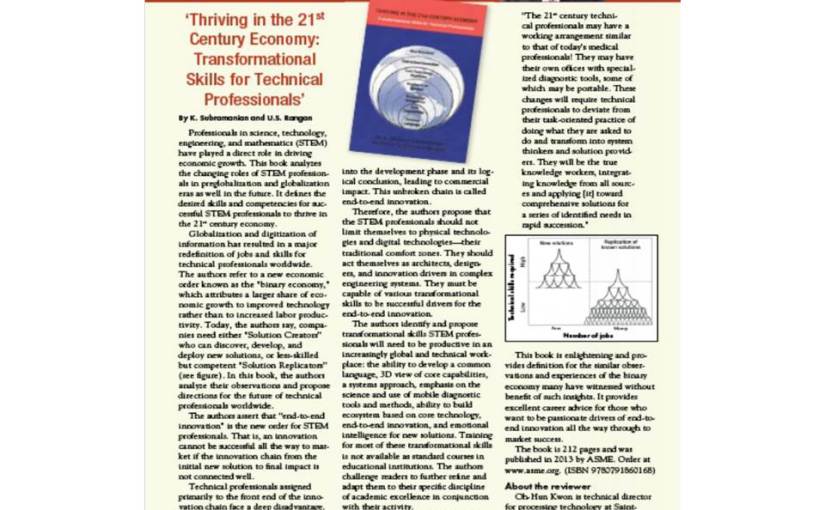
American Ceramic Society Bulletin Review of our recent book

ACS Book reviewThe American Ceramic Society Bulletin has review of our recent book titled:
Thriving in the 21st Century Economy: Transformational Skills for Technical Professionals. It is posted here with the permission of the ACS.

April 2014-Bulletin-Book Review

The magazine also is live online now. The link to the on line review:

http://americanceramicsociety.org/bulletin/2014/apr14/#/44/


Work shop for increasing the PE Score

Professionals today face challenges from two fronts.
• Their output is highly valued when there is a direct and visible connection to the PRDUCT (source of revenue), PROCESSes (That enable the Product) and/or the Application/USE of the Product. We identify this kind of work with identifiable impact as Professional Work (A).
• Absent such deliberate emphasis the professionals slowly drift towards highly task driven information work (B) and endless physical tasks (C)

As a result the professional is required to constantly focus on increasing the Professional Effectiveness. The PE – Score can be measured as the ratio of the impactful work of professionals as a fraction of their total effort.

PE Score = A / (A + B + C)

Recently we conducted a 2- day work shop on System Thinking and Transformational Skills at a Fortune 100 company to train their professionals with tools and means to increase their PE Score. The work shop was conducted for a group of 40 senior engineers and managers. We are pleased to present the summary of the feedback as noted in the table below:
Category Rating        (%)
Facilitator
The facilitator was knowledgeable about the subject                                                   91%
The facilitator was prepared and organized                                                                   89%
Participants were encouraged to take part in course discussions                             90%
The facilitator was responsive to participants’ needs and questions                        90%
The facilitator’s energy and enthusiasm kept the participants actively engaged  84%
Work shop materials and content:
The material content was appropriate                                                                          81%
The objectives were clearly explained                                                                           83%
The course content/materials were sufficient to achieve course objectives          81%
The length of the course was appropriate for the course objectives                       76%
Learning Effectiveness
I learned new knowledge and skills from this course               85%
This course was relevant to my work                                           84%
Near Term Impact:
I will be able to apply the knowledge and skills learned in this course to do my job    83%
Business Impact:
This course will improve my job performance.                                                        82%
Overall Impression:
I would recommend this training to my colleagues and co-workers                    84%

The professionals who attended the work shop also offered the following summary comments on their learnings from this work shop:
• The methodology was good and easy to relate to my work
• Binary Economy, System approach, the concept of “Why?”
• Work shop contents helped me to correlate and think on the connection.
System thinking
Approach to system thinking
• Concepts like binary economy, PE – Score
• Understood about A,B,C concepts,- Professional work, Information work and Physical work – very new learning
• PE Score – New concept
• PE Score, need to focus constantly on delivering innovative solutions else we will become obsolete
System approach and tools for transformational thinking
Different perspective on my day to day activities
Thought process to identify value from customer perspective, improve productivity and achieve engaged employees through challenging work
This kind of training itself is a new concept for us
• Emphasis on core capability enhancement to sustain and survive
• System/complete solution approach and science involved in all the projects we work
• Out of the box thinking in a different perspective
New way of working to improve efficiency and effectiveness
• Good presenter (knowledgeable & proven experience)
• Examples and video shown are excellent

Critical issues facing Organizational Development

I came across this blog prost recently: December 10, 2013http://www.blog.gr2010.com/?author=1The regular script and Bold highlights are by the original author. I have underlined a few important passages.

The items in Italics  are my comments and links.

Best wishes

Dr. K. (Subbu) Subramanian, President, STIMS Institute Inc.

1) organizations are war zones in which people struggle not to join the ranks of the unemployed. Few people expect to have job satisfaction; “satisfaction” is having a job. Since market conditions favor the employer and not the employee, people are no longer all that important. People have become spare parts.

This severe economic crisis, “organizations at war” and “people have become spare parts” is the reality in most developed nations, which are suffering the severe impact of the Binary Economy. This may not yet be the case in some startup companies or across the board in emerging countries, but it will certainly be the case for most established companies or businesses across the globe (it is becoming more of a case for IT sector also).

The cornerstone of OD was to align the individual with the organization and focus on creating an environment which is good for the individual and for the organization. Thus, the relevance of OD’s value proposition appears bizarre at the present moment.

Today OD has to focus on making sure each professional has the highest effectiveness – PE Score – which in turn translates to identifiable business impact. In other words, OD has to become “bottom up” rather than “top down”.

2) Professions should have professional standards. These professional standards serve as a balance and complement the commercial criteria by which professions are evaluat

We recommend the PE Score as the standard for all professionals and System Thinking and Transformational skills as the means to increase the PE Score.

So, a chartered accountant who has a thriving business but violates accounting practices will find himself in deep water.

Any scientist or engineer who is successful today will be in deep water soon, if they do not continue to exploit the principles of Science or Engineer pertinence to their profession. This is part of the System Approach.

OD is a poorly defined profession with no borders. There are no agreed upon professional standards. Thus, commercial standards are totally dominating how OD is practiced. OD has become a commodity, sold by an OD vendor, and the OD practitioner must satisfy the client. If the client does not know what he needs, this is irrelevant because you “follow the money” and deliver what has been ordered.

In most cases the client as well as the OD vendor is unaware that the needs of 21st century are not the same. They are Binary now: An organization to create a stream of New Solutions, and in parallel with an organization that can replicate known solutions in larger quantities. The requirements of these two parallel organizations – technical skills, people skills, risk taking, aptitude, System Thinking and Transformational Skills – are substantially different.

OD requirements for the two parallel organizations in the Binary Economy

Slide2

A cornerstone of OD was to “speak truth to power”. If one needs to “titillate” and please the “customer”, the ability of OD to deliver on one of its major principles is castrated.

The truth that needs to be spoken today is the emergence of the Binary Economy.  Requiring the above two parallel modes for OD. Customers are not aware of this or focused on this. The OD support providers are not aware of this or focused on this. This leads to the above conflict – need to titillate and inability to speak the truth – between OD Support provider and the clients.

3) OD was founded by White Western and European males, and the Western values of OD are in line with those of the founders: participation, openness, authenticity, delegation, team work. Organizations are now configured globally. In most of the world, there is more autocracy, more secretiveness, more discretion than is seen in the west; many of the values of OD are seen as parochial and irrelevant to the way people should operate, especially when they are threatened as people are in today’s economy.

These are not serious issues in the organizations focused on Replication Solutions (e.g): Large majority of Walmart workers or McDonald’s employees are not impacted by these issues of global cultures and management styles. But, this is true for professional workers (Scientists, engineers and managers, who work in global teams to create and implement New Solutions). The OD developmental requirements (see the Table above) for these professionals – engaged in New Solutions organizations – are nearly the same across the globe.

4) As OD “stands its ground” and waits for the economy to “recover”, other professions cannibalized OD. Change Management promises those in power that changes can be “managed” with a set of templates. HR is disguising itself as a “business partner”, has cast aside/betrays the lobbying for the human resource and often serves as management’s 5th column to “deal” and contain the human resource. Unions and organized labor may/will fill in the vacuum. Certainly in the country where I live, re-unionization is rampant.

This cannibalization is a reality in every profession. When the OD focus is largely for cost reduction, outplacement and out sourcing, then OD Providers serve this needs largely through Psychological counseling and rigorous training for effectiveness on standard tasks (such as speaking skills for call center employees). The Binary Economy requires structured and well executed OD development tools to growth the two parallel organizations at all levels in a diligent and sustained manner (and also in the right balance) unique to each company.

5) OD had a massive focus on communication. In organizations, people rarely talk too much anymore; they text and email and use portals. A major domain in which OD brought huge value is shrinking.

Knowledge (Academic, Sector/domain specific and Transformational), Experience and Inter-personal skills are the legs of any solution for OD. Of these, the Inter-personal skill requires effective communication. This small part of the skill development has been the major focus of OD, as mentioned above. But this view of the OD has to change. Instead OD has to become a system focused on a ladder of core capabilities, at the three levels: Individuals; Department/team; Enterprise/industry,  leading to an organization of T- shaped thinkers and problem solvers.

Slide2

T – Shaped employees,
organization and enterprise development.

What is your “Professional Effectiveness – PE” Score?

Are you a professional? — An Engineer, Scientist, Manager, Consultant, Doctor, Lawyer, ………….. ?

You are busy more than ever, working literally on a 24 x 7  clock?  Why is this? To help you assess your situation better, we offer you a simple test.

Everything you do, as part of your job or work can be divided into three distinct categories of work:

  • A = Clearly identifiable contribution of your work, in terms of Product (which generates revenue), Process (to make or create the product) and Application/USE of the product of your department, team or company.  This may sound a bit abstract at first. But, if you think carefully you will find, these are the only outcomes that ultimately determine your value or use to your team or the employer. This category of work requires active and deliberate use of your professional knowledge, your experience in creating and implementing New Solutions. It requires thinking, reflection, data analysis, inferences, conclusions, risk taking, …….. Only you can do this category of work. Try as best as you may, you can not simply delegate this category of work!
  • B = Your effort in processing information (e-mail, phone calls, net browsing, voice mails – recording/receiving, paper work, keeping track of budgets, accounts, expense reports, budgets, booking travel tickets,  etc.. With the increasing capability of  IT Tools and their applications , each of us are increasingly drawn into this category of work. Gone are the days where administrative assistants and support staff could be used to carry out these tasks. It appears easier to do it all by yourself and apparently more efficient. Companies may see it as a cost reduction, when you do all this by yourself. But, it has every opportunity to distract and diminish your output under category A. You can delegate this category of work if you choose to. May be some one has already put this monkey – more of it – on your shoulders?
  • C = Your effort in physical work, such as travelling, commuting, sit in meetings, typing, etc. When you over do this category of work, it leads to your lower back pain, Carpal tunnel syndrome, lack of sleep, jet lag, physical exhaustion, and all other ailments!

Your total effort  = A + B + C

Your PE = A / (A + B + C )

How is the work changing (1)

In a recent informal survey of professionals, over half of them felt that their PE is less than 20% While individual professionals attempt to increase their contribution through “A”, most companies are reducing the “B” and “C” content through IT applications, outsourcing, globalization, etc. The combined effect of these is a steady increase in labor productivity, where fewer people are producing more perceived outcomes. But, unless the “A” category of work is deliberately increased the innovative outcomes – in terms of new Products, Processes and/or Applications/USE – will continue to slide down. All that is left will be cost reduction (like squeezing the last few drops of water from  dry wood)!

Any one at any level of responsibility has to be worried about the PE score. Integrated across all the professionals in the company, PE score will be the true measure of innovation or lack there of, in the company.

Senior executives, HR managers, as well as individual professionals need to become aware of the PE score. Such awareness, has to be followed by next steps to increase the PE score, which in turn will require formal and structured education, training and practice of Transformational Skills

For more details and for tailored support  Contact US