What is common between Bernie Sanders and Donald Trump?

There has been huge attendance in the recent Democratic rallies featuring the Vermont Senator Mr. Bernie Sanders. On the  other hand Mr. Donald Trump has been sucking up all the oxygen and attention with his harsh language against immigrants and his fellow presidential candidates in the Republican primaries. The popular support for these candidates may be seen as the pent up anger in the population against the Wall Street and the perceived syphoning of jobs and economic opportunities by the illegal immigrants from the south of the border respectively. This kind of anecdotal explanations by the reporters and political pundits may not serve the nation well for the long term.

In a recent article published in the Washington Post titled: Sorry, but the jobless future isn’t a luddite fallacy  the author makes the point: Policy makers have a big new problem to deal with: the disappearance of human jobs. Not only will there be fewer jobs for people doing manual work, the jobs of knowledge workers will also be replaced by computers. Almost every industry and profession will be impacted and this will create a new set of social problems — because most people can’t adapt to such dramatic change.

The author makes it look like it might be a problem developing into the future. But, reality suggests that the problem started a decade before Regan years, got established through the Clinton years. When the very survival of the economic order was in question due to the financial crisis along with protracted engagements in wars, when Mr. Obama took office, gradual erosion of employable opportunities for the large cross sections of the society has continued but seen merely a side issue. Now as these two national concerns are addressed to some extent, the pent up fear and anger and despair in the population is finding its voice through the emotional appeals of Mr. Sanders and Mr. Trump, even if their tones are completely different.

We have documented this erosion in the meaningful opportunities for employment and economic well being as the Binary Economy well documented in our recent book. Instead of waiting for some one else to fix the problem we have suggested that technical professionals, students and others should systematically cultivate specific skills – Transformational Skills –  to enhance their job and career opportunities. These individual centered initiatives will go only so far. It requires national leaders to comprehend the evolving Binary Economy and develop policies and national consensus for coping with its  impact. Merely cloaking the Digital Technology as “high tech” and glorifying the thief using DT tools as “hackers” does not do well for societies that have succeeded through the use of all sorts of technologies as the backbone for their success.

Absent such policies we see continued isolation and layering of job opportunities. This leaves people in the lower levels of jobs (largely involving physical work or information tasks) with a sense of despair that unless you are born in a well to do family and go to school in a better neighborhood, your opportunities are permanently shut off. The knowledge economy and the skill based economy have become code words for the success of a few while others stagnate. These issues may be the under currents supporting the fan base for Mr. Sanders and Mr. Trump.

Clearly the answer is not the anger and abuse against the immigrants unleashed by Mr. Trump. Raising minimum wage and such social policies for re-distribution of wealth by Mr. Sanders may be temporary fix. But they may not be the sufficient or sustainable long term answers as well.  As noted in the Washington Post article: If we can develop the economic structures necessary to distribute the prosperity we are creating, most people will no longer have to work to sustain themselves. They will be free to pursue other creative endeavors. The problem, however, is that without jobs, they will not have the dignity, social engagement, and sense of fulfillment that comes from work. The life, liberty and pursuit of happiness that the constitution entitles us to won’t be through labor, it will have to be through other means. Is this the way of life we want?

What are the other means for such living, where anything a human can do – read, write, think, analyze, infer, conclude, decide and control – can all be done by computers and IT solutions? Mr. Steven Hawkins has raised this specter and fear one can envision due to irrational deployment of Artificial Intelligence in the future. But, the irrational deployment of digital technology for incremental gains in cost reduction and elimination of human employment has started at least four decades ago. This has been happening in parallel with unprecedented gains in many new areas thanks to advancements in Digital Technology. Are these two sides of the lever balanced? If not how to maintain the balance? These are the questions that have not been addressed for the past four decades.

There is also a need for discussion on another balancing act: Investors – those with capital or money – can work and use all resources across the globe and we call that as global capitalism. Yet national economic policies – of the countries in which the same investors live – are constrained by what the government can do within its shores. When human beings as employable resource  migrate from rural areas of China and India to the urban centers it is considered legal. The same migration of people for the same reasons from poor countries to more affluent regions in their neighborhoods we decry them as illegal labor.

Such balancing act in several fronts are entirely new. This is an open space for any national leader from either party to develop a dialogue and national mandate for future actions. Whoever fills this void may emerge as our next President. Or we may go through another election without any consensus and more shouting and name calling. After all any social  system under great stress needs to find the vent to release its anger and frustration. We see this release of frustration as the common outcome of the campaigns of Mr. Sanders and Mr. Trump at this time.

Some might say “the train has already left the station and it is too late to do anything”. Such pessimism and acceptance of systematic loss of opportunity for large segments of work force and relegate them as un-employable will only fuel the pent up anger. Then we can expect to see even larger crowds at Bernie Sanders rallies or higher poll numbers for Mr. Trump, even though neither of them may win the presidency. But it will also weaken any future president without a mandate to strike the right balance required, as mentioned above.
Stop being nice to your boss?

The news item “BlackRock’s Chief, Laurence Fink, Urges Other C.E.O.s to Stop Being So Nice to Investors” appeared in the recent NYT Dealbook segment.

In a letter sent recently by Mr. Fink to the top 500 CEOs in the country, he suggests, “Too many of CEOs have been trying to return money to investors through so-called shareholder-friendly steps like paying dividends and buying back stock. These maneuvers, often done under pressure from activist investors, are harming the long-term creation of value and may be doing companies and their investors a disservice, despite the increases in stock prices that have often been the result. The effects of the short-termist phenomenon are troubling both to those seeking to save for long-term goals such as retirement and for our broader economy …… such moves are being done at the expense of investing in innovation, skilled work forces or essential capital expenditures necessary to sustain long-term growth.  This move sends a discouraging message about a company’s ability to use its resources wisely and develop a coherent plan to create value over the long term …….  with interest rates approaching zero, returning excessive amounts of capital to investors isn’t helpful because they will enjoy comparatively meager benefits from it in this environment”.

In our opinion we need such bold leadership also among professionals to stop bowing to the pressures of the boss or organization that demands “fire fighing” on short term problems at the expense of time and resources necessary to dedicate to the long term needs and success of the company and the organization.

You can stop bowing to investors if you know who they are! The problem is that the “Investors” today are those who make money off of money. They pay everyone else for doing their work to get that result. This stratification of work between the investors and the rest is the insidious problem that has been evolving for the past three decades. You and I who invest in mutual funds – which can be local or global – are also the investors! The issue may be: Can the CEOs sell the value of their long term vision and goals to the “investors”? Once convinced can they deliver the long term value as promised? These are the questions that need to be addressed by every one – from the CEO to the lowest level employee in every company. We call these as the Transformational Skills.

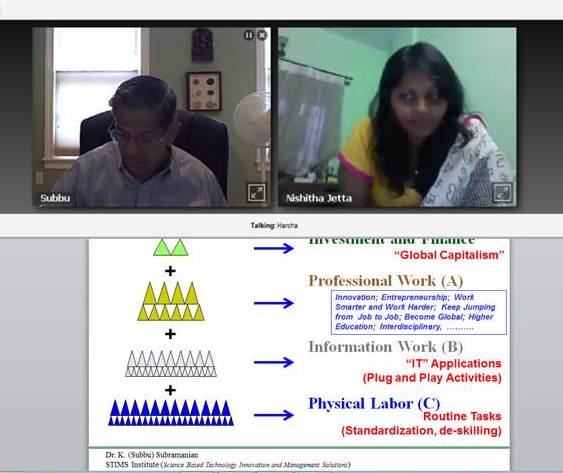
Today the  hedge fund managers, day traders, arbitragers, financial analysts and the fund managers are increasingly isolated from the main stream business. In this new model Finance, Professional work, Information work and Physical work are in stratified impermeable silos. In this scenario, the CEOs are just like any other professional (who gets paid for their work) as opposed to Finance (where money is made off of money!). Hence the CEOs have to learn new skills – Transformational Skills – to get the “investor driven finance” do what the CEO needs (long term business focus). The question is “Should the CEO quit bowing to investors? or “Should the CEO learn skills necessary to get the investor driven Finance bow to him/her?”

The question is also identical for many professionals where they say that their boss and organization is forcing them to focus on short term projects and quick results. Do these professionals have the necessary “Transformational Skills” – which is beyond academic education and industry/sector know-how that will make their boss and organization sit up and listen to them?

Contact us

Where is the real “Skill gap” ?

In his recent opinion page, Mr. Paul Krugman writes the following in the NYT:  Most people would surely agree that stagnant wages, and more broadly the shrinking number of jobs that can support middle-class status, are big problems for this country. But the general attitude to the decline in good jobs is fatalistic. Isn’t it just supply and demand? Haven’t labor-saving technology and global competition made it impossible to pay decent wages to workers unless they have a lot of education? ….  And the evidence that technology is pushing down wages is a lot less clear than all the harrumphing about a “skills gap” might suggest.

In the above referenced citation on “Technology”,  Mr. Mike Kanczal writes: When we think of the economic malaise of the past 30 years, we should probably think of it as a combination of technology, globalization, sociology, and public policy.

In all of the discussion, the word “Technology” is used with out a clear common understanding. If you are a Mechanical Engineer, your knowledge in applied mechanics, materials science and physics are not counted as “technology” in the above discussion by these eminent scholars. Same goes for Electrical Engineers, Chemical Engineers, Civil Engineers, Chemists and Biologists and their knowledge or know-how. Even a Robotics expert and his/her knowledge of mechanical design, path planning and fixturing are not counted in the above “technology” reference.

Instead, what is counted as “Technology” is the automation in the collection, processing, analysis and dissemination of information of any kind and in any place and for any reason. This is the automation of human centered capability in any and all aspects of our life. Instead of calling this as “Technology” we should call it as “Information work”. People, described as labor can be engaged in four sets of work:

  1. Finance – make money off money
  2. Professional Work – create and deliver a stream of new solutions each and every day (like a carpenter who makes and sells furniture, a plumber who fixes the leaking pipe and get paid for it, a cardiologist who fixes broken hearts (literally), etc.)
  3. Information Work
  4. Physical Work

The “Skill gap” mentioned above – which is seen as the major impediment against good paying jobs truly involve the following:

  • Recognizing that the work has indeed stratified into these four impermeable layers and only one of the four is available as a source of good wages (unless you are born with a silver spoon)
  • Recognizing that the Physical work and Information Work – which employed a large majority of the labor force with or with out higher education – will both be automated and what is left will only lead to low paying – “service” – jobs. Number of these jobs may grow, but their wages will hover around the minimum wage.
  • Only a narrow window of “Professional” work exists where there will be decent wages and opportunities to nudge into the middle class.
  • Finance – making money off the money – work is for a select few and these are the affluent 1%. If you can make it there great. Or if you are lucky to be born with a silver spoon, then you can count your blessings!
  • But, the better bet for the large cross section of the people may be to acquire skills that deliberately place them in the “Professional Work” category.
  • Such professional skills are not merely higher “Academic” education or Industry specific trade skills.
  • Instead the true skill gap is the blend of Academic, industrial specific skills together with System Thinking and Transformational Skills.

For details Contact us.

STEM Professionals: Here is some music to your ears?

Irrespective of the political spectrum one belongs to, the recent announcement of global energy policies  by USA, China, Russia and other countries, must be the music for the ears of all STEM Professionals.

The recent announcement from the White House on the new energy policy is noted as follows: Obama’s Strategy on Climate Change, Part of Global Deal, Is Revealed http://www.nytimes.com/2015/04/01/us/obama-to-offer-major-blueprint-on-climate-change.html?ref=energy-environment&_r=0

The White House on Tuesday introduced President Obama’s blueprint for cutting greenhouse gas emissions in the United States by nearly a third over the next decade…. Mr. Obama’s new blueprint brings together several domestic initiatives that were already in the works, including freezing construction of new coal-fired power plants, increasing the fuel economy of vehicles and plugging methane leaks from oil and gas production. It is meant to describe how the United States will lead by example and meet its pledge for cutting emissions.

There are four key areas of focus described in this policy: https://www.whitehouse.gov/energy/securing-american-energy

  • Carbon Capture and Sequestration Technologies
  • Make solar energy cost-competitive with traditional energy sources by the end of the decade.
  • Energy efficiency in our vehicles and homes
  • Developing Clean Fuels

Each is an ambitious goal in itself. For example: New Clean energy standards for cars require automakers to raise the average fuel efficiency of new cars and trucks to 54.5 miles per gallon by 2025. http://www.usnews.com/news/articles/2012/08/29/545-miles-per-gallon-for-all-cars-by-2025-not-exactly

Irrespective of the political spectrum one belongs to, the above must be the music for the ears of all STEM Professionals. Over the past three decades with a relentless emphasis on cost cutting, standardization, automation and off shoring and out sourcing, there has been little if any emphasis on development of NEW SOLUTIONS that exploit the physical phenomena of nature. Of course exceptions to this generalization do exist particularly in the areas of IT, biology, genetics, etc. But, there are plenty of Mechanical and Electrical engineers, Physicists and Chemists and many other professionals in the STEM professional community, than there are computer scientists, biologists and geneticists. These professionals cannot be gainfully engaged unless there are big challenges posed in front of them. Government funded projects always follow the mission set by National policies. Recall the spurt in space technology after the call by the President Kennedy to “land on the moon”? Private sector, despite their professed desire for risk taking, will always place their bets on “safe” opportunities for cost reduction – milking the same old cow – rather than push new pastures and there are plenty of old cows to milk for decades to come. This leaves all the STEM professionals waiting in the wing for their opportunities, while they see steady erosion in their standard of living. Chances are, the new policies and the mandates on the industry will also spur more demand to find better ways to burn coal, make solar energy more competitive, make the homes more energy efficient, and cars that can indeed generate 50+ MPG on an average. All of these will require serious and sustained new solutions developed and perfected by STEM professionals.

Of course there is also an onus on the STEM professionals as well. They cannot simply wait in line and be told what they should do every step of the way. These are the traditional task oriented technical professionals. Instead, they need to become system thinkers and solution providers with a constant emphasis to Discover, Develop, Deploy and Exploit a stream of new solutions. We call on all STEM professionals at every level – from technicians to engineers to managers to senior managers – for this End to End Innovation. Contact us.

STIMS Institute offers Webinar for young engineers

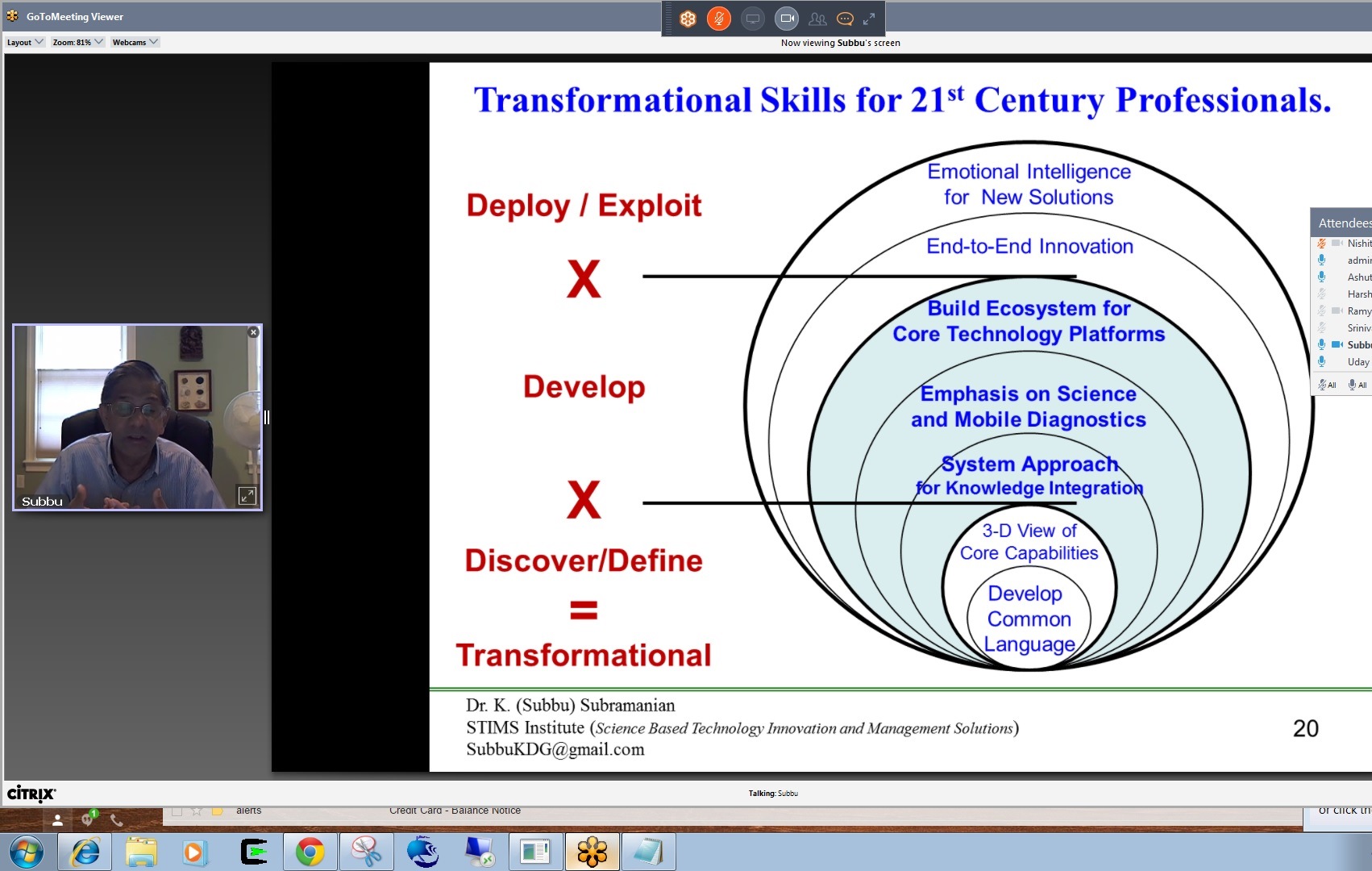
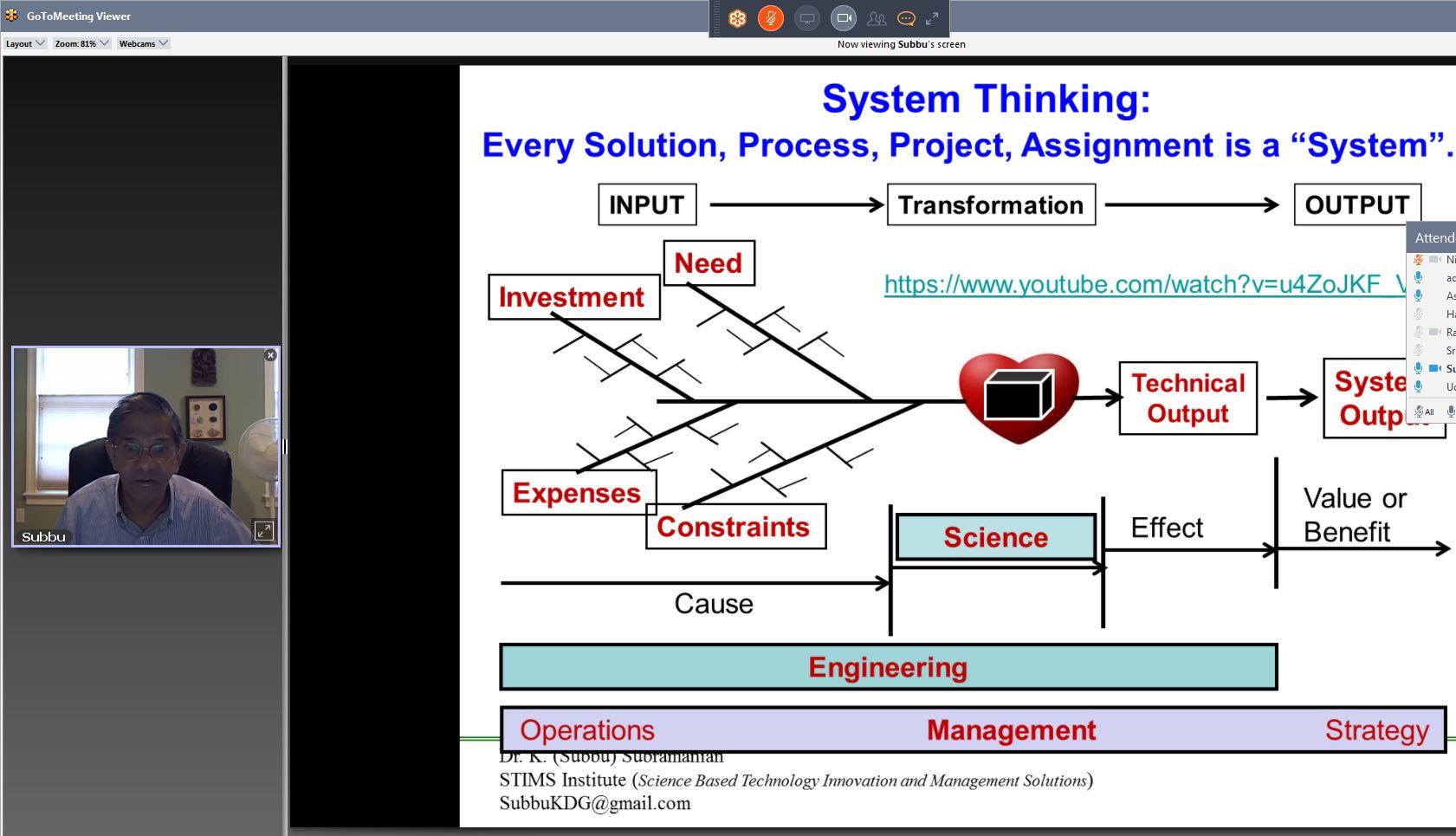
Slide10 Webinar_DrSubbu_March282015_10 Webinar_DrSubbu_March282015_20

Recently we conducted a webinar for a group of young engineers from across the globe on the tools and skills required to increase their PE Score.

If you have such need to train and develop your young professionals contact us

Online access to webinar sessions

Part – 1/4 :
https://www.youtube.com/watch?v=mn5KGtfb8yw


Part – 2/4
https://www.youtube.com/watch?v=sJS_jo_GdCk


Part – 3/4
https://www.youtube.com/watch?v=PERUzQ-syMI


Part – 4/4
https://www.youtube.com/watch?v=I74AdagU6cs


End of session feedback:

  • Thank you for joining today. For people who could not join today, we hope to see you in future sessions. I just wanted to thank Nishitha for taking the lead and organizing this for the common benefit of all. Thank you!!!  Special thanks to Dr. Subbu, for taking time off and sharing your knowledge and expertise with young people like me. It was indeed a very informative session and hopefully we can implement some of the ideas you suggested in our individual professional careers.

Cheers!!! have a great weekend  — Uday

  • It was a wonderful session. It is difficult to find someone who has a systems perspective and who can put it across in a way that can be easily understood. On behalf of everyone who attended the session, I would like to thank Dr. K Subramanian for taking out time and sharing his work with us. I am sure I will look at my work in a different way.

I am attaching the minutes of the meeting and some screenshots for everyone’s benefit. —  Nishitha

Minutes of the Meeting:

TOPIC – Systems Thinking and Transformational skills  SPEAKER – Dr. K. Subramanian, President, STIMS Institute    DATE – 28TH March 2015   ATTENDEES :   Name removed for privacy; Attendees from: USA, India, Dubai

HIGHLIGHTS

– Know the difference between tasks oriented jobs and solution oriented jobs

– Companies look for replicate solutions, but they also look for people with transformational skills who can provide “new solutions”

– Be conscious of the value you are adding to your company. If you don’t add enough value remember that you can easily be replaced

– How is work structure across the globe changing? What did it look like before? How does it look like in 21st century? How do you orient yourself to succeed?

– How can you practice transformational skills?