An obligation for every Technical Professional

Irrespective of your political affiliation you should read the attached link for an excellent panel discussion on Education, Advanced Manufacturing and Funding for Research https://fivethirtyeight.com/features/the-science-of-clinton-education-advanced-manufacturing-and-more-money-for-research/?ex_cid=2016-forecast

If your candidate understands and supports these issues vote for her / him. If your candidate has no clue on these issues then demand their attention and policy positions. Standing on the side line or casting a protest vote is not a good option.

Your jobs, career and future depend on your activist role in this election (and in every election).

10 Critical issues for Millennials

At STIMS Institute we are focused on System Thinking and Transformational Skills.

System Thinking requires an ability to focus on the larger issue on hand – the whole is larger than mere sum of the parts.

Transformational Skills are a set of capabilities to identify a need develop it into a solution with an emphasis on implementation fo such solutions for larger common good.

With the POTUS election less than 2 months away the millennials are now called upon to exercise their best judgement and cast their votes in large numbers. The Millennials are largely credited for the election of President Obama in 2008 and 2012. They are also faulted for their lack of enthusiasm at the polls in 2010 and 2014 mid term elections.

Do the millennials want to be a force of change? This is the question looming for them in the next ten weeks. This will require them to reflect on the larger picture and in a comprehensive manner. Here are 10 reasons why the Millennials should vote in droves in the coming election:

1. Millennials like free college education as promised by senator Sanders. How realistic was its passage into law? Isn’t  debt free education the better and more realistically achievable option?

2. Millennials need Better Health insurance – this would require preserving Obamacare and work towards a single payer system as a competitive alternative to commercial insurance plans.

3. Millennials need better minimum wages and they should push for this as a mandate in this election.

4. Millennials need good paying jobs which will come from Infrastructure investments and more investments in R&D. They should demand this from all candidates.

5. Millennials care for the future of the planet and hence ecology and are against Global warming – Their vote will affirm or reject efforts towards these goals.

6. Millennials are against wealth accumulation in the hands of  a few. Then they should push for policies that would prevent that.

7. Millennials want equality for all including Women’s rights, LGBT rights, protections against police excesses and racial equality. Their vote will affirm or deny progress in these areas.

8. Millennials want to lead the forces to create change – they are credited for electing the first black man for POTUS. Now if the choose to, they can elect the first woman for POTUS.

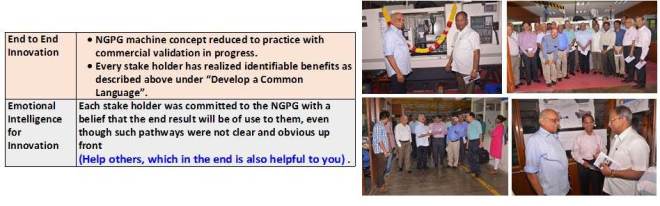
9. End to end innovation requires developing solutions which are carried on through the implementation and value generation stage. Are 8 years and 2 elections (08 and 12) enough for this end to end innovation?

10. Dreamers are also millennials. Will the rest of them support to create a sustainable eco-system of value for all millennials or whatever the young generation is called in the future?

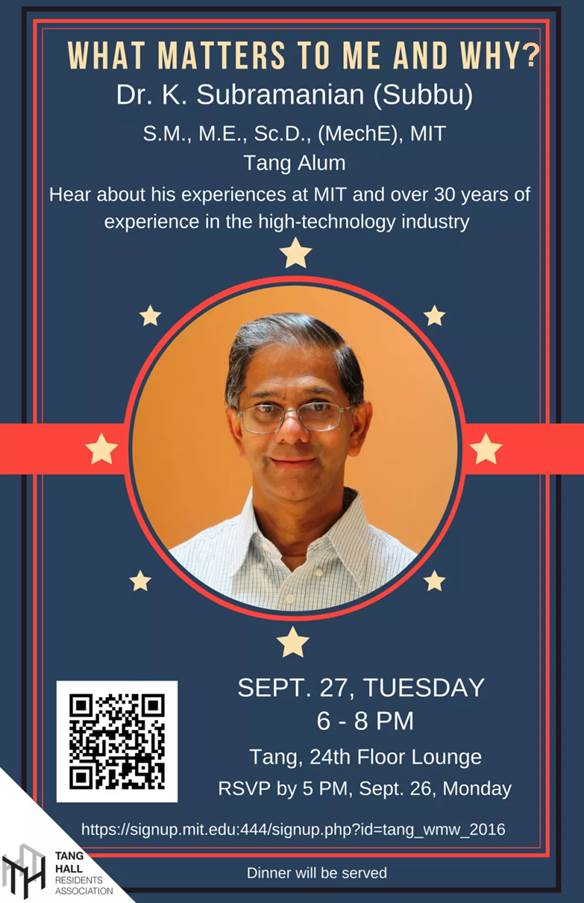
Talk scheduled at MIT campus

tang-hall-09-27-16

“What matters to me and Why?” – Dr. K. Subramanian

Date: Sep-27-2016
Time: 6:00pm to 8:00pm
Venue: Tang Hall, 24th floor lounge
Description: What skills do we develop to be relevant in this age when computers can seemingly do everything?
How has the landscape of innovation changed in the 21st century?Attend this interesting talk by Dr. K. Subramanian, an MIT and Tang Hall Alum who has over 30 years of experience in the high technology industry.Dinner will be served.

RSVP required. Click here.

What should you do when the thought leaders are so wrong?

slide1

Following is a quote from the recent Meet The Press show on NBC.  http://www.newsbusters.org/blogs/nb/nicholas-fondacaro/2016/09/11/meet-press-republican-party-becoming-party-less-educated 

On the show, Brooks warned of “chasms that open up socially” between the well-educated and the poorly-educated, and how you can measure other social aspects with that information. He also shared his worry about what it could mean for an educationally divided country:

And so my question and this is really a serious worry; suppose one party becomes the party of less college and who feel head winds, and that would be the Republican Party, I think. And suppose another party becomes the party of the tail winds because they’ve got college degrees, and that would be the Democratic Party. Suppose our partisan realignment over laps with a class alignment and that to me is extremely problematic for what it says about what’s going to happen.

 His fellow panelist Tom Brokaw concurred with this prediction saying that it goes against all preconceived notions the media had about Republicans.

And also this is a profound shift because the Republicans are representing those who don’t have a college education,” Brokaw explained, “We’ve all grown up with Republicans who are at the high end of the income scale and are the elitists in American life. So this has been turned upside down.

Both David Brooks and Tom Brokaw are well respected national thought leaders. No one can question their wisdom, experience or acumen.  Yet in their above comments one has to believe that they are merely expressing their opinions rather than reasoned factual conclusions (which we expect from these thought leaders).

It is true that a large segment of the population feel the head winds. This is due to the massive standardization and de-skilling of work of any kind and in any sector. This includes manufacturing, accounting, medicine, not to speak of Walmart and McDonald work. This has nothing to do with college degrees. It has everything to do with aptitude, a willingness to put in hard work with our supervision and follow-the-herd mind set. For this skill and work, the salaries are rushing close to the minimum wages. So, even after two jobs in a day, one can not still take care of a family.

In the above scenario college degrees are used today merely as a screening tool as evidence of diligence and ability to follow the rules. If you have these skills you don’t need a college degree.

Large cross section of people who fall in this category are both Democrats and Republicans. Simply because Bernie Sanders and Hillary Clinton promote ideas on free or affordable college education, those who need such help are not merely Democrats.

Since over 80% of what one needs to know as information (falsely attributed as knowledge) is already available through internet (Google, search engines and social media) the need today is not college education, but a job or solution that needs your services. The smart people are those who can find such opportunities and they can get attached to them. We call them as Transformational Skilled workers. Hillary Clinton has been promoting this kind of skill development through Community Colleges and Vocational Technical Schools.

Those with a blend of academic education (not necessarily a four year college degree), attached to real world needs and opportunities, but with an unending zeal (Transformational) to identify, develop and deliver a stream of new solutions are the few with the tail winds at their back in the new Binary Economy. These few are not Democrats or Republicans. They are both.

Unfortunately the current POTUS election is not a contest for identifying these head winds and tail winds. Instead it is a contest between a demagogue and opportunist (who has already benefited from the tail winds at the expense of many) and a life long Methodist (who believes in social good for as many as she can help).

Also the tail winds favor a few at the expense of the many. This is seen as the rise of the 1% vs. the 99% who suffer the pains of the head winds. Protection for the many against the head winds may need social programs and Government involvement – which would be the Democrat’s preference. Instead people may be left to fend for themselves, while Government steps out of the way – which would be the Republican’s preference. Unfortunately these are not the subjects of debate in the current election cycle, since one candidate (Hillary) has policy proposals, while the other candidate (Donald Trump) has nothing but lot of words with little in terms of policy alternatives.

Tail winds can be taken advantage of by individuals to lift their own boats. This is the preference by Republicans (through their preference for tax cuts for the rich). Benefit of the tail winds can be used by sharing for larger common good (through tax increase for the rich). This is preferred by the Democrats. This may be the only policy difference one can see between the two parties.

Some of those who benefit from the tail winds are clearly noted in the media. The many “Pundits” who offer constant opinions on news, TV and social media are not necessarily the highly educated – with reasoning and logic  as their core values – but instead are those who have a drive and will to appear in as many media outlets as they possibly can and repeat or regurgitate what is already known over and over again. We can only hope that scholars and thought leaders like David Brooks, and Tom Brokaw will not fall into that category of media opportunists who express their opinions as facts.


NGPG – 8 Year journey for end to end Innovation

1

NGPG

A group of executives of machine tool manufacturing companies and precision components manufacturers met in July 2008 at Ghaziabad, a small town in the outskirts of Delhi. This meeting was organized by Mr. N.K. Dhand, CEO, Micromatic Grinding Technology, a leading machine tool manufacturer in India. Their discussion centered on Precision Manufacturing in India. This was an early initiative very much in line with the now famous Make in India movement spear headed by the current Prime Minister of India, Mr. Narendra Modi. This journey started in 2008 has resulted in a commercially viable indigenous machine tool, capable of manufacturing higher precision engineered components in India. This machine (NGPG) was inaugurated on June 24th 2016 at IIT – Madras, India.

2

This report is a brief summary of the 8 – Year journey of collaborative development, leading to end to end innovation (i.e.) from concept to commercially viable end product.

Following are a few pictures from the kick off meeting held at Ghaziabad on July 1, 2008. The meeting was attended by CEOs of several precision machine tool manufacturers, Senior Managers from Precision components manufacturers, Senior advisers from Indian Machine Tool Manufacturers Association (IMTMA).

Slide1

Kick off meeting held at MGT at Gazhiabad, Delhi July 1, 20008

 Dr. K. (Subbu) Subramanian, President, STIMS Institute (then working at Saint-Gobain Co.)  was invited to this meeting to offer his views on manufacturing and innovation. He offered an outline for a road map for machine tool developments in India. He suggested the following outline:

  • Step 1: Target Industries, applications and their market opportunity (Driven by National and Global Policies): Inside of India; in Selected Geographies?
  • Step 2: There are similar applications (e.g): Cylindrical Grinding, everywhere. What is the “Served Market” for the IMTMA members?
  • Step 3: What industries and markets that IMTMA members want to drive? Proactive Vs. Reactive ?
  • Step 4: There is a natural evolution path for Core Capabilities  depending on the           component/supplier capabilities.
  • Step 5: Leverage capabilities of Individual members or industry suppliers?  (e.g): Grinding Technology
  • Step 6: Leverage capabilities of a collection of members and their capabilities for  “Integrated Solutions”? Technology Value Chain?

Dr. Subramanian also explained the need for an eco-system for collaborative development in India, as an unique alternative to the industry – university models noted in developed nations such as USA and Germany.

Slide2

At the end of this meeting the following conclusion was reached:

Indian Machine Tool manufacturers and their customers for the machines made in India cannot achieve tolerances for less than 1 micron (roundness, taper, size holding, …) with out in-process gaging. But in-process gaging cannot be used for many precision components including non-round grinding applications such as cam lobe grinding or match grinding of precision parts. Such machines can be imported but technologies to manufacture such machines are not available for sale that can be purchased from the overseas manufacturers. Lack of such higher precision machine tools also impacts further progress inside of India in the use of advanced grinding solutions – such as high speed CBN grinding – in the manufacturing sector.

After such clearly outlined industry need, Dr. Subramanian and Mr. N.K. Dhand contacted Prof. Babu at IIT – Madras. Further discussions together with Mr. Mohanram, Scientific Adviser, IMTMA resulted in a research proposal, which was timely for submission to a RFP for research in the year 2010, supported through the Office of the Principal Scientific Advisor, GOI. The proposal was accepted by GOI. The review process that followed was valuable as noted in the following exchange:

Reviewer Comment: The proposal should make the technical details of what is meant by the next generation precision grinding machine. This information given in the proposal is too general and is not sufficient to judge the quality of the proposal. It is also not proper to identify an existing machine tool of the sponsor without establishing its superiority over the existing machine tools of the other brands.

I recommend that the first phase of the project should compare and identify the  best grinding machine presently available and then spell out the requirements of the next generation precision Grinding machine so as to take up the second phase project involving the development.

Response:   There will be a parallel effort to calibrate cylindrical grinding machines available in India and the state of the art of such machines available worldwide. With this data set of the cylindrical grinding machine capabilities inside of India and those available abroad should be the reference for developing the next generation precision grinder. The framework developed in the project will provide the necessary guidance for building the next generation precision grinders.

After further reflection, the following factors were also identified by the R&D team:

  • In most industries the commercial developments are incremental. But the history of such development is not a well-documented continuum. Hence while many companies can manufacture higher precision machine tools, they cannot “teach” a comprehensive methodology for someone else to follow!
  • Often the legacy knowledge is also lost with the retirement or departure of experienced and senior level workers as each generation of machine tool is developed or due to changes in company business conditions and strategy.
  • The research pursued by individual academic researchers often delve into depth of one or the other aspect of precision machine tools such as stiffness, dynamic stability, etc. Rare few if any study all aspects of machine tool developments needed for the development of a higher precision machine tool. This requires an integrated or System View of the research and development.
  • Hence the System Approach developed and advocated by STIMS Institute and the related Transformational Skills were adapted as the frame work for the development of the Next Generation Precision Grinder (NGPG).

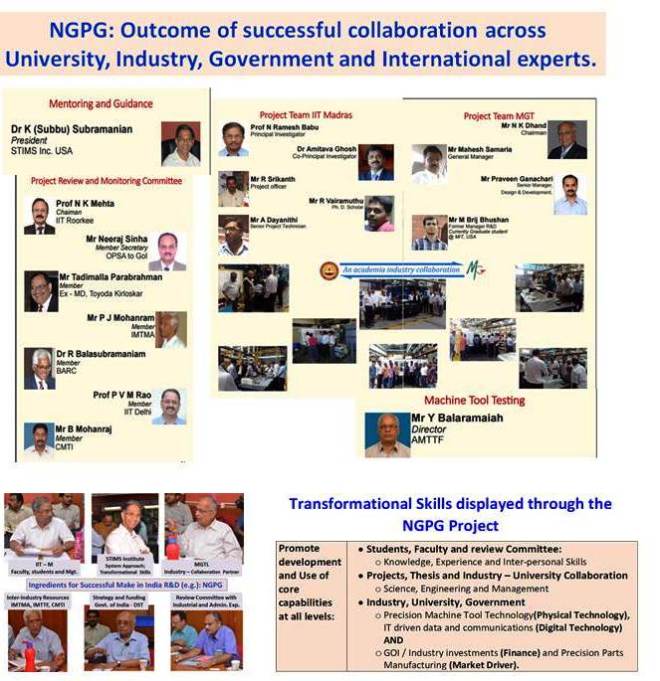
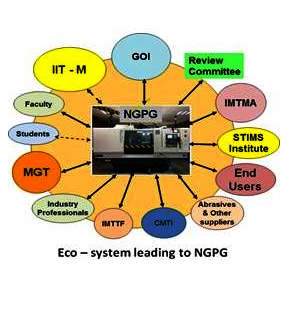
The NGPG project was approved by the end of 2012. It has progressed well to achieve all the goals set forth in the visionary meeting held at Ghaziabad in 2008. The machine was inaugurated on June 24th 2016 at IIT – Madras by Dr. R. Chidambaram, Principal Scientific Advisor, GOI. The project, its progress and the end result – a commercially viable next generation machine tool developed as an outcome of GOI funded research carried out through active team of collaborators from Industry, Academia, Govt. Research labs. and world experts – is a true testament to the application of System Thinking and Transformational Skills and their impact. We are pleased to document below the progress and the results through the following slides:

Slide3

Slide4

Slide5

Slide6

Slide8

Slide9

NGPG: Outcome of effective Project Management and guidance by the Project Review and Management Committee (PRMC)Slide7

Transformational Skills displayed through the NGPG Project
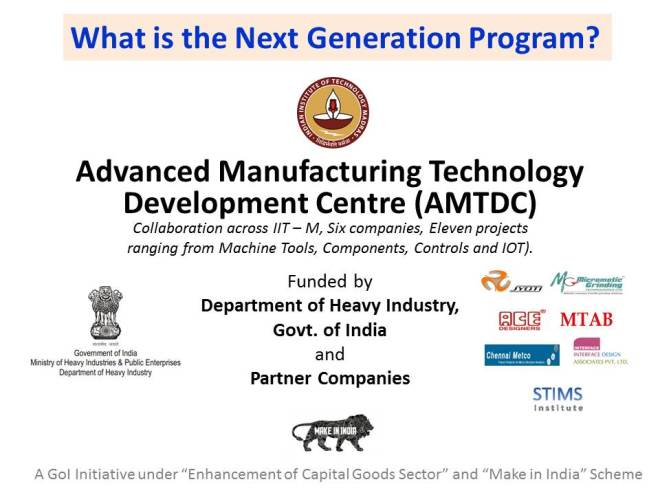
Slide12 As it is often said “Success Breeds Success”. The success of the NGPG project and the collaborative environment created across the industry / university research and manufacturing community has resulted in the development and formation of the Advanced Manufacturing Technology Development Center (AMTDC). This is a collaborative effort across six machine tool / components manufacturers, IIT – M supported by GOI R&D funding.  STIMS Institute will continue its role of mentoring and guidance for the success of this consortium and its impact on the manufacturing sector.
Slide13