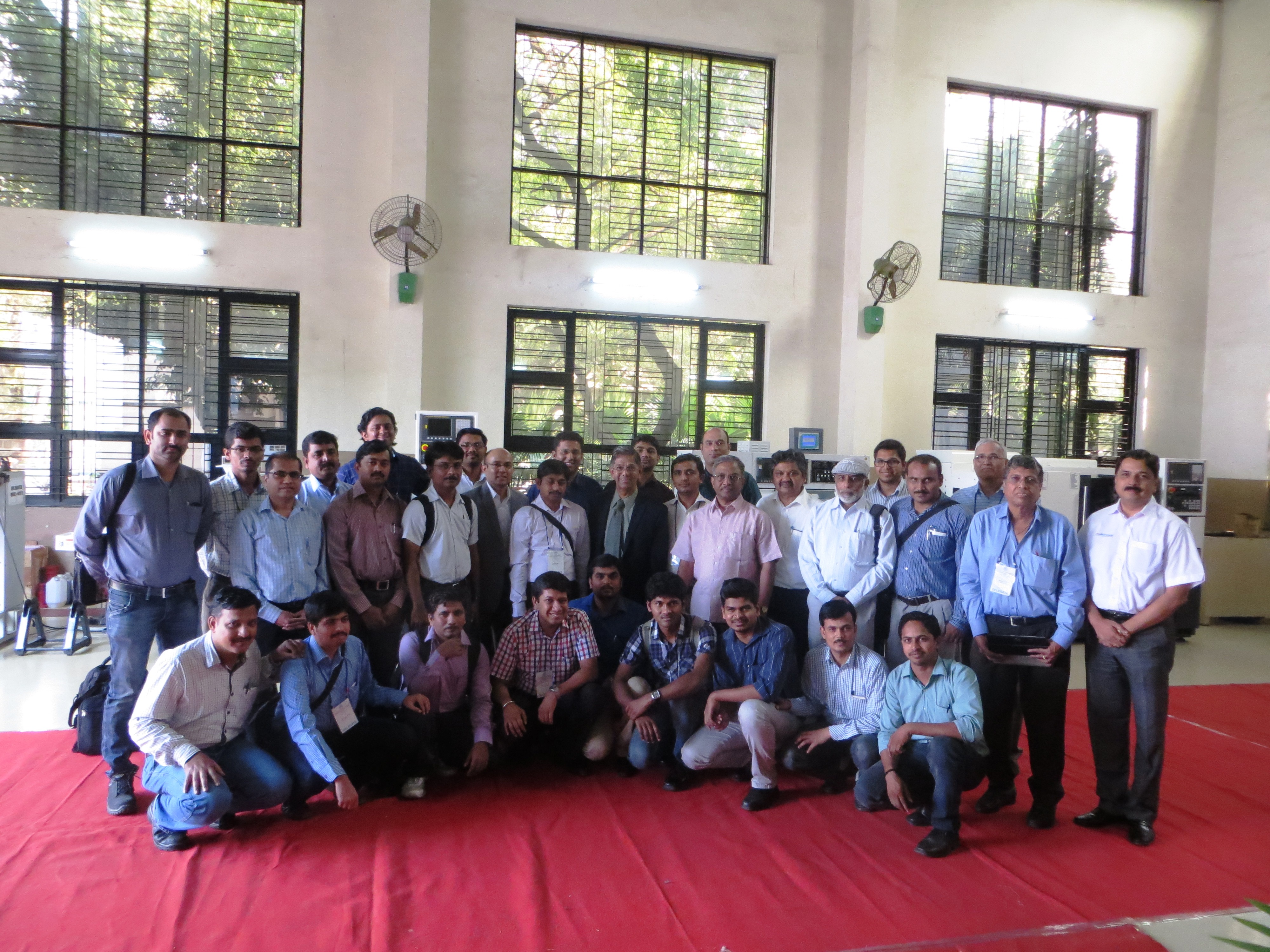
Sector specific education offered successfully for third year in a row!

We started 2 years ago an initiative in collaboration with  IMTMA (Indian Machine Tool Manufacturers Association).

The purpose is to upgrade the knowledge of  middle & senior level manufacturing engineers with the basic elements of “Systems Thinking of the Manufacturing Processes”, that they deal with every day at the work place. While the “Economics”(OEE or productivity) of these processes is their daily concern, the “Engineering” solutions they work out often lack the “Science”  & science-based fundamentals, which alone can help these engineers “Optimise the Process as a System”.

Encouraged by the success of previous two programs, first one launched in South at Bangalore, India in 2012 & repeated in the North at Delhi in 2013, IMTMA  decided to take this program to the West this time. The 3rd program was scheduled at Pune from 19-22 Nov. as per details attached.

Dr. Subbu Subramanian is PhD from MIT-USA, with working experience of over 30 years. He worked at Ford Motor Co. & was the International Director of R&D at Saint-Gobain Ltd. (earlier Norton USA). Now he is the President of STIMS Institute Inc., USA. Through this company he teaches and trains professionals on System Thinking and Knowledge Integration.  He is collaborating with IMTMA, MGT & also with IIT-M Chennai for helping Indian Industries understand & adopt “Systems Approach to Manufacturing”-starting with the Grinding Process. Details are given in the attached brochure with a link of a video of an “interview with Dr. Subbu”  & another link of last year’s “participants feedback”

??????????????????????????????? ??????????????????????????????? ??????????????????????????????? ???????????????????????????????

The success of this program can be seen from the participant feed back.

Overall Evaluation:              
      Excellent Very Good Good Average Poor
      -5 -4 -3 -2 -1
Relevance of Topics     67% 19% 15%   –    – 
Contents     59% 30% 11%   –    – 
Information in presentations     44% 44% 11%   –    – 
Usefulness of this program     48% 48% 4%   –    – 
Physical arrangements (Venue, Food, etc.)              
      56% 30% 15%   –    – 
Your views on lab, Exercise/Practical Session(s)               
      37% 41% 22%   –    – 
Name the presentation(s) or aspect of this program you liked :              
1. The presentation involving the microscopic interactions.              
2. Practical Test & Presentation Sessions              
3. Group Exercise, Trouble Shooting, Measure Analysis              
4. Asking – Why?              
5. Dr.Subbu’s Presentation              
6. Introduction about Abrasives              
7. Knowledge & experience shared by Dr.Subbu is excellent.              
8. Approach towards solving problems by scientific and also Technical way.              
9. The system approach for industrial process.              
What percentage of content presented at this training programme were new to you? 
    More than 25%   Less than 25%       
    89%   11%      

Future of Manufacturing and Core capability Development

ManufacturingSome of the trends noted as the future of manufacturing are:

1. Manufacturing process as a critical core competence

2. “Product as a service”,  as a core part of the overall value proposition.

3, Remote Diagnostics

4. Sensor driven data as the basis for product and service Innovation

More details on these evolving core capabilities can be seen at the end.

We at STIMS Institute execute projects and offer programs for companies – big and small – to advance their internal capabilities and work force skills to position themselves as leaders in each of these emerging growth areas in manufacturing. Unlike most other companies we do not offer a “strategy” and leave the implementation in your hands. Instead we work from end to end, from concept to commercial impact.

As a recent example we identified precision grinding process as a core competence for an auto parts manufacturer. Recognizing that a specific grinding process was the bottle neck operation, we used our process signal monitor to obtain the vital signs of the process. The signal was further used by our expert team trained in the System Approach for Manufacturing processes, to optimize the process and reduce the cycle time by over 40%. This in turn translated into a direct increase in line through put by 40% without any additional capital or plant and equipment investment required!

For more details please contact us

Details on evolving core capabilities in manufacturing:

1. Manufacturing process as a critical core competence: In the case of global agricultural-equipment manufacturer Deere Inc., a key driver for the tractor-manufacturing strategy hinged on drive trains, says Pat Pinkston, Vice President for Global Platform Services for the firm’s Agriculture and Turf Division. The complexities involved in the drive train manufacturing are:

  • The size and configuration of the drive train
  • Customers want different types of transmissions (power shift, infinitely variable, collar shift, or low cost) as part of the overall drive-train package. A further challenge was Deere’s competitive decision
  • Lead-time for building a drive train from 40-50 days to one week.

These layers of complexity quickly made it apparent that the Machining of drive-train castings and gears had to be a core internal competence for the company. That one strategic decision rippled across the length and breadth of Deere’s revamped Waterloo, Iowa manufacturing facility. “We’ve got to continually understand what’s core, what’s non-core, and as the technologies, business, and customer requirements shift, be able to reassess and figure out how to integrate all that in a way that allows us to differentiate.”

2. “Product as a service” as a core part of their overall value proposition.  Rolls Royce no longer just sells airplane engines to its customers. It has a service-based offering called TotalCare that sells only the hours that each engine is in service. From scheduled maintenance to overall management, Rolls Royce guarantees an engine’s performance by taking responsibility for its operations. TotalCare transfers the risks and costs associated with an engine being offline to the vendor, thereby making reliability and uptime major incentives for both the customer and Rolls Royce. Rolls Royce is part of their overall value proposition.

The aerospace/defense industry (74%) and medical device manufacturers (70%) plan to lead with performance-based contracts. Similar to the Rolls Royce TotalCare solution, these contracts are about a customer paying a vendor based on performance against a set of defined metrics.

3. Remote Diagnostics: Ingersoll Rand’s Ohio-based Trane Intelligence Systems, data from 10,000 pieces of  HVAC equipment around the world are managed remotely. Remote diagnostics enable Trane Intelligence Systems to know ahead of time when HVAC filters need to be changed, when oil or bearings are starting to wear, and when Trane should plan for maintenance. Harvesting this data from operations enables more efficient service scheduling for Trane while maintaining uptime across customer premises.

But along the way to better product maintenance, Trane Intelligence Systems realized that the same diagnostic data could be used to adjust the internal temperature of buildings in order to extract better energy use from the equipment. Given that air conditioning can amount to 40% of a commercial customer’s total energy bill, this is not an inconsiderable value proposition.

 4. Sensor driven data as the basis for product and service Innovation: After several product generations spent improving the core compressor design of its Copeland Scroll line of refrigeration units, Emerson’s Climate Systems unit made a strategic decision to focus on sensor-based diagnostics as a differentiator. According to Charles Peters, Senior Executive Vice President at Emerson, the initial reason for equipping the compressors with sensors was to measure use and changes in electric amperage, which is often an indicator measure for a variety of performance or fault conditions.

Source: Manufacturing Transformation – Achieving competitive advantage in a changing global marketplace http://support.ptc.com/WCMS/files/155978/en/Manufacturing_Transformation_Report.pdf


Work shop for increasing the PE Score

Professionals today face challenges from two fronts.
• Their output is highly valued when there is a direct and visible connection to the PRDUCT (source of revenue), PROCESSes (That enable the Product) and/or the Application/USE of the Product. We identify this kind of work with identifiable impact as Professional Work (A).
• Absent such deliberate emphasis the professionals slowly drift towards highly task driven information work (B) and endless physical tasks (C)

As a result the professional is required to constantly focus on increasing the Professional Effectiveness. The PE – Score can be measured as the ratio of the impactful work of professionals as a fraction of their total effort.

PE Score = A / (A + B + C)

Recently we conducted a 2- day work shop on System Thinking and Transformational Skills at a Fortune 100 company to train their professionals with tools and means to increase their PE Score. The work shop was conducted for a group of 40 senior engineers and managers. We are pleased to present the summary of the feedback as noted in the table below:
Category Rating        (%)
Facilitator
The facilitator was knowledgeable about the subject                                                   91%
The facilitator was prepared and organized                                                                   89%
Participants were encouraged to take part in course discussions                             90%
The facilitator was responsive to participants’ needs and questions                        90%
The facilitator’s energy and enthusiasm kept the participants actively engaged  84%
Work shop materials and content:
The material content was appropriate                                                                          81%
The objectives were clearly explained                                                                           83%
The course content/materials were sufficient to achieve course objectives          81%
The length of the course was appropriate for the course objectives                       76%
Learning Effectiveness
I learned new knowledge and skills from this course               85%
This course was relevant to my work                                           84%
Near Term Impact:
I will be able to apply the knowledge and skills learned in this course to do my job    83%
Business Impact:
This course will improve my job performance.                                                        82%
Overall Impression:
I would recommend this training to my colleagues and co-workers                    84%

The professionals who attended the work shop also offered the following summary comments on their learnings from this work shop:
• The methodology was good and easy to relate to my work
• Binary Economy, System approach, the concept of “Why?”
• Work shop contents helped me to correlate and think on the connection.
System thinking
Approach to system thinking
• Concepts like binary economy, PE – Score
• Understood about A,B,C concepts,- Professional work, Information work and Physical work – very new learning
• PE Score – New concept
• PE Score, need to focus constantly on delivering innovative solutions else we will become obsolete
System approach and tools for transformational thinking
Different perspective on my day to day activities
Thought process to identify value from customer perspective, improve productivity and achieve engaged employees through challenging work
This kind of training itself is a new concept for us
• Emphasis on core capability enhancement to sustain and survive
• System/complete solution approach and science involved in all the projects we work
• Out of the box thinking in a different perspective
New way of working to improve efficiency and effectiveness
• Good presenter (knowledgeable & proven experience)
• Examples and video shown are excellent

Scientists, Engineers and Managers – are they innovators and entrepreneurs too?

Sc En Mgr as entrepreneurRecently I was speaking with a friend, who is a successful dot com entrepreneur. We both agreed that, to be successful today you need to be an entrepreneur and an innovator. After this initial agreement, I was startled to learn how profoundly different we were in our thinking in terms of what it means to be an entrepreneur or innovator?
My friend told me that he always admired the sorts of people who took the risk, by getting a second mortgage on his/her home, to fund their business. They were the risk takers and the true entrepreneurs”
I asked him, “How about all those people who take risks and move all the mountains to put a new material in the jet engine blades or new process that melts glass or holds beams together in a sky scraper or pushes a new product out in the market, even when the marketing says they have never heard about it in the field? Are they all not entrepreneurs and innovators?”
After some reflection, he agreed and said, “You are partially correct. Entrepreneur and innovator need not always be only the investors. True, they sow the seed and create the climate. But the many scientists, engineers and managers – the professionals – are also innovators and entrepreneurs. It is their collective efforts that make entrepreneurship and innovation successful”.
While we teach entrepreneurship and skills for innovation in colleges as they pertain to investors and as part of management education, we rarely teach the skills for technical professionals – the scientists and engineers. The ability of the professionals that combines their Science, Engineering and Management skills – as a system – together with innovation and entrepreneurship can be best described as Transformational Skills. Is it about time we offered formal education on System Thinking and Transformational skills?
For more information Contact us

What is your “Professional Effectiveness – PE” Score?

Are you a professional? — An Engineer, Scientist, Manager, Consultant, Doctor, Lawyer, ………….. ?

You are busy more than ever, working literally on a 24 x 7  clock?  Why is this? To help you assess your situation better, we offer you a simple test.

Everything you do, as part of your job or work can be divided into three distinct categories of work:

  • A = Clearly identifiable contribution of your work, in terms of Product (which generates revenue), Process (to make or create the product) and Application/USE of the product of your department, team or company.  This may sound a bit abstract at first. But, if you think carefully you will find, these are the only outcomes that ultimately determine your value or use to your team or the employer. This category of work requires active and deliberate use of your professional knowledge, your experience in creating and implementing New Solutions. It requires thinking, reflection, data analysis, inferences, conclusions, risk taking, …….. Only you can do this category of work. Try as best as you may, you can not simply delegate this category of work!
  • B = Your effort in processing information (e-mail, phone calls, net browsing, voice mails – recording/receiving, paper work, keeping track of budgets, accounts, expense reports, budgets, booking travel tickets,  etc.. With the increasing capability of  IT Tools and their applications , each of us are increasingly drawn into this category of work. Gone are the days where administrative assistants and support staff could be used to carry out these tasks. It appears easier to do it all by yourself and apparently more efficient. Companies may see it as a cost reduction, when you do all this by yourself. But, it has every opportunity to distract and diminish your output under category A. You can delegate this category of work if you choose to. May be some one has already put this monkey – more of it – on your shoulders?
  • C = Your effort in physical work, such as travelling, commuting, sit in meetings, typing, etc. When you over do this category of work, it leads to your lower back pain, Carpal tunnel syndrome, lack of sleep, jet lag, physical exhaustion, and all other ailments!

Your total effort  = A + B + C

Your PE = A / (A + B + C )

How is the work changing (1)

In a recent informal survey of professionals, over half of them felt that their PE is less than 20% While individual professionals attempt to increase their contribution through “A”, most companies are reducing the “B” and “C” content through IT applications, outsourcing, globalization, etc. The combined effect of these is a steady increase in labor productivity, where fewer people are producing more perceived outcomes. But, unless the “A” category of work is deliberately increased the innovative outcomes – in terms of new Products, Processes and/or Applications/USE – will continue to slide down. All that is left will be cost reduction (like squeezing the last few drops of water from  dry wood)!

Any one at any level of responsibility has to be worried about the PE score. Integrated across all the professionals in the company, PE score will be the true measure of innovation or lack there of, in the company.

Senior executives, HR managers, as well as individual professionals need to become aware of the PE score. Such awareness, has to be followed by next steps to increase the PE score, which in turn will require formal and structured education, training and practice of Transformational Skills

For more details and for tailored support  Contact US