How to bring back the jobs that are “never coming back”?

The conventions are over and the 2016 POTUS election is now in the final stretch. Stagnant wages and increasing concentration of the wealth will continue to be the case irrespective of who wins the race and reached the White House. This is the sad reality as reflected in the article titled “What to do about jobs that are never coming back” in the latest issue of TIME magazine (August 1, 2016 – Page23):

“Rapidly emerging economic order in which automation and ever smarter artificial intelligence will make even cheap foreign labor obsolete and give rise to a society that will be highly productive – except at creating new jobs. Today’s persistently stagnant wages and rageful populism are early signs of the trouble this could generate”

Here are a few thoughts for both the Republicans as well as Democrats. Independents have to be concerned about this as well.

We have been concerned about this development for over three decades. Our two books titled:

address this development and also how individuals can cope with the same. Please see the links below for details:

Donald Trump is smart; Is America smarter?

President Obama gets it; then what?

In summary:

  •  “At a time when computers can do everything (read, write, speak, calculate, analyze, decide and direct), professionals and companies have to do something more!  This requires System Thinking and Transformational Skills
  • At a time when the products and services of any company have to serve one of two extremes – (a)High Volume and Lowest Cost or (b) High Value and Unique Capability – with no survival in the middle, companies and enterprises need to adapt System Thinking and Transformational Skills  to survive and succeed in this Binary Economy     

           – Dr. K. (Subbu) Subramanian, President

But our purpose of writing this blog  is larger than the issue of individual coping skills in this emerging new economic order.

While “Manufacturing” will continue to be a source of economic growth and employment, clearly the employment opportunities through manufacturing WILL NOT be as large as needed to address the larger populations and their needs. This will have serious impact for developed nations and developing nations alike:

For countries like India it will require economic policies that go beyond mere reliance on Manufacturing sector or “Make in India” as the sole growth engine for the future.

The Western or developed economies and industrial developments have largely been based on a simple model: “The economic success of an individual is judged by how large (limitless) one can consume energy”! – The richer you are, you own and enjoy bigger house, bigger planes, more cars, boats, ….”  These are also countries with small population size. Their emphasis on manufacturing are also related to products and services that support such energy intensive needs.

Today developing nations – India, China, …- seem to be copying the same models (with more reliance on cars, planes, highways, airports, ….). In fact copying this energy intensive opulence can be seen when the rich conduct their family weddings on board the airplanes! Investments in support of the above model benefits a very small fraction of the population – as one can expect – at the expense of the unmet needs for the larger population in the developing nations as well as the developed nations.

Unfortunately consultants and world economic planners view every growth from this lens of energy consumption intensive opulence. If the highways and airports are not in par with the “developed” nations then such countries are deemed under-developed! Add this unbridled copying of the energy intensive economic opulence model together with the relentless role of IT – Digital technology in a broad sense – to replace any and all human intensive work which leads us to the conclusion as  quoted above from the TIME Magazine article ” Rapidly emerging economic order in which automation and ever smarter artificial intelligence will make even cheap foreign labor obsolete and give rise to a society that will be highly productive – except at creating new jobs.”

One can see the writing on the wall ! Then what is the way out?

In a “Global Economy” the problems of any one has to be come the problems of all. USA as a world leader has to assume responsibilities for the global problems: World wide need for food, shelter, drinking water, energy efficiency, ecology, etc. Attempts to solve these problems of all also provide plenty of opportunities for high wage jobs and employment for highly skilled professionals.

These jobs created by the government will stay within the shore and create better employment in USA. Their outcomes when globalized will benefit every one and more economic opportunities for the private sector. Take for instance the GPS, developed with federal funding. It is now used by every one across the globe. Hence here are our suggestions:

Invest in areas to (a) educate and (b) employ a large number of skilled professionals, who are also educated and trained on  System Thinking with Transformational Skills.

Start thinking of “Technology” not limited to IT This is not the the current or prevailing notion.

Start thinking of all Physical Technologies as means to solve a wide variety of problems and meet a broad range of needs of the global populationThis would be like investing through NASA, NIH, Transportation, Space, etc. but many times over!

 These programs must be targeted not only for the immediate needs of the nation, but for the larger needs of the globe as a whole: Drinking water, food, home and shelter, better climate, low cost energy, better use of natural resources, better use of the ocean and the outer space, renewable energy, etc. Pollution in China need not be a crisis for China alone! Lack of adequate food distribution and hence hunger need not be India’s problem alone!

Global leadership requires ownership of global needs!

Where does the money for this come from? The unbridled use across the globe of developments inside of USA based on Physical  Technology  has given rise to unlimited wealth for investors who exploit the use of such developments across the globe, enabled by IT applications and their capabilities. These are the “new riches” of Globalization today that go with out being taxed.

GOP and the conservatives do not wish to tax the hard earned income of individuals. We agree with that. But the “new riches” – the non-wage income generated by investors – can not fall in the same category of income as that of the wage earners and their reward for their hard work.

Democrats believe that workers do not get living wages and the minimum wages have to go up. We agree with that as well. But beyond that individual income has to come from individual efforts and not government support. As an example we agree that “Debt free education” is better than “Tuition free education”.  Beyond that Government has an unique role to create New Jobs for skilled workers. These can be pursued as follows:


Investment for new high skill jobs that has to come from the federal government, since federal jobs can be protected and preserved to remain within the shores. Like the peace core that created good-will across the globe, we need Professional Core of high wage workers that can work in the USA and create a stream of new solutions based on a wide variety of technologies (beyond IT) for the betterment of the human kind across the globe as well as for a better planet tomorrow.

To this end Non-Wage income earners can contribute through higher taxes and the government can target this additional income for creating such high wage jobs.

The workers in these high wage jobs through their system thinking and Transformational skills have to be truly mindful of the outcome of their work and not become government employed bureaucrats merely pushing papers and administering programs, as they are perceived to be in the current work force.

STIMS Institute offers industry focused education for fourth year in a row.

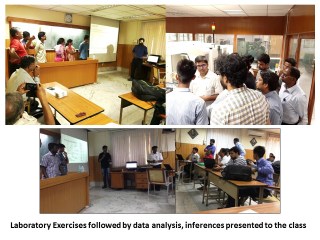
Education, Process Innovation and End to End Innovation are the focus areas of STIMS Institute. Each of these three focus areas are interconnected. education that is merely academic is less valuable today in the world where more than 80% of what is needed can be obtained through Google. Today education has to be holistic (i.e.) system oriented. That implies scientific fundamentals together with an emphasis on application of the science and the strategic reasoning required to make such education relevant and useful in the real world. Such Education was offered for the fourth year in a row . This leads to over 100 senior engineers, managers and teachers trained to meet the high end professional needs in the manufacturing sector.

This year the course was offered under the GIAN (Global Initiative for Academic Network) program at IIT – Madras, India.

Slide1Slide5

Course Outline:

  • Why should we grind?
    • Critical and enduring role of physical processes like grinding in manufacturing and especially in Precision Components Manufacturing
    • Examples of grinding processes used in a wide variety of:
      • Work materials, machines, components and applications
      • Role of grinding processes in traditional applications as well as emerging needs like high efficiency IC engines, computer parts, LED, PV and wind energy components manufacturing.
  • The System Approach to Grinding Processes:
    • Every process is an Input / Transformation / Output system
    • “Transformation” represents the Science of the Process
    • System Approach requires integration of Science, Engineering and Strategy
  • Grinding Processes are Input /Transformation / Output systems for surface generation to meet critical functional needs and process economics.
  • The Science of grinding: The microscopic interactions that occur at the grinding zone and their quantification
  • Inputs to the grinding process and how they impact the microscopic interactions:
    • Work Materials and components
    • Abrasive and dressing tools, coolants and other consumables
    • Machine Tools (key element of investment and process design)
    • Process parameters (that are selected as part of process design and can be changed at the shop floor )
  • Measurement and Analysis of grinding processes
  • Hands on laboratory exercises
  • Tutorials and analytical and data driven problem solving
  • Technical Outputs – What are the requirements to be met when using grinding processes
  • System Outputs – the Why? strategic and economic considerations pertaining to grinding processes
  • Application of the System Approach – Case Studies
    • Truing & Dressing of CBN grinding wheels
    • Optimal use of CBN grinding solutions
    • Simple Solid Shape (S^3) grinding – High MRR low WIP, short lead time and flexible processes
    • Processes for micro – chip, magnetic head and LED substrate fabrication.
    • Machining to Grinding Processes
    • Data driven process solutions.
    • Optimization in the development og new machine tools for grinding process solutions.
  • Guest Lectures from Industry and academic leaders on the need and role of System Approach for manufacturing processes.

Slide2
Slide3

Slide4

This course was a team effort in collaboration with Prof. Ramesh Babu, IIT – M, Mr. Sudheendra – a research student for his Ph.D program and Mr. Anant Jain – R&D manager, Micromatic Grinding Technologies, a well recognized Precision Grinding Machine manufacturer.

 Slide6Slide7

President Obama gets it; then what?

In the recent press conference at Poland, https://www.whitehouse.gov/the-press-office/2016/07/09/remarks-president-obama-press-conference-after-nato-summit  President Obama gave a very clear articulation of Globalization, its benefits and pitfalls. A brief abstract as noted below:

I’m not sure it’s accurate to say that I am a huge booster of globalization.  What is accurate to say is that I believe the process of globalization is here to stay — as a consequence of technology and the mobility of capital, and cargo container ships and global supply chains.  And conceivably, we could run back the tape to 50 years ago and see whether we could rearrange some of that process, but it’s happening.  It’s here.  And we see it every day in our lives. Everybody who has got a smartphone in their pocket is seeing it.

 It is good to see that the world leader openly acknowledging that Globalization is an effect and not the cause. The causes identified such as “Technology” (which stands for IT) “mobility of capital” (thanks to IT driven systems including credit cards, on-line money transfer solutions and global investment),  “Cargo container ships” (which is truly part of IT driven “supply chain” management )and smart phones. All these developments can be summarized as the unbridled use of Digital Technology (DT).

Such open acknowledgement of the role of unbridled use of DT and its negative consequences is the first step in our opinion to objectively deal with the ills of globalization, collapse of the middle class, globalization of terror and all other ills we face today.

And my argument has been that there are enormous benefits to be gained from that global integration, just as there are enormous benefits to be gained from European integration, so long as we recognize that with that integration there is the danger of increased inequality, or workers having less leverage and capital having more leverage, that it threatens to leave people behind.

 In the above the POTUS speaks more like a historian rather than as a strategic leader of the free world. He is not alone in this pitfall. No intellectual or policy maker or think tank is willing to acknowledge the obvious reality (i.e) DT has the capacity to (a) enhance the capacity of individuals and organizations to use their knowledge and resources from across the globe (including finance) leading to new solutions or (b) eliminate the need for human centered skills of information work and physical labor. Please see our description of BINARY ECONOMY. By its very nature the DT enabled Binary Economy WILL create increased inequality and less leverage for workers and more leverage for capital.

This inequality is now deeply entrenched thanks to unbridled deployment of DT. This is like life before and after electricity. With a flip of the switch the entire room can be lighted. With a faulty switch one can get electrocuted and die. Same holds good for un-regulated deployment of DT. The well-lit room is analogous to the quick fortunes for the wealthy, while the electrocution and death is the slow economic meltdown of anything “middle”: middle class wages, skills, capabilities, production volumes, middle tier price for consumer goods, etc. There were rules and inspection procedures set up for the proper use of electricity, while avoiding the dangers in its use. No such rules or regulations exist for proper deployment of DT that can benefit the rich while also taking care of those affected in their economics.

And if we don’t take steps to make sure everybody can participate in that global integration — making sure that wages are high enough, making sure that we rebuild the social compact so that pensions and health care are taken care of, making sure that communities are not completely abandoned when a factory leaves and there’s an economic plan for transition — if we do not do that effectively, then there’s going to be a backlash.

Again, the leader of the free world is preaching rather than proposing bold new solutions. He is not alone in this. Neither of the political parties in the US or their leaders have any proposals to address these growing issues.

Mr. President, the backlash is not a thing for the future, but it is happening here and now. Those of us in the brick and mortar manufacturing sector have faced it since its inception – since the late 1970s to present. We have written about this as early as the year 2000. The angry middle aged white voters who support Mr. Trump and the young who are angry against Wall Street and seek free college education – Mr. Sander’s supporters – are reflective of the backlash already in progress. The Brexit and the immigration issue in US cannot be seen anything but a backlash of migration of poor labor to fill the low wage jobs created at the expense of middle class jobs and wages (for whom no alternative exists), thanks to the DT enabled Globalization.

So, what should happen next?

  • Honest and open admission that DT is a two edged sword: (a) It will create opportunities for the few at the expense of good wage jobs for many in the middle (mostly in the developed nations); (b) It will create opportunities for low wage jobs for many across the globe and hence lift many boats in low wage labor pools (but mostly in the developing regions).
  • Unbridled use of DT must stop. This means if investors can use global resources to enhance their profits by merely displacing their economic activity from high labor cost region to lower labor cost regions there must be a tariff on such profits (to be used as investment for alternative economic and employment opportunities for the affected workers). This must be part of a global arrangement (and not through tariffs as Mr. Trump suggests).
  • Nations and their boundaries do not exist for capital, but they are strictly enforced for labor (through immigration policies and national economic policies). These traditional boundaries for labor have to be adjusted to keep pace with the new found freedom enabled for the capital (and the investors).
  • Tax the rich – who have disproportionately benefited from the unbridled use of DT – through mergers and acquisition, outsourcing, off shoring and right sizing – to create new high paying jobs in the developed nations. In our opinion the single most flaw in Mr. Sander’s proposal for free college education is that he does not identify where the new jobs will come from for his freshly minted graduates?
  • The new jobs in these developed nations should be to create new Physical Technology based solutions for global issues such as food, water, climate control, energy efficiency, etc. Every solution thus funded by the Government and developed in US always will find worldwide adoption (e.g.): GPS.

One can always live better, sleep better, etc. through DT enabled solutions. But DT cannot replace Physical Technology based solutions for food, water, shelter, clothing, etc. This inadvertent failure to deliberately nurture PT based solutions might have been the single most fault across the globe in the past four decades (under the myopia of globalization).

  • Development models across the globe need not be a mere copy of the West or the developed nations.

Developed nations have evolved where economic success implies replacing labor and increased use of energy per capita. These models were developed where the land area is large and/or population density is small. DT will continue  as the driving source to support of all efforts to reduce or eliminate human resources as a significant requirement of any economic activity.  For details please see: https://stimsinstitute.com/2014/02/16/can-the-economy-continue-to-grow-while-creating-fewer-well-paying-jobs-the-answer-is-yes/

Is this what the nations with large population really need?

Imitating the models of economic success and affluence from the developed nations by highly populated nations – like India and China – where human capital is abundant and human needs are largely unmet, might have been the single most economic blunder of these nations at the end of the 20th century.

The above are only few from our point of view. There could be more and better ideas from other sources. But collectively the world has to wake up to the reality that globalization is not the cause but an effect of unbridled and thoughtless deployment of DT to benefit a few at the expense of lot many and in the end to the detriment of every one. Sadly we do not see this point of view discussed in our current election cycle or in the global economic planning discussions.