End to End Innovation – Challenges!

Recently it was brought to our attention that a veteran in the work force – a technical professional – had five of his patent applications approved by the US patent department in the past eighteen months! To make it more interesting, these patents covered four different areas of focus for the employer. All these patents have been issued after this employee chose to retire, couple of years ago.. What was interesting was that the company did not make any effort to retain the services of the employee to gain commercial benefits from these patents. It is not clear if everyone in the company hierarchy were even aware of all these patents being processed through the work of this single employee. It is obvious that there was no well-established link between the output of this highly talented employee and the perceived value of the outputs!

How is the above scenario possible in a day and age, where everyone at every level are clamoring for innovation? Aren’t patents a well-established metric for the level of innovation? Companies have programs to measure, monitor and promote the number of invention disclosures filed within a company. They in turn lead to patents. Invention disclosure is a reflection of the creativity of the work force. Typically every ten invention disclosures lead to one patent. On this basis alone the five patents are worth fifty invention disclosures! Perhaps it is time for the R&D departments and the company management to start reshaping their metrics for measures of innovation?

In our recent book we refer to the concept of “End to End innovation”. Here are a few passages from our book:

Innovation starts with an “idea” to address a need. “Necessity is the mother of invention,” as the saying goes. The seed for generating such an idea is “creativity.” Once an idea is generated, it will require validation. Then it will require demonstration of its “use” to address the need. Even after the use is demonstrated, the utility has to be of some consequence (to those with the need). Thus, innovation may be thought of as a three-layered process consisting of “idea,” “use,” and “impact.” Now we come upon a very critical question: Can we innovate in any one of these three layers or do we need to innovate across all three? Much to our surprise, readers may find that most technical professionals rarely address this simple question directly. As an example, an R&D team may feel that coming up with ideas and documenting them as “invention disclosures” might be “adequate.” “Think tanks” or “consulting” projects do exactly that: document and catalog a set of new ideas. Most R&D teams will also carry the idea through experimentation, simulation, and validation, and then demonstrate its effectiveness. Where possible the idea may be pushed as far as patents and/or to the development stage. Later, they are released to the development section for a new-product launch. Finally, marketing and sales departments may also develop new ideas to gain the most revenue, impact, or value out of the new products launched. Among all these layers, the role of the technical professional may be defined in a limited context and his/her role in innovation will be perceived in that limited context. Rare indeed are the cases of technical professionals who stay with the idea through all its stages of innovation: discovery, development, validation, commercial development, as well as contribution to technical marketing efforts. Engagement in all these stages is needed to ensure that the new product is not only production-viable but also a commercial success. Thus, we can define End-to-End Innovation as follows: E-to-E Innovation = Idea X Use X Impact

  • Expanding the role of innovation from discovery to development to launch to use with identifiable impact.

Our book is written for technical professionals to take charge of their jobs, career and professional success. But success in innovation is not a one sided street. It also requires employers to take full advantage of the creative skills of their work force and foster a climate necessary for end-to-end innovation. To this end, we offer a scale of 1 to 125 for end to end innovation as opposed to a scale of 1 to 5 , for segmented innovation in each of the three phases. At a time, when there is preponderant emphasis on Digital Technology enabled capabilities, there are serious impediments for end to end innovation in physical technology enabled products and services, even though ultimately the later are the true sources of revenue. The positive note on this matter is a letter offering congratulations received by the employee after each patent was issued! But the letter was not from the employer. Instead it was a letter from a company offering to sell plaque and other items to recognize the patent!! With little research one could see that their automated CRM tool is linked to the US patent department data base. Within a day after the patent is issued the automated congratulatory letter with a sales offer is mailed out. There is a need for the employer and the employee to move with such speed in their end to end innovation efforts. Few can operate at that speed, but those few will survive and succeed in the current Binary Economy.

If you need support for fast response end to end innovation CONTACT US.

Make in India – Our views

Recently the Efficient Manufacturing magazine solicited views from their advisory panel on the Make in India policy promoted by the Modi Government.

Following are their questions and our answers:

How do you think the “Make in India” campaign will affect the Indian manufacturing sector, in short-term as well as long-term?

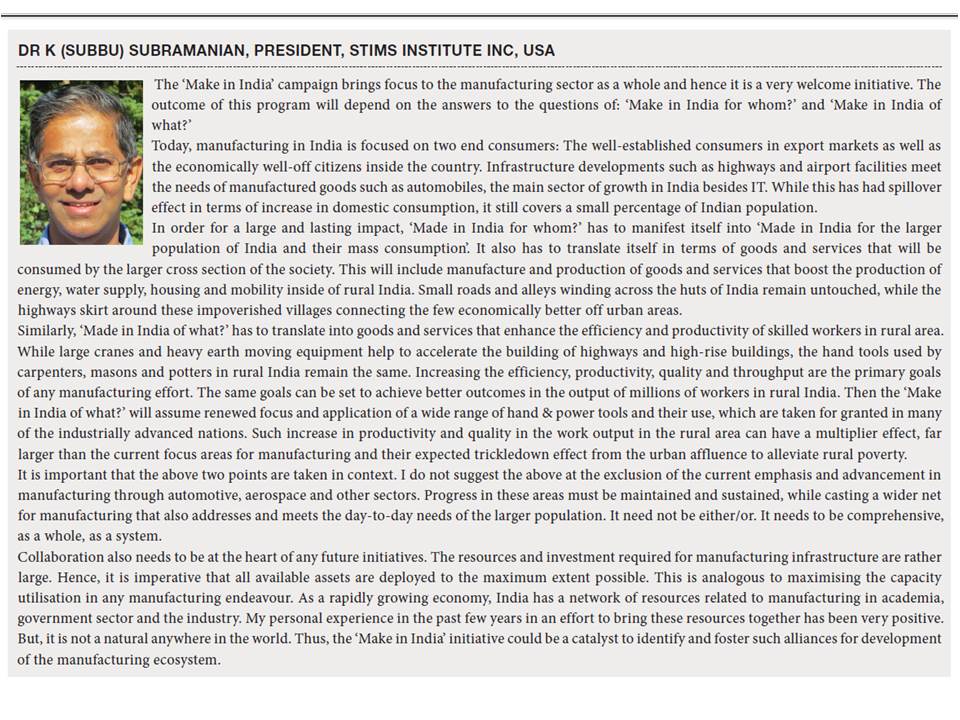
Today the manufacturing in India is focused on two end consumers: The well-established consumers in export markets as well as the economically well off citizens inside the country. The infrastructure developments such as the highways and airport facilities meet the needs of manufactured goods such as automobiles, the main sector of growth in India besides IT. While this has had spillover effect in terms of increase in domestic consumption and hence the better living opportunities for many, it still covers a small percentage of Indian population.

The “Make in India” campaign brings focus to the manufacturing sector as a whole and hence it is a very welcome initiative. The outcome of this program will depend on the answers to the questions of:  “Make in India for whom?” and “Make in India of what?”

  • In order for a large and lasting impact, “Made in India for whom?” has to manifest itself into “made in India for the larger population of India and their mass consumption”. It also has to translate itself in terms of goods and services that will be consumed by the larger cross section of the society. This will include manufacture and production of goods and services that boost the production of energy, water supply, housing and mobility inside of rural India. Small roads and allys winding across the huts of India remain untouched, while the highways skirt around these impoverished villages connecting the few economically better off urban areas.
  • Similarly “Made in India of what?” has to translate into goods and services that enhance the efficiency and productivity of skilled workers in rural area. While large cranes and heavy earth moving equipment help to accelerate the building of highways and high rise buildings, the hand tools used by carpenters and masons and potters in rural India remain the same from over a century ago!  Increasing the efficiency, productivity, quality and throughput are the primary goals of any manufacturing effort. The same goals can be set to achieve better outcomes in the output of millions of workers in rural India. Then the “Make in India of what?” will assume renewed focus and application of a wide range of hand tools and power tools and their use, which are taken for granted in many of the industrially advanced nations. Such increase in productivity and quality in the work output in the rural area could have a multiplier effect far larger than the current focus areas for manufacturing and their expected trickledown effect from the urban affluence to alleviate rural poverty.

It is important that the above two points are taken in context. I do not suggest the above at the exclusion of the current emphasis and advancement in manufacturing through automotive, aerospace and other sectors. Progress in these areas must be maintained and sustained, while casting a wider net for manufacturing that also addresses and meets the day to day needs of the larger population. It need not be either/or. It needs to be comprehensive, as a whole, as a system.

Make in India - View point

How can the government and the manufacturing industry collaborate to make this campaign a success? What are your recommendations?

Collaboration has to be at the heart of any future initiatives. The resources and investment required for manufacturing infra-structure are rather large. Hence it is imperative that all available assets are deployed to the maximum extent possible. This is analogous to maximizing the capacity utilization in any manufacturing endeavor. As a rapidly growing economy, India has a network of resources related to manufacturing in academia, government sector and industry. My personal experience in the past few years in an effort to bring these resources together has been very positive. But, it is not a natural anywhere in the world. But, “Make in India” initiative could be a catalyst to identify and foster such alliances for manufacturing eco-system development.

Do you think the “Make in India” campaign will help raise the share of manufacturing in the GDP, from the current 15% to 25%, by 2020?

There is also a worldwide effort to increase the role of equipment with programmable automation (such as robots, autonomous guided devices – such as drones) that can dramatically reduce the role of human labor in the manufacturing floor. This could have a distinct impact in terms of a decline in manufacturing using low cost labor resources. Indian manufacturing, especially for export markets may have to face this threat, while the manufacturing for domestic consumption could grow. The net effect of these two will also have an impact on the size of manufacturing activity inside of India as a % of GDP.

While that could be the goal, the outcome will largely depend on specific directions and initiatives as mentioned above and the emphasis on deliverables at all levels.

Stop being nice to your boss?

The news item “BlackRock’s Chief, Laurence Fink, Urges Other C.E.O.s to Stop Being So Nice to Investors” appeared in the recent NYT Dealbook segment.

In a letter sent recently by Mr. Fink to the top 500 CEOs in the country, he suggests, “Too many of CEOs have been trying to return money to investors through so-called shareholder-friendly steps like paying dividends and buying back stock. These maneuvers, often done under pressure from activist investors, are harming the long-term creation of value and may be doing companies and their investors a disservice, despite the increases in stock prices that have often been the result. The effects of the short-termist phenomenon are troubling both to those seeking to save for long-term goals such as retirement and for our broader economy …… such moves are being done at the expense of investing in innovation, skilled work forces or essential capital expenditures necessary to sustain long-term growth.  This move sends a discouraging message about a company’s ability to use its resources wisely and develop a coherent plan to create value over the long term …….  with interest rates approaching zero, returning excessive amounts of capital to investors isn’t helpful because they will enjoy comparatively meager benefits from it in this environment”.

In our opinion we need such bold leadership also among professionals to stop bowing to the pressures of the boss or organization that demands “fire fighing” on short term problems at the expense of time and resources necessary to dedicate to the long term needs and success of the company and the organization.

You can stop bowing to investors if you know who they are! The problem is that the “Investors” today are those who make money off of money. They pay everyone else for doing their work to get that result. This stratification of work between the investors and the rest is the insidious problem that has been evolving for the past three decades. You and I who invest in mutual funds – which can be local or global – are also the investors! The issue may be: Can the CEOs sell the value of their long term vision and goals to the “investors”? Once convinced can they deliver the long term value as promised? These are the questions that need to be addressed by every one – from the CEO to the lowest level employee in every company. We call these as the Transformational Skills.

Today the  hedge fund managers, day traders, arbitragers, financial analysts and the fund managers are increasingly isolated from the main stream business. In this new model Finance, Professional work, Information work and Physical work are in stratified impermeable silos. In this scenario, the CEOs are just like any other professional (who gets paid for their work) as opposed to Finance (where money is made off of money!). Hence the CEOs have to learn new skills – Transformational Skills – to get the “investor driven finance” do what the CEO needs (long term business focus). The question is “Should the CEO quit bowing to investors? or “Should the CEO learn skills necessary to get the investor driven Finance bow to him/her?”

The question is also identical for many professionals where they say that their boss and organization is forcing them to focus on short term projects and quick results. Do these professionals have the necessary “Transformational Skills” – which is beyond academic education and industry/sector know-how that will make their boss and organization sit up and listen to them?

Contact us

Where is the real “Skill gap” ?

In his recent opinion page, Mr. Paul Krugman writes the following in the NYT:  Most people would surely agree that stagnant wages, and more broadly the shrinking number of jobs that can support middle-class status, are big problems for this country. But the general attitude to the decline in good jobs is fatalistic. Isn’t it just supply and demand? Haven’t labor-saving technology and global competition made it impossible to pay decent wages to workers unless they have a lot of education? ….  And the evidence that technology is pushing down wages is a lot less clear than all the harrumphing about a “skills gap” might suggest.

In the above referenced citation on “Technology”,  Mr. Mike Kanczal writes: When we think of the economic malaise of the past 30 years, we should probably think of it as a combination of technology, globalization, sociology, and public policy.

In all of the discussion, the word “Technology” is used with out a clear common understanding. If you are a Mechanical Engineer, your knowledge in applied mechanics, materials science and physics are not counted as “technology” in the above discussion by these eminent scholars. Same goes for Electrical Engineers, Chemical Engineers, Civil Engineers, Chemists and Biologists and their knowledge or know-how. Even a Robotics expert and his/her knowledge of mechanical design, path planning and fixturing are not counted in the above “technology” reference.

Instead, what is counted as “Technology” is the automation in the collection, processing, analysis and dissemination of information of any kind and in any place and for any reason. This is the automation of human centered capability in any and all aspects of our life. Instead of calling this as “Technology” we should call it as “Information work”. People, described as labor can be engaged in four sets of work:

  1. Finance – make money off money
  2. Professional Work – create and deliver a stream of new solutions each and every day (like a carpenter who makes and sells furniture, a plumber who fixes the leaking pipe and get paid for it, a cardiologist who fixes broken hearts (literally), etc.)
  3. Information Work
  4. Physical Work

The “Skill gap” mentioned above – which is seen as the major impediment against good paying jobs truly involve the following:

  • Recognizing that the work has indeed stratified into these four impermeable layers and only one of the four is available as a source of good wages (unless you are born with a silver spoon)
  • Recognizing that the Physical work and Information Work – which employed a large majority of the labor force with or with out higher education – will both be automated and what is left will only lead to low paying – “service” – jobs. Number of these jobs may grow, but their wages will hover around the minimum wage.
  • Only a narrow window of “Professional” work exists where there will be decent wages and opportunities to nudge into the middle class.
  • Finance – making money off the money – work is for a select few and these are the affluent 1%. If you can make it there great. Or if you are lucky to be born with a silver spoon, then you can count your blessings!
  • But, the better bet for the large cross section of the people may be to acquire skills that deliberately place them in the “Professional Work” category.
  • Such professional skills are not merely higher “Academic” education or Industry specific trade skills.
  • Instead the true skill gap is the blend of Academic, industrial specific skills together with System Thinking and Transformational Skills.

For details Contact us.

STEM Professionals: Here is some music to your ears?

Irrespective of the political spectrum one belongs to, the recent announcement of global energy policies  by USA, China, Russia and other countries, must be the music for the ears of all STEM Professionals.

The recent announcement from the White House on the new energy policy is noted as follows: Obama’s Strategy on Climate Change, Part of Global Deal, Is Revealed http://www.nytimes.com/2015/04/01/us/obama-to-offer-major-blueprint-on-climate-change.html?ref=energy-environment&_r=0

The White House on Tuesday introduced President Obama’s blueprint for cutting greenhouse gas emissions in the United States by nearly a third over the next decade…. Mr. Obama’s new blueprint brings together several domestic initiatives that were already in the works, including freezing construction of new coal-fired power plants, increasing the fuel economy of vehicles and plugging methane leaks from oil and gas production. It is meant to describe how the United States will lead by example and meet its pledge for cutting emissions.

There are four key areas of focus described in this policy: https://www.whitehouse.gov/energy/securing-american-energy

  • Carbon Capture and Sequestration Technologies
  • Make solar energy cost-competitive with traditional energy sources by the end of the decade.
  • Energy efficiency in our vehicles and homes
  • Developing Clean Fuels

Each is an ambitious goal in itself. For example: New Clean energy standards for cars require automakers to raise the average fuel efficiency of new cars and trucks to 54.5 miles per gallon by 2025. http://www.usnews.com/news/articles/2012/08/29/545-miles-per-gallon-for-all-cars-by-2025-not-exactly

Irrespective of the political spectrum one belongs to, the above must be the music for the ears of all STEM Professionals. Over the past three decades with a relentless emphasis on cost cutting, standardization, automation and off shoring and out sourcing, there has been little if any emphasis on development of NEW SOLUTIONS that exploit the physical phenomena of nature. Of course exceptions to this generalization do exist particularly in the areas of IT, biology, genetics, etc. But, there are plenty of Mechanical and Electrical engineers, Physicists and Chemists and many other professionals in the STEM professional community, than there are computer scientists, biologists and geneticists. These professionals cannot be gainfully engaged unless there are big challenges posed in front of them. Government funded projects always follow the mission set by National policies. Recall the spurt in space technology after the call by the President Kennedy to “land on the moon”? Private sector, despite their professed desire for risk taking, will always place their bets on “safe” opportunities for cost reduction – milking the same old cow – rather than push new pastures and there are plenty of old cows to milk for decades to come. This leaves all the STEM professionals waiting in the wing for their opportunities, while they see steady erosion in their standard of living. Chances are, the new policies and the mandates on the industry will also spur more demand to find better ways to burn coal, make solar energy more competitive, make the homes more energy efficient, and cars that can indeed generate 50+ MPG on an average. All of these will require serious and sustained new solutions developed and perfected by STEM professionals.

Of course there is also an onus on the STEM professionals as well. They cannot simply wait in line and be told what they should do every step of the way. These are the traditional task oriented technical professionals. Instead, they need to become system thinkers and solution providers with a constant emphasis to Discover, Develop, Deploy and Exploit a stream of new solutions. We call on all STEM professionals at every level – from technicians to engineers to managers to senior managers – for this End to End Innovation. Contact us.