MSNBC program Last Word with Lawrence O’Donnell aired on May 8th an interview with the economist and professor Dr. Robert Reich and the entrepreneur/billionaire Mr. Nick Hanauer. The segment carried the caption: Income inequality issue sinking in with CEOs. http://www.msnbc.com/the-last-word 05/08/14
The theme of the segment: the growing income inequality is increasingly recognized by the rich, who see it as an economic disadvantage for their continued growth in their wealth. Hence they may be ready to part with a portion of their current income through higher taxes to ensure sustained demand through increased consumption and hence economic growth with the potential for more future profits.
“Very wealthy are beginning to understand that unless the middle class and the poor have purchasing power, there will not be enough customers to create the demand for goods and services” mentioned Dr. Reich.
Mr. Hanauer said, “When workers don’t have money, we the business owners do not have enough customers”. He continued “It is self-defeating for the rich people to pay less taxes, while the poor keep getting poorer”…. “We will all be better off if more people earned a little more, while we – the rich – earned a little bit less”
The above arguments imply that everyone who wants to work is employed (but under-paid) and their work truly contributes to the revenue and the profits. This is a far cry from the reality as reported in the Mckinsey Global Report This report states:
•Recoveries are increasingly becoming “jobless” due to firm restructuring, skill and geographic mismatches between workers and jobs, and sharp decline in new start-ups.
•The US needs to create 21 million new jobs by 2020 to regain full employment—and only achieves this in our most optimistic job-growth scenario.
•The US workforce will continue to grow until 2020, but under current trends, many workers will not have the right skills for the available jobs. Technology is changing the nature of work: Jobs are being disaggregated into tasks, work is becoming virtual, and firms are relying on flexible labor (temporary, contract workers). These trends offer new opportunities for creating jobs in the United States, a trend that some companies do not fully appreciate.
•Progress in four dimensions will be essential for reviving the US job-creation machine:
• Develop the US workforce-skill to better match what employers are looking for;
• Expand US workers’ share of global economic growth by attracting foreign investment and spurring exports;
• Revive the nation’s spark by supporting emerging industries, ensuring more of them scale up in the United States, and
• Reviving new business start-ups; and speed up regulatory decision-making that blocks business expansion and new investment.
We agree with the view that the present economic recovery is also “jobless”. We have already described the reason or why the economic recovery is increasingly jobless. The need for new jobs – about 21 million by 2020 – and this may become reality only under the most optimistic scenario , according to McKinsey must be worrisome for the rich as well as the working and unemployed low wage population. But it is the result of a structural change in the nature of jobs created through relentless growth in Digital Technology and its pervasive effect to de-skill all human centered activities and make them amenable to be achieved through computers, network, systems and if all else fails through low wage workers from across the globe. Economists would call this as the “General Purpose Technology”. Hence this “jobless” recovery will be the prevailing pattern across the globe, for years to come. Few billionaires in the US cannot change this depletion of high wage work for the large majority of the population. You cannot get more milk from the same old cow. We need new cows and new pastures for them to graze!
The rich merely giving up their wealth through more taxes as suggested by Dr. Reich and Mr. Hanauer will do no good to increase the wages. Today high wage workers are the professionals, whose knowledge and its application is unique and hence they are rewarded through higher wages. All others are low wage workers, without any unique skills that demand the higher wages. Such higher wages for workers would occur only when the investments are targeted for new job creation for skilled professionals. This has to be coupled with professionals having new work force skills that the employers are looking for. At the moment there is no consensus on: what are the high wage jobs? type of work force skills required? the nature of education required for that? We have already proposed what is needed and how to get there. The new work force skills cannot be more of the same education. It has to be a different education that combines technical skills together with System Thinking and Transformational Skills.
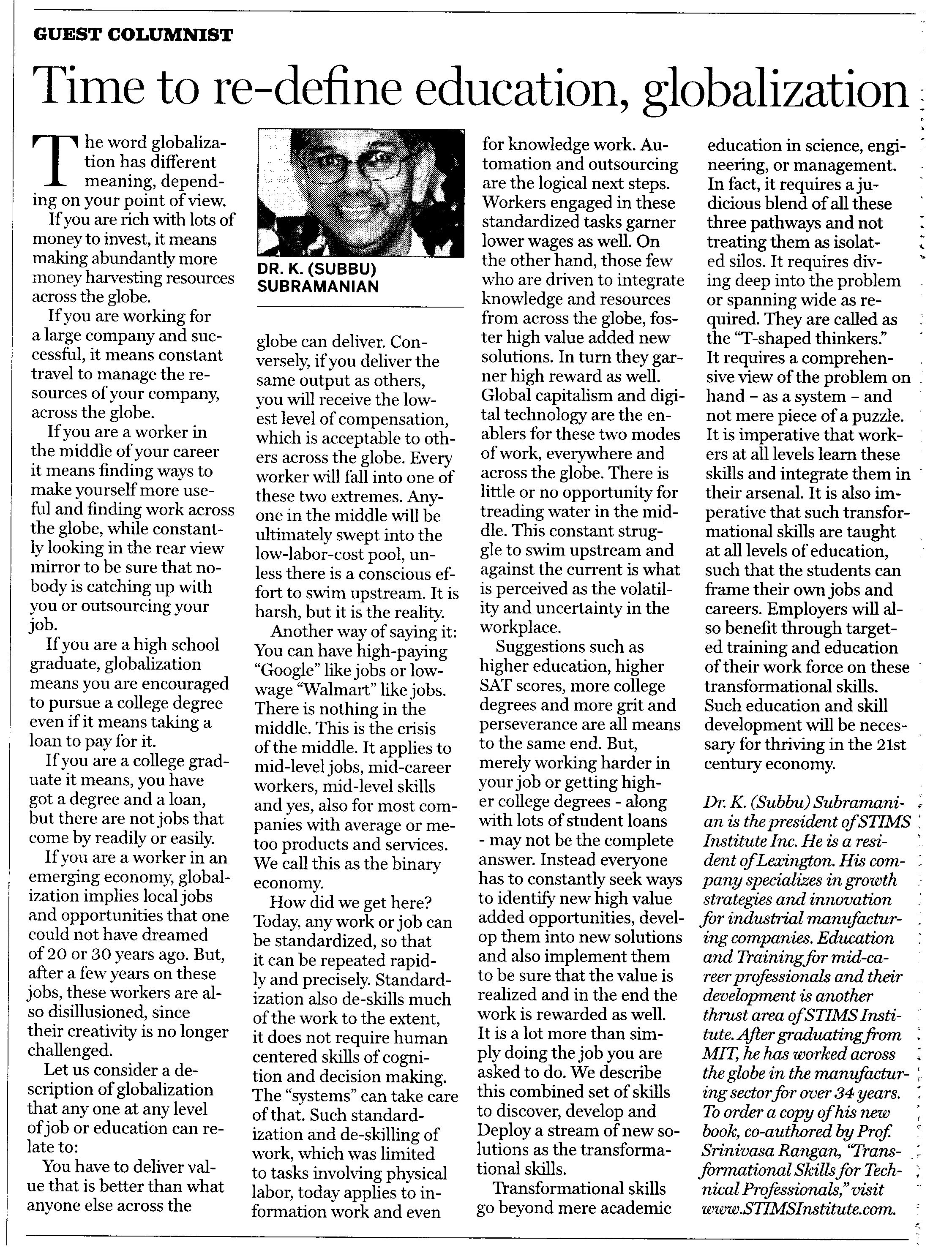
Mckinsey’s second suggestion that US should attract foreign investments and spur export growth will face headwinds from the forces of globalization and free trade. While the US can be at the cutting edge of innovating and creating new technologies and the businesses around them, the larger share of employment from these developments will continue to favor workers in low wage countries. We call this as the Binary Economy. Worldwide there is an emerging economic model, with few number of high wage jobs for those professionals who can create and implement new solutions (Economy1) and a large number of low wage jobs for those who carry out standardized jobs which are highly de-skilled (Economy 2). Large majority of jobs in the middle – that require a random combination of some technical or professional skills and large majority of information tasks – do not exist in any business and in any industry. This is the collapsing middle that used to employ the large number of middle class, middle wage workers. The path way for workers for higher wages through their professional effectiveness is limited. At the same time, the investors have many options: Invest in a few high wage professionals and their output, use such highskilled workers from across the globe (and thus reduce their cost, while gaining their benefits), reduce cost through de-skilling and automation and also constantly de-localize jobs from high wage areas to low wage areas across the globe. It is this lopsided number of options available for the investors vs., very limited and narrowing set of options for high wage jobs is the reality of the 21st century Binary Economy. The few billionaires wanting to part with some of their wealth cannot change the basics of this Binary Economy.
The only pathway left for any reasonable chance for reducing income in-equality is to relentlessly create large number of high wage jobs. Such higher wage jobs to be created will have to rely on the last two suggestions from McKinsey (i.e.) Revive the nation’s spark by supporting emerging industries, ensuring more of them scale up in the United States, and Reviving new business start-ups. Let us face it. These cannot guarantee large number of jobs in the USA. As soon as solutions and such high wage work is conceived of, the investors will find ways to ship them overseas to use lower wage workers! Also IT enabled solutions such as Business Process Re-Engineering, Robots and Programmable Automation may take away more of the jobs, even if such work could be competitively carried out in the USA. Hence it is also necessary to preserve these jobs locally, if any country wants higher employment. This could be mistakenly interpreted as a kind of “protectionism”, which will face resistance from the puritans of free and fair trade, unless the fundamentals of Global Economy are understood, which is neither free nor fair! There cannot be a viable or sustainable global economy until every nation gives up their isolated effort to protect and preserve their “national” economy. Instead we need coordinated programs and policies for higher employment across the globe. This may sound utopian at a time, when investors are given free reins to make more money across the globe, while the workers are constrained to work and live by the local economic conditions and policies imposed on them within the country, where they live. In other words the interests of the investors and the interests of the country they live in and its population are no longer synergistic. This is an implicit outcome of global economy.
Our point is this: Yes, few rich billionaires may be willing to part with their wealth, if the Republicans can be persuaded to tax them at a higher rate. Even if the Government gets such increased revenue, it is no guarantee that the wages of average American workers can go up –as desired by the Democrats – and hence create the demand for goods and services, leading to a robust economic activity inside of USA. So, we need to accept the reality: Taxing the rich or cutting Government spending by themselves will not spur the economic growth. Economic growth and creating higher paying jobs need not be synergistic. Without higher paying jobs there is no hope to decrease income in-equality for the large majority of unemployed and the working poor.
So, what is the answer? We may need to invest in areas that can (a) educate and (b) employ a large number of skilled professionals,who are also System Thinkers and Transformational in their Skills. This would be like investing in NASA, NIH, rails, roads and bridges, many times over! In order to foster such high wage jobs we need to start thinking of “Technology” not limited to IT – as is the current or prevailing notion – and we need to start thinking of Technology as a means to solve a wide variety of problems and meet a broad range of needs of the global population. These programs can be targeted not only for the immediate needs of the nation, but for the larger needs of the globe as a whole: Drinking water, home and shelter, better climate, low cost energy, better use of natural resources, better use of the ocean and the outer space, renewable energy, etc. Pollution in China need not be a crisis for China alone! Lack of adequate food distribution and hence hunger need not be India’s problem alone!
Such investment has to come from the federal government, since such jobs can be protected and preserved to remain within the shores. Like the peace core that created good-will across the globe, we need a professional core of high wage workers that can work in the USA and create a stream of new solutions based on a wide variety of technologies (beyond IT) for the betterment of the human kind across the globe as well as for a better planet tomorrow. To this end the billionaires can contribute their wealth through higher taxes and the government can target this additional income for creating such high wage jobs. The workers in these high wage jobs through their system thinking and transformational skills have to be truly mindful of the outcome of their work and not become government employed bureaucrats merely pushing papers and administering programs, as they are perceived to be in the current work force. This targeted investment through high wage jobs with the right skill set in professionals will Revive the nation’s spark by supporting emerging industries and Revive new business start-ups, as suggested in the McKinsey report, with one difference: the emerging industries and new business startups may occur across the globe and may not be limited to USA alone. But, this should not be a concern for the billionaires. Instead it will be net positive for them since their source of income is the globe and is not limited to USA. Such growth in new solutions to meet the needs of the population across the globe, will also have its multiplier effect for additional high wage jobs in the private sector and a large number of lower wage jobs. It is a Keynesian type multiplier effect, except the stimulant in our case is Knowledge of the skilled professionals and its integration, as opposed to mere infusion of money through the banks or the government. This is not the trickle down supply side economics of the Republicans. This is also not the unending safety net as the solution offered by the Democrats. It is a solution that accepts the true realities of the Binary Economy in which we live, where knowledge and its judicious application is the king.





 STIMS Institute