Blog

President Obama gets it; then what?

In the recent press conference at Poland, https://www.whitehouse.gov/the-press-office/2016/07/09/remarks-president-obama-press-conference-after-nato-summit  President Obama gave a very clear articulation of Globalization, its benefits and pitfalls. A brief abstract as noted below:

I’m not sure it’s accurate to say that I am a huge booster of globalization.  What is accurate to say is that I believe the process of globalization is here to stay — as a consequence of technology and the mobility of capital, and cargo container ships and global supply chains.  And conceivably, we could run back the tape to 50 years ago and see whether we could rearrange some of that process, but it’s happening.  It’s here.  And we see it every day in our lives. Everybody who has got a smartphone in their pocket is seeing it.

 It is good to see that the world leader openly acknowledging that Globalization is an effect and not the cause. The causes identified such as “Technology” (which stands for IT) “mobility of capital” (thanks to IT driven systems including credit cards, on-line money transfer solutions and global investment),  “Cargo container ships” (which is truly part of IT driven “supply chain” management )and smart phones. All these developments can be summarized as the unbridled use of Digital Technology (DT).

Such open acknowledgement of the role of unbridled use of DT and its negative consequences is the first step in our opinion to objectively deal with the ills of globalization, collapse of the middle class, globalization of terror and all other ills we face today.

And my argument has been that there are enormous benefits to be gained from that global integration, just as there are enormous benefits to be gained from European integration, so long as we recognize that with that integration there is the danger of increased inequality, or workers having less leverage and capital having more leverage, that it threatens to leave people behind.

 In the above the POTUS speaks more like a historian rather than as a strategic leader of the free world. He is not alone in this pitfall. No intellectual or policy maker or think tank is willing to acknowledge the obvious reality (i.e) DT has the capacity to (a) enhance the capacity of individuals and organizations to use their knowledge and resources from across the globe (including finance) leading to new solutions or (b) eliminate the need for human centered skills of information work and physical labor. Please see our description of BINARY ECONOMY. By its very nature the DT enabled Binary Economy WILL create increased inequality and less leverage for workers and more leverage for capital.

This inequality is now deeply entrenched thanks to unbridled deployment of DT. This is like life before and after electricity. With a flip of the switch the entire room can be lighted. With a faulty switch one can get electrocuted and die. Same holds good for un-regulated deployment of DT. The well-lit room is analogous to the quick fortunes for the wealthy, while the electrocution and death is the slow economic meltdown of anything “middle”: middle class wages, skills, capabilities, production volumes, middle tier price for consumer goods, etc. There were rules and inspection procedures set up for the proper use of electricity, while avoiding the dangers in its use. No such rules or regulations exist for proper deployment of DT that can benefit the rich while also taking care of those affected in their economics.

And if we don’t take steps to make sure everybody can participate in that global integration — making sure that wages are high enough, making sure that we rebuild the social compact so that pensions and health care are taken care of, making sure that communities are not completely abandoned when a factory leaves and there’s an economic plan for transition — if we do not do that effectively, then there’s going to be a backlash.

Again, the leader of the free world is preaching rather than proposing bold new solutions. He is not alone in this. Neither of the political parties in the US or their leaders have any proposals to address these growing issues.

Mr. President, the backlash is not a thing for the future, but it is happening here and now. Those of us in the brick and mortar manufacturing sector have faced it since its inception – since the late 1970s to present. We have written about this as early as the year 2000. The angry middle aged white voters who support Mr. Trump and the young who are angry against Wall Street and seek free college education – Mr. Sander’s supporters – are reflective of the backlash already in progress. The Brexit and the immigration issue in US cannot be seen anything but a backlash of migration of poor labor to fill the low wage jobs created at the expense of middle class jobs and wages (for whom no alternative exists), thanks to the DT enabled Globalization.

So, what should happen next?

  • Honest and open admission that DT is a two edged sword: (a) It will create opportunities for the few at the expense of good wage jobs for many in the middle (mostly in the developed nations); (b) It will create opportunities for low wage jobs for many across the globe and hence lift many boats in low wage labor pools (but mostly in the developing regions).
  • Unbridled use of DT must stop. This means if investors can use global resources to enhance their profits by merely displacing their economic activity from high labor cost region to lower labor cost regions there must be a tariff on such profits (to be used as investment for alternative economic and employment opportunities for the affected workers). This must be part of a global arrangement (and not through tariffs as Mr. Trump suggests).
  • Nations and their boundaries do not exist for capital, but they are strictly enforced for labor (through immigration policies and national economic policies). These traditional boundaries for labor have to be adjusted to keep pace with the new found freedom enabled for the capital (and the investors).
  • Tax the rich – who have disproportionately benefited from the unbridled use of DT – through mergers and acquisition, outsourcing, off shoring and right sizing – to create new high paying jobs in the developed nations. In our opinion the single most flaw in Mr. Sander’s proposal for free college education is that he does not identify where the new jobs will come from for his freshly minted graduates?
  • The new jobs in these developed nations should be to create new Physical Technology based solutions for global issues such as food, water, climate control, energy efficiency, etc. Every solution thus funded by the Government and developed in US always will find worldwide adoption (e.g.): GPS.

One can always live better, sleep better, etc. through DT enabled solutions. But DT cannot replace Physical Technology based solutions for food, water, shelter, clothing, etc. This inadvertent failure to deliberately nurture PT based solutions might have been the single most fault across the globe in the past four decades (under the myopia of globalization).

  • Development models across the globe need not be a mere copy of the West or the developed nations.

Developed nations have evolved where economic success implies replacing labor and increased use of energy per capita. These models were developed where the land area is large and/or population density is small. DT will continue  as the driving source to support of all efforts to reduce or eliminate human resources as a significant requirement of any economic activity.  For details please see: https://stimsinstitute.com/2014/02/16/can-the-economy-continue-to-grow-while-creating-fewer-well-paying-jobs-the-answer-is-yes/

Is this what the nations with large population really need?

Imitating the models of economic success and affluence from the developed nations by highly populated nations – like India and China – where human capital is abundant and human needs are largely unmet, might have been the single most economic blunder of these nations at the end of the 20th century.

The above are only few from our point of view. There could be more and better ideas from other sources. But collectively the world has to wake up to the reality that globalization is not the cause but an effect of unbridled and thoughtless deployment of DT to benefit a few at the expense of lot many and in the end to the detriment of every one. Sadly we do not see this point of view discussed in our current election cycle or in the global economic planning discussions.
What does Brexit mean for you?

Slide1What does Brexit mean for you? The answer depends on who “you” are? The exit of UK from the European Union is reported as a large calamitous event. One may wonder why there is such a great concern now for this internal decision by the citizens of UK?  After all companies routinely make decisions to   dissolve their mergers with other companies. Not all such decisions are wise or well thought out. But the owners of such companies – the share holders have the right to do so. No one would question their right. In a democracy the citizens are the owners of their country. Hence the decision by the British citizens is nobody’s concern except their own.

The above would be very logical as long as everything can be looked at only through the lens of owners and their rights. But nations are not mere business entities. At the same time we must also note that companies are not citizens, despite the decision by the SCOTUS. One must acknowledge that SCOTUS did not declare corporations as citizens in all aspects including the human and emotional aspects of citizens.

The decision by the Brits to exit the EU is the reflection of the pain and anger of those who have been left out or left to fall down in their economic standards and opportunities for the past four decades. We have described in great detail that Globalization is not the cause but a mere effect of indiscriminate deployment of Digital Technology to merely cut costs in all areas of economic activity.

Learn to swim against the tide of Binary Economy

Do Americans really miss the unions?

Can the economy continue to grow while creating fewer well paying jobs? – the answer is “YES”.

Opportunities that should not be lost in the current Presidential Election Cycle?

This has dramatically affected workers largely dependent on Information work directly.  This has also indirectly affected physical labor in high wage nations by de-localizing their work to low wage economies.  The combined effect is the collapse of the middle class in developed nations. These affected populations express their anger and anguish in different ways. In US these are the angry supporters for Donald Trump and the relatively reflective supporters of Bernie sanders. The later also include naive  students who believe in “free” college, with out asking where will be their jobs after they graduate?  In UK it is the disgruntled middle class who voted for the Brexit in a narrow margin over those who wanted to continue to be part of the EU.

Irrespective of who “You” are, the present form of Globalization is unsustainable.  There can not be one rule for the investors to use their money to make more money across the globe with out regard for the impact of their decisions on local economy, while there is a different rule for workers whose rewards, taxes and employment opportunities are limited to the confines of their national boundaries. This is not a problem for the UN to resolve!  Workers can not work across the globe and park their profits overseas without paying due local taxes, but the corporations can and do. Whose responsibility is it to bring about an economic equity between the workers and the investors across the globe and independent of national economic models (such as capitalism, socialism, communism, etc.)? These questions go unaddressed and it has perpetuated over the past four decades, which is the problem. Hopefully exposing this weakness and inability of economists and policy makers to address this may be what Brexit means for you?

Don’t count on Mfg. to create large number of future jobs.

According to the house Democrat’s “Our Agenda”, when more products are made in America, there will be greater opportunity for our people to Make it in America”. This implies more jobs through the growing mfg. sector.

Donald Trump claims on the campaign trail that he will bring back mfg. to USA and along with it lots and lots of jobs.

These claims for large employment and more number of jobs through manufacturing sector are at odds with what is happening in the real world.

The role and impact of labor cost is gradually declining in most manufacturing activities. With the rapidly declining cost for information processing and increasing competencies through programmable automation (robots, CNC, AGV, drones, etc.) the need for human labor in manufacturing sector is substantially lower today than any time before. Hence large segments of manufacturing may return to US on their own accord. But it is unlikely that they will bring back the large number of jobs lost in the manufacturing sector.

Enabled by IT (Digital Technology in a broader context) we see a constant elimination of human labor for information work. Aided by DT (Programmable automation) robots will also replace large need for human workers. Both of them do not bode well for large scale employment through manufacturing sector. As evidence please see the attached:
Meaningful impact in national mfg. strategy and employment policies are beyond the scope of individual professionals. Of course they can voice their views and shape the dialogue through their participation in national dialogue and through professional societies. Beyond that one should take hold of their individual careers through a set of skills acquired through education, application /training /experience and Transformational skills.
Triangle of Skills
For details please see:

Donald Trump is smart; Is America smarter?

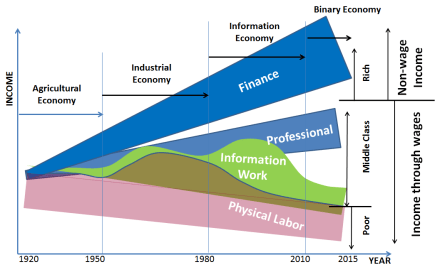
Wage and non-wage income

The rise of Donald Trump and Bernie Sanders, the two outsiders who are challenging the “establishment” should not come as a surprise to any one! After all we live in a world where multi billion dollar enterprises (Apple, Amazon, Google,….) and all other Digital Technology enabled giants have dwarfed the role and attention away traditional giants such as GE, P&W, Timken, GM, Ford, etc. In fact these companies are considered as “established”, “industrial”and “brick and mortar” companies, while the Silicon Valley giants are lauded as the “hi-tech” companies.

Yes, it is the period for the glory for those who leverage IT (Digital Technology in a broader sense) in unique ways and make an enormous impact. Donald Trump has exploited the cable news – a product of Digital Technology  – and access to free press in unique ways for his success as of now. His success in public arena merely mirrors the success of the few IT giants in the industry, bur only in terms of their ability to deploy Digital Tools. The anger and divisiveness of Donald Trump campaign are sad and do not deserve any analysis or comparison.

The stagnant wages, low income, lack of growth opportunities, fear of terrorism, need for immigration reform have all been issues brewing over the past four decades. This is also the period of relentless use of Digital Technology which creates large opportunities for the few at the expense of economic disadvantage for the many and the hollowing out of the middle. These are issues that require sustained economic planning and re-thinking of priorities we as a nation can subscribe to. They can not be achieved merely through slogans of “Make America great again”.

Over the past four decades work as we know of it has changed. Rewards of the investors and the reward for the rest are no longer two sides of the same coin. Investors can continue to make huge rewards by gradually and constantly eliminating the need for human involvement (i.e.) wage earning workers.

Four layers

In this climate every US Citizen and resident must look for skills to (a) identify new opportunities, (b) develop them into solutions, (c) implement them and (d) garner the benefits as a result. Of these (a) and (d) belonged to the investors; (b) and (c) belonged to the workers – the two sides of the coin. Now all four of these tasks have to be carried out as an integral effort. We call the skills for this as Transformational Skills. 

Donald Trump is smart in identifying the opportunity (i.e) a disaffected population can be excited through anger and bigotry; this opportunity can be developed into a solution for his political ambitions. Now he is in the phase of implementing his solution through the general election.

The question is this: Is America smarter than Donald Trump?  Can the American population see the true nature of the Binary Economy at work? Can they see the opportunities in the Binary Economy which requires every one to become Transformational? Can they demand economic reforms, educational reform and work force training that  moves the population away from task orientation (skills for success on one side of the coin only) into a system oriented solution providers (take hold of the coin as a whole)?

America has less than six months left to answer this question: Is America smarter than Donald Trump?


Do Americans really miss the unions?

Slide2

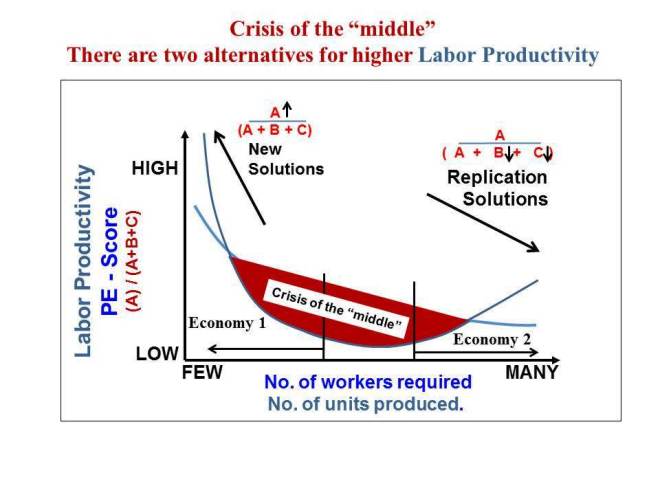
Every wage earner contributes to three kinds of wage earning effort: Knowledge and its use (A); Information work (B) and Physical Labor (C).

Labor Productivity as judged by the employer = A / (A + B + C)

There are claims that the current low wage economic climate in US is a refection of poor US education, need for higher college degrees, weak unions, …. These traditional arguments miss a couple of fundamental issues. They are:

  1. The role of IT (and broadly Digital Technology) in eliminating the need for human centered activities (labor);
  2. Failure of the nations to invest heavily in new technologies – beyond DT
  3.  Meaningful programs to convert them into new economic activities and jobs;
  4. Failure of students, educators, universities and parents to point out the need for a three legged balanced education (which will be the only way to find high wage jobs in the new Binary Economy).

Weakness in all of the four points are leading to a low or stagnant wage labor, with a collapsing middle class.

We address this fourth point in this essay as it pertains to the role of strong/weak labor unions. When the labor is strong in terms of its direct and identifiable contribution to the GDP, then unions will find their role and strength. It is like blaming the security guard in a bank, when there is no money left in the vault! The money is not stolen, but it has been used up and not replenished.

Following is a quote from a recent NYT article.

More than 151 million Americans count themselves employed, a number that has risen sharply in the last few years. The question is this: What are they doing all day? Because whatever it is, it barely seems to be registering in economic output. The number of hours Americans worked rose 1.9 percent in the year ended in March. New data released Thursday showed that gross domestic production the first quarter was up 1.9 percent over the previous year. Despite constant advances in software, equipment and management practices to try to make corporate America more efficient, actual economic output is merely moving in lock step with the number of hours people put in, rather than rising as it has throughout modern history.

Productivity is one of the most important yet least understood areas of economics. Over long periods, it is the only pathway toward higher levels of prosperity; the reason an American worker makes much more today than a century ago is that each hour of labor produces much more in goods and services. 

In our opinion this confusion exists because of the long held conventional views on labor productivity.

There is a traditional view that everything that is done to increase the productivity in one nation has to reflect in the GDP of that nation. If this were true that the rate of growth in GDP in countries like India and China will reflect a far larger labor productivity in these countries  than that in USA.

According to a report from Oxford.  ” the basis of U.S. manufacturing’s continued strong competitive position is increasing productivity. The productivity of U.S. manufacturers has risen by 40% since 2003, outpacing competitors such as Germany (23%), the UK (30%), and Mexico (18%). While productivity of manufacturers in China and India has more than doubled over the same period, the report notes, U.S. manufacturers in 2016 are still nine times as productive per employee than manufacturers in China”

Why is this dichotomy?

Today labor productivity – PE Score – can be measured as the value added effort by the employee / Total Effort. Value addition is achieved through the skills of the work force to create “New Solutions”. Value addition can also be through their workers in terms of their contribution to pass along information or pick and place or move things (Physical labor). This later kind of labor activity which is disappearing is illustrated well in the GE Commercial.  

New Solutions can be created and implemented  using labor and the productivity here will be much higher. This can be judged by the output / employee in companies like Apple, Google, Tesla, Space X. The labor productivity in manufacturers in USA are much higher (as noted above) because of the very low content of information work and physical effort (replaced by IT systems and automation) per employee.

What does this mean in terms of graduates and their earning potential? Simply graduating from colleges and looking for new jobs is not enough. They need a collection of three sets of knowledge: Academic education from the college, application oriented experience or training and Transformational Skills to identify, develop and implement New Solutions.

For details Contact us.