System Approach for Engineers – a new course developed and being offered at Thyagaraja College of Engineering in Collaboration with TVS Co., India.

Madurai Temple 2                      How do you promote system thinking and why is it necessary?

This subject was discussed in depth recently by Dr. K. (Subbu) Subramanian, President, STIMS Institute, with a large manufacturing company and a well renowned College of Engineering in India recently. As a result it was concluded that while system engineering and the structures and techniques related to that are well established, System Thinking is not a natural part of working for practicing engineers. It was noted that, while there is a lot of discussion on Cross functional teams and concurrent engineering, there is little in terms of education and practice that promotes concurrency in thought process that brings together the Science, Engineering and Management disciplines pertaining to any problem or solution. While we see every medical professional with a Stethoscope, thermometer and blood pressure monitor, practicing engineers rarely resort to active diagnostic tools to obtain the “Vital signs” of the process or solution they deal with. There is also a tendency to execute whatever they are asked to do or assigned, rather than constantly ask the question “Why?”
With out a system thinking outlook, engineers tend to work in silos and stick to their cubicles. Knowledge, which is available from many sources – suppliers, inside the company, customers, … – is rarely integrated in a deliberate fashion, since there is no framework readily available for such frame work. While tools like Fishbone diagram look at the Cause and the effect, they rarely focus on the “phenomena” or the science that links the cause and the effect. The effect itself is seen only in technical terms (what is the solution) and rarely in terms of the “Why?” or benefits to stake holders and the order of priority.
To address the above needs, a new course is being developed to be offered as an optional course for the 7th semester students. While the initial plan was targeted the ME and EE students, the college has decided to offer this course for all majors. The expected outcome of this course are:

  • Definition of any solution as the System: Input/Transformation/Output Scheme
  • Distinction between:

—    System Thinking (which underlies the) System Engineering
—   Task Orientation Vs. Solution orientation (System Thinking)
—   Technical Output Vs. System Output

  • The four components of the Inputs categories of any system or solution
  • Definition and distinction between Science, Engineering and Management
  • The role of each of the above three pathways for critical thinking
  • Transformation — What does it mean?
  • How to identify the “transformation” behind any solution?
  • Ability to frame any assignment, job or problem as the system and its parts
  • Ability to recognize the need for diagnostic tools and their use to probe the “Transformation”
  • Principles of the System Approach (Captured in the books referenced below)
  • Comfort level to know who the stake holders are (who are also the sources for inputs)?
  • Ability to seek them out for help and collaboration from both inside as well as outside the company.


    1. Thriving in the 21st Century: Transformational Skills for Technical Professionals”, K. (Subbu) Subramanian, Srinivas U. Rangan, ASME Press, 2013, ISBN: 978-0-7918-6016-8
 

Transformational Skills for Advanced Manufacturing

Transformational Skills For Advanced Mfg. – Feb. 2012IMG_2285Image

One day Seminar on 

Transformational Skills for Advanced Manufacturing

Dr. K. (Subbu) Subramanian

President, STIMS Institute

Lexington, Massachusetts, USA.

at

IIT – Chennai, India

February 24, 2012.

All manufacturing companies across the globe face two parallel needs:

  • Create and implement “New Solutions” for step change or large scale improvements
  • Execute tasks (with minimum demand for technical/professional skills) to replicate known manufacturing processes and solutions for incremental or continuous improvement in cost, quality and service.

The rapid growth of manufacturing sector in India has substantially benefitted from manufacturing process solutions already available from across the globe and replicating them.  But, there is an increasingly growing need to develop Advanced Manufacturing solutions whose implementation in shop floor will create a large scale impact. This is very essential for long term vitality and competitiveness of these companies and to many of their suppliers such as Machine Tool manufacturers, Tooling suppliers, and component fabricators, etc.

Skills required for advancements in manufacturing solutions are always a hybrid between Academic Knowledge and Industrial Know-how. They also require active collaboration across many industries and suppliers. Investments required for new manufacturing process solutions are always high and hence seen more risky. Above all, they require people who can identify new opportunities and Transform them into solutions of commercial impact. These Transformational Skills for Advanced Manufacturing will require formal education for manufacturing professionals with sound academic background and proven track record of success in their current industrial profession.

This  seminar addresses the following questions to benefit those engaged either directly or indirectly in manufacturing of products.

Ö    What are the emerging needs for competitiveness of Manufacturing Companies and Industries in the global market place?

Ö   Need for “New solutions” that create a step change Vs. Current practices of lean and Six Sigma?

Ö   Transformational Skills necessary to identify, create and implement advanced manufacturing solutions.

Ö   Education and Training programs required for Transformational Skills for Advanced Manufacturing?

This meet will provide an opportunity to share the views of practicing engineers/managers with the speaker who has been engaged in addressing the issues with his vast experience in the manufacturing field. The participants are encouraged to bring a set of identified needs that are relevant to their company. This seminar specifically looks at the needs of professionals and their requirements pertaining to education and skill development for grooming them into successful and high potential employees. There will be an opportunity to discuss these needs in a group setting as well as one-on-one with the speaker and other faculty members during this seminar.

Interview of Dr. Subramanian published in the Efficient Manufacturing Magazine

MANAGEMENT INTERVIEWpicture 2 Picture 3 Picture1

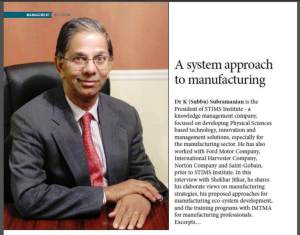
A system approach to manufacturing

You will find here excerpts from an interview with
Dr. K. (Subbu) Subramanian, President, STIMS Institute Inc.

• What should be the ideal strategies to survive, succeed and achieve competitive excellence in today’s volatile global economy?

• What is the “Systems Thinking of the Manufacturing Processes”?

• Tell us more about your program with IMTMA to train manufacturing professionals at all levels?

• Can you brief us on your proposed manufacturing eco-system – an approach that can create synergy from all sectors, much needed for a sustainable growth in the manufacturing industry?

• How to set up a suitable supply chain eco-system and acquire capabilities for machine tool components so as to make the overall production more dynamic and growth oriented?

• What should be the role of a CEO in strategy and planning towards operational excellence?

EM Management Interview (1) 12 12