STEM Professionals: Here is some music to your ears?

Irrespective of the political spectrum one belongs to, the recent announcement of global energy policies  by USA, China, Russia and other countries, must be the music for the ears of all STEM Professionals.

The recent announcement from the White House on the new energy policy is noted as follows: Obama’s Strategy on Climate Change, Part of Global Deal, Is Revealed http://www.nytimes.com/2015/04/01/us/obama-to-offer-major-blueprint-on-climate-change.html?ref=energy-environment&_r=0

The White House on Tuesday introduced President Obama’s blueprint for cutting greenhouse gas emissions in the United States by nearly a third over the next decade…. Mr. Obama’s new blueprint brings together several domestic initiatives that were already in the works, including freezing construction of new coal-fired power plants, increasing the fuel economy of vehicles and plugging methane leaks from oil and gas production. It is meant to describe how the United States will lead by example and meet its pledge for cutting emissions.

There are four key areas of focus described in this policy: https://www.whitehouse.gov/energy/securing-american-energy

  • Carbon Capture and Sequestration Technologies
  • Make solar energy cost-competitive with traditional energy sources by the end of the decade.
  • Energy efficiency in our vehicles and homes
  • Developing Clean Fuels

Each is an ambitious goal in itself. For example: New Clean energy standards for cars require automakers to raise the average fuel efficiency of new cars and trucks to 54.5 miles per gallon by 2025. http://www.usnews.com/news/articles/2012/08/29/545-miles-per-gallon-for-all-cars-by-2025-not-exactly

Irrespective of the political spectrum one belongs to, the above must be the music for the ears of all STEM Professionals. Over the past three decades with a relentless emphasis on cost cutting, standardization, automation and off shoring and out sourcing, there has been little if any emphasis on development of NEW SOLUTIONS that exploit the physical phenomena of nature. Of course exceptions to this generalization do exist particularly in the areas of IT, biology, genetics, etc. But, there are plenty of Mechanical and Electrical engineers, Physicists and Chemists and many other professionals in the STEM professional community, than there are computer scientists, biologists and geneticists. These professionals cannot be gainfully engaged unless there are big challenges posed in front of them. Government funded projects always follow the mission set by National policies. Recall the spurt in space technology after the call by the President Kennedy to “land on the moon”? Private sector, despite their professed desire for risk taking, will always place their bets on “safe” opportunities for cost reduction – milking the same old cow – rather than push new pastures and there are plenty of old cows to milk for decades to come. This leaves all the STEM professionals waiting in the wing for their opportunities, while they see steady erosion in their standard of living. Chances are, the new policies and the mandates on the industry will also spur more demand to find better ways to burn coal, make solar energy more competitive, make the homes more energy efficient, and cars that can indeed generate 50+ MPG on an average. All of these will require serious and sustained new solutions developed and perfected by STEM professionals.

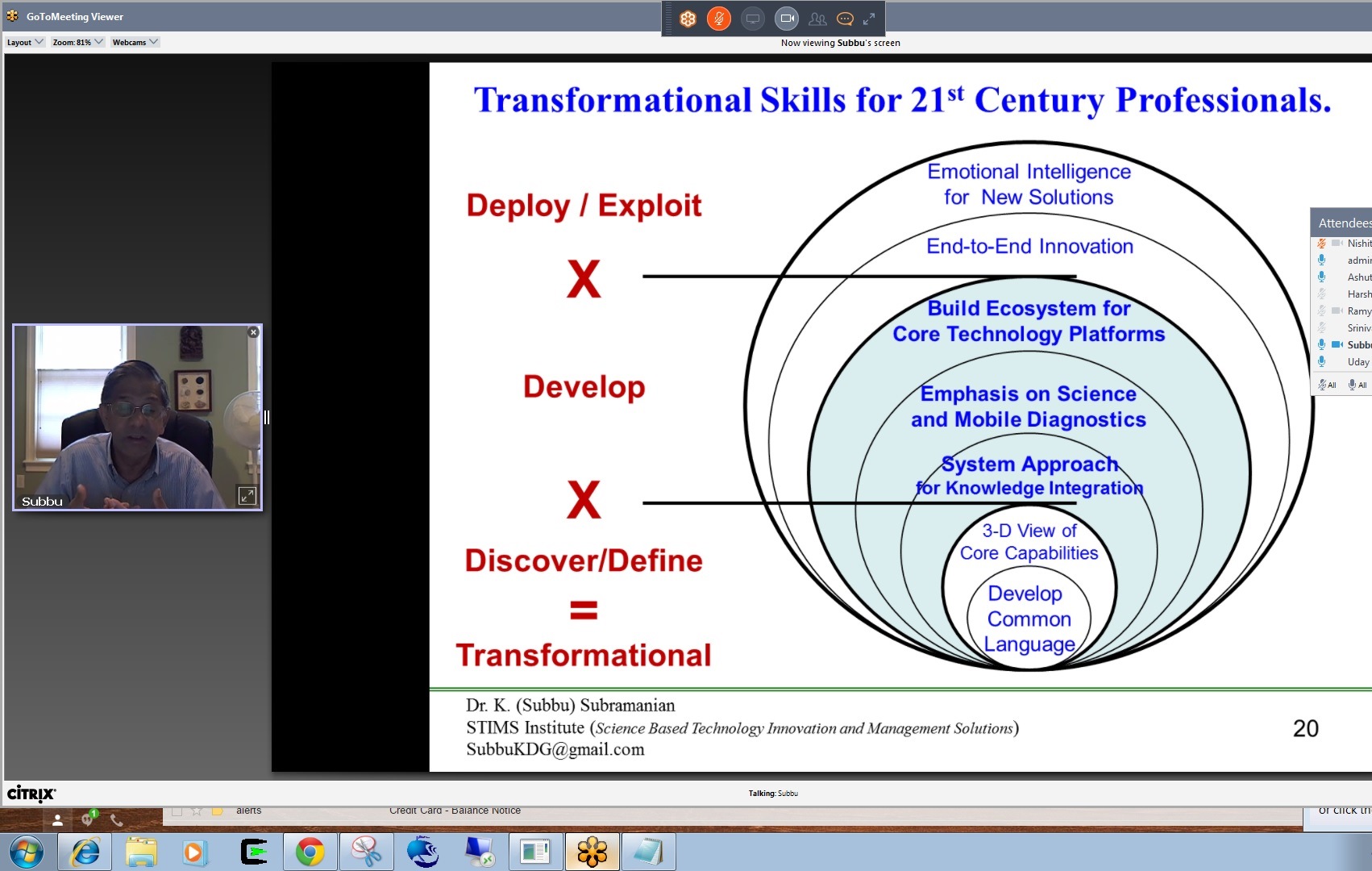
Of course there is also an onus on the STEM professionals as well. They cannot simply wait in line and be told what they should do every step of the way. These are the traditional task oriented technical professionals. Instead, they need to become system thinkers and solution providers with a constant emphasis to Discover, Develop, Deploy and Exploit a stream of new solutions. We call on all STEM professionals at every level – from technicians to engineers to managers to senior managers – for this End to End Innovation. Contact us.

STIMS Institute offers Webinar for young engineers

Slide10 Webinar_DrSubbu_March282015_10 Webinar_DrSubbu_March282015_20

Recently we conducted a webinar for a group of young engineers from across the globe on the tools and skills required to increase their PE Score.

If you have such need to train and develop your young professionals contact us

Online access to webinar sessions

Part – 1/4 :


Part – 2/4


Part – 3/4


Part – 4/4


End of session feedback:

  • Thank you for joining today. For people who could not join today, we hope to see you in future sessions. I just wanted to thank Nishitha for taking the lead and organizing this for the common benefit of all. Thank you!!!  Special thanks to Dr. Subbu, for taking time off and sharing your knowledge and expertise with young people like me. It was indeed a very informative session and hopefully we can implement some of the ideas you suggested in our individual professional careers.

Cheers!!! have a great weekend  — Uday

  • It was a wonderful session. It is difficult to find someone who has a systems perspective and who can put it across in a way that can be easily understood. On behalf of everyone who attended the session, I would like to thank Dr. K Subramanian for taking out time and sharing his work with us. I am sure I will look at my work in a different way.

I am attaching the minutes of the meeting and some screenshots for everyone’s benefit. —  Nishitha

Minutes of the Meeting:

TOPIC – Systems Thinking and Transformational skills  SPEAKER – Dr. K. Subramanian, President, STIMS Institute    DATE – 28TH March 2015   ATTENDEES :   Name removed for privacy; Attendees from: USA, India, Dubai

HIGHLIGHTS

– Know the difference between tasks oriented jobs and solution oriented jobs

– Companies look for replicate solutions, but they also look for people with transformational skills who can provide “new solutions”

– Be conscious of the value you are adding to your company. If you don’t add enough value remember that you can easily be replaced

– How is work structure across the globe changing? What did it look like before? How does it look like in 21st century? How do you orient yourself to succeed?

– How can you practice transformational skills?


When will we see the writing on the wall? What should we do then?


Yesterday, I heard the talk show “On point” hosted by Tom Ashbrook. The topic was: Why our kids are not winning today?  http://onpoint.wbur.org/2015/03/11/robert-putnam-our-kids-book  The guest at this talk show was Prof. Robert D. Putnam His new book, “Our Kids: The American Dream In Crisis.” (Simon & Schuster), suggests that the crisis for the children in USA today is indeed severe and it is not a blue or red issue, but a “purple problem”.

On looking at the blame game between both the Democrats and the Republicans on the growing income gap and its toll on our children, the host made the following passionate plea: “How appalling, how galling this picture is to me! I grew up in a down in the income ladder family. I was a white kid in a strong community with good schools at a time when you could rise and the society was structured to help me to rise and I did. What a marvelous thing that is! To imagine being down there with all the rungs stripped away, looking at a kind of hopeless surrounding that you describe the kids are seeing, just makes me crazy. That is not what this country is supposed to be”

Professor Putnam responded “We need to think of all these kids as OUR kids. For my parents “our” kids did not mean my sister and me, but all the kids in the community. In the past 30 or 40 years, the meaning of the term our kids has shriveled…… If we don’t invest in poor kids, all our kids and their future are at stake

Throughout the discussion reference was made to three decades of growing income gap and disparity between the rich and the poor. But nobody seems to ask, “Why three decades?”, “Why not before?” or “What is unique to this time frame of three decades”?

To suggest that some how every one in the country and the communities we live have now become mean spirited and selfish, seems to miss the point. When there is a growing scarcity for economic opportunities, instincts of self-preservation could also be the fall out. But, with a broader view – system thinking that focusses on the broader picture instead of the dots or pixels in it – we can see the issues are more fundamental and less superficial than that.

What is consistently missing in such scholarly discussions here and elsewhere is a simple, but fundamental fact of life: It is undeniable fact that evolution in IT (and Digital Technology in a broader context) has diminished the role and need for human skills from a large body of workers, generally belonging to the middle class in the USA. This has been growing from the early 70s and is in full swing since 1980s (for the past three decades). This implies that we need a few – very few well educated and skilled professionals, who will be paid well and rewarded nicely and their children will be well cared for. This was indeed reflected in a scenario described by one of the callers: “I am a stay at home mom. My parents are first generation immigrants with only 3rd and 4th grade education, who worked in the factories. I have got a degree in Bio Technology and we have a very good life. Our children are well cared for”. This mom and their family succeeded in the same time period – past three decades, when so many other families and their children are suffering and failing. What really happened?

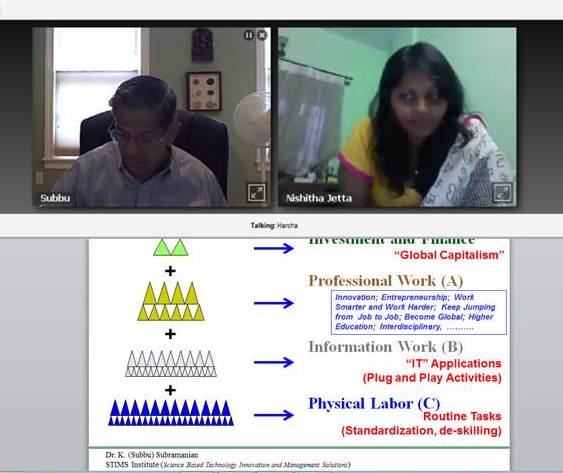
The work in the 21st century is divided between (a) Finance – make money off money, (b) Professional work which requires knowledge (through higher education, when possible) and its use, (c) Information work (which can be increasingly automated using IT) and (d) Physical work (which can be increasingly automated using robots, CNC and drones).  The distinctions between these four categories of work is now far more discrete and their boundaries are less permeable. Add to that the ability to off shore all these kinds of work (b, c and d) as required, against thanks to DT enabled capabilities. This leaves a very small slice of work – professional work to deliver knowledge driven solutions – that can be carried out by a few with unique set of skills, which we call as SYSTEM THINKING AND TRANSFORMATIONAL SKILLS. These few jobs pay good wages within the shores of this country. All the rest (including those who work on Finance) will be driven to low skill, minimum wage jobs. Therein lies the secret of the growing wage disparity. Unless we recognize this new reality and then develop policies that incorporates this new reality, we shall continue to have growing wage disparity and an increasing number of children driven to poverty and its ravages. We call this as the Binary Economy.

One can only hope such evolved thinking and policy making will happen sooner than later. In the meantime, what can you do? If you are from the poor or middle class family, you need to learn the few ropes still available to you and pull yourself out of the forces of the Binary Economy and its downward spiral. If you are lucky enough to attend a college don’t just learn what you are taught. The same issues faced by families are also faced by companies and their survival in the USA. Every one of them can benefit from System Thinking and Transformational Skills as part of their knowledge portfolio. For more details Contact Us.

Transformational Skills and their application as Leadership Imperatives

cropped-gears.jpg

Recently replying to a Linkedin discussion group under the heading: What are your four timeless key leadership imperatives? , we posted the following as the timeless leadership imperatives:

— Help others so that they can help themselves.

— Always keep an eye on the “stake holders” and their needs.

— Use what you have learned and learn what you need to know.

— Everyone is a leader; your role is transient until someone else takes that role!

Here we discuss how these leadership imperatives are linked to the Transformational Skills:

  1. Help others so that they can help themselves

Words do have meaning. But, if the same word has different meanings between the leader and the team, then there is no common language. Words which are frequently used such as Product, Process, Application, Manufacturing, Science, System, Output, etc. need to have the same meaning between the leader and the team. Ensuring the Common Language is an important Transformational Skill.

While every leader has the instinct to help, it is not often possible (a) due to a lack of role clarity (b) Expectations are mismatched and /or (c) delegation is absent. But, frequently all of these are evidences of a more fundamental problem (i.e.) Absence of a common language!

2. Always keep an eye on the “stake holders” and their needs.

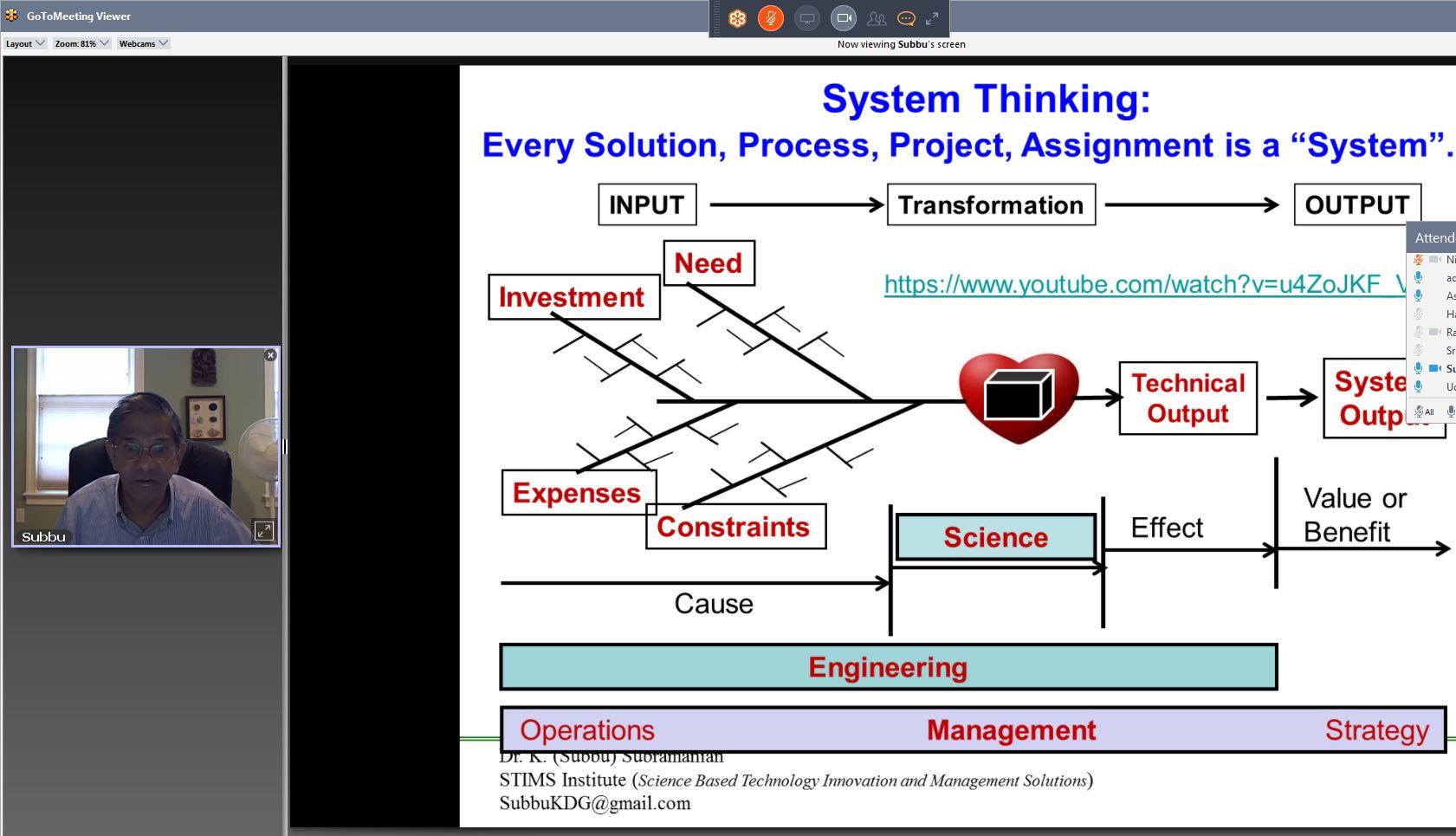
Stake holders are not synonymous with Shareholders. This is the frequent folly of many leaders. To recognize the Stake Holders, the leader will need system thinking, the perspective of a larger picture. Stake Holders are all those who contribute their inputs to the leader’s role viewed as an Input/Transformation/Output system. Every input is a cog in the wheel! Any cog that is ignored and hence becomes weak will in due course render the wheel dis-functional!

3. Use what you have learned and learn what you need to know:

Individual core capabilities are: Knowledge, Experience and People Skills. Core capabilities of any team are: Science, Engineering and Management (Strategy and operations). Core Capabilities of any enterprise are: Finance, Technology (not limited to Digital Technology) and Market drivers. Any leadership effort involves manipulating the Core Capabilities at three levels: Individuals, Team and the Enterprise.

Ultimately the role of the leader is one of a watchman who is fully aware of these core capabilities at each level and deploys them to the fullest extent. It is equally the role of the leader to look for and learn about the holes in the core capabilities and fill them systematically

4. Everyone is a leader; your role is transient until someone else takes that role!

We call this emotional intelligence for leadership. Leader is always one who helps others who in turn can help themselves. This self-help will be fully evident, when the leader’s role is no longer required. That does not imply that the leader himself is not required or useful any longer. Through his/her knowledge of the three dimensions of core capabilities, the leader would have already transitioned to new efforts and initiatives. This of course will also depend on the culture cultivated in the team!

Contact us

Year End Review – 2014 and Greetings for the New Year

Happy New Year!

2014 has been a great year of accomplishments for the STIMS Institute. During the third year of this young company, we have made great strides in a number of areas. Our clients / collaborators now include:

  • Educational institutions (IIT – Chennai, SNHU, MIT, TCE – Madurai)
  • Industrial clients (in India, NA, China, Colombia)
  • Industry Organizations (IMTMA, MassMEP)
  • Industry Sectors (Machine Tools, Auto parts manufacturing, Energy services, Engineering Services)
  • Fellow consulting services
  • Industry Publications.

We thank each and every one of our collaborators for the opportunity to work with them. It is through such collaboration that we can build an eco-system that sustains the development and growth for all. We look forward to your continued support and further opportunities to expand the universe of System Thinkers with Transformational Skills. Please find below a summary of STIMS Institute activities in the year 2014 as we look ahead to the coming New Year.

With best wishes and warm greetings to each of you and every one in your families for a healthy, happy New Year!

Subbu

Dr. K. (Subbu) Subramanian, President, STIMS Institute

Year in Review – 2014

STIMS Institute was founded based on a single identified need:

When computers (in a broader context the DT – Digital Technology) can do everything that a human can do (pick and place, read, write, analyze, decide, direct and control), then humans – professional workers and their companies – have to find ways to be more useful to be relevant and hence be economically viable!

This need, which we have identified as the crisis of the “middle” of any kind – middle class, mid-tier products and services, etc. is an outcome of the “Binary Economy” fostered by DT and this will continue to progress for decades to come. Now, eminent leaders are beginning to speak about the same crisis. For details please see: http://www.cnn.com/2014/12/26/opinion/scoblete-ai-human-threat/index.html?hpt=hp_bn7

Unlike those who identify the problem and the impending concerns, we at STIMS Institute also offer a vision for the future:

System Thinking and Transformational Skills as the core for any education and their use as the basis for sustainable jobs and careers and ultimately their collective use as the driving strategy in all aspects of any company, to develop and implement a stream of New Solutions, relentlessly.

We are now implementing this vision through:

  • Workshops, On-line training and one-to- one mentoring,
  • In-house mentorship programs and projects in our client companies,
  • New models for “Concept to Commercialization” and their incentive programs,
  • Science based manufacturing process solutions and diagnostic tools for them, and
  • Inter-company and Inter – industry collaboration programs.

We have also attempted to disseminate much of this work, through our website. For details, please see:

STRATEGY:

Vision of 21st Century Manufacturing:    https://stimsinstitute.com/2014/12/26/stims-institute-offers-its-vision-of-21st-century-manufacturing/

Message on Manufacturing day: Need for emphasis on “Process Science” : https://stimsinstitute.com/2014/10/04/message-on-manufacturing-day/

High Wage jobs – the engine for middle class growth: https://stimsinstitute.com/2014/05/10/tax-the-rich-to-create-new-high-wage-jobs/

With Economic growth, high wage jobs are not a given for all: https://stimsinstitute.com/2014/02/16/can-the-economy-continue-to-grow-while-creating-fewer-well-paying-jobs-the-answer-is-yes/

PROCESS INNOVATION:

Diagnostic Tools for Manufacturing Processes: https://stimsinstitute.com/2014/12/19/stims-institute-supports-development-and-implementation-of-diagnostic-tools-for-manufacturing-processes/

Future of manufacturing and Core capability development: https://stimsinstitute.com/2014/10/22/future-of-manufacturing-and-core-capability-development/

Emotional Intelligence as a business philosophy for collaboration and End to End to Innovation: https://stimsinstitute.com/2014/06/26/are-you-a-predator-enslaver-competitor-cooperator-or-collaborator-how-about-your-business-philosohpy/

EDUCATION:

Sector Specific Education: https://stimsinstitute.com/2014/12/12/sector-specific-education-offered-successfully-for-third-year-in-a-row/

Higher education – Not just more of the same!: https://stimsinstitute.com/2014/04/18/it-may-be-a-mistake-to-get-a-degree-in-chemistry-unless-you-have-also-figured-out-how-to-use-your-knowledge/

Education and Work Force Development: PE Score: https://stimsinstitute.com/2014/03/12/work-shop-for-increasing-the-pe-score/

REVIEWSon our recent Book on Transformational Skills:

https://stimsinstitute.com/2014/04/29/steering-hr-growth/

https://stimsinstitute.com/2014/04/17/american-ceramic-society-bulletin-review-of-our-recent-book/

https://stimsinstitute.com/2014/06/26/another-positive-review-on-our-recent-book/

Slide1