When will we see the writing on the wall? What should we do then?


Yesterday, I heard the talk show “On point” hosted by Tom Ashbrook. The topic was: Why our kids are not winning today?  http://onpoint.wbur.org/2015/03/11/robert-putnam-our-kids-book  The guest at this talk show was Prof. Robert D. Putnam His new book, “Our Kids: The American Dream In Crisis.” (Simon & Schuster), suggests that the crisis for the children in USA today is indeed severe and it is not a blue or red issue, but a “purple problem”.

On looking at the blame game between both the Democrats and the Republicans on the growing income gap and its toll on our children, the host made the following passionate plea: “How appalling, how galling this picture is to me! I grew up in a down in the income ladder family. I was a white kid in a strong community with good schools at a time when you could rise and the society was structured to help me to rise and I did. What a marvelous thing that is! To imagine being down there with all the rungs stripped away, looking at a kind of hopeless surrounding that you describe the kids are seeing, just makes me crazy. That is not what this country is supposed to be”

Professor Putnam responded “We need to think of all these kids as OUR kids. For my parents “our” kids did not mean my sister and me, but all the kids in the community. In the past 30 or 40 years, the meaning of the term our kids has shriveled…… If we don’t invest in poor kids, all our kids and their future are at stake

Throughout the discussion reference was made to three decades of growing income gap and disparity between the rich and the poor. But nobody seems to ask, “Why three decades?”, “Why not before?” or “What is unique to this time frame of three decades”?

To suggest that some how every one in the country and the communities we live have now become mean spirited and selfish, seems to miss the point. When there is a growing scarcity for economic opportunities, instincts of self-preservation could also be the fall out. But, with a broader view – system thinking that focusses on the broader picture instead of the dots or pixels in it – we can see the issues are more fundamental and less superficial than that.

What is consistently missing in such scholarly discussions here and elsewhere is a simple, but fundamental fact of life: It is undeniable fact that evolution in IT (and Digital Technology in a broader context) has diminished the role and need for human skills from a large body of workers, generally belonging to the middle class in the USA. This has been growing from the early 70s and is in full swing since 1980s (for the past three decades). This implies that we need a few – very few well educated and skilled professionals, who will be paid well and rewarded nicely and their children will be well cared for. This was indeed reflected in a scenario described by one of the callers: “I am a stay at home mom. My parents are first generation immigrants with only 3rd and 4th grade education, who worked in the factories. I have got a degree in Bio Technology and we have a very good life. Our children are well cared for”. This mom and their family succeeded in the same time period – past three decades, when so many other families and their children are suffering and failing. What really happened?

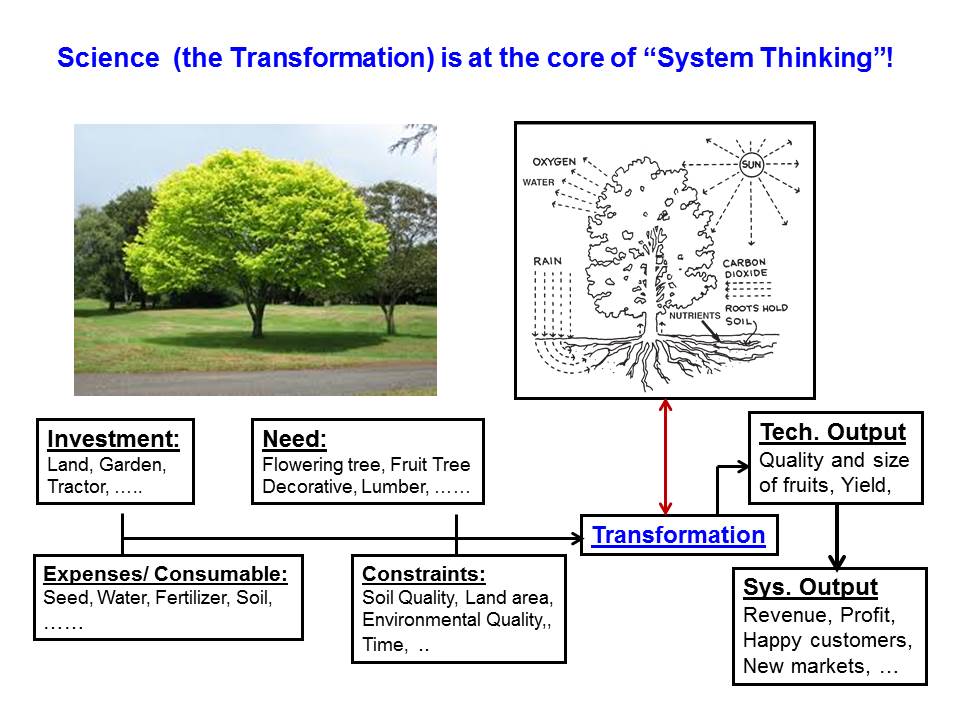
The work in the 21st century is divided between (a) Finance – make money off money, (b) Professional work which requires knowledge (through higher education, when possible) and its use, (c) Information work (which can be increasingly automated using IT) and (d) Physical work (which can be increasingly automated using robots, CNC and drones).  The distinctions between these four categories of work is now far more discrete and their boundaries are less permeable. Add to that the ability to off shore all these kinds of work (b, c and d) as required, against thanks to DT enabled capabilities. This leaves a very small slice of work – professional work to deliver knowledge driven solutions – that can be carried out by a few with unique set of skills, which we call as SYSTEM THINKING AND TRANSFORMATIONAL SKILLS. These few jobs pay good wages within the shores of this country. All the rest (including those who work on Finance) will be driven to low skill, minimum wage jobs. Therein lies the secret of the growing wage disparity. Unless we recognize this new reality and then develop policies that incorporates this new reality, we shall continue to have growing wage disparity and an increasing number of children driven to poverty and its ravages. We call this as the Binary Economy.

One can only hope such evolved thinking and policy making will happen sooner than later. In the meantime, what can you do? If you are from the poor or middle class family, you need to learn the few ropes still available to you and pull yourself out of the forces of the Binary Economy and its downward spiral. If you are lucky enough to attend a college don’t just learn what you are taught. The same issues faced by families are also faced by companies and their survival in the USA. Every one of them can benefit from System Thinking and Transformational Skills as part of their knowledge portfolio. For more details Contact Us.
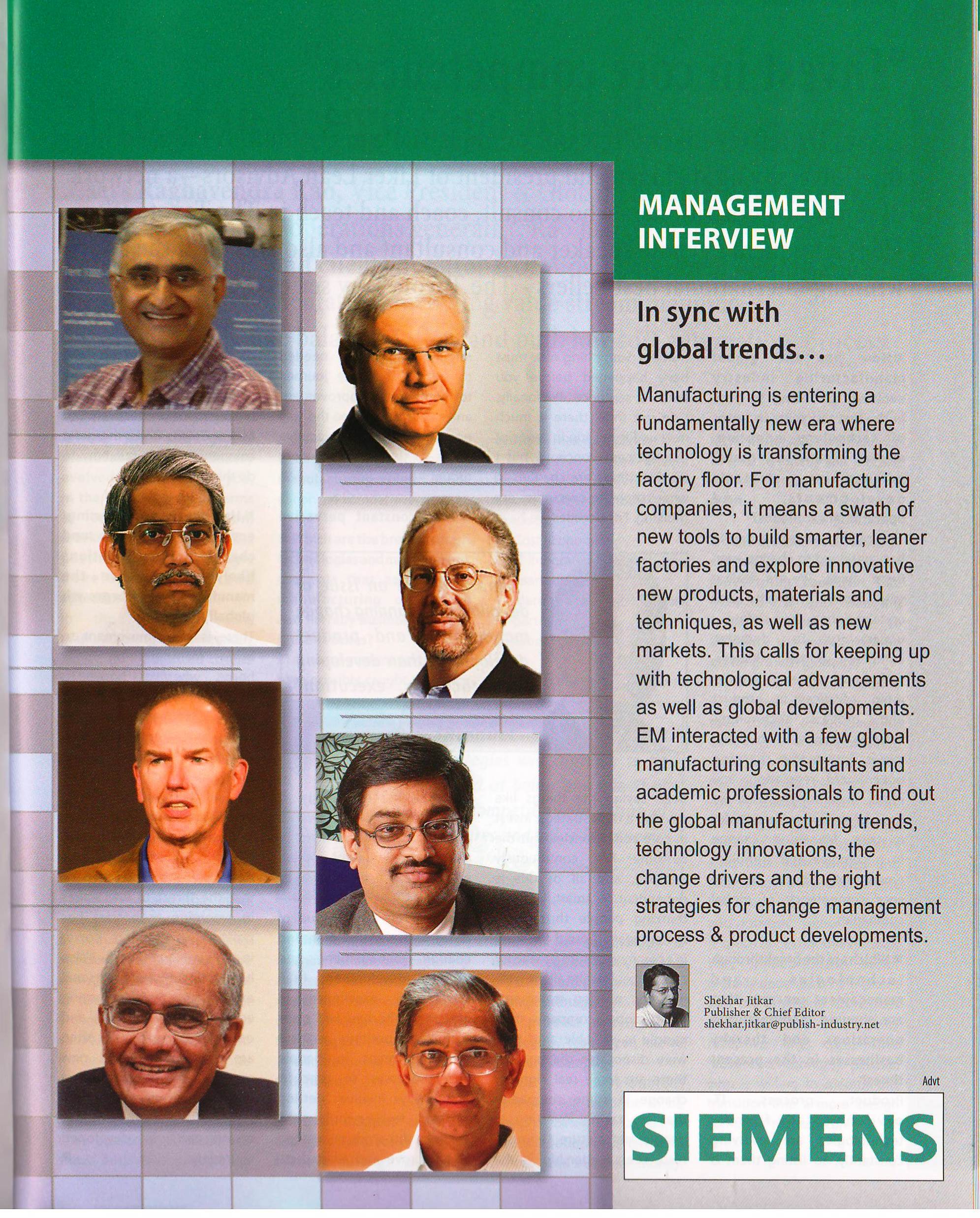
Global Manufacturing trends and technology – Management Inteview

View point 1

Shekat Jitkar, Publisher and chief Editor of Efficient Manufacturing magazine interviewed eight global experts on trends in manufacturing.

The interview is published in their Kompendium 2014. Following is a summary :

Dr Wilfried AulburManaging Partner for Roland Berger Strategy Consultants Pvt Ltd. Establish the right capabilities and Culture.* Shift to Asia:  China is the #1 machine building country worldwide and performance and quality requirements in Asia are getting closer to European levels.

* Game change in the mid-end: The mid-end performance segment is growing the fastest and this is the new global battlefield for emerging and developed market players.

* Go Green: Energy efficiency is increasingly important in key markets such as Europe and Japan. Substantial energy savings can be achieved for selected applications, while for others it is mostly a marketing issue

Dr K (Subbu) SubramanianPresident, STIMS Institute Inc, USA. System Thinking and Transformational Skills required.* Data, analysis and process intelligence aided by Big Data and analytics

* Sensors and Smart devices everywhere;  Innovation in manufacturing processes; Programmable automation (the generic name for CNC, robots, flying robots, AGV and drones);

* Products and  their manufacturing to increase the quality of life at all levels?

* No more learning curve (price -vs- volume is a flat line and not a curve)?

* If low labor cost only means low skilled labor for physical labour tasks or well defined information tasks, then such low cost labour is no longer a competitive advantage?

* Product (Source of revenue), Physical Processes (that enable the products) and USE (Application process of the customer) are the only three unique core capabilities of any manufacturing company.

Michael BremerPresident, Cumberland Group – Chicago;

VP of Manufacturing Excellence Awards process for the Association for Manufacturing Excellence (AME)

Eliminate Waste, but create new Value.* People, people, people! — Ability to find and develop talent. People will be attracted to organizations that treat them with respect and develop their skills and capabilities. Elite organizations create an environment where associates are encouraged to give that little bit of extra effort = passion and engagement

* Rapid prototyping (faster lead times)

* Use of sensors to track manufactured product, provide feedback for early maintenance, and develop closer relationships with customers

* Safety of intellectual property and cyber security – ability to more easily identify fake products

* Ability to more deeply understand customer requirements and total cost of the supply chain

* More collaborative practices across the supply chain where companies partner together to pursue joint growth opportunities.

Dr P N RaoProfessor, Department of Technology, University of Northern Iowa, USA. Utilize the Opportunities available.* Developments in robotics

* Digital Everywhere: Information thread that integrates design, planning, manufacturing and product support through all stages will greatly improve the possibility to achieve first pass success.  This will combine innovative automation, various sensors and control systems, communications across all segments, including the global supply chain. This would mean advanced manufacturing enterprises, intelligent machines, advanced analysis techniques, and cyber security systems in view of the information exchange across the internet with globalization.

* Additive manufacturing (3D printing)

* Integrated systems that will have sensors to monitor the manufacturing process continuously and then adapt the process to achieve the best possible performance by a combination of software and hardware tools.

* Sustainable manufacturing that deals with product design for sustainability, sustainable

manufacturing processes, and sustainable manufacturing systems, while also trying to maximize resource efficiency

Sanjeev BaitmangalkarPrincipal Consultant (Strategy & Lean Manufacturing), Stratmann Consulting. Go Lean …..* The growing number of embedded sensors, collecting information about the world, and the rise of social networks that store the data people share, will generate immense quantities of information.

* Many businesses of the future will use analytics to mass customize and differentiate themselves.

* Business intelligence, which enables organizations to gather quantifiable data on each area of the organization and analyses it in a way that yields information they can act on — helping them enhance decision making, improve performance, mitigate risk and sometimes even create new business models — is growing in importance.

* Small, comfortable, low cost, fuel efficient cars will drive product development.

Suresh Lulla

Founder and MD, Qimpro Consultants Pvt. Ltd.

Quality will not be negotiable.

* Leadership, Strategy and Customer focus* Work force and its quality; cycle time reduction; double the profit without capital through better quality practices; left brain for quality improvement and right brain for process innovation; cross-country bench markeing.

* Low labor cost in developing nations is not sustainable;

* Three bottom lines: Planet, people and profit!

* Three core capabilities needed: Understand customer needs; ability to translate that into product design and ability to outsource where required!

Raghavendra Rao V.P. & Global Mfg. Leader, Frost & Sullivan Invest in design capability.* Rapid prototyping, 3 D printing, real time data and analysis

* Manufacturing “hub” for toll manufacturing to “Design to manufacturing” alliance between partners across developed and emerging economies.

* Cost/ economics; IT Integrated Mfg.; Lean supply chain; Mature, eithical and stable partners; Green manufacturing.

Dr. Jeffrey Liker Prof. of Ind. And Opertions Engineering, U. of Michigan, President, Liker Lean Advisors Invest in core competencies.* Excellence in Execution

*Serious focus on investing in people and culture

* Culture that is humble and open to new knowledge and new sources of learning may have a competitive advantage in the future.

Transformational Skills and their application as Leadership Imperatives

cropped-gears.jpg

Recently replying to a Linkedin discussion group under the heading: What are your four timeless key leadership imperatives? , we posted the following as the timeless leadership imperatives:

— Help others so that they can help themselves.

— Always keep an eye on the “stake holders” and their needs.

— Use what you have learned and learn what you need to know.

— Everyone is a leader; your role is transient until someone else takes that role!

Here we discuss how these leadership imperatives are linked to the Transformational Skills:

  1. Help others so that they can help themselves

Words do have meaning. But, if the same word has different meanings between the leader and the team, then there is no common language. Words which are frequently used such as Product, Process, Application, Manufacturing, Science, System, Output, etc. need to have the same meaning between the leader and the team. Ensuring the Common Language is an important Transformational Skill.

While every leader has the instinct to help, it is not often possible (a) due to a lack of role clarity (b) Expectations are mismatched and /or (c) delegation is absent. But, frequently all of these are evidences of a more fundamental problem (i.e.) Absence of a common language!

2. Always keep an eye on the “stake holders” and their needs.

Stake holders are not synonymous with Shareholders. This is the frequent folly of many leaders. To recognize the Stake Holders, the leader will need system thinking, the perspective of a larger picture. Stake Holders are all those who contribute their inputs to the leader’s role viewed as an Input/Transformation/Output system. Every input is a cog in the wheel! Any cog that is ignored and hence becomes weak will in due course render the wheel dis-functional!

3. Use what you have learned and learn what you need to know:

Individual core capabilities are: Knowledge, Experience and People Skills. Core capabilities of any team are: Science, Engineering and Management (Strategy and operations). Core Capabilities of any enterprise are: Finance, Technology (not limited to Digital Technology) and Market drivers. Any leadership effort involves manipulating the Core Capabilities at three levels: Individuals, Team and the Enterprise.

Ultimately the role of the leader is one of a watchman who is fully aware of these core capabilities at each level and deploys them to the fullest extent. It is equally the role of the leader to look for and learn about the holes in the core capabilities and fill them systematically

4. Everyone is a leader; your role is transient until someone else takes that role!

We call this emotional intelligence for leadership. Leader is always one who helps others who in turn can help themselves. This self-help will be fully evident, when the leader’s role is no longer required. That does not imply that the leader himself is not required or useful any longer. Through his/her knowledge of the three dimensions of core capabilities, the leader would have already transitioned to new efforts and initiatives. This of course will also depend on the culture cultivated in the team!

Contact us

Year End Review – 2014 and Greetings for the New Year

Happy New Year!

2014 has been a great year of accomplishments for the STIMS Institute. During the third year of this young company, we have made great strides in a number of areas. Our clients / collaborators now include:

  • Educational institutions (IIT – Chennai, SNHU, MIT, TCE – Madurai)
  • Industrial clients (in India, NA, China, Colombia)
  • Industry Organizations (IMTMA, MassMEP)
  • Industry Sectors (Machine Tools, Auto parts manufacturing, Energy services, Engineering Services)
  • Fellow consulting services
  • Industry Publications.

We thank each and every one of our collaborators for the opportunity to work with them. It is through such collaboration that we can build an eco-system that sustains the development and growth for all. We look forward to your continued support and further opportunities to expand the universe of System Thinkers with Transformational Skills. Please find below a summary of STIMS Institute activities in the year 2014 as we look ahead to the coming New Year.

With best wishes and warm greetings to each of you and every one in your families for a healthy, happy New Year!

Subbu

Dr. K. (Subbu) Subramanian, President, STIMS Institute

Year in Review – 2014

STIMS Institute was founded based on a single identified need:

When computers (in a broader context the DT – Digital Technology) can do everything that a human can do (pick and place, read, write, analyze, decide, direct and control), then humans – professional workers and their companies – have to find ways to be more useful to be relevant and hence be economically viable!

This need, which we have identified as the crisis of the “middle” of any kind – middle class, mid-tier products and services, etc. is an outcome of the “Binary Economy” fostered by DT and this will continue to progress for decades to come. Now, eminent leaders are beginning to speak about the same crisis. For details please see: http://www.cnn.com/2014/12/26/opinion/scoblete-ai-human-threat/index.html?hpt=hp_bn7

Unlike those who identify the problem and the impending concerns, we at STIMS Institute also offer a vision for the future:

System Thinking and Transformational Skills as the core for any education and their use as the basis for sustainable jobs and careers and ultimately their collective use as the driving strategy in all aspects of any company, to develop and implement a stream of New Solutions, relentlessly.

We are now implementing this vision through:

  • Workshops, On-line training and one-to- one mentoring,
  • In-house mentorship programs and projects in our client companies,
  • New models for “Concept to Commercialization” and their incentive programs,
  • Science based manufacturing process solutions and diagnostic tools for them, and
  • Inter-company and Inter – industry collaboration programs.

We have also attempted to disseminate much of this work, through our website. For details, please see:

STRATEGY:

Vision of 21st Century Manufacturing:    https://stimsinstitute.com/2014/12/26/stims-institute-offers-its-vision-of-21st-century-manufacturing/

Message on Manufacturing day: Need for emphasis on “Process Science” : https://stimsinstitute.com/2014/10/04/message-on-manufacturing-day/

High Wage jobs – the engine for middle class growth: https://stimsinstitute.com/2014/05/10/tax-the-rich-to-create-new-high-wage-jobs/

With Economic growth, high wage jobs are not a given for all: https://stimsinstitute.com/2014/02/16/can-the-economy-continue-to-grow-while-creating-fewer-well-paying-jobs-the-answer-is-yes/

PROCESS INNOVATION:

Diagnostic Tools for Manufacturing Processes: https://stimsinstitute.com/2014/12/19/stims-institute-supports-development-and-implementation-of-diagnostic-tools-for-manufacturing-processes/

Future of manufacturing and Core capability development: https://stimsinstitute.com/2014/10/22/future-of-manufacturing-and-core-capability-development/

Emotional Intelligence as a business philosophy for collaboration and End to End to Innovation: https://stimsinstitute.com/2014/06/26/are-you-a-predator-enslaver-competitor-cooperator-or-collaborator-how-about-your-business-philosohpy/

EDUCATION:

Sector Specific Education: https://stimsinstitute.com/2014/12/12/sector-specific-education-offered-successfully-for-third-year-in-a-row/

Higher education – Not just more of the same!: https://stimsinstitute.com/2014/04/18/it-may-be-a-mistake-to-get-a-degree-in-chemistry-unless-you-have-also-figured-out-how-to-use-your-knowledge/

Education and Work Force Development: PE Score: https://stimsinstitute.com/2014/03/12/work-shop-for-increasing-the-pe-score/

REVIEWSon our recent Book on Transformational Skills:

https://stimsinstitute.com/2014/04/29/steering-hr-growth/

https://stimsinstitute.com/2014/04/17/american-ceramic-society-bulletin-review-of-our-recent-book/

https://stimsinstitute.com/2014/06/26/another-positive-review-on-our-recent-book/

Slide1

STIMS Institute offers its vision of 21st Century Manufacturing.

CEO Dialogue 2I

In a recent CEO Forum organized by MGTL, Dr. K. (Subbu) Subramanian, President STIMS Institute Inc., offered his vision of the 21st Century Manufacturing and outlined the need for requisite work force skills to meet the emerging needs. This forum was held at Pune, India on Nov. 21, 2014. For a complete presentation, please see: Manufacturing in the 21st Century

Few excerpts:

  • “Manufacturing” is a collection of (a) physical processes enabled by a host of (b) information processes and aided by a collection of (c) pick and place and transfer processes, which at the moment are a combination of physical events and information events.
  • Core capability for any manufacturing:  repetitive use of physical processes, to achieve or USE the “Product” at the required quantity, place and time to meet the end user needs.
  • Manufacturers have two options: (a) Steady improvement in the processes already deployed; The result is a constant reduction in the explicit knowledge and skill required with respect to the Physical Processes used. Over time, they have become the black boxes surrounded by a myriad of service processes, which are generic and practiced in all companies and industries. (b) Introduction of a stream of new solutions resulting in New Products, New Processes and New Applications/ USE. These new solutions are the result of intense knowledge of the physical processes unique to the manufacturing company.
  • Breakthrough – step change – solutions will be expected as a routine output of manufacturing professionals of the future. But, in order to sustain such improvements the process has to be managed as a whole – as a system. Constant tweaking or small changes in the system which disturbs the equilibrium of the process cannot be tolerated, if maximum impact is the desired outcome. This will require manufacturing professionals who are simultaneously good at process science as well as process economics, with expertise to integrate knowledge from all available sources.
  • We find two parallel chains operating across all manufacturing companies (i.e.) Supply Chain which deals with the information processes that interconnect the various tiers of manufacturers and Functional Value Chain, where the physical processes and their exploitation play a silent but foundational role across the manufacturers.
  •  Since the products are enables by processes and the USE is also a process in a manner of speaking, we are left with “Process and its knowledge and the capability to manipulate any process” may be the primary core capability or skill set of future manufacturing professionals! The role of human labor and their employment in large numbers is not a critical need in this description of manufacturing. It is important for policy makers to make note of this subtle but significant point.
  • Work force skills required for 21st century manufacturing:

Manufacturing Processes

Traditional Sources of Knowledge

New Knowledge Required

 Traditional Worker Skills

 New Worker Skills Required

   Physical Processes Engineers and shop floor workers with technical training, trade skills and academic education. ·  Process Science·  Diagnostics·  Data and   Analysis·  Sector specific know-how Engineers with years of experience located close to the shop floor operations ·       System Thinkers and Solution Providers Reliant on Process Science·       Reliant on sensors, signals and their use.
 Information Processes Collection of tasks that evolved through the years ·       IT·       Data Base·       Big data·       Analytics White Collar Workers with standard plug and play IT solutions ·       System Thinkers·       Solution Providers·       Customized IT solutions
  Pick and Place / Transfer Processes Industrial work force through many years of training and hands on experience. ·       CNC, Robotics and AGV·       Drones ·       Blue collar workers·       Standard work and tasks·       Physical effort and de-skilled operations. ·       System Thinkers·       Solution Providers·       Comfortable in virtual control environment