Thriving in the 21st Century Economy:
Transformational Skills for Technical Professionals
By
Dr. K. Subramanian and Prof. U. Srinivasa Rangan
 Thriving in the 21st Century Economy: Transformational Skills for Technical Professionals, co-authored by Dr K. Subramanian, President, STIMS Institute Inc., USA and Professor U. Srinivasa Rangan, Luksic Chair Professor of Global Studies, at Babson College has been published by the ASME Press. Copies of this book can be accessed at any of the following links:
http://www.amazon.com/Thriving-Century-Transformational-Technical-Professionals/dp/0791860167/ref=sr_1_1?s=books&ie=UTF8&qid=1371673516&sr=1-1&keywords=Transformational+Skills+Subramanian
https://www.asme.org/products/books/thriving-21st-century-economy-transformational
Below is the link for the image of the cover of the book along with reviewer’s comments:
The following is a short summary of the book:
Technical professionals, represented by the short hand STEM (Science, Technology, Engineering, and Mathematics), face a crisis, especially in the United States. Fewer American students are interested in pursuing these disciplines in college. Even many professionals currently working in these areas discourage their children from following them into their profession, since they see few attractive and financially rewarding jobs and careers when compared to the IT or financial sector. As research budgets shrink in the public and private sectors, many professionals feel that their contributions are not valued. Some blame the outsourcing fad for this and some others believe that foreign professionals are taking their jobs. Amidst all this, senior managers in major industrial and technology firms expect technical professionals to manage their own careers rather than help the professionals to develop their abilities for such career management.
Drs. Subbu Subramanian and Srinivasa Rangan address these concerns through three critical and related questions:
1. What is the nature of the challenge facing STEM professionals in the twenty-first century global economy?
2. What are the reasons for it?
3. How should STEM professionals manage their careers in the future if they want to lead a professionally fulfilling and productive life?
At the outset, Subramanian and Rangan assert that, since the 1980s, the workplace in most industrial companies has been undergoing a rapid transformation largely due to two factors: globalization and business model revolution. Globalization is described as the outcome of Global Capitalism combined with evolutions in Digital Technology. The business model revolution is seen as the result of disaggregation of the value chain and its disbursement across the world. These new business models require a new type of professional skillset. The result of these two trends are pushing more firms to rely on a small cadre of high quality professionals to be problem solvers or solution providers and a much larger group of professionals (even with lower levels of technical skills as required), to be replicators of those solutions across the globe. As more firms across the world adopt this new model of workforce deployment, a binary labor force is emerging. The first part, consisting of leading technology professionals, specializes in creating and implementing new solutions. This is enhanced through the use of DT solutions, which aggregates information from across the globe. The other part of the labor force, required for lower skilled jobs, is finding their functions further de-skilled and de-localized because of DT driven automation and off-shoring. There appears to be no middle ground, which in the past employed a large number of technical professionals. All STEM professionals now face the challenge of adapting to this binary economy that is becoming the hallmark of the twenty-first century.
STEM professionals are experiencing angst because of their transition to new roles in this binary economy. Many who have invested years getting trained at advanced levels and acquiring specialized skills suddenly feel unable to create new solutions that are considered valuable.
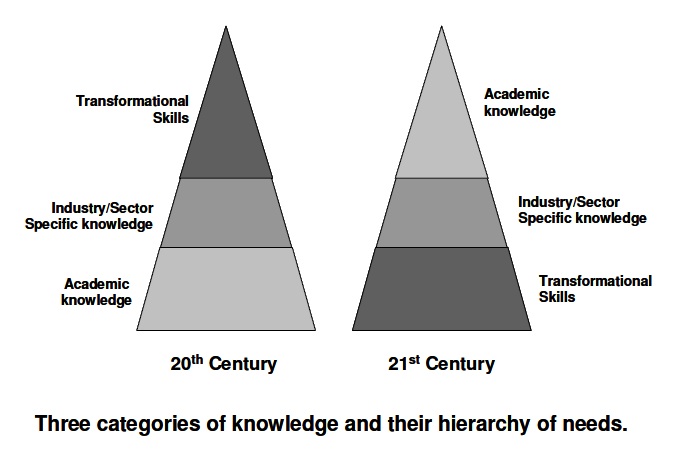
Subramanian and Rangan argue that STEM professionals need to become exceptional and relentless solution providers. They must be able to identify new opportunities, convert such opportunities into complete and integrated solutions, and maximize the benefits from these solutions. These skills are not purely technical or managerial. Instead they are a combination of skills pertaining to Science, Engineering and Management. These Transformational Skills are:
• Identify a problem or opportunity and frame it as a “need”:
• Develop a Common Language
• Three Dimensional view of Core Capabilities and their deployment:
— As an individual
— As part or member of a team
— As part of the company or enterprise
— As part of the industry/community
• Develop the need into a “Solution”:
• Integrate Knowledge from all available sources (across the globe)
• Place emphasis on “Science”; Relentlessly use Portable Diagnostic Tools and methods, Analysis
techniques and Analytics
• “System Thinking”: Focus on the big picture and not merely on the pixels;
• Deploy the Science/Engineering/Management pertinent to the “solution” simultaneously (The
System Approach); Emphasize on mobile/portable diagnostic tools.
• Synthesize: Connect the dots leading to the “Solution”; Emphasis on Core Technology driven
ecosystems.
• Exploit the “Solution” and maximize the benefits:
• Focus on “End to End Innovation” = Idea X Use X Impact
Measure innovation in a scale of 1 to 125 (= 5X5X5 and not 1 to 5 scale in isolated silos). “Branding” as an outcome of End to End innovation
• “Emotional Intelligence”:
Find ways to be useful to others, which in turn benefits you.
Co-create value; I open the door for you, and you let me in as well.
Focus on end user (Customer) benefits as the primary goal and driver for innovation and entrepreneurships.
The authors then describe the roles of individual professionals, organizations, management, the Government and the educators. Each player is called upon to understand these Transformational Skills and integrate them into education as part of a Life Long Learning strategy. The authors conclude that this education is the only reliable pathway enabling technical professionals to thrive in the 21st Century economy.