In the age of AI, where machines (Computers and Network) can replace anyone and anything, one individual – Mr. Huang – is considered indispensable for NVDIA and its leadership. It is strange! Is it really true? Or is it “iconic worship” of one or few held in high esteem for certain unique knowledge, by many who do not have a clue on what that knowledge is or how to acquire and formalize it? Capturing such knowledge – abstract and not formalized – and leveraging that is real intelligence? Is this the AI capability that we are fearful of, heading into the future? Now, are we in an endless circle?
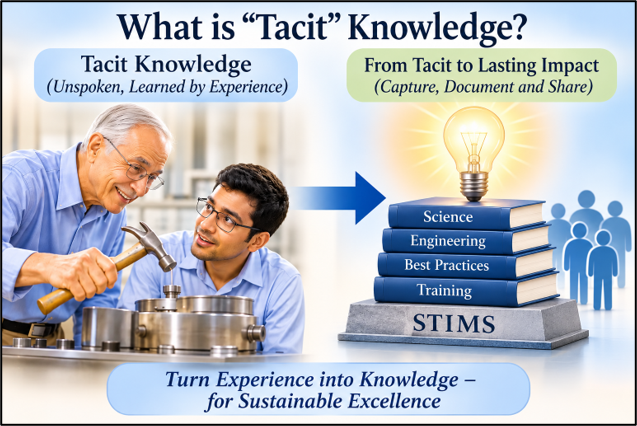
“Tacit” knowledge is unspoken, not documented, silent and understood through its use at the right time and circumstances. It is the loss of such tacit knowledge, one has to be concerned with, when an experienced person leaves his post, Mr. Huang being no exception! This loss of tacit knowledge is the most prevalent problem in the manufacturing workforce training and development. Without a formal understanding of such tacit knowledge, most are like moths flying around a shiny object, finally being caught up and sacrificed in the heat and glow of the lamp!
Over five decades ago, I was a Graduate Student, conducting my research at the Manufacturing Processes Laboratory (Building 35) at MIT. I was trying to set up a strain gage dynamometer for measurements in an experiment. Try as I may, I could not bring the strain gage bridge into balance. My professor Nathan Cook had been observing my struggle all day. On his was out, at the end of the day, he walked by me and stood near the experimental set up. He picked up a plastic hammer and bagged it on one location of the dynamometer. Like a miracle, the strain gage bridge in the dynamometer came into balance and I could proceed with my experiment. With mind full of awe, I asked “Professor, I thought we were supposed to handle this instrument delicately and with care? We are not supposed to bang on this with a hammer?” Prof. cook replied smilingly “Yes, you are correct. You should not do any of that. But I can!” That is the tacit knowledge? He was also a scientist and engineer with years of research and experience, building many dynamometers as well teaching others.
As my education and career continued, I learned a few such tricks as well. Tacit knowledge Is a few short cuts you learn along the way. But reliance of tacit knowledge without an ability to translate that into models (Science for measurement, analysis and verification) or use of such models (Engineering, for real life applications) is a sure sign of weakness in any technology or solution! It will remain in the arena of primitive know-how. Let us hope that the country is not betting its future and AI leadership on one man and his primitive tacit knowledge.
After my graduation, I joined Ford Motor Co. My first assignment was to develop solutions to improve “Productivity” in machining lines. There were many of them spread through the many parts fabrication plants for the manufacture of engine and transmission components. When I visited one of the plants, a senior machine operator told me “Don’t be proud of your degree and title. I am far richer than you ever will be! I have two cars, a boat, a RV, two house – one in MI and another in FL.”
His first statement proved correct. I have seen many of my fellow graduates from various universities proud of their degree and title struggle to get ahead in the late 20th century economy! When a professor in Chemistry wrote “Do not get a Ph.D. in Chemistry?” it reflected the state of affairs for any advanced degree holder in any field. This is also the struggle of those in their high paying IT jobs in Silicon Valley today? But his second statement did not turn out to be true. His job did not last a long time as manufacturing shifted across the globe favoring low-wage workers.
Fortunately, his admonishing was also a wakeup call for me! though relevant Science, Engineering and Strategy, I was able to invent and implement – together with a team – new patented solutions for the machining operations. The machine operator was stopping the machine every hour for tool changes; now he had to stop the machine only once a shift for the same. The time he saved (and idled) would remain a secret between the two of us for a while, until the IE department caught up with that! I moved on and my career continued with success and satisfaction (even during the very difficult times for any manufacturing technology professional)!
Degree and title are valuable when they are systematically used to identify, develop and implement new solutions. It need not be “tacit” knowledge. It must be reduced to relevant science, engineering and strategy and their implementation. It requires STIMS (Science based Technology, Innovation and Management Solutions). We shall discuss more on this
– STIMS : System Thinking and Transformational Skills to move from Tacit Knowledge to Sustainable Excellence – in our next post.
Happy Thanksgiving!

