The economic upheavals we face today has not been well understood and/or articulated effectively by the political leaders, intellectuals and the media. When the cause and effect is not clear, irrationality sets in. It creates a vacuum, an opening where demagogues can fill the space with their vile accusations pitting one group against other. It creates a conducive climate for anger, vitriol and racial animosity to thrive like the fungus which is ever present but grows in dark spaces.
Now the mid term elections are over. There is now some opportunity for both the major political parties to address the anguish of the true “Trump voters” on the right and the “Bernie voters” on the left. Their common concern is their Economic Anxiety, despite the strong economic indicators such as low unemployment. But this will require a true and genuine understanding of the fundamental economic issues. We summarize this as the “Binary Economy stupid”.
James Corville, Democratic Strategist coined the phrase “The Economy Stupid”. It may be time to restate that as “It is the Binary Economy stupid”. There are not enough well-paying jobs for every one across the globe. Fewer such jobs are created against the many that are being depleted. The rest are being pushed into low wage jobs with stagnant wages. Those who are not at either end of this binary job pool are being left behind, like falling in the chasm in this economic divide. This is the “Binary Economy” evolving across the globe for the past four decades. This is the true source of anguish of the large US population? This anguish has been exploited through demagoguery and pitting one group against other?
In a recent opinion piece by Nick Robertson titled “The world is changing before our eyes. And we can’t do anything to stop it” he writes the following:
We are watching the world order being ripped up over fears of a return to a world order that our current post-war world order was designed to forestall. …… It sounds complicated, but it is not. …………There is not enough of everything to go around. There are not enough people making decent livings in a global economy. So, we are reverting to protectionist nationalism to insulate ourselves from the deficit. …………. The suggestion that “There are not enough people making decent livings in a global economy” is true and well documented. But the conclusion that “we are reverting to protectionist nationalism to insulate ourselves from the deficit” may not be correct or accurate as a rationale.
If poverty and economic disparity has been the source of protectionism, racism, bigotry and ethnic centered phobia, then the world as we know of it could never have lived in peace at large. Yes, there will always be social unrest thanks to economic inequity. But, it has never reached the current fever pitch and irrationality.
At times of economic disparity, the “haves” have figured out a way to share their wealth in some proportion with the “have-not”. Whenever this sharing of wealth has been voluntary social equilibrium has been maintained and political unrest held under check. There have been times in the history, when the rich – economically well off – did not pay attention to the needs of the poor among them and restoration of tolerable economic equity was forced upon them. While many of these revolutions such as the French Revolution, Indian Independence movement, the American Revolution, are seen as “political”, each of them were fueled by the oppression of the poor by the rich and powerful holding the seats of power.
But there are few significant differences from the past to the present:
First, the economic angst felt is universal (i.e.) worldwide. It is not limited to one country or region. Within each country there are pockets of economic abundance – like the East and West coast regions of U.S. and the economically depressed central and mid-west. Even such segregation as a broad sweep might be inaccurate. Few with drive and motivation to learn new skills are well off, such as the educated and the millennial, who congregate in the urban communities. Their neighbors affected by globalization – less than four year college degree, white, living in the rural areas and without a sense of direction for the future fall prey for the blame game against the ethnic minorities and the immigrants.
In other words the “us” and “them” are not segregated by country, region, state, etc. This insidious economic upheaval is like the cancer affecting all body organs with different impact at each location!
In addition to the widespread inequality, the cause of such inequality is not simple and evident upfront. Why did the “globalization” that is supposed to lift all boats has not lifted many boats? How is it that one boat in the rural Wisconsin or New Hampshire – well educated, professional with skills to adapt to modern work force – gets lifted, while the boat next to it – neighbor- is getting left behind?
If world is flat, is the much touted outcome, then why do we see rise of right wing authoritarianism rising in Brazil, one of the BRIC countries supposed to have benefitted from globalization?
The conclusion has to be that reason for the economic upheavals we face today has not been well understood and/or articulated effectively by the political leaders, intellectuals and the media. When the cause and effect is not clear, irrationality sets in. It creates a vacuum, an opening where demagogues can fill the space with their vile accusations pitting one group against other. It creates a conducive climate for anger, vitriol and racial animosity to thrive like the fungus which is ever present but grows in dark spaces.
Consider for example the Trump supporters.
“They are primarily white, older men with low levels of education and income. They believe that immigrants and free trade deals have harmed their earning power and they prefer an America in which white people are the majority”.
But their major concern is “Better Economy”. But, every one of the actions of the GOP supported Trump administration – Tax cuts which favor the rich, ballooning deficits which threatens the future economy for all, deregulation which favor those in power and affect the safety and living quality for the masses, assault on public education, health care, …- are totally against the needs of the economic needs and well being of the poor, less educated, less skilled (as seen in the modern economy), rural white population. The support for the Trump led GOP, who blatantly and openly work against the economic self-interest of their supporters, is nothing short of Irrationality.
But, before the rational GOP leaders, Democrats, intellectuals and the Media attempt to address the needs of the changing world and stop the above irrationality – which is now seen as spreading across the globe – they need to get a clear handle on what is changing and why?
The world we live in today is driven by “Binary Economy”. It is like two sides of a large chasm: One side that connects and informs every one across the globe about anything and everything, while the other side isolates people into their narrow subsets and twitter lists, specialties and task oriented efforts and Standard de-skilled work. More pervasive the role and impact of Digital Technology, faster and greater will be the polarization into these extremes with a constantly disappearing middle.
Pope Francis has addressed this development as follows:
“Taken as a whole, do our technological advances — news in real time, live global communication, access to more information and entertainment (and all the shades in between) than we could ever fully absorb — help or hurt the causes when those causes should be engaging with our lives to the fullest, and fostering peace, love and happiness? “
“Real relationships with others, with all the challenges they entail,” Pope Francis said, “is giving way to more fickle online relationships and “a new type of contrived emotion which has more to do with devices and displays than with other people and with nature.”
“Nobody is suggesting a return to the Stone Age, but we do need to slow down and look at reality in a different way?”
“When media and the digital world become omnipresent, their influence can stop people from learning how to live wisely, to think deeply and to love generously. In this context, the great sages of the past run the risk of going unheard amid the noise and distractions of an information overload.”
Few Years ago, Chris Mathews at CNN raised the question: “Can the economy continue to grow while creating fewer well-paying jobs? Our answer is a resounding “YES”.
Wage earning work of all employees can be divided between:
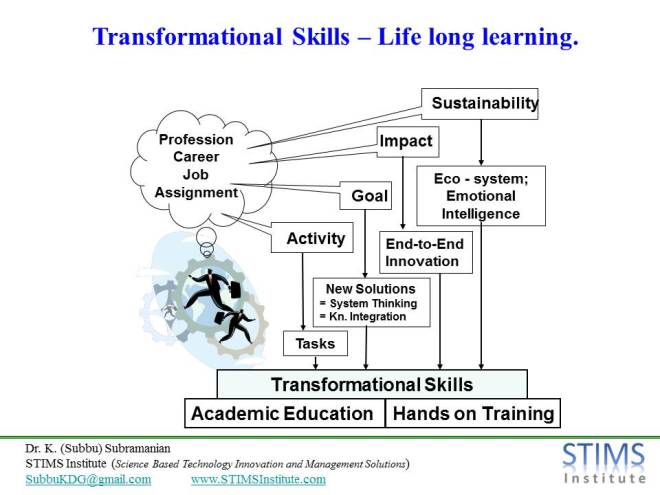
- Professional Work – where the wages are earned for value added solutions – something new and unique. Higher education and learning new skills qualifies one for these jobs. But higher education is merely a ticket to the ball game. Long term survival and success depends a lot more on certain sustained learning and a new set of skills.
- Information Work – where wages are earned for executing well defined tasks to collect, process and disseminate information (much of the work in call centers, BPOs, front end and back office work, etc. belong to this category), The Draftsmen in the early 80s was replaced by CAD solutions and software. Their jobs are not coming back.
- Physical work – where wages are earned literally for well-defined physical tasks (like flipping burgers or driving trucks or Taxi cab, factory work, moving packages at FedEx distribution centers, etc.). The loss of such jobs through “Technology”, outsourcing and automation is well documented.
Of these three categories of work, the professional work is the highest paying. In fact the U.S. economy with low inflation, moderate growth, and lowest unemployment rate has been very good for a small class of “Professional workers”. These are the affluent in the two coasts of the U.S. They are also seen in the large cities and the suburbs across the nation. They are rarely seen among the rural populations. This evolution of a small segment of well-paid professional workers can be seen in all nations and across the globe. These are workers who have also marginally benefited further through the GOP tax cuts with most gains going to the richest. They have managed to acquire the necessary skills to find well-paying jobs in the Binary Economy. To be part of this gold rush or mirage is why everyone is pushing for higher education. The H1B Visa workers fall in this category. Enough U.S. citizens cannot fill these needs because they do not pursue necessary education or cannot accept the lower wages paid to the H1B temporary workers by U.S. employers. Major organized effort to educate and train for such workers in the U.S. is also absent at all levels – local, state or federal – from both the major parties.
Pure information work and physical labor as the means for well-paying jobs is the thing of the past. It started with elimination of Draftsmen and office secretaries. It started with outsourcing and automation. Both these trends started in the late 70s and have continued unabated in the past four decades.AI and Automation will further diminish these kinds of jobs further in the future.
Those who merely do the tasks they are asked to do unwittingly fall into the two categories: The information work and physical labor intensive work. They are able to do maintain their economic needs by working through two or three jobs, all at minimum or low wages. These are the affected millennial. But their wages have been stagnant. They are not the Trump voters. They will continue to be paid poorly (since their value addition is only that much – very low) as their work continues to be de-skilled, standardized and automated. Unions and organized labor cannot help, when the human centered worker skills for processing information or labor are no longer seen as indispensable. Instead they would benefit very much from the upward rise of minimum wages across the board. They would also benefit from the equal pay for equal work, child care at work, as well as programs for learning new skills.
But, how about the workers whose jobs are never coming back and who do not have the wherewithal to acquire new skills in the Binary Economy? These are the segment of the population – the Trump voters for whom economy is the major concern – are dispersed across the nation. To address this question we need to better understand the Binary Economy at work:
Till the 1970s these three classes of work were somewhat intermixed. One could migrate from one layer to the next (upward) and this created the large pool of middle class. Such mobility across the levels of jobs also created the American Dream: If you work hard and smart you can get ahead. This doctrine is no more valid. The layers of work in the Binary Economy are nearly water tight and with a steady effort to push the work content and number of jobs to the lower paying information tasks and physical work tasks. The numbers of such low wage jobs created are increasing as we continue to bleed the professional work jobs to fewer and fewer in number. This is reflected in the low unemployment together with stagnant wages in a growing U.S. economy.
Now there is also a constant effort to de-skill and standardize information work and physical labor. As a result their value addition will continue to decline and hence the wages for such jobs will also decline. Programmable automation, robotics. AI, etc. will also take more out of the lower paying information work and physical work jobs as well. (e.g.): The octopod to deliver packages for Amazon will reduce more of the truck driver jobs. The number of professional jobs needed to create and implement the octopod will be far fewer than the professional jobs and lower paying jobs they will replace. This is the productivity gain and the JOBLESS RECOVERY! In the beginning there could be an appearance of job growth at some locations, but across the globe there will continue to be less of a need for human centered activities called work and the reward for them.
Hence the answer to the question: Can we continue to grow while creating fewer well-paying jobs? – is “YES”. Evolution in Digital Technology applications and their ability access to resources across the globe are the drivers for this development. It is not the outcome or ploy by a few.
It should be made clear that no single technology is good or bad. In that sense Digital Technology is neutral and agnostic for employment or economic conditions of the population. But wide and prudent deployment of any “Technology” is the role of political leaders, thought leaders and administration. In this regard there is a collective failure across the board and across the globe! “we are reverting to protectionist nationalism to insulate ourselves from the deficit” may be accurate and correct. But the “deficit” is the diminishing need for human centered work enabled by Digital Technology capabilities. Their wide spread application, without regard for the economic consequences for the broad population has been the failure across the globe for the past four decades. This failure continues unabated leaving the opening for irrational choice and support as seen in the Trump voters. This is also evidenced in the protectionist nationalism and the rise of ultra-right wing ideologies across the globe.
The sad thing is that neither the liberals nor the conservatives or angry folks – the burn everything down ultra-right or the far left seem to understand this basic truth. Or they choose to ignore the sad reality and find their escape through irrational alternatives as solutions. The heads of institutions and leaders in every function of the society also pay only lip service to this evolving fundamental issue. The media has totally failed to articulate the view (i.e.) It is the Binary Economy stupid! When the agricultural industry evolved, 40% employment in agriculture shrunk to 1% of the population now working in it. Industry driven employment replaced agricultural employment. Now, we are headed in the direction in all forms of employment where few workers are needed. But there is no replacement in sight.
Can there be a solution to this? – YES.
But, to get there, we need to recognize the problem, first (i.e.) It is the “Binary Economy stupid”! At times of economic disparity, the “haves” have figured out a way to share their wealth in some proportion with the “have nots”. Whenever this sharing of wealth has been voluntary social equilibrium has been maintained and political unrest held under check. This may require an economic security program as a safety net for those who cannot adjust to the diminishing opportunities for well-paying jobs. At a time, when Social Security is in the chopping block to pay for the deficits created by the tax cut for the wealthy, any thought of “Economic Security” program is a non-starter. Instead what we are offered are fears of economic insecurity and the protectionist nationalism it fosters.
 STIMS Institute