Leadership: Three levels of System Skills

In a recent post in the HBR titled: Want to be an outstanding leader: Keep a journal? https://hbr.org/2016/01/want-to-be-an-outstanding-leader-keep-a-journal? the author suggests keeping a personal journal and also taking time off for periodic reflection. We fully agree with these suggestions. Here are some additional thoughts:

A Leader evolves to be one by gathering ideas (Self and that from others), integrates them into a solution and leads a team to achieve and enjoy the benefits of such solution. Hence by inference every leader and in any field is a Knowledge Integrator, capable of thinking of problems or opportunities as a system: The Whole is larger than the mere sum of its parts.
There are three levels of System Thinking in any leadership role:
AWARENESS of the big picture (at this level any form of knowledge and information aggregation is very useful; Maintaining a personal diary or journal is one such tool; it offers a structure or discipline for knowledge aggregation.)
ANALYSIS: This is the next level of System Thinking for any leadership role. Some times this analysis of data and information is personal, some times it is collective. A good leader finds ways to push every one to this stage. Most will resist it as the tendency will be to just supply information and wait for orders. Such task oriented persons can never be a leader, no matter what their title or assigned role is.
Moments of peace and introspection are ways in which a leader separates himself from the mere tasks and engages in analytical reasoning that connect the dots, to see the big picture – how the whole can become larger than mere sum of the parts.
SYNTHESIS: Few, Very few ascend to this level. The synthesis is an outcome of analysis. While Analysis offers an answer to the “Why?”, synthesis challenges the leader to inspire the self and others to ask “Why not?” and then find the answers.
For details on the three levels of System Skills for a leader:

Books

Managing the role of Digital Technology: Life before and after electricity.

Slide1

With the advent of the New Year, the presidential campaigns will certainly move into next gear. The economic anguish of the Bernie Sanders supporters and the rudderless fear of the Trump supporters have been the driving forces for much of the discussion in 2015. Of course the media circus and bigotry of certain candidates need no further elaboration.

In a recent TV interview Senator Bernie Sanders has correctly pointed out: “what we’ve got to do is come together and say, ‘Why is it that the middle class is disappearing” Sanders said. “And sometimes Chris, to be honest with you, it can’t be done in a six-second sound bite.”

We agree with Mr. Sanders. Slowly but surely the campaigns have to articulate the fundamental economic model at work and how it affects all of us.

We have described that Binary Economy as the driving force behind the collapsing middle class and the growing wage and income disparity. This Binary Economy fueled by the evolutions in Digital Technology is described in detail in our book and other writings (see links) https://stimsinstitute.com/2014/02/16/can-the-economy-continue-to-grow-while-creating-fewer-well-paying-jobs-the-answer-is-yes/

Why are the rich getting richer and the poor getting poorer? What can be done about that?

Slide1

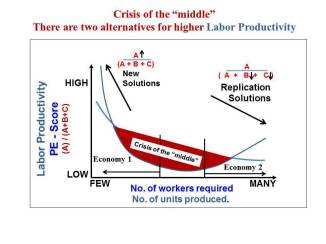
Globalization and shifting of jobs away from US are not the cause of our economic anxiety. Instead they are the effects or outcome of unrelenting use of IT tools by the investors to reach and leverage all low cost resources from across the globe. Even the few jobs available within the USA are getting stratified into impermeable layers of low wage jobs (for physical labor and information work) and better wages for professional work. Few well-paying jobs and lots of low wage jobs will be the reality for foreseeable future as IT systems, robots and drones take a larger chunk of available work. For the few well-paying professional jobs college degree will be an asset. But not every college graduate will get or keep these professional jobs. There is a growing gap between the wage and non-wage income, the later going to the 1% of the society.
Slide2

The above are the economic realities. They are the direct and sweeping outcome of relentless growth in Digital Technology (commonly and inaccurately referred to as “Technology”) and their applications commonly referred to as IT. This sweeping change and its impact is like the life before and life after electricity!

Intellectuals and think-tanks have to boldly articulate this fundamental reality sweeping across the globe. Increase in labor productivity enabled by Digital Technology does not and need not automatically translate into higher wages for all workers. Blaming only the Wall Street or the immigrants or specific groups like unions and even failure/in-action of the POTUS, Congress or other establishments is truly futile. They are pathways –wiring – through which the emerging Binary Economy takes foot hold. Such blame game is similar to those living in the age of candle light blaming the changes in the society on everything but the role of electricity as a General Purpose Technology.

Of course one cannot go out and say that Digital Technology is your problem and deal with it. Electricity can illuminate the room or cities instantly at the flip of a switch. But electricity can also electrocute and kill large number of people instantly. In the case of Digital Technology the killing is more of economic starvation of the many in the middle class through the Binary Economy at the benefit of a few (1%). This impacts every one, but the pain and suffering is most acute today (after four decades of brewing) for certain demographics who populate the campaign events of Mr. Sanders and Mr. Trump. This does not imply any false equivalence between the economic reasoning of Mr. sanders and the raw emotional appeal of Mr. Trump.

As a society at large we have learned to adapt and use the electricity wisely. There are rules and regulations on the proper use of electricity. We have codes and standards to be met. Meeting such standards is not a personal choice. Do we need such economic safety standards for the development and use of Digital Technology enabled tools and platforms?

At an individual level every professional – wage earning worker – can become aware of the Binary Economy and how to cope with it through a set of Transformational Skills as outlined in our book.

The questions for any campaign are: Do they get it? Do they truly comprehend the role and impact of the emerging – and now well established – Binary Economy? If yes, what policies do they advocate for managing the development and deployment of Digital Technology that will help to alleviate their negative effects (Collapsing middle class and more people being pushed into low skill and hence low wage or no wage growth replication solutions)? Answers to these questions and articulating them effectively will lead to policies and programs to successfully deflate the economic anguish valiantly articulated by Senator Sanders and quell the anger fueling the Donald Trump campaign.

POTUS has rightly pointed out that ISIS is a bunch of thugs with social media. We need to recognize Social Media as a product enabled by Digital Technology. Electricity requires physical connectivity – wiring – for transmission of power and energy. Digital Technology enabled social media and wireless communication require no such connection. Hillary Clinton has rightly pointed out that encryption technology (used in the mobile digital devices) has to be worked out between the Govt. (to protect the people against terrorists) and the IT Sector leaders (who claim to protect the privacy rights of individuals). But HC campaign has to move further to explain how the individual rights and societal good (safety and security) go hand in hand? If they are inter-related how does one navigate through these polar opposites imposed on us by Digital Technology? Any defective car – that kills a number of people – will be pulled off the street instantly. Why do we not impose the same standards for the use of social media tools?

The role of Digital Technology is also evident through the 24 hour news cycle, social media and the relentless tweets. Once created they also serve for relentless repetition and digital re-wind of the same statements or images without any new additional information or fact. The political pundits and the main stream media and the intellectuals (in colleges and think tanks) need to get out of their comfort zone and stop repeating the same opinions as conclusions.

Today investors, political leaders, intellectuals and pundits and the main stream as well as the social media are the beneficiaries of the Digital Technology, while the rest of the society pays the heavy price. Soon they will also pay the price as well, as the US economy declines into an unsafe consumer-less economy. One can be certain that will not be the end result. But we can get there when we as a society learn to manage the Digital technology and its use as we have learned to manage and use electricity wisely, safely and with individual responsibility guided by suitable rules and regulations.

Welders and philosophers – a case for skill needed for Developing Common Language

In the fourth Republican debate Senator Rubio stated, “Welders make more money than philosophers,” “We need more welders and less philosophers.”

One can fully appreciate the possible resurgence of the need for welders, as the manufacturing sector shows some signs of life after decades of being decimated under the banner of globalization. Yes, if you are a hands on welder there are some good jobs available in the range of $35,000 to $50,000/year. Before every one rushes to send their children for welding schools, let us be sure that they are also trained on basics of engineering, business economics and IT applications. Otherwise the welders of today will be left behind in the next few years as Robotics get a greater and stronger foot hold in our manufacturing not long from now.

In every discipline of study one is awarded the highest degree (i.e.) Doctor of Philosophy (Ph.D). It is very logical to find – and indeed there are many – Doctor of Philosophy in welding as well. Any Ph.D in welding capable of integrating and implementing new solutions is a hot commodity for employment today. Indeed we need such results oriented Ph.D in every field. At any time the demand for such highly educated and qualified people will be far fewer than welders with basic trade school education and training. But their income will always be higher than the welders in the shop floor.

Why is it that Mr. Rubio suggests that we need more welders and not philosophers? Such thought and language comes from a limited knowledge of the words and their repeated use. The word Philosophy is an in-depth study of any subject. Of course in-depth study of life in general is commonly referred to as “Philosophy”. But every graduate in philosophy major is not a Philosopher any more than any one holding a welding gun is a welder!

Mr. Rubio’s comment also has another ramification as well. There is a general misconception that education in a hot field and income are directly correlated and hence once should get educated in specific areas where opportunity presents itself. This has been the case for the 20th century education. Students flocked to Automobile engineering, Textile engineering, Nuclear engineering, Chemical engineering, Polymer engineering, etc. as each industry grew and shrunk well within the confines of the US shores. With the globalization such sector specific education may still be a need, but every worker needs also to be a system thinker and solution provider first. Absent such transformational skills no amount of education will be a sustainable competitive advantage for the workers at any level. These considerations and in-depth analysis leading to meaningful solutions of impact for average workers will require every presidential candidate to be a bit more philosophic in their reflection, thinking and answers. May be we don’t need more philosophy graduates compared to the number of welders required. But for certain we need every presidential candidate be required to take a crash course in philosophy and the reflection and analytical thinking such education brings.

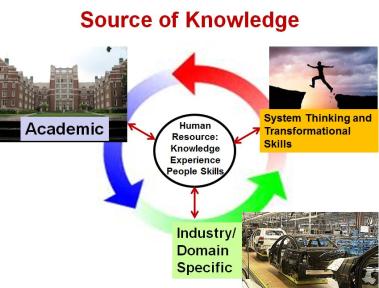
This episode also points to another important issue we face in the economy and the society today. Words and their true meaning are lost, when they are misused. Thanks to the advent of IT, this abuse spreads quickly and across the globe at the speed of electrons. Then with very little thought such terms and their erroneous meaning become the accepted norm! Welding is a technical skill and philosophy is a thought process. A welder could also be a philosopher. To be grounded on the true meaning of the word requires an ability to step back and look at the big picture and a special skill to “Develop a common language”. We call this as the capacity for System Thinking and Transformational Skills.

Few other examples where we need the above skills and the common language are:

  • Technology (it is not IT or Digital Technology alone as presumed in many conversations),
  • Service Economy is distinct from Industrial Economy (Every economy – industrial, service, high-tech., brick and Mortar, etc. – is rooted in Products (source of revenue), Process (Means to an end) and Application/USE (where the value of the product is perceived hence generating revenue))
  • Globalization  is the cause of many of our problems (It is an outcome and not a cause; pervasive and indiscriminate use of IT applications is the cause))
  • Globalization will lift all boats (Globalization as the result of indiscriminate use of IT to improve operating costs and re-distribute employment across the globe is like a shrinking vessel and can not lift all boats; Unless IT applications together with human skills are also used to create new products, markets and better way of living for all, Globalization as it exists can not lift all the boats)

Why are the rich getting richer and the poor getting poorer? What can be done about that?

As the 2016 Presidential race gets into next gear it appears that everyone running for the high office wants to do something to address the increasing gap between the rich and the poor. For Republicans it means giving more tax breaks for the rich and let the benefit trickle down. Democrats suggest it is a matter of increasing the minimum wage, free higher education, better safety net for the poor and paying for all that by taxing the ultra-rich.

Any discussion in the Republican circles on lifting the poor out of poverty gets mired by suggestions of “class war fare”, while majority of the “Reagan Republicans” – the lunch bucket working class – are seeing an erosion of their wages, income and living standards.

For the Democrats like Bernie Sanders it is a moral issue. As he puts it, “Let us wage a moral and political war against the billionaires and corporate leaders, on Wall Street and elsewhere, whose policies and greed are destroying the middle class of America”.

But is it possible that the rich are no more greedy now than they ever have been? May be the control of Washington by the Wall Street is no more or less than it has always been? Are there other reasons for the growing income gap in America?

We see a separation of jobs of the industrial economy into four parallel and distinctly separate layers: Finance, Professional, Information work and physical labor. This is schematically illustrated in the figure below:

Four layersIn a recent book titled The age of acquiescence, the author describes the industrial revolution, where the investors were getting more of the new found riches. The workers organized into unions and demanded a better share for themselves. This resulted in the thriving middle class. Since the 1980s, in the age of “High Tech” when the income gap has also been growing, the workers have become sullen and have given up their rights to fight. They have acquiesced to a life of lower wages and benefits suggests the author.

A Large majority of the jobs during industrial revolution were based on information and physical work and some combination of the two. As the workers contributed to the outcome – the industrial output – they had the clout to fight back for better wages. Without the workers the industries and factories could not be run. Hence the union had the power.

Since the 1980s – since the advent of Digital Technology – information work and physical work can be automated. Now they are cheaper, faster and better with fewer workers required. The gain in labor productivity claimed as the positive outcome of globalization has been largely through elimination of human work in developed nations. Even the low cost off shore labor is likely to be replaced in the future by more information systems, robotics and programmable automation. Unlike the workers of the Industrial age, the current work force has little or no influence on the economic output. For them accepting lower wages and benefits is an economic reality. It is not a matter of surrender or acquiescence.

Creating jobs at sustainable living wages is not a business priority now. This is the time when the human resources are not needed thanks to “Technology”. However jobs that pay well and create a middle class is more than simply a matter of sharing the wealth from the rich to the needy. In the words of Vice President Joe Biden, “A job is a lot more than a paycheck. It’s about your dignity, it’s about your place in the community, it is about who you are.” Mr. Biden may or may not enter the presidential race. But, his words must be the calling for every contender in the race from either party.

The evolution of income for each layer of work and how it separates between wage and non-wage income is shown schematically in the figure below. Non-wage incomes come from bonus, dividends, securities trading, hedge fund income, etc. May be what we see as the gap between the rich and poor is really the gap between the “wage” Vs. “non-wage” income? May be the debate should be on the taxation of “non-wage” income and how to use that to pay for creating new higher wage jobs?

Wage and non-wage income

Mr. Sanders in the last debate suggested that “College education today is equivalent to the high school education of the past. Hence college education must be made free for all”. What happens if the number of jobs created for knowledge work – “professional jobs” – is far fewer than the jobs eliminated through “Technology”? In this case, merely graduating all high school graduates with college degree may only add to the cost incurred and higher unemployment without the benefits expected?

Not all professional jobs with good wages require college degree. These professionals may come from high school, community colleges or universities. But every one of them will be required to be System Thinkers and Solution providers. They should be capable of doing what the computers and networks cannot do. This may require a special set of skills – the Transformational Skills – to identify, develop and deliver a stream of new solutions, in whatever job one is employed. Investment in such education may not be large, but the payoff will be far higher than merely opening up the colleges for free. More of the same education, even if it is free may serve only a very few in the end.