System Approach for Customer Success Management

Customer Success Management (CSM) is a relatively new functional area within many companies, an increasingly vital operational role, a rapidly growing profession, and an underlying systems management philosophy that is growing in importance, especially – but not exclusively – within the technology industry. One leading industry organization (Customer Success Association 2021) defines CSM as “a long-term, scientifically engineered, and professionally directed business strategy for maximizing customer and company sustained business value,”. Others describe CSM as “a customer-facing, non-direct sales role that embodies the mindset of a counselor
to proactively partner with customers to help them achieve their goals and promote long-term customer health that ultimately leads to relationship growth”.

A recent paper that outlines the System Approach for CSM has been authored by Prof. Vijay Merhotra at UCSF, School of Business and Dr. Krishnamoorthy (Subbu) Subramanian from STIMS Institute. For a complete vesrion of this paper, please see: https://stimsinstitute.com/wp-content/uploads/2025/08/system-view-of-csm-published-paper-with-prof.-vijay-merhotra-ucsf-07-22.pdf

Every Co. has processses required to produce and supply their products. When their products are used and the value realized by the customer, only then recurring sales and sustained sales growth of the supplier is realized as illustrated in the figure below:

CSM plays an imptortant interfcae role between the customer and supplier as illustrated in the figure above.

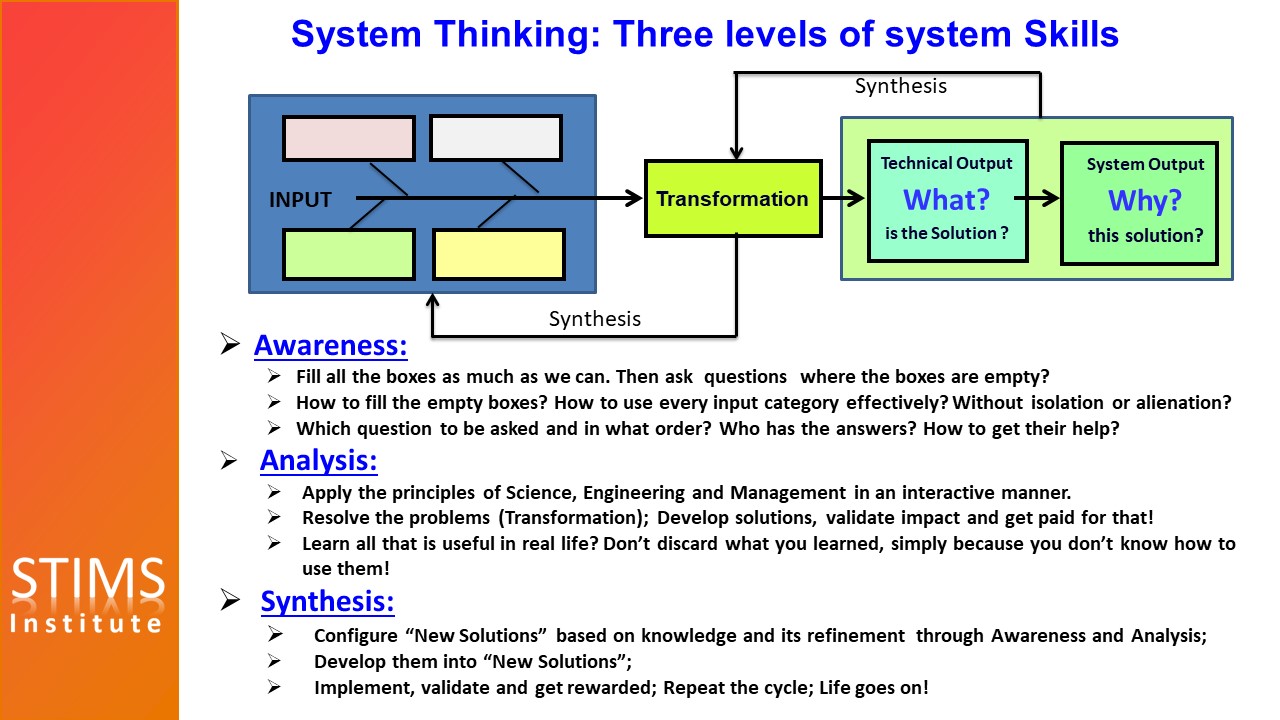
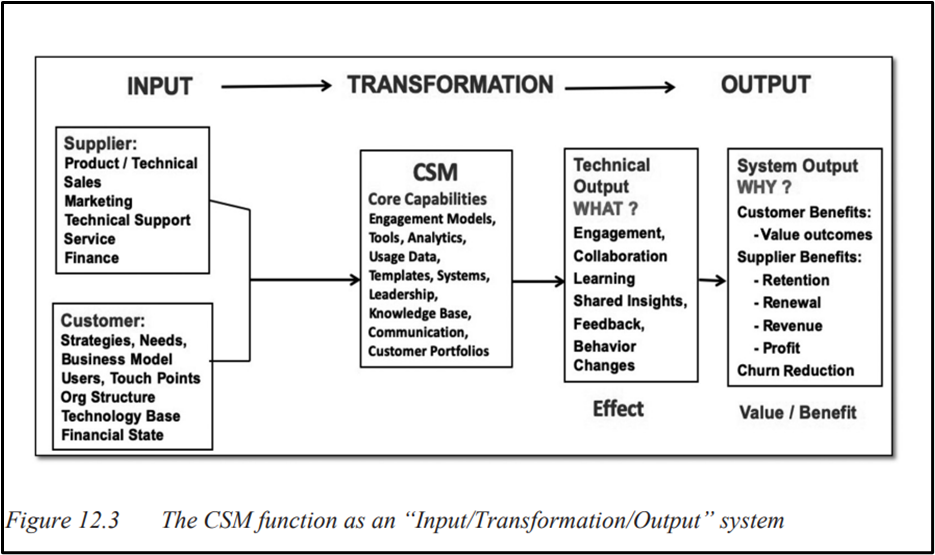
Every process of the “Customer” is a “system” that can be described as an

“Input /Transformation / Output” Scheme
The output itself may be classified as “Technical Outputs” or the nuts and bolts of the solution, leading to the desired value/benefits called the “System Outputs”.

This System Approach has been setailed in the book authored by Dr. Subramanian and Prof. Rangan: https://www.amazon.com/Thriving-Century-Transformational-TechnicalProfessionals/dp/0791860167/ref=sr_1_1s=books&ie=UTF8&qid=1371673516&sr=1-1&keywords=Transformational+Skills+Subramanian

The Customer Success Management as a System integrating customers and Suppliers is illustrated in the Figure below:

In figure 12.3 above on the input side the various functions of the “Customer” and “Supplier” are listed. Everyone of them is a stakeholder in the “Transformation” (i.e.) Customer’s process in which the Supplier’s product is used. Hence opportunities for maximizing or “Optimizing” the System outputs – Stakeholder benefits – could be far larger than that listed even in this figure!

Beyond that, consider all other “Suppliers” involved and their “Products” required for the Customer’s process. Now you have a far larger list of “Stakeholders” and their benefits that you could synergistically optimize and attempt to satisfy. Every such satisfied “Supplier” is also a beneficiary for the “Customer” and his “process”. This a substantially expands the role and impact of “Customer Success Management”! 

In this CSM Philosophy, any supplier can adopt the “Customer’s Process” as his own (i.e.) “Becoming a Customer’s Customer”! In many respects it may also be seen as the evolution of Applications Technology in the Customer / Supplier relationships.

Whose America is it? – Part 2

“It has been said that democracy is the worst form of Government except for all those other forms that have been tried from time to time” – quote attributed to Winston Churchill. Today with all the challenges we face in our system of Government, faith in Democracy and America as the unfailing cradle and leader of such Democracy is called into question.

Successful Democracy requires well informed citizens, who vote for their best self-interest. It also requires that self-interest is viewed through a larger perspective and not merely through polarized lens of narrow partisan interests. In the recent election, even narrow partisan self-interest seems to have failed. How else can one explain the vote of those in the Dearborn area – supporters of Palestinian’s aspirations – who now find themselves between a rock and a hard place, thanks to the policies proposed from the current administration, centered around expelling millions of Gazans from their historic home land. This is just one example of irrationality of voting patterns that might have failed the American Democracy, the greatest political experiment on earth.

Failure of ill-informed voting public goes beyond such narrow ethnic group oriented politically sensitive subjects. Nor is it our goal to dwell on them. Let us look at a couple of rather broadly accepted notions that cut across all groups and population segments. One among them is the notion that “Government must be run efficiently, like a business. Hence it is necessary to cut the cost to the bones!”. This statement assumes that “businesses are run efficiently”. This is a far cry from reality. Business leaders, part of the voting public, must be honest and truthful to admit that every successful business is run to make profit and meet share holder expectations. In this shadow boxing – the mythical notion of satisfying shareholders, the “kabuki theater” – there is plenty of inefficiency. Rare indeed are businesses that are truly run lean and mean in a sustained manner over time.

Next is the notion that ALL Government departments must be cut back to demonstrate efficiency! Another hog wash notion? In some areas like production operations, it is realistic and feasible to show efficiency and cost cutting as directly related to the resources needed. But that is not the case for R&D, Marketing, Administration, HR and all such “service” functions. You don’t hire and fire intellectual talent or critical resources at will and on demand. This concept may apply to many of the important Government Departments that affect our health, safety, security and welfare.

Here is one more: In the name of efficiency and cost cutting senior employees in the work force were seen as “fixed cost” and can be disposed off, leading severe loss of unique talent in Manufacturing operations in the 80s and 90s. Now we find the same mistake repeated by indiscriminate firing of key staff in FDA, Missile systems management, FAA, etc. Whose America is it to permit all these reckless and loose cannon approach to management of our vital resources and services?

Following are a few passages from an article titled: 2,400 years ago, Plato saw democracy would give rise to a tyrannical leader filled with “false and braggart words –https://qz.com/1293998/2400-years-ago-plato-saw-democracy-would-give-rise-to-a-tyrannical-leader-filled-with-false-and-braggart-words

Josiah Ober, professor of political science and classics at Stanford University says the passages from Plato’s Republic read as “a particularly harsh description of the most tyrannical parts of Trump’s public personality.”

Plato’s Republic, which evaluates the nature and justice of various political regimes and examines how individuals’ moral psychologies are interlinked with the moral psychology of their state, is intended as a work of philosophy rather than a prediction of how political events would unfold. That said, Plato’s critique of democracy contains a number of aspects relevant today.

Plato believed that the key and driving feature of democracy is desire for freedom; this very trait, though, ultimately leads a state to tyranny. A democratic regime involves such a plurality of interests, he believed, that the only way anything can be achieved under it is to have strong leadership that can unite interests. “It’s not a complete portrait of modern democracy but it captures something: This desire for a strong leader who can give guidance to diverse pluralistic uncoordinated desires,” says Oder.

Plato states “The tyrant mistrusts both those within and outside his circle, and so essentially ends up in a sort of servitude himself.” Role and influence of men like Elon Musk and their passion to change all things at all costs reminds us of this self-enforced slavery of an elected leader today.

For a more optimistic interpretation of today’s political regimes, Ober suggests looking to Aristotle, who understood that true democracy is fundamentally opposed to tyranny. Contemporary politics may cause consternation, but Ober says it’s worth believing in the political regime. After all, he adds, “Democracy has to be built on hope.”

Keynote Presentations at COPEN-13, @ NIT Calicut – India

Dr. Krishnamoorthy (Subbu) Subramanian, President STIMS Institute and Prof. Ramesh N. Babu, IIT – Madras and Secretary AMTDC presented a joint invited Key Note address at the 13th Conference on Precision Engineering (COPEN – 13) on Dec. 13th 2024 at NIT Calicut, Kerala, India. The presentation was followed by a panel session to further gain insights on successful models and strategy for industry/academia collaboration together with support from the funding agencies, and future directions.
It was an unique opportunity as well as experience. It was the culmination of over a decade long collaboration between STIMS Institute, IIT- Madras, several industry partners as well as support from Govt. of India. The presentations covered two themes:
Substantial collaborative work has progressed inside of India for more than a decade now. This is a remarkable demonstration of success in   Industry/Academia collaboration, much sought after by Industries, Academia and funding agencies from the Govt. in all nations across the globe.
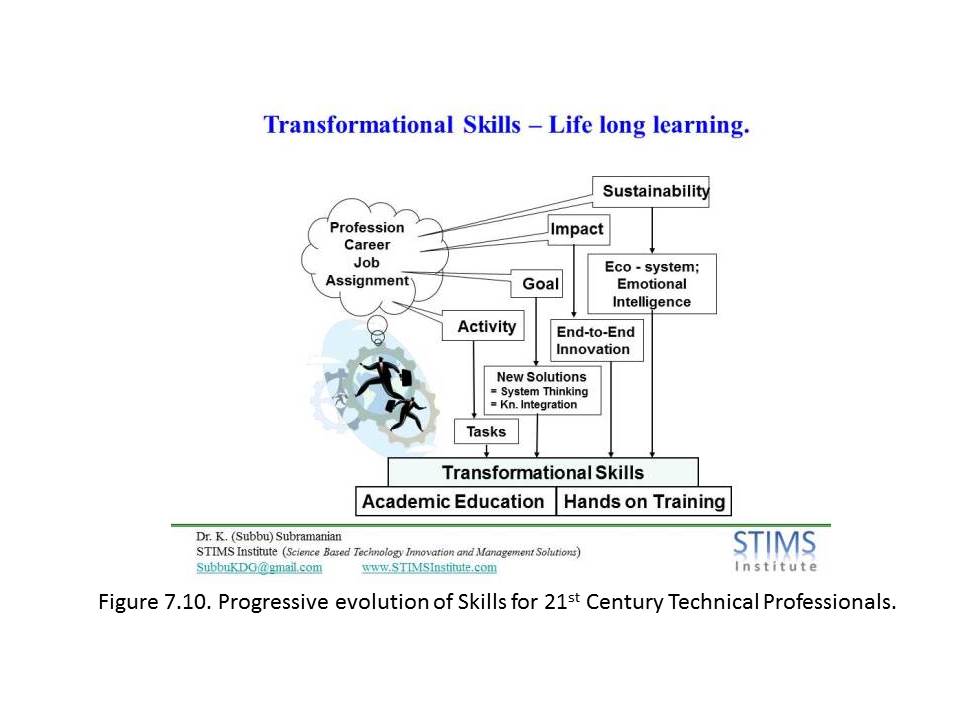
The secret for success can be summatized as a relentless emphasis on System Thinking and Transformational Skills with a determined focus on End-to-End Innovation!
This joint key note talk was presented in two parts by an academic leader with hands on experience in real world innovation and the Knowledge-Integration expertise promoted by the STIMS Institute.

Part 1:   Prof. Babu: Real life experience – home grown success in  Industry/academia collaboration, which is now seen as the successfully established Advanced Manufacturing Technology Development Center (AMTDC) located at the IIT Research Park, Taramani, Chennai, Tamil Nady, India.
https://stimsinstitute.com/wp-content/uploads/2025/01/copen13_nitc_final-1-prof.-babu.pdf

Part 2:   Dr. Krishnamoorthy (Subbu) Subramanian: Origins and Strategy (based on over   40 years of experience in inter-industry and   Industry / Academia Collaboration).Strategies for End-to-End Innovation -“System Thinking” and “Transformational Skills”
https://stimsinstitute.com/wp-content/uploads/2025/01/copen-13-key-note-paper-final.pdf

Few images from this event and presentations are included below. We thank the conference organizers, academia and industry partners as well as industry consortium represented by IMTMA and also the fiunding agencies from the Government of India. Special thanks to Mr. N.K. Dhand, Chairman, Micromatic Grinding Technology Ltd. (MGTL) and Mr. Mohanram, adviser, Indian Machine Tool Manufacturers Association (IMTMA) for their unstincting support for this decade long collaboration and outcome.

This successful model, for industry/academia collaboration at AMTDC has also been implemented earlier as an inter-industry collaborative effort inside the industry, by Dr. Subramanian through his industrial working career. We hope there will be more efforts to replicate this successful model and its outcomes by many in the Academia/Industry and Govt. agencucies.

Advanced Manufacturing Technology Development Center (AMTDC) https://amtdc.org/

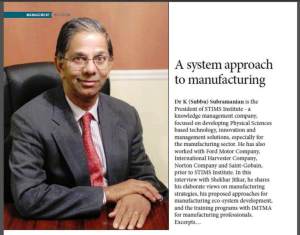
Interview of Dr. Subramanian published in the Efficient Manufacturing Magazine

MANAGEMENT INTERVIEWpicture 2 Picture 3 Picture1

A system approach to manufacturing

You will find here excerpts from an interview with
Dr. K. (Subbu) Subramanian, President, STIMS Institute Inc.

• What should be the ideal strategies to survive, succeed and achieve competitive excellence in today’s volatile global economy?

• What is the “Systems Thinking of the Manufacturing Processes”?

• Tell us more about your program with IMTMA to train manufacturing professionals at all levels?

• Can you brief us on your proposed manufacturing eco-system – an approach that can create synergy from all sectors, much needed for a sustainable growth in the manufacturing industry?

• How to set up a suitable supply chain eco-system and acquire capabilities for machine tool components so as to make the overall production more dynamic and growth oriented?

• What should be the role of a CEO in strategy and planning towards operational excellence?

EM Management Interview (1) 12 12