
In the recent press conference at Poland, https://www.whitehouse.gov/the-press-office/2016/07/09/remarks-president-obama-press-conference-after-nato-summit President Obama gave a very clear articulation of Globalization, its benefits and pitfalls. A brief abstract as noted below:
I’m not sure it’s accurate to say that I am a huge booster of globalization. What is accurate to say is that I believe the process of globalization is here to stay — as a consequence of technology and the mobility of capital, and cargo container ships and global supply chains. And conceivably, we could run back the tape to 50 years ago and see whether we could rearrange some of that process, but it’s happening. It’s here. And we see it every day in our lives. Everybody who has got a smartphone in their pocket is seeing it.
It is good to see that the world leader openly acknowledging that Globalization is an effect and not the cause. The causes identified such as “Technology” (which stands for IT) “mobility of capital” (thanks to IT driven systems including credit cards, on-line money transfer solutions and global investment), “Cargo container ships” (which is truly part of IT driven “supply chain” management )and smart phones. All these developments can be summarized as the unbridled use of Digital Technology (DT).
Such open acknowledgement of the role of unbridled use of DT and its negative consequences is the first step in our opinion to objectively deal with the ills of globalization, collapse of the middle class, globalization of terror and all other ills we face today.
And my argument has been that there are enormous benefits to be gained from that global integration, just as there are enormous benefits to be gained from European integration, so long as we recognize that with that integration there is the danger of increased inequality, or workers having less leverage and capital having more leverage, that it threatens to leave people behind.
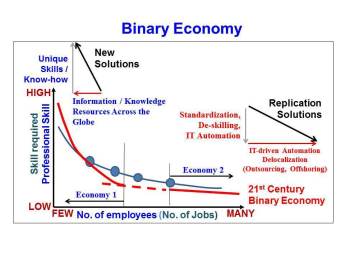
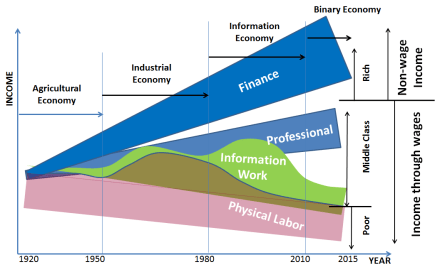
In the above the POTUS speaks more like a historian rather than as a strategic leader of the free world. He is not alone in this pitfall. No intellectual or policy maker or think tank is willing to acknowledge the obvious reality (i.e) DT has the capacity to (a) enhance the capacity of individuals and organizations to use their knowledge and resources from across the globe (including finance) leading to new solutions or (b) eliminate the need for human centered skills of information work and physical labor. Please see our description of BINARY ECONOMY. By its very nature the DT enabled Binary Economy WILL create increased inequality and less leverage for workers and more leverage for capital.
This inequality is now deeply entrenched thanks to unbridled deployment of DT. This is like life before and after electricity. With a flip of the switch the entire room can be lighted. With a faulty switch one can get electrocuted and die. Same holds good for un-regulated deployment of DT. The well-lit room is analogous to the quick fortunes for the wealthy, while the electrocution and death is the slow economic meltdown of anything “middle”: middle class wages, skills, capabilities, production volumes, middle tier price for consumer goods, etc. There were rules and inspection procedures set up for the proper use of electricity, while avoiding the dangers in its use. No such rules or regulations exist for proper deployment of DT that can benefit the rich while also taking care of those affected in their economics.
And if we don’t take steps to make sure everybody can participate in that global integration — making sure that wages are high enough, making sure that we rebuild the social compact so that pensions and health care are taken care of, making sure that communities are not completely abandoned when a factory leaves and there’s an economic plan for transition — if we do not do that effectively, then there’s going to be a backlash.
Again, the leader of the free world is preaching rather than proposing bold new solutions. He is not alone in this. Neither of the political parties in the US or their leaders have any proposals to address these growing issues.
Mr. President, the backlash is not a thing for the future, but it is happening here and now. Those of us in the brick and mortar manufacturing sector have faced it since its inception – since the late 1970s to present. We have written about this as early as the year 2000. The angry middle aged white voters who support Mr. Trump and the young who are angry against Wall Street and seek free college education – Mr. Sander’s supporters – are reflective of the backlash already in progress. The Brexit and the immigration issue in US cannot be seen anything but a backlash of migration of poor labor to fill the low wage jobs created at the expense of middle class jobs and wages (for whom no alternative exists), thanks to the DT enabled Globalization.
So, what should happen next?
- Honest and open admission that DT is a two edged sword: (a) It will create opportunities for the few at the expense of good wage jobs for many in the middle (mostly in the developed nations); (b) It will create opportunities for low wage jobs for many across the globe and hence lift many boats in low wage labor pools (but mostly in the developing regions).
- Unbridled use of DT must stop. This means if investors can use global resources to enhance their profits by merely displacing their economic activity from high labor cost region to lower labor cost regions there must be a tariff on such profits (to be used as investment for alternative economic and employment opportunities for the affected workers). This must be part of a global arrangement (and not through tariffs as Mr. Trump suggests).
- Nations and their boundaries do not exist for capital, but they are strictly enforced for labor (through immigration policies and national economic policies). These traditional boundaries for labor have to be adjusted to keep pace with the new found freedom enabled for the capital (and the investors).
- Tax the rich – who have disproportionately benefited from the unbridled use of DT – through mergers and acquisition, outsourcing, off shoring and right sizing – to create new high paying jobs in the developed nations. In our opinion the single most flaw in Mr. Sander’s proposal for free college education is that he does not identify where the new jobs will come from for his freshly minted graduates?
- The new jobs in these developed nations should be to create new Physical Technology based solutions for global issues such as food, water, climate control, energy efficiency, etc. Every solution thus funded by the Government and developed in US always will find worldwide adoption (e.g.): GPS.
One can always live better, sleep better, etc. through DT enabled solutions. But DT cannot replace Physical Technology based solutions for food, water, shelter, clothing, etc. This inadvertent failure to deliberately nurture PT based solutions might have been the single most fault across the globe in the past four decades (under the myopia of globalization).
- Development models across the globe need not be a mere copy of the West or the developed nations.
Developed nations have evolved where economic success implies replacing labor and increased use of energy per capita. These models were developed where the land area is large and/or population density is small. DT will continue as the driving source to support of all efforts to reduce or eliminate human resources as a significant requirement of any economic activity. For details please see: https://stimsinstitute.com/2014/02/16/can-the-economy-continue-to-grow-while-creating-fewer-well-paying-jobs-the-answer-is-yes/
Is this what the nations with large population really need?
Imitating the models of economic success and affluence from the developed nations by highly populated nations – like India and China – where human capital is abundant and human needs are largely unmet, might have been the single most economic blunder of these nations at the end of the 20th century.
The above are only few from our point of view. There could be more and better ideas from other sources. But collectively the world has to wake up to the reality that globalization is not the cause but an effect of unbridled and thoughtless deployment of DT to benefit a few at the expense of lot many and in the end to the detriment of every one. Sadly we do not see this point of view discussed in our current election cycle or in the global economic planning discussions.




 What does Brexit mean for you? The answer depends on who “you” are? The exit of UK from the European Union is reported as a large calamitous event. One may wonder why there is such a great concern now for this internal decision by the citizens of UK? After all companies routinely make decisions to dissolve their mergers with other companies. Not all such decisions are wise or well thought out. But the owners of such companies – the share holders have the right to do so. No one would question their right. In a democracy the citizens are the owners of their country. Hence the decision by the British citizens is nobody’s concern except their own.

 STIMS Institute