STIMS Institute offers industry focused education for fourth year in a row.

Education, Process Innovation and End to End Innovation are the focus areas of STIMS Institute. Each of these three focus areas are interconnected. education that is merely academic is less valuable today in the world where more than 80% of what is needed can be obtained through Google. Today education has to be holistic (i.e.) system oriented. That implies scientific fundamentals together with an emphasis on application of the science and the strategic reasoning required to make such education relevant and useful in the real world. Such Education was offered for the fourth year in a row . This leads to over 100 senior engineers, managers and teachers trained to meet the high end professional needs in the manufacturing sector.

This year the course was offered under the GIAN (Global Initiative for Academic Network) program at IIT – Madras, India.

Slide1Slide5

Course Outline:

  • Why should we grind?
    • Critical and enduring role of physical processes like grinding in manufacturing and especially in Precision Components Manufacturing
    • Examples of grinding processes used in a wide variety of:
      • Work materials, machines, components and applications
      • Role of grinding processes in traditional applications as well as emerging needs like high efficiency IC engines, computer parts, LED, PV and wind energy components manufacturing.
  • The System Approach to Grinding Processes:
    • Every process is an Input / Transformation / Output system
    • “Transformation” represents the Science of the Process
    • System Approach requires integration of Science, Engineering and Strategy
  • Grinding Processes are Input /Transformation / Output systems for surface generation to meet critical functional needs and process economics.
  • The Science of grinding: The microscopic interactions that occur at the grinding zone and their quantification
  • Inputs to the grinding process and how they impact the microscopic interactions:
    • Work Materials and components
    • Abrasive and dressing tools, coolants and other consumables
    • Machine Tools (key element of investment and process design)
    • Process parameters (that are selected as part of process design and can be changed at the shop floor )
  • Measurement and Analysis of grinding processes
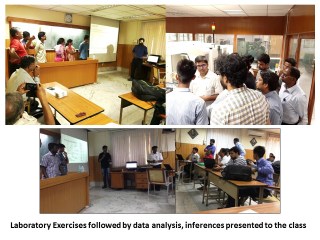
  • Hands on laboratory exercises
  • Tutorials and analytical and data driven problem solving
  • Technical Outputs – What are the requirements to be met when using grinding processes
  • System Outputs – the Why? strategic and economic considerations pertaining to grinding processes
  • Application of the System Approach – Case Studies
    • Truing & Dressing of CBN grinding wheels
    • Optimal use of CBN grinding solutions
    • Simple Solid Shape (S^3) grinding – High MRR low WIP, short lead time and flexible processes
    • Processes for micro – chip, magnetic head and LED substrate fabrication.
    • Machining to Grinding Processes
    • Data driven process solutions.
    • Optimization in the development og new machine tools for grinding process solutions.
  • Guest Lectures from Industry and academic leaders on the need and role of System Approach for manufacturing processes.

Slide2
Slide3

Slide4

This course was a team effort in collaboration with Prof. Ramesh Babu, IIT – M, Mr. Sudheendra – a research student for his Ph.D program and Mr. Anant Jain – R&D manager, Micromatic Grinding Technologies, a well recognized Precision Grinding Machine manufacturer.

 Slide6Slide7

Do Americans really miss the unions?

Slide2

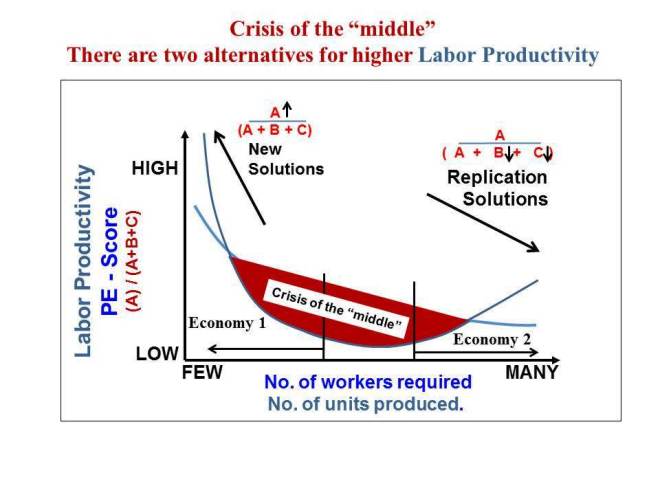
Every wage earner contributes to three kinds of wage earning effort: Knowledge and its use (A); Information work (B) and Physical Labor (C).

Labor Productivity as judged by the employer = A / (A + B + C)

There are claims that the current low wage economic climate in US is a refection of poor US education, need for higher college degrees, weak unions, …. These traditional arguments miss a couple of fundamental issues. They are:

  1. The role of IT (and broadly Digital Technology) in eliminating the need for human centered activities (labor);
  2. Failure of the nations to invest heavily in new technologies – beyond DT
  3.  Meaningful programs to convert them into new economic activities and jobs;
  4. Failure of students, educators, universities and parents to point out the need for a three legged balanced education (which will be the only way to find high wage jobs in the new Binary Economy).

Weakness in all of the four points are leading to a low or stagnant wage labor, with a collapsing middle class.

We address this fourth point in this essay as it pertains to the role of strong/weak labor unions. When the labor is strong in terms of its direct and identifiable contribution to the GDP, then unions will find their role and strength. It is like blaming the security guard in a bank, when there is no money left in the vault! The money is not stolen, but it has been used up and not replenished.

Following is a quote from a recent NYT article.

More than 151 million Americans count themselves employed, a number that has risen sharply in the last few years. The question is this: What are they doing all day? Because whatever it is, it barely seems to be registering in economic output. The number of hours Americans worked rose 1.9 percent in the year ended in March. New data released Thursday showed that gross domestic production the first quarter was up 1.9 percent over the previous year. Despite constant advances in software, equipment and management practices to try to make corporate America more efficient, actual economic output is merely moving in lock step with the number of hours people put in, rather than rising as it has throughout modern history.

Productivity is one of the most important yet least understood areas of economics. Over long periods, it is the only pathway toward higher levels of prosperity; the reason an American worker makes much more today than a century ago is that each hour of labor produces much more in goods and services. 

In our opinion this confusion exists because of the long held conventional views on labor productivity.

There is a traditional view that everything that is done to increase the productivity in one nation has to reflect in the GDP of that nation. If this were true that the rate of growth in GDP in countries like India and China will reflect a far larger labor productivity in these countries  than that in USA.

According to a report from Oxford.  ” the basis of U.S. manufacturing’s continued strong competitive position is increasing productivity. The productivity of U.S. manufacturers has risen by 40% since 2003, outpacing competitors such as Germany (23%), the UK (30%), and Mexico (18%). While productivity of manufacturers in China and India has more than doubled over the same period, the report notes, U.S. manufacturers in 2016 are still nine times as productive per employee than manufacturers in China”

Why is this dichotomy?

Today labor productivity – PE Score – can be measured as the value added effort by the employee / Total Effort. Value addition is achieved through the skills of the work force to create “New Solutions”. Value addition can also be through their workers in terms of their contribution to pass along information or pick and place or move things (Physical labor). This later kind of labor activity which is disappearing is illustrated well in the GE Commercial.  

New Solutions can be created and implemented  using labor and the productivity here will be much higher. This can be judged by the output / employee in companies like Apple, Google, Tesla, Space X. The labor productivity in manufacturers in USA are much higher (as noted above) because of the very low content of information work and physical effort (replaced by IT systems and automation) per employee.

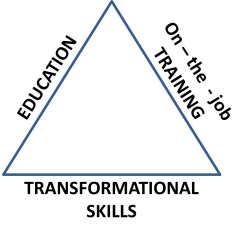
What does this mean in terms of graduates and their earning potential? Simply graduating from colleges and looking for new jobs is not enough. They need a collection of three sets of knowledge: Academic education from the college, application oriented experience or training and Transformational Skills to identify, develop and implement New Solutions.

For details Contact us.


The Men of America

Triangle of Skills

Slide2

The article titled Election 2016: The men America has left behind, in the CNN – Election 2016: Your money, your vote section is misleading on many ways.

In the first place, America did not leave behind any one. America as a nation is made up of people, who work in the country and get paid for AND the business men who run the companies and employ these workers. So, the article should be titled: The men that American businesses have left behind.

America is not a socialistic or communist country where everyone gets taken care of by “America” (i.e.) the US government and hence the POTUS and the US Congress. It is a Democracy – of the people, by the people and for the people. Hence the more appropriate title may be: The men of America who let themselves to be left behind. These American men were happy to be paid good wages as long as they had a job where they could use their physical labor in the factory floor. This is very well illustrated in the GE commercial: https://www.youtube.com/watch?v=3xGoBlI_fdg These skills – the muscle power – has always been available everywhere across the globe. Being born or living in the US does not guarantee the use or need for these skills. These men always used their brawn, but never used their innate skills to think and analyze what is happening around them. They let business men like Donald Trump take their jobs across the globe. Now they are being conned by the same business leader to think that it is everybody else’s fault, except theirs. The focus is on men only because there were more men than women using their brawn in our factory floors. But, the issues and being conned are the same for the women as well as the men of America. Also these men were idle or willing to let the state governments weaken the unions and their bargaining power, while the crony capitalism was also growing. Democracy does not succeed if the voters do not exercise their vote or uneducated on policies that affect them or swayed by cable news and radio talk shows and reality TV.

The title could also be The Men of America left behind by “Technology”. It is sad but true that everyone has been conned to accept that the word “Technology” stands for Digital Technology or IT. This technology is useful to take the power of information away from many people into the hands of a few. This has dramatically reduced the number of white collar jobs. This impact has been largest in the US first, but it is sweeping its impact across the globe. With the automation of information the men of muscle power could also be replaced by lower cost labor from Mexico, China, … all padding the pockets of business men like Donald Trump, with more profit. I

The title could also be The Men of America left behind by intellectuals and policy makers across the globe. The word Technology stands for integrated use of Science, Engineering and Managnment in any discipline. While America continues to make progress in a few other technology areas besides IT, the time and investments needed in many more technologies – for alternative fuels, clean air and water, controlling the global warming, space exploration, under water exploration, eradicating hunger, thirst and poverty across the globe, peace through prosperity in Middle East, …. – is far less than the jobs being taken away by the relentless use of IT in the current work place.

The title could also be The Men of America being misled by Donald Trump. No matter how much Mr. Trump promises, he cannot make America great again, by forcing US businesses to “make” things in America. It is only a matter of time that some manufacturing jobs will be returning to US due to natural economic forces (with or without Mr. Trump). But, they will not be for these men of muscle power. They will be for the few who with skills to work in an automated factory floor with robots and AGVs and networked machines and systems.

The title could also be The Men of America lured by cheap products at Walmart. While the US business men were attracted and even addicted to low cost labor, the US population has been equally attracted to lower cost items – made in China – available in places like Walmart. No one gets anything for nothing. Lower cost products at Walmart also mean lower cost labor from China and Mexico and lower cost of white collar labor every where.

May be the title can also be The Men of America who think college education is their savior. This is the myth propagated by the media and fueled by free college for all by Mr. Bernie Sanders. College education, even if it is free may not be the answer for a large majority of American workers. Yes, it is a definite pathway but only for a few.

May be the tile could be Men of America who are not learning some skills – to be a solution provider – for locally accessible jobs. Following quote from the same CNN Money article is relevant here:

Meanwhile, unlike some of his fellow factory workers, Cavins is determined to get a good job. He’s betting that a yearlong course in industrial maintenance will give him the skills needed to work in heating and cooling services, which his online searches found can start at $40,000 a year. He’s willing to leave Scioto County and work anywhere … in a hospital, factory, school or water supply facility, for instance. One day, he’d like to start his own business. …… The program, offered at Scioto County Career Technical Center, costs nearly $10,000 and has placed 95% of its graduates over the past two years in jobs that typically earn between $31,000 and $40,000 annually. To finance it, Cavins received a federal Pell Grant for $5,900 and took out two loans.  ….   “I didn’t think I’d get anywhere without learning a trade,” said Cavins, who graduates in September. “I want to give my family better than what I had. I want to try to break the cycle and not live on disability.”

May be the title could be: Men of America that the country and US policies left behind, due to crony capitalism, Republican obstruction in the Congress for infra-structure investment and false hope on higher education at the expense of free or affordable training for employable skills development. Perhaps for the time left before the November election, the presidential candidates can propose and develop support for such training. Community Colleges in collaboration with local companies and employers can offer such training. The companies who collaborate on such training can be given tax subsidies as their incentive? Free community college education proposed by the POTUS can be for such targeted training and not for open ended education?

For more details on how these men – working middle class – were left behind, please read: The System Approach – A strategy to survive and succeed in the global economy  ;

Thriving in the 21st Century Economy – Transformational skills for technical professionals.

Three levels of System Thinking

In a recent blog post: http://blog.readytomanage.com/how-is-critical-thinking-different-from-analytical-or-lateral-thinking/  three kinds of “thinking” are described – Analytical, Lateral and Critical thinking. Following is our take on this subject:

In our view, every activity and/or solution is an INPUT/TRANSFORMATION/OUTPUT system.

TRANSFORMATION represents the Phenomena pertinent to the activity. Understanding the Transformation implicitly, explicitly or through inference/intuition is the “SCIENCE”. Application of the Transformation to obtain the desired change of the inputs to outputs is the “ENGINEERING” behind the activity or solution. Discerning the Output between the “What?” and “Why?” is the strategic thinking. Ensuring that the desired outputs are achieved by orderly integration – with respect to time, cost, resources and their efficient deployment – of the inputs to effect the transformation is the “Operational” aspect of the activity. Strategy and Operations are the two sides of anything we call as “MANAGEMENT”.

In this Systems thinking there are three levels, which relate to the three aspects described in in the blog post mentioned above

AWARENESS: analytical thinking mainly aims to review the data/information we are presented with (for relevance, patterns, trends etc.) — the ability to clarify the information on-hand and their assignment into the various aspects of the “System” as defined above. It also helps to identify the missing data or gaps and the questions to ask and in what order?

ANALYSIS: Lateral thinking aims to put data/information into a new or different context (in order to generate alternative answers or solutions) — answer the questions raised using the tools of Science, Engineering and Management in an interdisciplinary manner. Today such lateral thinking is part of higher education, but limited to the three disciplines, but mostly as impermeable silos!

SYNTHESIS: Critical thinking aims to make an overall or holistic judgment about the data/information which is as free from false premises or bias as much as possible — ability to answer the question ” 2 + 2 = ?” with an answer, “Why is this question raised in the first place” ? Then find answers which might lead to “2+2 = 3, 4, 5 or Fruit Salad”. In the last case it will be the sum of two fruits (Apple and Orange) with two other fruits (Peach and Banana) together with some ice cream on the side making the whole the Fruit Salad! Hence CRITICAL THINKING can be thought of as third level of SYSTEM THINKING, where the whole is seen as larger (or smaller, if that is the output of the “System”) than the mere sum of the parts. It is an ability to see the picture or pattern, rather than the mere emphasis on the pixels! For more details on System Thinking and the three levels: https://stimsinstitute.com/20151207books/

Warning against AI and job loss: What can be done about that?

“Scientists warn AI means job losses in every profession” is the headline for an article in the Financial Times dated Feb. 15, 2016. This page 1 article is authored by Clive Cookson.  The copy of the article can be seen at the end of this post.

Following are a few quotes from this article: Intelligent machines would soon replace people in all sectors of the economy, computer scientists told a meeting of the American Association for Advancement of Science in Washington at the week end. ……….. “We are approaching the time when machines will be able to outperform humans at almost any task”, according to the computer science professor Moshe Vardi from Rice University, Texas. ”Society needs to confront this question before it is upon us …..”  Professor Selman from Cornell University has helped to draft an open letter last year from the Future of Life Institute, Cambridge, MA. to policy makers urging them to explore the risks associated with increasingly intelligent machines.

While the above caution and appeal for better public policies are valid and timely, it is perplexing to see that such caution is raised only against a future possibility imposed on us by self-driving cars, robotics and Artificial Intelligence. We believe that individuals and enterprises cannot sit and wait till some policies are debated and implemented to address the unabated role of DT (and its formulations such as AI and Robotics and driver-less cars, etc.) in eliminating human centered work. Individuals need to gain academic knowledge in combination with their applications know-how (called sector or domain specific knowledge), together with a set of skills for “System Thinking and Transformational Skills”.

Knowledge Integration

We call this collective know-how and its application as the Knowledge Integration. Such KI capability is the essential education at all levels. The practice of KI will be the competitive weapon for workers and their employers for the foreseeable future.

For education on System Thinking and Transformational skills and for projects to implement them for competitiveness in the global economy https://stimsinstitute.com/contact-us/

Our detailed views on this topic can be seen at: Warning against job loss

AI and employment