Reflecting on the views of Larry Summers, Bill Gates and Basic Living Income.

In a recent opinion article in Washington Post article titled “Picking on robots won’t deal with job destruction“, Mr. Larry Summers argues against the tax on robots proposed by Mr. Bill Gates as a away to counter the effect of Robots on unemployment and declining wages.

There is half truth in these opinions of both these eminent leaders! We need an approach that combines them. Here are some suggestions:

The role of IT (Digital technology in general) has been to replace human centered activities through information and physical labor by “machines” that can standardize information processing (Microsoft products!) and their applications. Hence machines can read, write, compute, analyze and make decisions as well as move objects locally (Robots) or over distances (Drones), etc. This leaves only low wage jobs – REPLICATION SOLUTIONS – that are standardized and de-skilled. Only these jobs have been growing and hence the noted low unemployment without wage growth in the recent years.  https://stimsinstitute.com/2016/05/23/do-americans…
These Replication Solutions leads to a large no.of jobs that need no skills and hence no education in many cases. These are also the jobs that can be automated, outsourced and de-localized. The large majority of manufacturing jobs that have been lost – and which are not coming back – belong to this category.

This new economy also leaves room for a small no. of jobs – which every one is clamoring for – with better wages, where new skills to conceive, develop and deploy NEW SOLUTIONS.

This is the BINARY ECONOMY that has been evolving across the globe for the past four decades. https://stimsinstitute.com/20151207books/

The few jobs that require a constant stream of New Solutions need “major reforms of education and retraining systems” as suggested by Mr. Summers. We need to recognize this much needed education as a combination of academic education, hands on training and formalized education/training on System Thinking and Transformational Skills. 

Mr. Summer’s proposal for better education, etc. are part of the set of well known solutions. Proposals by Mr. Sanders for free college tuition for all gained traction during the recent POTUS election. But, Mr. Sanders or his campaign never addressed the question of creating more new jobs to employ all the new graduates (albeit without student loans). Proposals by Secretary Clinton were modest and more in terms of promoting vocational education and hands on training in addition to free tuition at public colleges. But this would have been like staying afloat in the current stream with out creating new jobs in massive numbers needed to offset the effect of DT, IT, AI, Robots and Drones.

Republicans have advanced promises of massive infrastructure spending, “bringing back mfg. jobs” by renegotiating trade treaties and accelerated GDP growth through massive tax cuts mostly for the businesses and the rich. U.S. voters have signed up for these policies for a minimum of two years if not four years. Promises like these are based on the assumption that jobs have been merely displaced outside the country and are readily available to be brought back. This assumption seems counter to the realities of the Binary Economy outlined above and the constant and progressive role of DT, IT, AI, Robots and Drones to deplete the human centered jobs.

We need job creation at a rate much faster than they are depleted. Also what happens when you are well educated and trained and you don’t have jobs since, AI, IT and Robots and drones have taken away most jobsda that humans can do?  Higher and better education may not be all the answer we need as proposed by Mr. Summers.

Also how do you create more no. of well paying jobs and how to fund them are the unanswered questions? You can not create more jobs by simply making existing jobs more efficient and productive through IT and Robots — this has been the case for the past four decades – with what is left leading to large no. of low wage deskilled worker needs.

We need to create  more jobs for humans than we deplete through AI, IT, Robots and Drones. These jobs can come if America as a global leader thinks “World and humanity’s needs and opportunities are U.S. Opportunities”.

New Jobs with good wages will come only when we invest massively to solve existing problems of the humanity and new opportunities for human kind looking across the globe. We need to think beyond looking at Manufacturing as the job creation engine. https://stimsinstitute.com/2016/12/11/restoring-ma…  This requires few clear objectives:

  • Recognize that Technology is not “IT” alone as perceived in common language today. Instead TECHNOLOGY is the exploitation of SCIENCE, ENGINEERING and MANAGEMENT in all areas of studies and exploration.
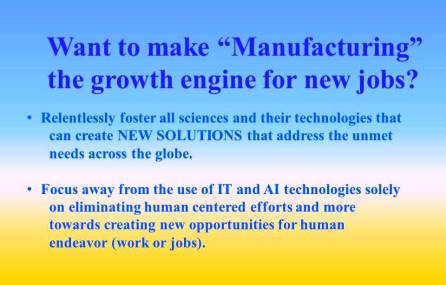
  • Relentlessly foster all sciences and their technologies that can create NEW SOLUTIONS that meet the unmet needs of humanity and creating new ways for betterment of humanity across the globe.
  • Focus away from the use of IT and AI technologies  solely on eliminating human centered efforts and more towards creating new opportunities for human endeavor (work or jobs).

But this will require large investments. Such investments have to come from Government initiatives – such as the NASA program to put the man on the moon.  Suggestions that such massive investments for new explorations have to be driven by private sector seems flawed based on our experience over the past four decades. Private sector and investors have the singular goal to maximize their returns while minimizing the risk in that process. This invariably drives the focus towards “Replication Solutions” of the known rather than exploration of the unknown to conceive and create “New Solutions”.

Where will the money come for this? It has to come from those who are the beneficiaries of the current IT and DT revolutions. This can come in the form of

  • Higher taxes for the top 1%. This will require a break in the tax policies of the Republican leaders.
  • It can also come from a smaller tax through the beneficiaries of IT revolution – most of whom will be the customers of Bill Gates IT empire.
    • This will include beneficiaries like myself, Mr. Summers and Mr. Gates who can write and post our views on line for millions to read with minimal marginal cost!
  • In the end some revenue can from   investors who merely replace current jobs with robots as suggested by Mr. Bill Gates.

The worst solution is a living income pay out for all citizens as proposed in some European countries. Example: Finland to consider introducing universal basic income in 2017. Similar proposals have been floated in other countries as well. That may be the killer of “Self Esteem” and the worst outcome in nurturing the creativity and drive of the human spirit. One could equal argue why bother about the human spirit when human body is wasted through unemployment and poverty? The fact we have to ask this question at the beginning of 21st century is a sad commentary of our evolution in technology and their unbridled use for the benefit of the few at the expense if the many in the past four decades.


Restoring Manufacturing as a job creation engine.

slide1

President elect Donald Trump’s efforts to shine light on Carrier Co. and their limitation of jobs might have one silver lining, although it may not be what he seems to suggest (i.e.) he as the POTUS can retore US manufacturing jobs. It is reported that  Carrier Co. to ultimately cut some of jobs Trump saved

The company’s deal with President-elect Donald Trump to keep a furnace plant from moving to Mexico also calls for a $16 million investment in the facility. But that has a big down side for some of the workers in Indianapolis. Most of that money will be invested in automation said to Greg Hayes, CEO of United Technologies, Carrier’s corporate parent. And that automation will replace some of the jobs that were just saved. “We’re going to…automate to drive the cost down so that we can continue to be competitive,” he said on an interview on CNBC earlier this week. “Is it as cheap as moving to Mexico with lower cost labor? No. But we will make that plant competitive just because we’ll make the capital investments there. But what that ultimately means is there will be fewer jobs.”

We have described in detail this migration and transformation of the “Manufacturing work” in one of our earlier blog posts under the title “How to bring the manufacturing jobs that are never coming back”. It cannot be achieved merely by blaming Trade Agreements or past government policies. Certainly it cannot be achieved merely by blaming the CEOs of Carrier or Being Co. or the union leaders that Mr. Trump thinks of as his whipping boys for the day.

“You can’t just blame cheap labor [outside the U.S.],” said Dan Miklovic, principal analyst with LNS research. “Certainly many of the jobs that we’ve lost, especially in more sophisticated industries, it’s not so much that they’ve been offshored, but it has been automation that replaced them. We use a lot more robots to build cars.” Altogether, U.S. factories are actually producing more products today than they did in the post-World War II era, according to the Federal Reserve’s reading on manufacturing output. Output at U.S. factories is up 150% in last 40 years. But U.S. manufacturing jobs have plunged by more than 30% in that same period. And automation is a big reason why.

The above suggests that the US labor has been producing 50% more output with 30% less labor. A simple math would suggest that US labor has been doing such a good job that the manufacturing labor productivity has gone up by 114% (= 150% output put with only 70% of labor needed). But to gain even more employment at this higher level of productivity US will need to produce and sell 214% more than we did 40 years ago! Unless these products can be consumed inside of USA at the current prevailing prices the US will be required to sell them to other countries. How can this be achieved with the Trump administration’s position opposing Trade agreements? Senator Sanders has been equal contributor to this fallacy.

Let us be clear about something else. Not all of these productivity gains have come thanks only to better worker skills. If that were the case the workers can walk out of their jobs and the manufacturing plants will come to a screeching halt. That was the power of the labor 40 years ago and hence the strength of the unions. That is not the case today. We discuss this point in more detail in our essay: Do Americans really miss the unions? It is true that few workers are better skilled and contribute far better than their peers 40 years ago. These are also the among the college educated workers – with minimum of associate degree from Community colleges – working mostly in the two coasts and the few newly industrialized manufacturing centers in the South and the Midwest. These are not the voters in the industrial mid-west without higher education (or even H.S. Degree). These “higher skilled” workers are not large in number or concentrated in a few places to have the strength necessary to force higher wages through unions and their demands. The challenge is to train and educate more of these skilled workers so that they can acquire and maintain higher paying manufacturing jobs on their own. This is not more of the same education leading to the suggestion from a professor of Chemistry “It may be a mistake to get a degree in Chemistry, unless you have also figured out how to use your knowledge!”

There is no end in sight in this trend in automation and depletion of manufacturing jobs. Anyone who pushes the idea that they can reverse this trend and grow lots of manufacturing jobs in the US merely through trade barriers or building isolationist policies  is selling you another Trump University!

 And it’s not a trend that’s going to end with Carrier or even with manufacturers. A recent study by McKinsey & Co. said that 45% of the tasks that U.S. workers are currently paid to perform can be automated by existing technology. That represents about $2 trillion in annual wages.

If you take the above data and through simple math one can conclude that the US manufacturing has to reach 400% of our production output to maintain employment parity that existed 40 years ago. This does not take into account additional increase required to account for our modest population growth.  This also does not take into account additional developments through Digital Technology for further automation. Information technology, which will continue to deplete the need for manufacturing labor.

Where will this new production come from? It cannot come by simply producing more of the same. 400% of manufacturing production in US over 40 years ago would suggest that all manufactured goods are made in US and everyone else in the world will merely but what we make! This Utopian view of the world is foolish at best. Hence it implies US has to conceive and produce goods and services for the unmet needs that other countries can not produce today.

These unmet needs to be full filled can be for consumption in the US and better yet for all the unmet needs across the globe. This has to start with our redefining the commonly used term “Technology”. Everyone in the media, leadership, think tanks make the same mistake by addressing developments in IT (Broadly in the category of Digital Information Technology) as the Technology.  Look at the parent Co. of Carrier (i.e.) United Technologies. The word technology here refers to jet engines and air conditioners. It does not imply IT in isolation. For more details see: Managing the role of Digital Technology: Life before and after electricity.

Why is this important? There has been relentless effort to improve and enhance the efficiency and productivity of human centered activities in the past 40 years using IT / DT. Progress in automation and AI are merely focused for furtherance of the same. The resultant depletion of human center activities (jobs) are being lost at a far larger arte than any new jobs being created. For more details see: Understanding the voter resentment. The only way to reverse this trend is to emphasize as a nation – and across the globe – the need to focus on

  • Relentlessly foster all sciences and their technologies that can create NEW SOLUTIONS that meet the unmet needs across the globe.

This implies that products and services for alternative energy, high speed transport across the US, solutions to fight global warming, exploring the space. eliminating poverty, hunger and poor health, products and services for the growing old age population, etc. are not mere matters of policy and political debate. Instead these are real opportunities for new products and services not available from other countries. These are also new business opportunities for the investors. In combination these are the manufacturing activities that can create net new jobs in the US.

The need for such expansive role of new science based initiatives (the true meaning of the word “Technology”) is not fully recognized. For more details see: Dwindling gains in Science, medicine and technology in the WSJ article.

But the WSJ report suggests that we the US population is some how risk averse. This is far from the truth. When the new technology is an acceptable alternative US as nation is the first to accept the risk and embrace the change. But these businesses and services based on new science based technologies will not take off without substantial initial investments to foster them through Government initiatives.    We should be honest to admit that US auto industry would not have succeeded without the Highways and freeways built across the nation by the US Govt. The same auto industry would not be viable today without the Govt. intervention of the 2008 financial crisis. The same can be said of aerospace industry and the role of government funded defense contracts supporting many basic research projects.

  • Focus away from the use of IT and AI technologies  solely on eliminating human centered efforts and more towards creating new opportunities for human endeavor (work or jobs).

Our reliance on IT to reduce jobs and increase labor productivity has been the untold “Opioid crisis” in all our economic activities. It was prescribed as a solution to over the labor cost issues in the late 1970s. Now it has become the crutch and the only medicine consumed by CEOs across all companies and in all sectors to reduce labor cost year after year to keep their balance sheet look attractive to their investors.

The above two prescriptions for increasing the manufacturing employment have to become the corner stone of any policy advocates as well as the fundamentals for any administration that truly believes in restoring US manufacturing and increased jobs as a result.

Reagan, Clinton and Bush administrations complexly missed the boat in terms of the above two prescriptions. Republican ideologues who want to keep Government out of everything they see as  interfering with “free market economy”have thwarted most of President Obama’s efforts in this direction, every step of the way. Democrats who see the need are not clear in their vision or vocal to articulate the need for real growth in new jobs. Instead they offer platitudes in terms of free college education and more manufacturing jobs (without a clue on where they will come from).

The CEOs have also a role to play. After all they can not continue to cut  jobs and look good in their bottom line in the long run.  Recall the comment by the CEO of Carrier Co. quoted earlier? “We’re going to…automate to drive the cost down so that we can continue to be competitive”. He did not suggest investing in more new products and services that can increase employment and also improve his company’s performance bottom line in the long term!

If the policy planners and administration will come to such consensus is anybody’s guess. In the meantime individuals should take the matter of their jobs and careers in their own hands and develop strategies for the same on their own. Transformational Skills for success in the 21st Century Economy.
Comment on HBR Article: Think Strategically About Your Career Development

The HBR article on the above subject suggests the following as important steps for career development:

  • Get clear on your next steps.
  • Force yourself to set aside time.
  • Invest in deep work.
  • Build your external reputation.

Of these four suggestions it is very important to “Invest in Deep Work”. Before (and during) such focus one should be clear about Why/ What? and How? about the Deep Work.

Why Deep Work: As the author of the HBR article says you have to do something different from others. If you do the same work as others then there are more people competing for your career path. Chances are the co. will find a way to standardize your jobs and eliminate a few people or outsource them :-(

What is Deep Work? It is the ability to identify a need, convert it into a solution and make it useful (and be sure you get paid for that). We call this ability (Discover X Develop X Deploy) to implement a stream of new solutions as the TRANSFORMATIONAL SKILLS.
https://stimsinstitute.com/20151207books/ 

How to engage in Deep Work? Here are are seven path ways (Transformational Skills):
1. Develop a common language (What is the NEW SOLUTION? Why/ How?)
2. Focus on using all your core capabilities (Knowledge, Experience and People Skills; Science, Engineering and Management skills); Constantly add to these six skill buckets through life long learning as needed.
3. Practice a system view for all solutions (Task is what you do; System is what you develop). Every system is an Input / Transformation/Output scheme. Keep in mind that the whole is always larger than the mere sum of its parts. You are required to complete an entire jig saw puzzle( the new solution) and not just fit one piece in it.
4. Focus on the SCIENCE (Quantitative understanding and use of the Transformation); Use Digital and Mobile data as much as possible.
5. In developing and implementing the solution reach out and use a broad network of resources and clients. This is called networking in general. It is more specifically called as Ecosystem development, since everyone in the network feeds off of each other for their collective success and growth.
6. Be motivated to go from beginning all the way to the end (= Discovery X Development X Deploy)
7. Practice Emotional Intelligence (Be useful to others which in turn can be useful to you).
https://stimsinstitute.com/2016/03/18/urgent-need-for-education-that-addresses-the-real-needknowledge-and-its-use-to-deliver-solutions-that-commands-better-wages/

Building a career where you are seen as useful is always much easier than simply chasing ideas and connections. It is not easy. It will need you to set aside time and effort to gain clarity on your new solutions and the value through them. There will always be pressure to do a lot of tasks unless you set aside time to step out of them and think clearly to work on the above sevenn steps.

If you build your external reputation when you are not seen as valuable in your current employer that may get you a new job, but it will not be a solid base for building your career path.

Understanding the voter resentment is also an opportunity for professionals.

In his essay The Populism Perplex, Mr. Paul Krugman describes the sad reality that Secretary Clinton lost the POTUS election despite her winning over 2 Million of popular votes than the PEOTUS Donald Trump.

Mr. Krugman  describes this reality as a result of news media spending very little time on policy positions and explaining the fundamentals of the economics at work. He conveys his sense of disbelief while explaining the economy and job situation in Kentucky where the uninsured for health care are far fewer today. The jobs lost in the coal country are due to shifts in methods of mining (from underground to surface layers) as well as due to cheap natural gas through fracking. Clinton lost Kentucky heavily when she spoke of this reality and promised to replace the lost jobs through new jobs through renewable energy.

Mr. Krugman concludes:  To be honest, I don’t fully understand this resentment. In particular, I don’t know why imagined liberal disdain inspires so much more anger than the very real disdain of conservatives who see the poverty of places like eastern Kentucky as a sign of the personal and moral inadequacy of their residents. One thing is clear, however: Democrats have to figure out why the white working class just voted overwhelmingly against its own economic interests, not pretend that a bit more populism would solve the problem.

We would like to offer a few thoughts to clarify the situation.

Income can be through wages and non-wage income (through real estate appreciate and making money off money). This is 99 % Vs. 1%. Deriding this gap serves no one any benefit. This grip of the 1% on the 99% can be lessened only though higher taxation of the 1% for the benefit of the 99%. But sadly the country has elected one among the 1% as the next POTUS. This is like hiring a fox to guard the chicken coup.

The 99% make their living through wage income. As we have described in the past, any wage can be earned only through one of three avenues: Professional Skill (ability to develop, deploy and implement a new solution – one could describe this as “Brain power”), Information work (to collect, process, analyze and disseminate information  – one could call this as “Pen Power”) and Physical labor work (one could call this as “Muscle power”). Of these three today one can gain reliable income through Professional Work. Even this situation is precarious as the physical effort and information work content are being depleted routinely through relentless application of Digital Technology and its uses.

The pen power and the muscle power have been diminished substantially as the sources of income through evolution in Digital Technology. This is well understood and well documented in many places. These jobs have literally fallen off the cliff.

slide3

How did we get here? Any organization – place of work – is described as a pyramid. The bottom of any Organization Pyramid is made up of labor work force. Above them are the information workers and then the professional workers. In any organization we use a pyramid to depict that for good reasons. There were always more non-college educated labor workers. The number of college educated white collar information workers is fewer than physical labor workers. The number of professionals required are always far fewer than the other two categories. These work categories have been increasingly stratified since the advent of Digital Technology and its evolution since the late 1970s.

slide1  slide2

But when these categories are clearly stratified and mobility across them is limited or eliminated (thanks to the standardized nature of work) now we have the highly divided and polarized America. Most of those with college degrees and professional work live on either coast (East of I – 95 and West of I – 5 corridors) and the rest – non college educated and mostly white, who have lost their jobs in information and labor work, live between these two highways.  Indeed these are also the two polarized groups which have supported Secretary Clinton and Mr. Trump respectively.

But this polarization and support for either candidate is not directly correlated to the level of employment as noted in the analysis reported in Fivethirtyeight.com. Instead it is far better correlated with the standardized or repetitive nature of nature of work. More routine and standardized the job, the voter support went for Mr. Trump. The majority of the voters with their work content that is least standardized or routine overwhelmingly went for Secretary Clinton.

slide4

What does this voting pattern tell us? It seems to be directly linked to what we have described as the Binary Economy!

Jobs or wage earning work at any level of skill can be standardized and hence de-skilled using Digital Technology tools. This de-skilling of work can be seen at any job and in any industrial activity and in any sector and in any region of the country. Such de-skilled jobs can also be automated and outsourced. What is left can command only low wages and often below the minimum wage. In these de-skilled jobs the power of the union is minimal as their contribution though skills that cannot be replaced is constantly reduced or eliminated. Industrial Midwest and much of the nation between the east and west coast has not found ways to replace these jobs with higher skill level jobs.

There are few opportunities where the worker can integrate knowledge from many sources and hence offer higher skilled and higher value addition. This knowledge integration is not a matter of higher education alone. While higher education and college degrees help, that is not the minimum requirement. Instead an aptitude for discovery of a need, developing a solution and implementing the same and get paid for that is the new skill required.  The startups culture and the entrepreneurship in the East and the West coast foster such on the job skill development. These are also the voters who see new opportunities in Globalization, alternative energy sources, solutions to counter global warming, etc.  These are the voters who have overwhelmingly voted for the Democrats.

The above skills development are not the Republican or Democratic priorities. Instead these are the priorities of those seeking high wage jobs and better incomes. But Democrats need to find ways to promote such skills development that supports and fosters the “Economy 1” in the Binary Economy model displayed in the figure above. This skill development cuts across all genders, races and economic levels. This new skill development has to be seen as the new Democratic priority. In this respect Senator Sanders’ call to Democrats to go beyond identity politics is correct. But his call that understand that working-class incomes are down, and “stand up to Wall Street, to the insurance companies, to the drug companies, to the fossil fuel industry” may be dubious at best since these are obvious action steps without outlining the fundamental reason (i.e.) the relentless need for new skills development and investment policies that will draw on these skills with new job opportunities and solutions focused on that.

Returning to Mr. Krugman’s comment: “To be honest, I don’t fully understand this resentment. In particular, I don’t know why imagined liberal disdain inspires so much more anger than the very real disdain of conservatives who see the poverty of places like eastern Kentucky as a sign of the personal and moral inadequacy of their residents. One thing is clear, however: Democrats have to figure out why the white working class just voted overwhelmingly against its own economic interests, not pretend that a bit more populism would solve the problem”.

The resentment of the voters is not liberal disdain or affirmation of the conservatives. It is certainly against their economic self-interest. It is like the person sinking in the lake grabbing on to any straw no matter how flimsy it may be. Mr. Trump’s promise as an “outsider” to create new jobs and stop the bleeding of jobs from USA through trade agreements are the flimsy straws for the voters who see their demand for their skills – through muscle power and pen power – depleted. Either party that sees the real underlying causes – the polarization of jobs into few high skilled jobs (with decent wages) and large no. of low or no skill jobs (with constant spiral of diminishing wages)  at all levels of the economic activity – and finds answers for that will be rewarded in the long run. In the meantime the elections will be just toss ups governed less by rational choices and more by emotions and irrational events such as hacking and Comey letters.

As we have often said in our columns, the individual workers need not wait for politicians to figure out the evolving Binary Economy and the solutions for that. Instead they can seek out and learn skills for new solutions development. We call these new skills as the System Thinking and Transformational Skills.

Economy, Education and Democracy -response to Donald Trump election.

economy-4-0In the essay On the making of Trump – The blind spot that created him, Otto Schammer describes in great detail the psychological pathways to comprehend and cope with the reality of the election of Donald Trump.

http://www.huffingtonpost.com/entry/on-the-making-of-trumpthe-blind-spot-that-created_us_58264d03e4b02b1f5257a1ca

Otto also suggests Economy 4.0, Democracy 4.0 and Education 4.0 as the pathways looking into the future.

It is good to analyze and suggest solutions based on Psychological and Sociological frame works. But the fundamentals that describe our current conditions are: low wage jobs, inadequate high wage jobs, concentration of wealth among the non – wage income earners (make money out of money and real estate). These lead to a fear of the future and a desire to cling on to anything (including the false pretenses and false promises of Donald Trump). They may be the same drivers for Brexit and other development across the globe. These drivers and the resulting fear have to be acknowledged first and addressed forthrightly by all nations across the globe. This is not Democracy 4.0. Instead it is economy 4.0. where Otto suggests an economy that addresses the well being of all.

What does economy 4.0 mean? Economy is never egalitarian. It is the survival of the fittest. In order to conceive of an Economy 4.0 we must accept the ills of the current economy.

Ever since the evolution of Digital Technology and its many aspects (automation, globalization, outsourcing, off shoring, Artificial Intelligence, …) we have been depleting current jobs faster than we have been replacing them. This has been progressing since the 1970s (which is now more than four decades in the making). Investors (including Donald Trump) have been at the fore front of this devolution.

Conversion of all fixed cost to variable cost has been enabled by Digital Technology and its capabilities. Good income high wage professionals were seen as “fixed costs” and replaced by outsourced and off shore workers in all levels and with all educational backgrounds. We have been depleting these jobs faster than we have been replacing them through new developments and new solutions based on science and engineering (often called as STEM jobs). It is not always the case of these jobs being moved abroad. Cloud computing is the rage today (where you can do all your computing, without investments in Servers and storage hardware), but its impact is to outplace thousands of IT professionals in MIS departments across the country today. Manufacturing jobs that return to US will be highly automated and may not necessarily create the large number of jobs expected. Even investments in infrastructure development are not likely to create a humongous number of high paying jobs as these activities are also highly standardized (de-skilled) and automated (mechanized).

Wage income can come from only three sources: Brain Power (Creating new added value solutions – Professional work), Pen power (ability to write, document, calculate, communicate, …) and Muscle power (often described as “labor”). Of these three sources of income the later two are being relentlessly depleted world wide thanks to unbridled use of Digital Technology enabled capabilities.

Investments and developments in renewable energy created few such new job opportunities. Presenting them as alternatives to fossil fuel jobs has created an unhealthy condition of pitting one industry against the other and also one party against the other (Republican Vs. Democrats).

The solution is not to offer free college education, more safety net or living income subsidy for those without jobs. Instead it has to be a reversion to massive investment to create “New Solutions” leading to high wage jobs. This could be hundreds of Tesla and SpaceX making five wheel cars, three winged planes, … that accomplish things for better living than we can not even imagine today.

This could also come from taking on world problems such as drinking water, food and nutrition, climate change, better living conditions for the billions who live under poverty and upgrading their quality of life. These solutions – developed through science and engineering – will lead to massive good paying jobs in USA first and their commercialization to increased jobs world wide. But this does not merely imply more college degrees as we know of them today.

The above Economy 4.0 will not happen until the Republicans stop thinking that Govt. has no role in creating such economy. It will also not happen if Democrats continue to think that Govt. is the primary source for creating this Economy 4.0. It requires both and not either one acting individually. The public sees this inaction – as the failure of the “establishment” – and may be also sees Donald Trump as an arbiter (mistakenly as the case might be – only the history will tell). It is this conundrum that we are faced with in USA, which is also seen as the struggle between the conservatives and progressives across the globe.

The author (Otto) suggests and Education 4.0 – an evolving educational systems toward freely accessible infrastructures that help individuals, communities and multi-stakeholder groups to activate the deep human capacity to co-sense, co-shape and co-create the emerging future in their own context any place and any time.  The suggestion here is to create ability within individuals to define and develop their own jobs and eventually expand this skill across fellow professionals and communities in which they live in. Such education requires certain core skills. Return of trade schools to H.S. education and access to more community college education proposed by Hillary Clinton were good initiatives. Unfortunately they are likely to be jettisoned by the new Trump administration.

Education 4.0 also needs a structure and frame work. We call them as “System Thinking and Transformational Skills”. System Thinking is the ability to look at the picture (and not get fixated on the pixels) on the screen. It is a natural capacity to frame any problem and develop solutions based on the understanding that the whole is larger than the mere sum of its parts. This capacity for system thinking has to be backed by Transformational Skills (i.e.) an ability to combine academic (STEM) education together with its tools of Science, Engineering and Management as inter-disciplinary and interactive set of core capabilities. Such education on defining, developing and deploying new solutions may have to begin at the H.S. level and continue through the college education, in order to support the Economy 4.0 outlined above.

Majority of the voters from the Midwest who elected Donald Trump are non-college educated from the industrial “rust” belt. If the Economy 4.0 and the Education 4.0 as described above do not evolve, these voters will be the ones who will suffer the most. How does one educate the Trump administration and the Republicans to push for Economy 4.0 and Education 4.0? How does one re-focus the social policies of Democrats (Free college education, higher minimum wage, …) to align with the above needs of Economy 4.0 and Education 4.0? What role do the voters and public at large have in the re-alignment of both the political parties and the elected officials? These are the challenges faced by the nation. May be this is the Democracy 4.0 that we need?